

This article was automatically translated from the original Turkish version.
Origin(s) | Dutch colonial period | ||||||||
|---|---|---|---|---|---|---|---|---|---|
Geography | Java / Dutch East Indies | ||||||||
Basic Element | Rice | ||||||||
Number of Dishes | Many small portions | ||||||||
Kitchen | Indonesia – Europe synthesis | ||||||||
Service Time | Lunch → dinner | ||||||||
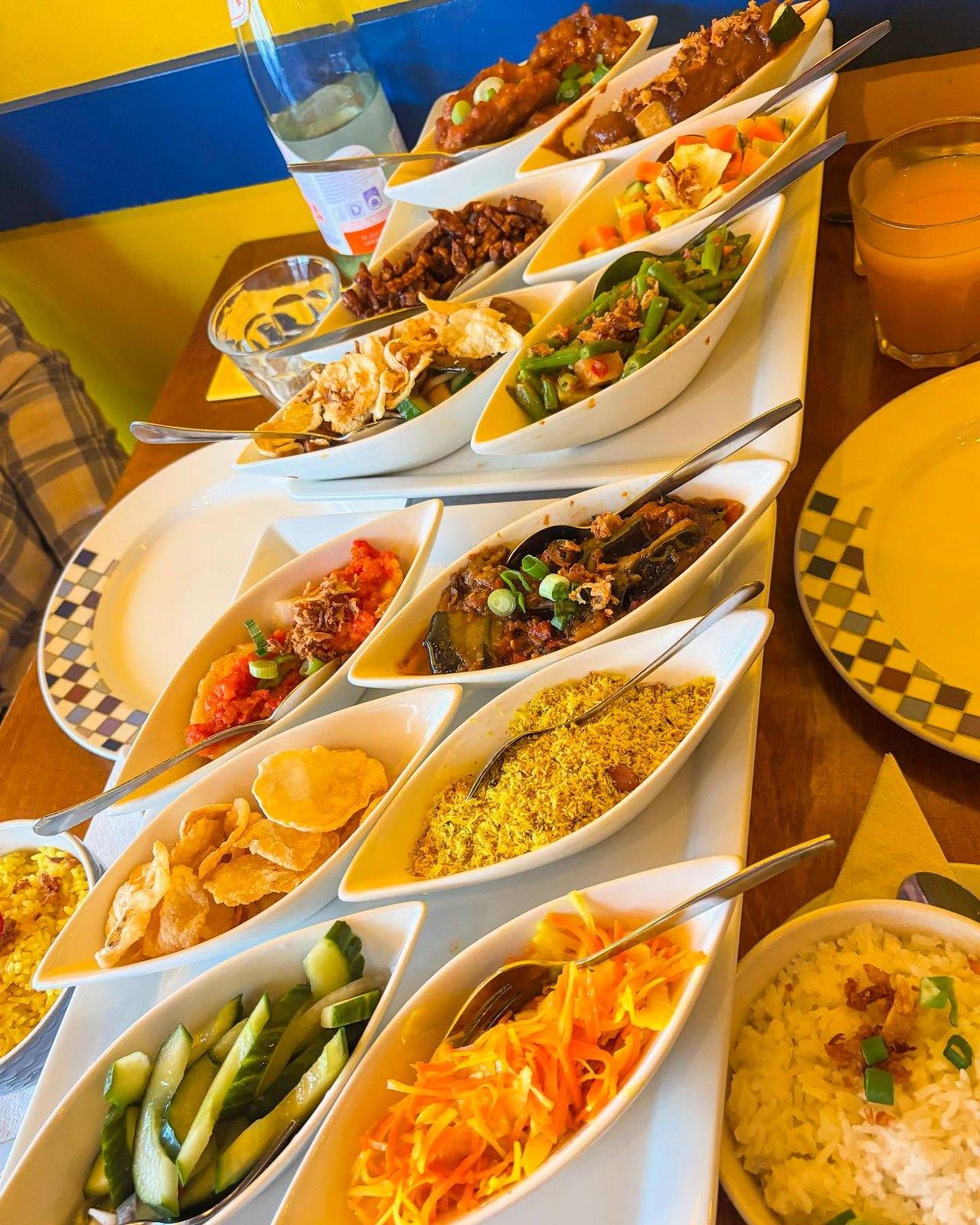
Rijsttafel is a dining arrangement that developed during the Dutch colonial period, centered around rice and featuring numerous dishes of Indonesian origin served in small portions. It is both a style of eating and a dining ritual. Various sources indicate that between 10 and 40 different dishes could be served simultaneously at such tables.
Today, rijsttafel tables in the Netherlands typically consist of various sambals, vegetable dishes, meat dishes such as rendang, rice, sambal, and pickles. In Indonesian historical texts, rijsttafel is regarded as one of the most characteristic products of Indo culture, emerging from the fusion of indigenous (particularly Javanese) culinary traditions with European (Dutch) dining etiquette.
Rijsttafel emerged in the 19th century within the eating habits of European colonial elites in the Dutch East Indies, especially on the island of Java. This dining format arose from the convergence of local rice-based cuisine with European table manners and social customs. The emergence of rijsttafel is understood as a consequence of cultural interactions during the colonial era.
The practice of serving dishes in small portions and sequentially reflects European food presentation customs. However, the majority of the dishes served are rooted in local culinary traditions, featuring indigenous spices and cooking methods.
A decisive role in the development of rijsttafel was played by indigenous women (nyai) who lived with or worked for European men. These women adapted local culinary knowledge to suit European palates and acted as cultural intermediaries in shaping the form of rijsttafel.
Rijsttafel is an elaborate dining arrangement in terms of both dish variety and presentation technique. In Java, rijsttafel is defined as a rice-centered table featuring a large number of small-portioned dishes served in a sequential and orderly manner. Its main features are as follows:
The dining arrangement was shaped by European service etiquette: plates, bowls, knife-fork-spoon sets, different serving spoons, and drink glasses of various sizes are used; even silver cutlery is noted as a marker of wealth and status. In the 19th century, rijsttafel was primarily served at lunch, but in the 20th century it shifted to dinner; it evolved into a more formal and layered structure with a three-part service of appetizer, main course, and dessert.
Rijsttafel was not merely a style of eating but also became a social status symbol within colonial society. The variety of dishes on the table and the number of servants present visibly reflected a family’s social position. The greater the number of “special” dishes and the larger the staff serving them, the higher the class status conveyed.
After World War II and especially following Indonesia’s independence, rijsttafel was brought to the Netherlands by Indo-European communities returning from the East Indies. During this process, rijsttafel ceased to be merely a culinary practice in the Netherlands; it became a cultural element tied to migration, memory, and identity. For many Dutch families, rijsttafel represents a continuing emotional connection to their Indonesian past.
Over time, rijsttafel became part of Dutch restaurant culture. Indonesian restaurants offering rijsttafel became widespread, particularly in major cities, and this dining style came to be perceived in Dutch culinary circles as “special,” “elaborate,” and often “elite.” This positioning has also drawn criticism regarding rijsttafel’s colonial origins. Some scholars argue that rijsttafel obscures the power dynamics and inequalities of the colonial era.
Nevertheless, rijsttafel is not perceived entirely negatively in the Netherlands. For Indo communities especially, rijsttafel is associated with sharing, family togetherness, and cultural memory. Gathering around large tables is seen as a way to connect with the past and preserve identity. Thus, rijsttafel continues to exist in the Netherlands as both a colonial legacy and a living cultural practice.
Rijsttafel became widespread in Indonesia during the Dutch colonial period, particularly in Java. This dining style emerged as an acculturated product combining indigenous culinary elements with European presentation formats and was initially adopted primarily by colonial elites.
However, with Japan’s occupation of Indonesia in 1942, the public visibility of rijsttafel declined significantly. As part of its policy to eliminate Dutch symbols and colonial structures, the Japanese administration removed elaborate feasts like rijsttafel from everyday life. This process led to a rapid decline in rijsttafel’s popularity in Indonesia.
With the end of the colonial era, rijsttafel began to be viewed in Indonesia as an artifact of colonial history. Today, large segments of Indonesian society do not incorporate rijsttafel into daily life, and many people are unfamiliar with this dining arrangement. The majority of the local population perceives rijsttafel as a cultural practice that does not belong to them.
Nevertheless, rijsttafel is still occasionally practiced in some Indonesian restaurants or by certain families on special occasions, albeit in limited form.
Claproth, Gwenna. "The Rijsttafel: Intersecting Dutch and Indonesian Identities." *Smithsonian Folklife Magazine*. Accessed December 11, 2025. https://folklife.si.edu/magazine/rijsttafel-dutch-indonesian-identities
Nurlitasari, Fadilla Putri, and Dyah Ayu Anggraheni Ikaningtyas. "Rijsttafel di Masa Kolonial Belanda (1900–1942)." *Kronik: Journal of History Education and Historiography* 6, no. 2 (2022): 1–11. Accessed December 11, 2025. https://journal.unesa.ac.id/index.php/jhi/article/view/21292
Rohmawati, Yulia. "Historiography of Indonesian Culinary: Tracing Trails and National Identity through the History of Food." *Journal of History Studies* 4, no. 2 (2024): 158-174. Accessed December 11, 2025. https://online-journal.unja.ac.id/siginjai/article/download/37758/19475/117318
Syril, Anthon., and Van Schaik. "Effects of Indonesian Cuisine on the Dutch Kitchen and Culture Post World War II." Master's thesis, Claremont Colleges, 2020. Accessed December 11, 2025. https://scholarship.claremont.edu/cgi/viewcontent.cgi?article=1195&context=pitzer_theses
Vries, Heidi de. “Rijsttafel JPG.” Flickr. Accessed July 10, 2025. https://flic.kr/p/2r1GVrz

Origin(s) | Dutch colonial period | ||||||||
|---|---|---|---|---|---|---|---|---|---|
Geography | Java / Dutch East Indies | ||||||||
Basic Element | Rice | ||||||||
Number of Dishes | Many small portions | ||||||||
Kitchen | Indonesia – Europe synthesis | ||||||||
Service Time | Lunch → dinner | ||||||||
Origins
Dining Arrangement, Menu, and Presentation Style
Class, Status, and Colonial Context
Place in the Netherlands
Place in Indonesia