


This article was automatically translated from the original Turkish version.
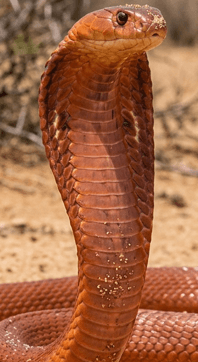
Red-spitting Cobra (Naja pallida)
(Generated by Artificial Intelligence.)
Conservation Status | No special conservation status Population stable | ||||||||
|---|---|---|---|---|---|---|---|---|---|
Class | Reptilia (Reptiles) | ||||||||
Subteam | Serpentes (Snakes) | ||||||||
Genus | Naja | ||||||||
Distribution Area | East Africa | ||||||||
Feeding Method | Carnivorous | ||||||||
Reproduction Type | Oviparous (lays eggs) | ||||||||
Type | Naja pallida | ||||||||
Family | Elapidae | ||||||||
Team | Squamata (Scaled Reptiles) | ||||||||
The Red Spitting Cobra is a venomous snake species belonging to the phylum Chordata, class Reptilia, and family Elapidae. Found in widespread populations across eastern Africa, this species is particularly characterized by brick-red or red-orange coloration, though it may also be observed in brown, pink, yellow, or gray hues. It is distinguished from other species in the genus Naja by a single thick dark band around the neck and throat region.
Naja pallida is endemic to eastern Africa, ranging geographically from Egypt to northern Tanzania, encompassing the coastal regions of Uganda, Sudan, Ethiopia, Somalia, and Kenya. The species exhibits a broad habitat range, occurring from sea level in the lowland plains of Somalia up to elevations of 1,995 meters in the highlands of Kenya. In this region, where average annual temperatures range from 18°C in the highlands to 26.5°C in lowland areas, the species forms denser populations in arid and hot habitats such as savannas and semi-deserts. As an ectothermic organism, Naja pallida can survive in environments where body temperature is maintained between 0 and 40°C; temperatures outside this range pose a lethal risk to the species.【1】
Naja pallida possesses four fixed, hollow fangs used to inject venom; each fang is approximately 4.5 mm in length and about 1 mm in basal width. The structure of its teeth has evolved to allow regular regeneration of lost or broken fangs. The anterior portion of these specialized fangs features wide, slightly elongated channel openings that direct venom straight forward rather than downward. Internal ridges on the fangs are believed to reduce pressure and velocity loss during spitting. The species can spit venom with high accuracy up to a distance of 2.5 meters and may repeat this action up to 40 times within two minutes. This mechanism is primarily a defensive adaptation designed to blind predators.【2】
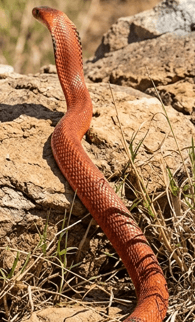
Red Spitting Cobra (Generated by Artificial Intelligence.)
The venom of Naja pallida consists of a complex mixture of neurotoxins and cytotoxins. Research has revealed that the protein composition of its spit venom undergoes significant changes over very short time periods. In humans, its effects include severe swelling, paralysis, and tissue necrosis; if the venom contacts the eyes and remains untreated, it can lead to blindness or conjunctivitis.
Naja pallida is a strict carnivore whose dietary needs are met primarily by rodents, lizards, frogs, and toads. Described as an active hunter, this species locates prey through active searching rather than ambush, pursuing it upon detection. During hunting, it relies mainly on visual cues and secondarily on chemical and thermal senses. Lacking infrared-sensing facial pits, it is adapted for diurnal activity; however, adults are known to be more nocturnal while juveniles exhibit a more diurnal lifestyle. Before capturing prey, it may display erratic and frenzied movements to disorient or immobilize its target. Once captured, the prey is swallowed whole due to the flexible structure of its jaw bones.
Naja pallida is an oviparous species, with its breeding season extending from mid-spring to early summer. Mating begins when males detect lipoprotein vitellogenin pheromones secreted by females. Males perform a distinctive "dance" characterized by head bobbing and chasing the female. Females lay between two and 16 eggs per clutch, with an incubation period lasting 80 to 120 days. Hatchlings emerge at approximately 31.7 cm in length and are born with fully functional venom glands and fangs. The species reaches sexual maturity at around three years of age and continues growing until approximately nine years old. The maximum recorded lifespan in captivity is 20.2 years.【3】
Naja pallida currently holds no special conservation status on the IUCN Red List or CITES appendices, and its population is considered stable. The species’ distinctive colored scales are used as raw material in the textile industry and are also traded among exotic pet enthusiasts. Scientifically, its venom and spitting mechanism serve as subjects for research in antivenom development and biochemical studies.
Cascardi, Jennifer, Bruce A. Young, H. David Husic, and Joseph Sherma. "Protein Variation in the Venom Spat by the Red Spitting Cobra, Naja pallida (Reptilia: Serpentes)." Toxicon 37, no. 9 (1999): 1271–79. Accessed June 7, 2026. https://doi.org/10.1016/S0041-0101(98)00264-5
Chiszar, David, Hobart M. Smith, Charles W. Radcliffe, Benjamin P. Boyer, Kristin Beaman, and Robert J. Shwalb. "Cover-Seeking Behavior and Ecdysis in Red-Spitting Cobras (*Naja pallida*)." *Bulletin of the Psychonomic Society* 30, no. 3 (1992): 215–16. Accessed June 7, 2026. https://doi.org/10.3758/BF03330446
Trimarchi, Alexander. "Naja pallida." Animal Diversity Web. 2020. Accessed June 7, 2026. https://animaldiversity.org/accounts/Naja_pallida/
[1]
Alexander Trimarchi, "Naja pallida," Animal Diversity Web, 2020, access date: 7 June 2026, https://animaldiversity.org/accounts/Naja_pallida/
[2]
Alexander Trimarchi, "Naja pallida," Animal Diversity Web, 2020, access date: 7 June 2026, https://animaldiversity.org/accounts/Naja_pallida/
[3]
Alexander Trimarchi, "Naja pallida," Animal Diversity Web, 2020, access date: 7 June 2026, https://animaldiversity.org/accounts/Naja_pallida/

Red-spitting Cobra (Naja pallida)
(Generated by Artificial Intelligence.)
Conservation Status | No special conservation status Population stable | ||||||||
|---|---|---|---|---|---|---|---|---|---|
Class | Reptilia (Reptiles) | ||||||||
Subteam | Serpentes (Snakes) | ||||||||
Genus | Naja | ||||||||
Distribution Area | East Africa | ||||||||
Feeding Method | Carnivorous | ||||||||
Reproduction Type | Oviparous (lays eggs) | ||||||||
Type | Naja pallida | ||||||||
Family | Elapidae | ||||||||
Team | Squamata (Scaled Reptiles) | ||||||||
No Discussion Added Yet
Start discussion for "Red-spitting Cobra (Naja pallida)" article
Geographic Distribution, Habitat Preferences, and Environmental Adaptations
Venom Apparatus and Defensive Spitting Mechanism
Zeck Biochemistry and Temporal Protein Variations
Feeding Ecology and Hunting Strategies
Reproductive Biology, Development, and Life Cycle
Conservation Status and Economic Interactions