


This article was automatically translated from the original Turkish version.
+1 More
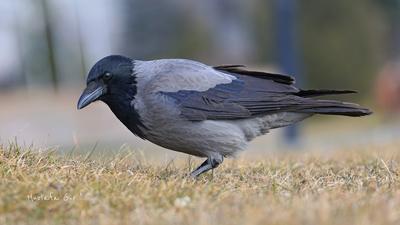
Rook (Corvus cornix)
Wingspan | 84-100 cm | ||||||||
|---|---|---|---|---|---|---|---|---|---|
Scientific Name | : Corvus cornix | ||||||||
Length | 45-50 cm | ||||||||
World | Animalia | ||||||||
Phylum | Chordata | ||||||||
Class | Aves | ||||||||
Order | Passeriformes (Ötücü kuşlar) | ||||||||
Family | Corvidae (Kargagiller) | ||||||||
Genus | Corvus | ||||||||
Carrion Crow is a bird species belonging to the genus Eurasia. Its Latin name is "Corvus cornix," derived from the words corvus, meaning "raven," and cornix, meaning "crow." Carrion Crows are on average 48 to 52 cm in length, have a wingspan of 98 cm, and weigh approximately 510 grams.
Most of their feathers are metallic glossy black, with this head, neck, upper chest, wings, and tail being dominated by this color. The back, belly, chest, and nape areas are gray. Juvenile Carrion Crows have duller plumage that becomes increasingly shiny and vibrant with age. Additionally, juveniles have grayish-blue irises, while adults have brown irises.
Carrion Crows molt throughout the year; this process begins between May and July and ends in October. Their flight is typically straight and direct, but they can display acrobatic maneuvers in windy conditions. Carrion Crows reach sexual maturity at approximately three years of age.

17/01/2023 ANKARA / Gölbaşı Görsel: https://ornito.org/Bird/Detail/358
Carrion Crows are an extremely intelligent bird species, with their performance in scientific experiments confirming their cognitive abilities in the wild. Behavioral biologists refer to them as "Avian Primates," as they are more intelligent than many other bird species. Their feeding habits are highly varied; they are both carnivorous and omnivorous, feeding on carrion, animals, fruits, seeds, food waste, earthworms, and many other types of food.
Moreover, as social birds that live in groups, Carrion Crows have a more social structure compared to other crow species. In their natural habitat, they primarily inhabit wooded areas, parks, forest edges, wetlands, and mountainous regions.

Leş Kargası 01/01/2024 (K.K.T.C), Görsel: https://ornito.org/Bird/Detail/358
Carrion Crows begin breeding between late February and late May each year. Nests are built high in tree branches or in rock crevices and typically consist of four layers. The outer layer is made of thick twigs, while inner layers are lined with finer materials. The nest contains two to six eggs with a blue-green hue. Chicks fledge between 28 and 38 days after hatching. Predators such as magpies and conspecifics may pose a threat to the young in the nest.
Carrion Crows are widespread across a large part of Eurasia, including Türkiye. They are the most common crow species in Türkiye and can be found in every region. They are also highly successful in adapting to urban life. They commonly inhabit a variety of habitats including parks, wooded agricultural areas, wetlands, and forest edges.
Carrion Crows are generally non-migratory and remain in their territories year-round. However, populations living in colder climates may undertake short-distance migrations to warmer regions during the winter months. They also have a wide geographic distribution, and their populations are typically stable. Due to the expansion of agricultural lands and their adaptability to urban environments, population increases have been observed in some regions.
The Carrion Crow is similar in size to the Hooded Crow and can be distinguished by its gray plumage. Unlike other crows, the Carrion Crow is characterized by its black and gray coloration. It can be specifically differentiated from the Hooded Crow by its gray body feathers. Juvenile Carrion Crows have duller plumage and initially have reddish mouths. The Carrion Crow is generally distinguished from the Hooded Crow by its larger feathers and overall physical structure. Its calls are low, hoarse sounds such as "krarr" or "aark."
In recent years, albino individuals of the Carrion Crow have been observed. This white plumage may result from partial leucism, a genetic disorder, or environmental factors. Such individuals are increasingly common within populations, and white coloration is spreading across specific regions of the birds. The Carrion Crow is a highly successful species in nature due to its social structure, intelligence, and adaptability.
"Corvus Cornix – Hooded Crow." Avibase, March 5, 2025. Accessed March 5, 2025.https://avibase.bsc-eoc.org/species.jsp?avibaseid=F13D8350405F3C10
"Corvus Cornix." *FeatherBase*, March 5, 2025. Accessed March 5, 2025.https://www.featherbase.info/en/species/corvus/cornix.
"House Crow." *Ornito*, March 5, 2025. Accessed March 5, 2025.https://ornito.org/Bird/Detail/358
"House Crow." eBird, March 5, 2025. Accessed March 5, 2025.https://ebird.org/species/hoocro1

Rook (Corvus cornix)
Wingspan | 84-100 cm | ||||||||
|---|---|---|---|---|---|---|---|---|---|
Scientific Name | : Corvus cornix | ||||||||
Length | 45-50 cm | ||||||||
World | Animalia | ||||||||
Phylum | Chordata | ||||||||
Class | Aves | ||||||||
Order | Passeriformes (Ötücü kuşlar) | ||||||||
Family | Corvidae (Kargagiller) | ||||||||
Genus | Corvus | ||||||||
Behavior and Intelligence
Reproduction
Habitat and Distribution
Migration and Population
Physical Characteristics and Identification
Genetic Characteristics