


This article was automatically translated from the original Turkish version.
A radiator is a heat exchange system that transfers heat from one medium to another, typically using a high-temperature liquid or gaseous fluid to emit heat into the surrounding environment. These systems are widely preferred in both industrial and personal applications. Radiators can operate for heating or cooling purposes; for example, they can be used for space heating in buildings and engine cooling in motor vehicles. Heat is carried by a fluid circulating within the system and is generally transferred to the surrounding air through metal surfaces.
The modern development of radiators occurred in the mid-19th century. One of the earliest patents in this field was granted in 1855 to Franz San Galli, a German engineer living in Rusya. San Galli developed a panel radiator system made of cast iron for use in central heating systems. This invention significantly improved the efficiency of indoor heating in regions with harsh winters and laid the foundation for today’s water-based central heating systems.
Radiators operate primarily through convection and radyasyon. Metal bodies through which a hot fluid—most commonly water, antifriz, or oil—flows transfer this heat to their outer surfaces. Due to the metal’s high thermal conductivity, heat is released into the surrounding environment. As a result, the ambient air warms, rises, cools as it descends, and is reheated, creating a natural circulation. This cycle ensures a uniform distribution of heat.
In automobiles, radiators dissipate excess heat generated by the engine. Cooling fluid flows through the engine block, absorbs heat, and reaches the radiator. There, it is cooled by a fan and recirculated back into the engine. This process prevents the engine from overheating.
This type of radiator, used in central heating systems, operates by circulating hot water in a closed loop. Water heated in a boiler is transported through pipes to the radiators, where it releases heat into the surroundings. The cooled water then returns to the boiler.
These radiators operate using electrical energy to heat a special heat-resistant oil inside them, thereby emitting heat into the environment. The oil does not circulate while the device is closed, making the system silent and capable of retaining heat for a uzun süre.
Used in internal combustion engines to distribute heat generated during operation. Cooling fluid—typically a mixture of water and antifriz—surrounds the engine, absorbs heat, and is directed to the radiator. Heat is then dissipated into the air.
These operate by heating wires through electrical resistance, which then come into contact with a metal surface. The heated surface warms the surrounding air. Thermostat-controlled models offer energy savings.
Modern systems made from lightweight aluminum with high thermal conductivity. Due to their high convection efficiency, they provide hızlı heating.
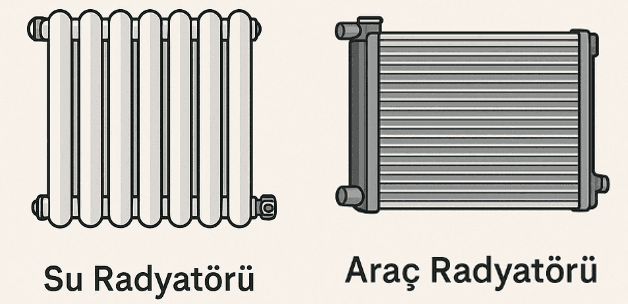
Water Radiator and Automotive Radiator (Source: AI-Generated Image)
Radiators are manufactured from metals with high thermal conductivity and resistance to environmental factors. The most common materials include:
Carisa. 2020. “Kalorifer ve Radyatör Dünyasına Kısa Bir Yolculuk.” *Carisa*. Accessed April 20, 2025.https://carisa.com.tr/en/kalorifer-ve-radyator-dunyasina-kisa-bir-yolculuk/.
Energuide. 2024. “What Is the Difference Between a Radiator and a Convector Radiator?” Energuide. Accessed April 20, 2025.https://www.energuide.be/en/questions-answers/what-is-the-difference-between-a-radiator-and-a-convector-radiator/453/.
Haynes. 2016. “What Is a Car Radiator?” Haynes. Accessed April 20, 2025.https://us.haynes.com/blogs/tips-tutorials/what-is-car-radiator.
Kia. "What Is a Radiator in a Car?" Kia British Dominica. Accessed April 20, 2025.https://www.kia.com/dm/discover-kia/ask/what-is-a-radiator-in-a-car.html.
Shriram General Insurance. "What Is a Radiator in a Car?" Shriram General Insurance. Accessed April 20, 2025.https://www.shriramgi.com/article/what-is-radiator-in-a-car.
Victorian Plumbing. "The History of Radiators." Accessed April 20, 2025.
Çengel, Yunus A., and Afshin J. Ghajar. 2023. Isı ve Kütle Transferi: Esaslar ve Uygulamalar. 4. basım. Çev. Vedat Tanyıldızı. Ankara: Palme Yayıncılık.

Definition and General Function
Historical Development
Working Principle
Types of Radiators
Water Radiators
Oil-Filled Radiators
Automotive Radiators
Electric Radiators
Aluminum or Panel Radiators
Material Properties
Applications
Advantages and Limitations
Advantages:
Limitations: