


This article was automatically translated from the original Turkish version.

Purslane (Portulaca oleracea L.)
Scientific Name(s) | Portulaca oleracea L. | ||||||||
|---|---|---|---|---|---|---|---|---|---|
Family | Portulacaceae | ||||||||
Plant Type | Annual, fleshy-leaved | ||||||||
Distribution(s) | Widespread worldwide | ||||||||
Nutritional Components | iron potassium magnesium beta-carotene vitamins C and E Omega-3 fatty acids | ||||||||
Pharmacological Properties | neuroprotective antidiabetic antimicrobial anti-inflammatory Antioxidant | ||||||||
Purslane (Portulaca oleracea L.) is a widely distributed plant worldwide, valued for its high nutritional content and diverse pharmacological properties. Although commonly regarded as a weed, it is used both as a food and for medicinal purposes due to its rich array of nutrients and bioactive compounds. This plant is particularly abundant in omega-3 fatty acids, vitamins, minerals, and antioxidants.
Purslane is an annual herb belonging to the Portulacaceae family, characterized by fleshy leaves and succulent stems. Its leaves are typically green, oval or spatula-shaped. The flowers are small, yellow, and have five petals. The plant spreads close to the soil surface and exhibits rapid growth.
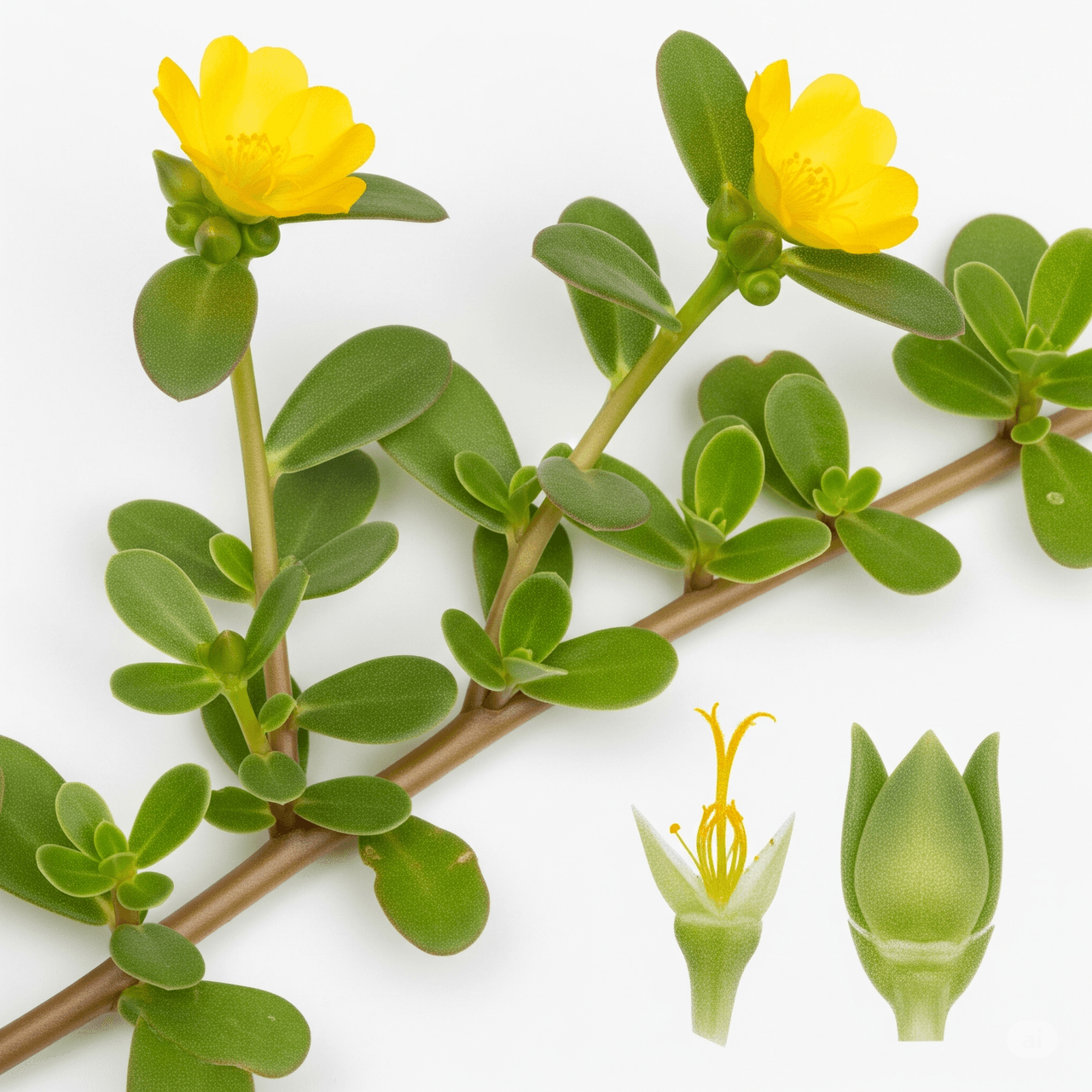
Morphological Structure of Purslane (Generated by Artificial Intelligence)
Purslane is a highly adaptable plant that thrives under a variety of climatic and soil conditions. It demonstrates tolerance to environmental stresses such as drought and salinity. Due to these traits, it is considered an alternative crop for marginal soils and sustainable agricultural practices.
Purslane is rich in omega-3 fatty acids, particularly alpha-linolenic acid. It also contains significant amounts of essential vitamins and minerals including vitamin C, vitamin E, beta-carotene, magnesium, potassium, and iron. These nutrients enhance its nutritional and health-promoting properties.
Scientific studies have confirmed the antioxidant, anti-inflammatory, antimicrobial, antidiabetic, and neuroprotective effects of purslane. These effects are associated with its content of flavonoids, alkaloids, and other phenolic compounds. Additionally, hepatoprotective and cardioprotective properties have been reported.
In traditional medicine, purslane has been used to treat various ailments. It is particularly favored for digestive disorders, skin conditions, and inflammatory conditions. It is also commonly used as a diuretic and antipyretic agent.
Research on the bioactive compounds of purslane is increasing in modern medicine. Its antioxidant and anti-inflammatory properties offer potential benefits in the prevention and treatment of various diseases. In the food industry, purslane is consumed fresh or dried in salads, soups, and other dishes. It is also evaluated as a functional food and dietary supplement.
Warning: The content presented here is intended solely for general encyclopedic information. These details must not be used for diagnosis, treatment, or medical advice. Always consult a physician or qualified healthcare professional before making any health-related decisions. The author and KÜRE Encyclopedia assume no responsibility for any consequences arising from the use of this information for diagnostic or therapeutic purposes.
Barroso, T. L. C. T., De Barros Alexandre, J., Da Cruz, E. P., Dias, A. R. G., Forster-Carneiro, T., & Bastos, C. P. (2024). An updated on applications and future perspectives for the valorization of purslane (Portulaca oleracea): a comprehensive review and bibliometric analysis. *European Food Research and Technology*, *250*(5), 1285–1306. Accessed May 30, 2025. https://doi.org/10.1007/s00217-024-04494-z
Iranshahy, M., Javadi, B., Iranshahi, M., Jahanbakhsh, S. P., Mahyari, S., Hassani, F. V., and Karimi, G. "Anti-infective and Anti-inflammatory Properties of Portulaca oleracea L." Journal of Ethnopharmacology 202 (2017): 1-10. Accessed May 30, 2025. https://www.sciencedirect.com/science/article/pii/S0378874116312752
Zhou, Y., Xin, H., Rahman, K., Wang, S., Peng, C., & Zhang, H. (2015).Portulaca OleraceaL L.: A Review of Phytochemistry and Pharmacological Effects. BioMed Research International, 2015, 1–11. Accessed May 30, 2025. https://doi.org/10.1155/2015/925631
Zhou, Yan-Xi, et al. "Portulaca oleracea L.: A Review of Phytochemistry and Pharmacological Effects." Biomed Research International (2015): 925631. Accessed May 30, 2025. Accessed May 30, 2025. https://europepmc.org/article/MED/25692148

Purslane (Portulaca oleracea L.)
Scientific Name(s) | Portulaca oleracea L. | ||||||||
|---|---|---|---|---|---|---|---|---|---|
Family | Portulacaceae | ||||||||
Plant Type | Annual, fleshy-leaved | ||||||||
Distribution(s) | Widespread worldwide | ||||||||
Nutritional Components | iron potassium magnesium beta-carotene vitamins C and E Omega-3 fatty acids | ||||||||
Pharmacological Properties | neuroprotective antidiabetic antimicrobial anti-inflammatory Antioxidant | ||||||||
No Discussion Added Yet
Start discussion for "Purslane (Portulaca oleracea L.)" article
Botanical Characteristics and Cultivation
Morphological Features
Growth Conditions
Chemical Composition and Pharmacological Properties
Nutritional Content
Pharmacological Effects
Traditional and Modern Applications
Use in Traditional Medicine
Applications in Modern Medicine