

Project Azorian (sometimes referred to by the mis-nomer Project Jennifer) was a covert United States Central Intelligence Agency (CIA) operation to raise the wreck of the Soviet Golf-class ballistic-missile submarine K-129 from the floor of the Pacific Ocean. Conducted between 1968 and 1974, the effort aimed to recover cryptographic materials, nuclear missiles, and other intelligence from the submarine, which had sunk in March 1968 approximately 1,560 nautical miles (2,890 km) northwest of Hawaii.
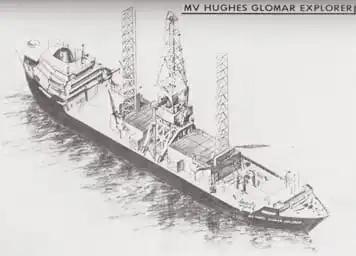
Hughes Glomar Explorer (CIA.gov)
Project Azorian remains one of the most ambitious and expensive intelligence operations ever attempted. It advanced deep-ocean engineering, coined a landmark legal doctrine on government secrecy, and became emblematic of Cold War espionage ingenuity.
Greg Norman, "Baltimore bridge collapse: Powerful crane linked to CIA secret Cold War mission arrives to clean up debris," Fox News, 29 March 2024.https://www.foxnews.com/us/baltimore-bridge-collapse-powerful-crane-linked-cia-secret-cold-war-mission-arrives-clean-debris
Lila Thulin, "During the Cold War, the CIA Secretly Plucked a Soviet Submarine From the Ocean Floor Using a Giant Claw," Smithsonian Magazine, 10 May 2019. https://www.smithsonianmag.com/history/during-cold-war-ci-secretly-plucked-soviet-submarine-ocean-floor-using-giant-claw-180972154/
Project Azorian, Central Intelligence Agency, Accessed 25 June 2025. https://www.cia.gov/legacy/museum/exhibit/project-azorian/
Background
Planning and Construction
Recovery Operation (1974)
Aftermath and Secrecy
Legacy
This article was created with the support of artificial intelligence.