


This article was automatically translated from the original Turkish version.
Postmodern architecture is an approach that emerged in opposition to modernism’s formal simplicity, functionality, and universality principles; it is characterized by historical allusions, decorative facades, collage logic, and an eclectic understanding of form. This perspective, which arose in the second half of the 20th century, seeks to increase diversity in architectural form and meaning by reinterpreting past architectural styles within contemporary contexts.
The theoretical framework of postmodern architecture was prominently defined by Charles Jencks’s book The Language of Postmodern Architecture (1977). One of the pivotal moments in public memory of the movement was the demolition of the Pruitt-Igoe public housing complex in 1972; this event became a symbol of criticisms that modernist architecture had failed to address social problems. In this context, postmodern architecture developed as a tendency that emphasized locality and pluralism against modernism’s universal language.
Postmodern architecture foregrounds locality, historical references, irony, and symbolic allusions in opposition to modernism’s rationalist and ornament-free approach to building. Fredric Jameson defined postmodernism as the “cultural logic of late capitalism,” while Jean Baudrillard evaluated architecture within the framework of a “universe of simulation.” Venturi and Scott Brown’s study Learning from Las Vegas (1972) opened the way for incorporating popular culture and ordinary building forms into architectural discourse. With this work, the distinction between high and low culture was questioned; billboard aesthetics neon lighting and kitsch elements were integrated into the architectural repertoire.
Baudrillard’s concepts of simulation and hyperreality describe an architectural environment in which meanings produced through postmodern structures replace reality itself. Shopping malls and themed spaces are particularly notable examples where consumption-oriented aesthetic principles come to the fore. In these buildings architectural forms carry theatrical and associative meanings; ironic and nostalgic elements are frequently employed. Thus postmodern architecture has demonstrated that architecture is not merely a formal discipline but also a discourse shaped by cultural and economic processes.
The postmodern approach has embraced fragmented collage-like spatial arrangements and historical references in urban design. In contrast to modernism’s centralizing and functionalist planning principles postmodern urban space offers diversity by taking into account historical layers and cultural contexts. The Dancing House (Fred and Ginger) in Prague stands out as an example of this approach due to its relationship with the surrounding historical fabric and its formal dynamism.
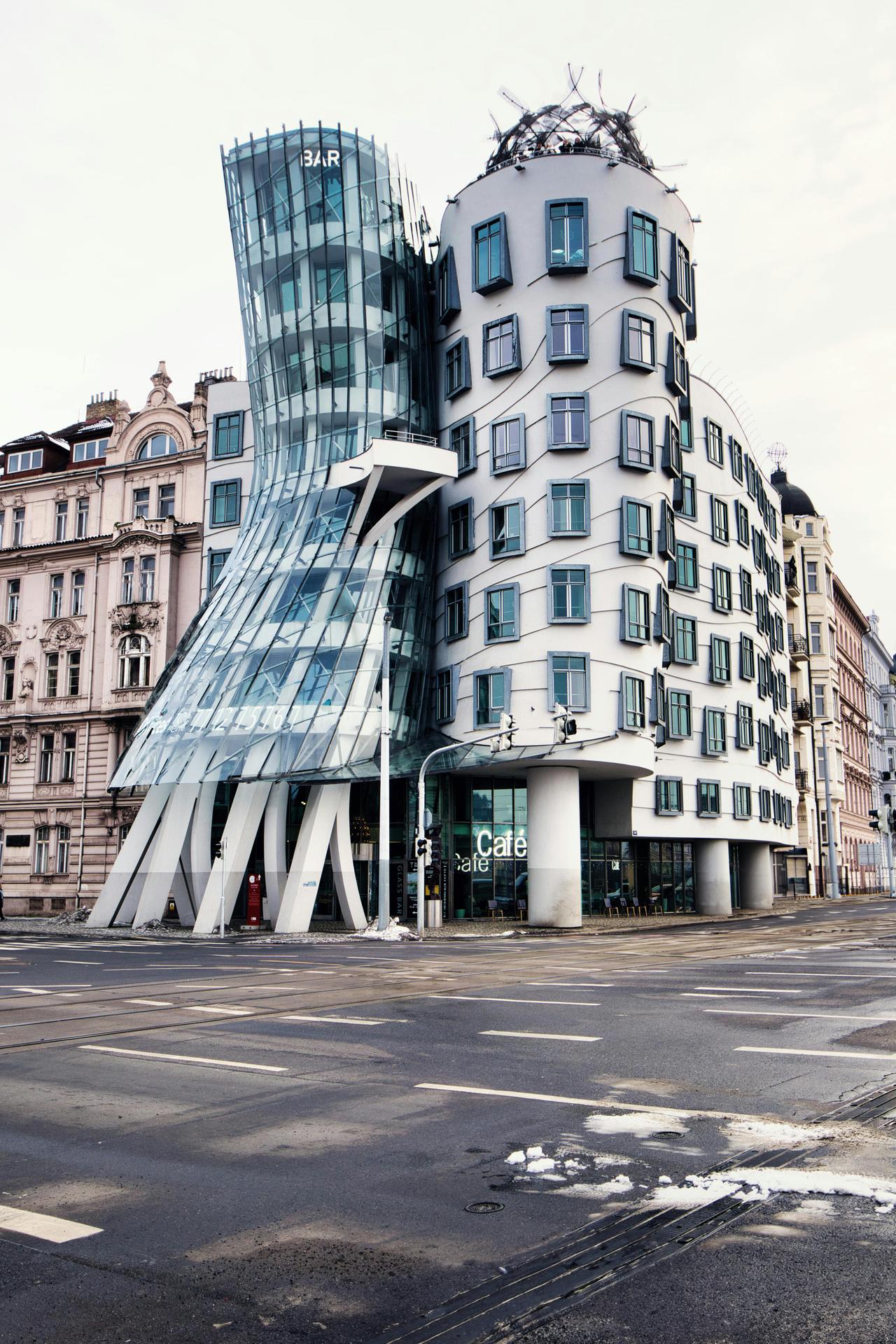
Dancing House, Prag, Çekya (Pexels, Ruben Boekeloo)
In this global diffusion process postmodern architecture has been interpreted in different ways within local contexts. In Türkiye in recent years some university campus projects and urban cultural buildings have combined postmodern aesthetic elements with contemporary architectural language to strengthen their connection with local context. For instance the Santralİstanbul Energy Museum complex reflects postmodernism’s character of historical reference combined with contemporary readings through its approach of preserving and transforming industrial heritage. Such buildings serve as examples demonstrating that architecture can be produced not only formally but also through interaction with historical and sociocultural contexts.
Although the direct influence of postmodern architecture has diminished today its principles of formal pluralism historical reference and contextual sensitivity continue in various forms. This legacy when combined with digital fabrication tools and parametric design methods contributes to the emergence of new hybrid spatial understandings.
Somol and Whiting’s approach to reflexive architecture emphasizes architecture’s capacity to develop speculative narratives oriented toward the future. Within this framework postmodern architecture retains its significance not as a limited historical period but as an enduring intellectual and formal legacy.
Aras, Lerzan. “Bir Mimarlık Bilinmeyeni: Postmodern Gündelik Yaşamda ‘Konut’ Tükendi mi?” *Megaron* 9, no. 2 (2014): 103–112. Accessed May 31, 2025.https://jag.journalagent.com/megaron/pdfs/MEGARON_9_2_I_IV.pdf#page=39
Aras, Lerzan. “Bir Serginin Ardından: Postmodern Mimarlık ve Yansıtmalı Yaklaşımlar.” *Yedi: Sanat, Tasarım ve Bilim Dergisi* 14 (2015): 125–133. Accessed May 31, 2025.https://dergipark.org.tr/tr/download/article-file/203773
Batı, Uğur. “Kentin Postmodernitesi: Postmodern Tüketim Kültürü Işığında Hedonik Bir Biçim Olarak Kent Tasarımı.” Yeditepe Üniversitesi Yayını. Accessed May 31, 2025.https://openaccess.iku.edu.tr/server/api/core/bitstreams/a1a6df64-af55-4e68-89d4-ad4838fb694a/content
Karakurt, Elif. “Kentsel Mekanı Düzenleme Önerileri: Modern Kent Planlama Anlayışı ve Postmodern Kent Planlama Anlayışı.” *Erciyes Üniversitesi İktisadi ve İdari Bilimler Fakültesi Dergisi* 26 (2006): 1–13. Accessed May 31, 2025.https://dergipark.org.tr/en/download/article-file/66469
Pexels. "Danseden Ev JPG." Accessed May 31, 2025.
Pexels. "Kent şehir seyahat JPG." Accessed May 31, 2025.https://www.pexels.com/tr-tr/fotograf/kent-sehir-seyahat-yolculuk-19492360/
Sungur, Suat. “Tüketimin Küreselleşmesi ve Tüketim Tapınakları: Postmodern Panayır Yerlerinde Alışveriş.” *İstanbul Aydın Üniversitesi İletişim Fakültesi Yayını.* Accessed May 31, 2025.http://iletisimdergisi.gsu.edu.tr/en/download/article-file/82704
Telci, İsmail Numan. “Küresel Postmodern Mimariye Yerel Modern Başkaldırı: TOKİ’nin Yurtdışı Toplu Konut Projeleri.” *Liberal Düşünce* 18, no. 71 (2013): 219–225. Accessed May 31, 2025.https://dergipark.org.tr/tr/download/article-file/790657

No Discussion Added Yet
Start discussion for "Postmodern Architecture" article
Historical Development
Theoretical Background and Cultural Reflections
Urban Applications and Local Interpretations
Contemporary Approaches