


This article was automatically translated from the original Turkish version.
Fir cone jelly is a natural, thick, semi-fluid product obtained through various processing methods of immature or resinous fir cones, particularly from species of the genus *Pinus*. Traditionally, it has been used in folk medicine as an adjunctive treatment for respiratory tract diseases, digestive system disorders, and immune system weaknesses.
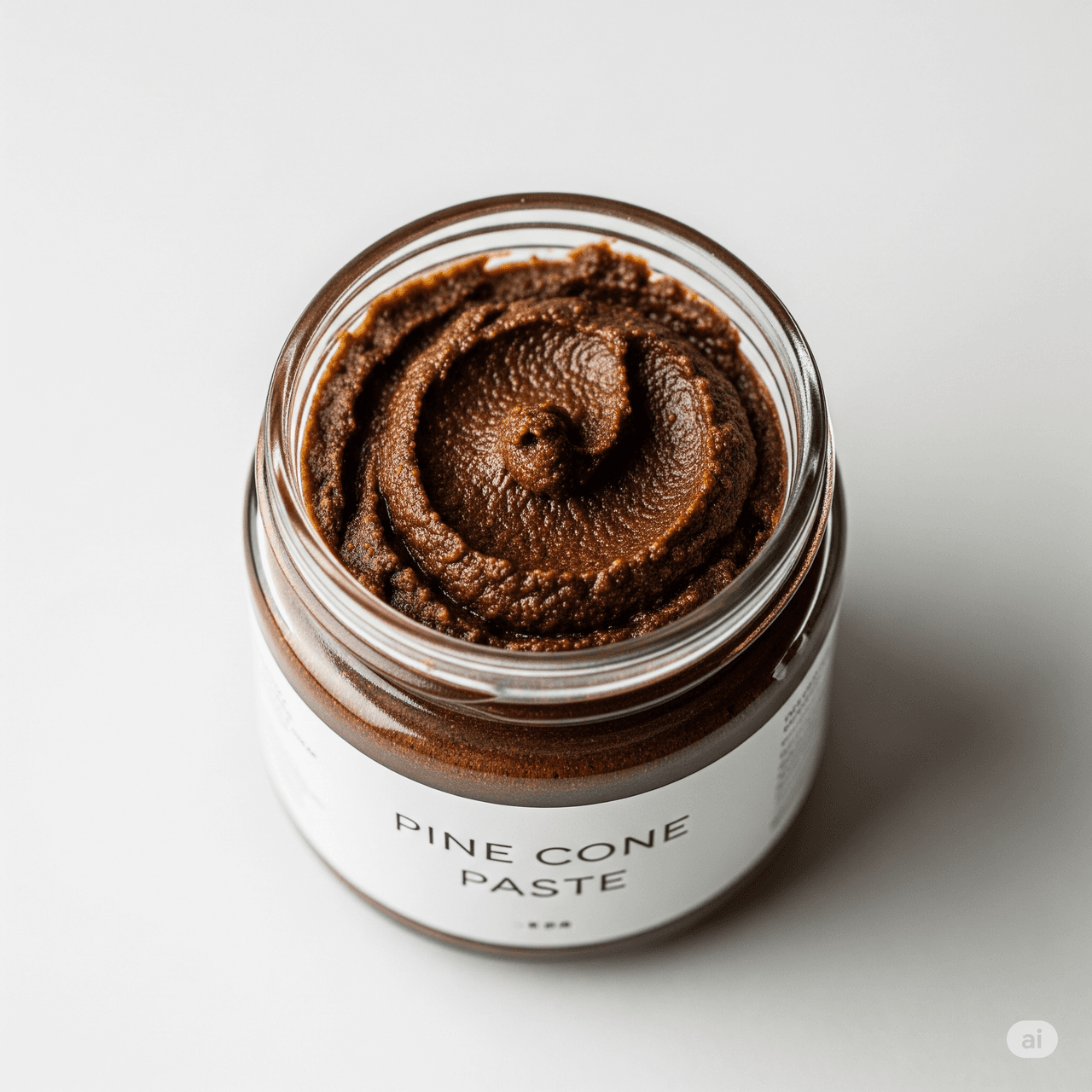
Representative Image of Fir Cone Jelly (Generated by Artificial Intelligence)
Among the most notable chemical constituents of fir cones are phenolics, including proanthocyanidins, flavonoids, phenolic acids, and stilbenoids, all known for their potent antioxidant properties. These compounds reduce cellular oxidative stress and protect against the harmful effects of free radicals. Stilbenoids such as pinosylvin and its derivatives are particularly recognized for their antifungal and anti-inflammatory effects.
The essential oils extracted from fir cones are rich in monoterpenes and sesquiterpenes. Compounds such as α-pinene and β-pinene, along with limonene, camphene, myrcene, and borneol, exhibit antimicrobial and mucolytic properties. Due to these characteristics, the aromatic extracts of fir cones have been traditionally used in the treatment of upper respiratory tract infections.
The cellular structure of fir cones contains polysaccharides composed of sugar units such as arabinose, galactose, glucose, and xylose. Experimental studies have reported that these natural sugar chains may modulate the immune system and induce cytotoxic effects in certain tumor cell lines. Additionally, lignin derivatives have been found to exhibit both antiviral and antitumor activities.
Extracts of fir cones demonstrate strong antioxidant activity, primarily due to their phenolic content. Laboratory tests using methods such as DPPH (2,2-diphenyl-1-picrylhydrazyl) and FRAP (Ferric Reducing Antioxidant Power) have confirmed that fir cone extracts possess significant free radical scavenging capacity. The antioxidant efficacy has also been noted to vary depending on the cone species, extraction method, and growing environment.
Components of fir cone jelly, including α-pinene and β-pinene, show inhibitory effects against both Gram-positive and Gram-negative bacteria. Furthermore, stilbenoids and lignin derivatives have been found to exert antiviral activity against viruses such as herpes simplex virus (HSV), influenza virus, and human immunodeficiency virus (HIV). These effects occur through various mechanisms, including inhibition of viral entry into host cells and suppression of viral replication.
Fir cone extracts have been reported to stimulate immune system cells, particularly enhancing T-cell activation and cytokine production. At the same time, they appear to regulate inflammatory processes by suppressing the production of inflammatory mediators such as TNF-α and IL-6. These properties suggest potential applications of fir cones in adjunctive therapy for immunological disorders.
Fir cone jelly has been traditionally used in Anatolia and other cultures to treat asthma, bronchitis, cough, and throat infections. In modern phytotherapy, it is evaluated as a complementary therapeutic product due to its antioxidant, antimicrobial, and immune-modulating properties.

Preparation of Fir Cone Jelly (Generated by Artificial Intelligence)
Extracts derived from fir cones are used in anti-aging cosmetic formulations due to their potential to protect skin cells against oxidative stress. In the food industry, research is ongoing into their use as natural preservatives and functional food additives. Their high polyphenol content may contribute to extended shelf life.
Industrial utilization of fir cones enables the conversion of forest by-products into economic value. This approach aligns with sustainable production principles and offers significant opportunities for reducing environmental waste and promoting rural development. Derivatives obtained from fir cones can serve as alternative raw materials for the industrial production of naturally derived bioactive compounds.
Latos-Brozio, Małgorzata, Anna Masek, Elżbieta Chrzescijanska, Andrzej Podsędek, and Dariusz Kajszczak. “Characteristics of the Polyphenolic Profile and Antioxidant Activity of Cone Extracts from Conifers Determined Using Electrochemical and Spectrophotometric Methods.” *Antioxidants* 10, no. 11 (2021): 1723. Accessed May 28, 2025. https://doi.org/10.3390/antiox10111723
Sakagami, Hiroshi, Yutaka Kawazoe, Noriko Komatsu, Alan Simpson, Meihan Nonoyama, Koji Konno, Takashi Yoshida, Yutaka Kuroiwa, and Seiichi I. Tanuma. “Antitumor, Antiviral and Immunopotentiating Activities of Pine Cone Extracts: Potential Medicinal Efficacy of Natural and Synthetic Lignin-related Materials.” Anticancer Research 11, no. 2 (1991): 881–888. Accessed May 28, 2025. https://pubmed.ncbi.nlm.nih.gov/1648335/
Zhang, Xiaoyu, Lisha Yang, Guohua Liu, Ying Liu, Chunmei Zheng, Yanan Lv, Hongyu Li, and Yan Zheng. “Potent Anti-HIV Activities and Mechanisms of Action of a Pine Cone Extract from Pinus yunnanensis.” *Molecules* 17, no. 6 (2012): 6916–6929. Accessed May 28, 2025. https://doi.org/10.3390/molecules17066916

Chemical Composition and Bioactive Content
Phenolic Compounds
Volatile Compounds and Terpenoids
Polysaccharides and Lignin Derivatives
Pharmacological Properties
Antioxidant Activity
Antimicrobial and Antiviral Effects
Immunomodulatory and Anti-inflammatory Effects
Applications and Industrial Potential
Traditional and Modern Uses
Cosmetic and Food Industries
Sustainability and Economic Contribution