


This article was automatically translated from the original Turkish version.
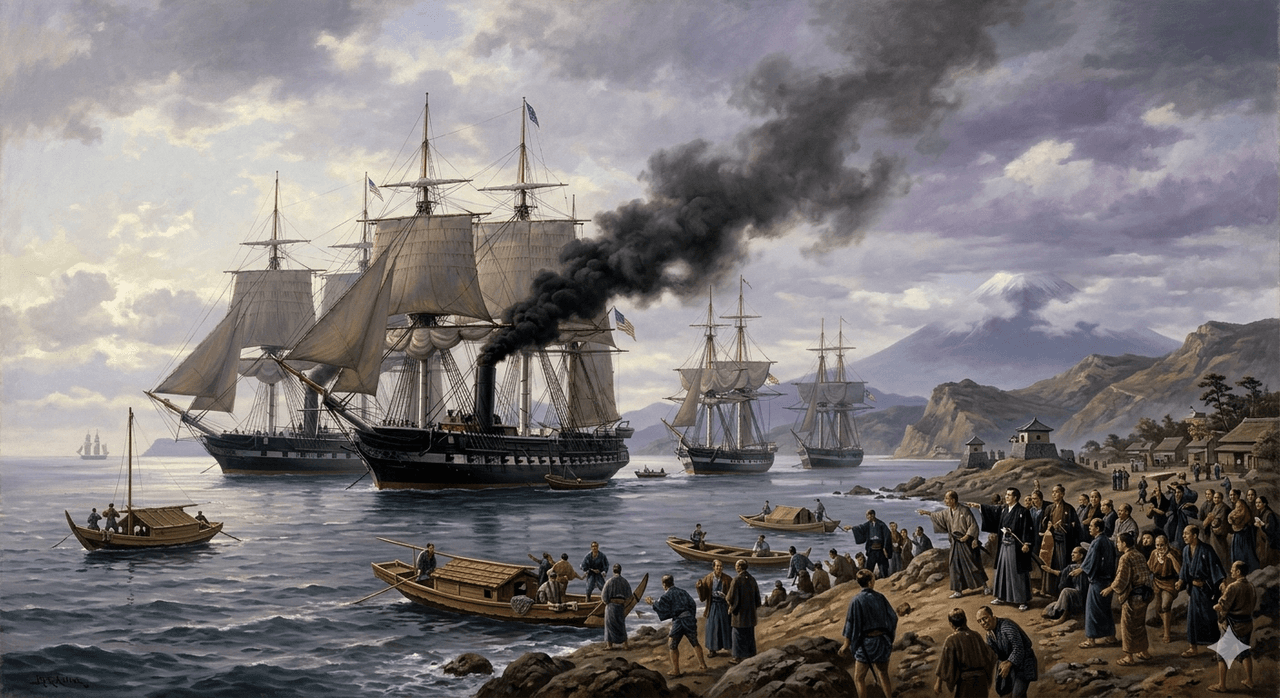
(Generated by Artificial Intelligence.)
Commodore Perry's Expedition to Japan
Date | 1853-07-14 | ||||||||
|---|---|---|---|---|---|---|---|---|---|
Event | The expedition under Commodore Perry forcing Japan to open to the outside world | ||||||||
Actors | Commodore Matthew C. Perry | ||||||||
Outcome of the Event | Japan's emergence from isolation and entry into the process of modernization | ||||||||
Side | United States of America Japan (Tokugawa Shogunate) | ||||||||
Place | Uraga Port - Yokosuka District - Kanagawa Prefecture - Japan | ||||||||
The Perry Expedition (Commodore Perry’s Expedition to Japan) was a diplomatic and military mission conducted by a U.S. naval fleet under the command of American Commodore Matthew C. Perry in 1853–1854. This expedition ended Japan’s policy of isolation maintained throughout the Edo Period and initiated its process of modernization.
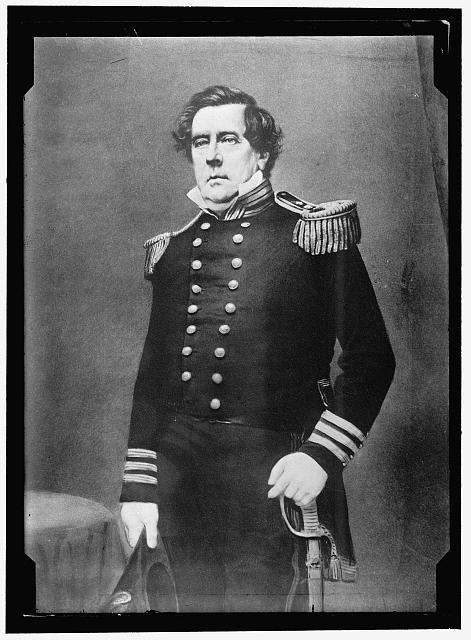
Commodore Matthew Perry (U.S. Congress Library)
Since 1639, Japan had been under the sakoku (closed country) policy enforced by the Tokugawa Shogunate, which aimed to minimize contact with the outside world. During this period, Japan restricted its interactions with the Western world exclusively to the Dutch traders on Dejima Island in Nagasaki. However, by the mid-19th century, the United States’ (U.S.) commercial and strategic interests in the Pacific played a decisive role in ending this isolation. During this time, the expansion of U.S. trade with China, the annexation of California, the growth of whaling activities in the Pacific, and the need for coaling stations for steamships made Japan’s geographic position increasingly significant to the United States.
The U.S. fleet led by Commodore Matthew Calbraith Perry arrived at Uraga Harbor in Edo Bay (present-day Tokyo) on July 8, 1853. Comprising four ships—two steam frigates (Susquehanna and Mississippi) and two sailing sloops (Plymouth and Saratoga)—this fleet was referred to by the Japanese people and officials as “Kurofune” (Black Ships). 【1】 Perry adopted the method of “gunboat diplomacy” to deliver a letter from U.S. President Millard Fillmore requesting friendship, trade, and protection for shipwrecked American sailors. Perry insisted on personally delivering the letter to Japanese authorities and informed them that he would return a year later with a larger force if his demands were rejected.【2】
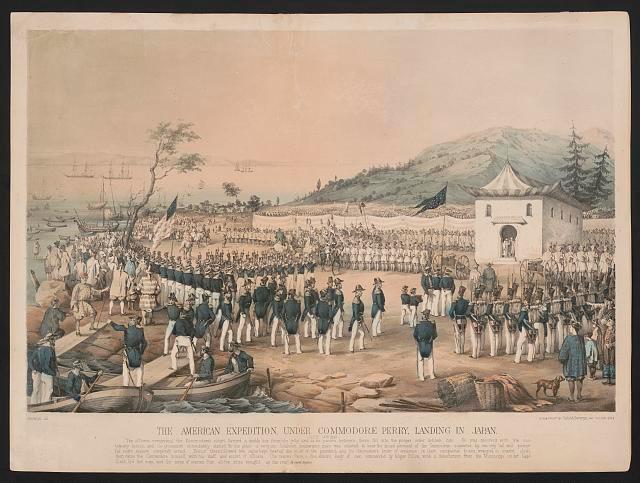
Commodore Perry stepping ashore in Japan on July 14, 1853 (U.S. Congress Library)
Perry returned to Japan on February 13, 1854, this time with a stronger fleet of nine ships. Faced with this display of power and Western technological superiority, the Tokugawa Shogunate recognized its inability to resist foreign pressure and initiated negotiations. On March 31, 1854, the parties signed the Treaty of Kanagawa (Japan–U.S. Convention of Peace and Amity). Under this treaty, the ports of Shimoda and Hakodate were opened to American ships, assistance to shipwrecked American sailors was guaranteed, and the establishment of a U.S. consulate in Shimoda was permitted. During the expedition, Perry presented the Japanese with gifts including a quarter-scale steam locomotive, a telegraph system, and various scientific instruments to introduce them to Western technology.【3】
The Perry Expedition triggered a process that went beyond Japan’s opening to the outside world—it undermined the authority and legitimacy of the Shogunate. The Shogunate’s submission to foreign demands provoked backlash from domestic opposition groups and regional lords (daimyo), contributing to the rise of the “Sonno Joi” (Revere the Emperor, Expel the Barbarians) movement. Unequal treaties such as the Harris Treaty of 1858, which restricted Japan’s tariff autonomy, further intensified internal unrest. Ultimately, the Tokugawa Shogunate collapsed in 1867, and in 1868, with the restoration of imperial rule under Emperor Meiji, the Meiji Restoration began. During this era, Japan embarked on rapid modernization, industrialization, and military reform based on Western models, quickly emerging as a global power.
Bakenhus, Reuben E. “Commodore Matthew Calbraith Perry.” *The Military Engineer* 30, no. 169 (1938): 40–42. Accessed March 10, 2026. http://www.jstor.org/stable/44566706
Büyükbaş, Hakkı. “Japon Modernleşmesi Üzerine (1868-1912).” *Bilimname*, no. 3 (2003): 65–86. Accessed March 10, 2026. https://makale.isam.org.tr/handle/123456789/201468
Chaiklin, Martha. “Monopolists to Middlemen: Dutch Liberalism and American Imperialism in the Opening of Japan.” *Journal of World History* 21, no. 2 (2010): 249–269. Accessed March 10, 2026. http://www.jstor.org/stable/20752949
Drury, Clifford M. “Early American Contacts with the Japanese.” *The Pacific Northwest Quarterly* 36, no. 4 (1945): 319–30. Accessed March 10, 2026. http://www.jstor.org/stable/40732703
Harris & Ewing Collection. "PERRY, MATTHEW C., COMMODORE, U.S.N." Library of Congress Prints and Photographs Division. Accessed March 10, 2026. https://www.loc.gov/pictures/item/2016866868/
Hatch & Severyn. "The American expedition, under Commodore Perry, landing in Japan, July 14, 1853" Library of Congress Prints and Photographs Division Washington. Accessed March 10, 2026. https://www.loc.gov/pictures/item/2014647410/
Honjo, Eijiro. “From the Tokugawa Period to the Meiji Restoration.” *Kyoto University Economic Review* 7, no. 1 (1932): 32–51. Accessed March 10, 2026. http://www.jstor.org/stable/43217270
Jansen, Marius B. “The Opening of Japan.” *Japan Review*, no. 2 (1991): 191–202. Accessed March 10, 2026. http://www.jstor.org/stable/25790903
Kitahara, Michio. “Commodore Perry and the Japanese: A Study in the Dramaturgy of Power.” *Symbolic Interaction* 9, no. 1 (1986): 53–65. Accessed March 10, 2026. https://doi.org/10.1525/si.1986.9.1.53
Rabson, Steve. “Perry’s Black Ships in Japan and Ryukyu: The Whitewash of History.” *The Asia-Pacific Journal | Japan Focus* 14, no. 16 (2016). Accessed March 10, 2026. https://apjjf.org/2016/16/rabson
U.S. Department of State. “The United States and the Opening to Japan, 1853.” Office of the Historian. Accessed March 10, 2026. https://history.state.gov/milestones/1830-1860/opening-to-japan
[1]
Steve Rabson, “Perry’s Black Ships in Japan and Ryukyu: The Whitewash of History.” The Asia-Pacific Journal | Japan Focus 14, no. 16 (2016), accessed March 10, 2026, https://apjjf.org/2016/16/rabson.
[2]
Hakkı Büyükbaş, “On Japanese Modernization (1868–1912).” Bilimname, no. 3 (2003): p.71, accessed March 10, 2026, https://makale.isam.org.tr/handle/123456789/201468.
[3]
Michio Kitahara, “Commodore Perry and the Japanese: A Study in the Dramaturgy of Power.” Symbolic Interaction 9, no. 1 (1986): p.60, accessed March 10, 2026, https://doi.org/10.1525/si.1986.9.1.53.
(Generated by Artificial Intelligence.)
Commodore Perry's Expedition to Japan
Date | 1853-07-14 | ||||||||
|---|---|---|---|---|---|---|---|---|---|
Event | The expedition under Commodore Perry forcing Japan to open to the outside world | ||||||||
Actors | Commodore Matthew C. Perry | ||||||||
Outcome of the Event | Japan's emergence from isolation and entry into the process of modernization | ||||||||
Side | United States of America Japan (Tokugawa Shogunate) | ||||||||
Place | Uraga Port - Yokosuka District - Kanagawa Prefecture - Japan | ||||||||
Background: Japan’s Isolation (Sakoku) and the United States
Kurofune: Black Ships and Initial Contact
The 1854 Expedition and the Treaty of Kanagawa
Political Transformation and the Meiji Restoration