

This article is not approved yet.
+2 More
Primary Applications | Building-integrated PV, portable electronics, vehicle integration | ||||||||
|---|---|---|---|---|---|---|---|---|---|
Peak Efficiency | 26.54% | ||||||||
Technology Type | Photovoltaic Solar Cells | ||||||||
Material Composition | ABX₃ crystals (A = MA⁺, FA⁺, Cs⁺; B = Pb²⁺, Sn²⁺; X = I⁻, Br⁻, Cl⁻) | ||||||||
Perovskite solar cells (PSCs) are third-generation photovoltaic devices that utilize perovskite-structured materials, typically hybrid organic-inorganic lead or tin halides (chemical formula ABX₃), as light-absorbing layers. First developed in 2009 with an initial efficiency of 3.8%, PSCs have achieved certified efficiencies exceeding 26% by 2025. These cells are characterized by high absorption coefficients, tunable bandgaps, and low-temperature solution-based manufacturability. Research focuses on improving stability, scalability, and mitigating environmental risks associated with lead content. Global deployment initiatives include building-integrated photovoltaics (BIPV) and tandem configurations with silicon.
PSCs originated from dye-sensitized solar cells (DSSCs), with Miyasaka et al. first demonstrating methylammonium lead iodide (CH₃NH₃PbI₃) as a sensitizer in 2009 . Liquid electrolytes initially caused perovskite dissolution, limiting stability. Breakthroughs in 2012 replaced liquid electrolytes with solid hole-transport materials (e.g., spiro-OMeTAD), enabling efficiencies near 10% and enhanced durability. By 2015, formamidinium lead iodide (H₂NCHNH₂PbI₃) emerged as a superior absorber due to its narrower bandgap (1.48 eV), closer to the Shockley-Queisser optimal limit of 1.34 eV.
The ABX₃ lattice comprises:
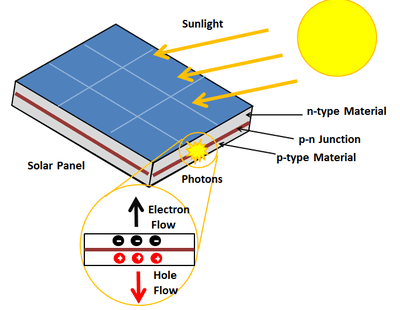
Photoexcitation generates electron-hole pairs (excitons) with low binding energy (<50 meV), enabling efficient separation at interfaces. Electrons inject into electron transport layers (ETLs) like SnO₂ or TiO₂, while holes move through hole transport layers (HTLs) such as spiro-OMeTAD. Long carrier diffusion lengths (>1 μm) reduce recombination losses.
Tandem cells combining perovskite with silicon or CIGS absorbers capture broader solar spectra:
Phenylselenenyl chloride additives anchor grain boundaries, reducing lattice distortion during thermal cycling. This extends T80 (time to 80% efficiency retention) tenfold under natural operating conditions.
Chen, Wei, et al. “Aqueous-Based Recycling of Perovskite Photovoltaics.” Nature, vol. 638, 2025. Accessed August 16, 2025. https://www.nature.com/articles/s41586-024-08408-7.
Conings, Bert, et al. “Environmental Impact of Metal Halide Perovskite Solar Cells and Potential Mitigation Strategies: A Critical Review.” Environmental Research, vol. 219, 2023. Accessed August 16, 2025. https://www.sciencedirect.com/science/article/abs/pii/S0013935122023933.
Hailegnaw, Bekele, et al. “Environmental and Health Risks of Perovskite Solar Modules.” iScience, vol. 26, no. 1, 2022. Accessed August 16, 2025. https://pmc.ncbi.nlm.nih.gov/articles/PMC9860350/.
Kumar, Naveen, et al. “Perovskite Solar Cells: Progress, Challenges, and Future Avenues to Clean Energy.” Solar Energy, vol. 287, 2025. Accessed August 16, 2025. https://www.sciencedirect.com/science/article/abs/pii/S0038092X24009009.
Li, Zhen, et al. “Achievements, Challenges, and Future Prospects for Industrialization of Perovskite Solar Cells.” Light: Science & Applications, vol. 13, 2024. Accessed August 16, 2025. https://www.nature.com/articles/s41377-024-01461-x.
Miyasaka, Tsutomu. “Perovskite Solar Cells: An Emerging Photovoltaic Technology.” Materials Today, vol. 18, no. 2, 2015. Accessed August 16, 2025. https://www.sciencedirect.com/science/article/pii/S1369702114002570.
Zhang, Feng, et al. “Strain Regulation Retards Natural Operation Decay of Perovskite Solar Cells.” Nature, vol. 635, 2024. Accessed August 16, 2025. https://www.nature.com/articles/s41586-024-08161-x.
“Perovskite Solar Cells: Advantages, Challenges, and Future Prospects.” Maysun Solar. Accessed August 16, 2025. https://www.maysunsolar.com/blog-perovskite-solar-cells-advantages-challenges-and-future-prospects/.
Babayigit, Aslihan, et al. “Assessing the Toxicity of Pb- and Sn-Based Perovskite Solar Cells in Model Organism Danio Rerio.” Scientific Reports, vol. 6, 2016. Accessed August 16, 2025. https://www.nature.com/articles/srep18721.

Primary Applications | Building-integrated PV, portable electronics, vehicle integration | ||||||||
|---|---|---|---|---|---|---|---|---|---|
Peak Efficiency | 26.54% | ||||||||
Technology Type | Photovoltaic Solar Cells | ||||||||
Material Composition | ABX₃ crystals (A = MA⁺, FA⁺, Cs⁺; B = Pb²⁺, Sn²⁺; X = I⁻, Br⁻, Cl⁻) | ||||||||
No Discussion Added Yet
Start discussion for "Perovskite Solar Cells" article
Historical Development and Material Evolution
Origins and Early Innovations (2009–2015)
Efficiency Milestones (2016–2025)
Technical Fundamentals and Device Architecture
Perovskite Crystal Structure
Charge Transport Mechanisms
Multi-Junction Configurations
Environmental and Stability Challenges
Toxicity and Leaching Risks
Degradation Pathways
Mitigation Strategies and Innovations
Lead Sequestration and Recycling
Strain Regulation and Defect Passivation
Alternative Perovskite Formulations
This article was created with the support of artificial intelligence.