


This article was automatically translated from the original Turkish version.
+1 More
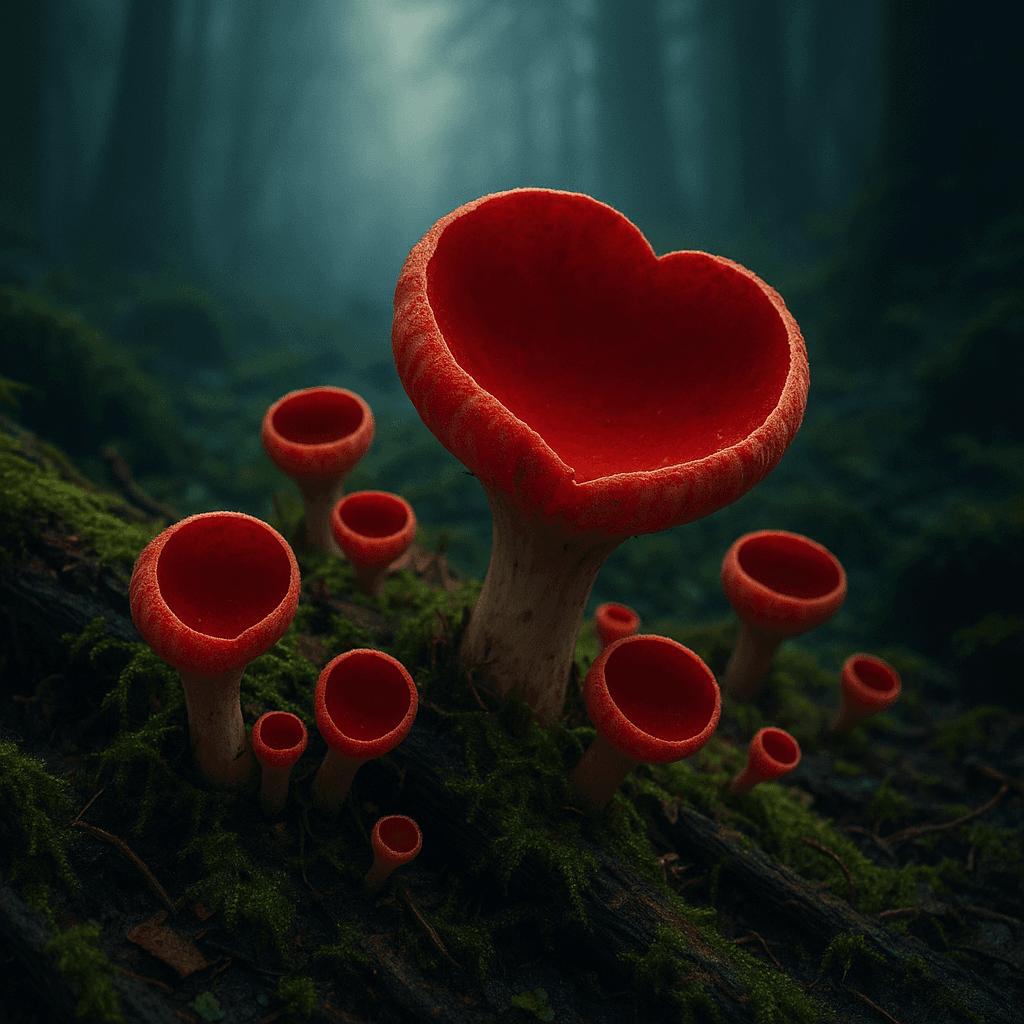
Generated with AI.
Fairy Cup Mushroom
Family | Sarcoscyphaceae | ||||||||
|---|---|---|---|---|---|---|---|---|---|
Genus | Sarcoscypha | ||||||||
Specie(s) | Sarcoscypha coccinea (Scop.) | ||||||||
S. coccinea is a morphologically distinctive Ascomycota species that develops on decaying woody material in forest ecosystems. Fungi are organisms that drive the transformation of organic matter in nature and possess significant biotechnological potential. Sarcoscypha coccinea is one of the species notable for its red apothecial structure and commonly known as the “scarlet cup fungus.” Due to its visual appeal, this species attracts the interest of nature photographers, yet its microbial properties have still not been sufficiently evaluated in scientific research. Findings indicate that this species merits scientific interest not only for its aesthetic value but also for its microbial antagonism and enzymatic capacity.
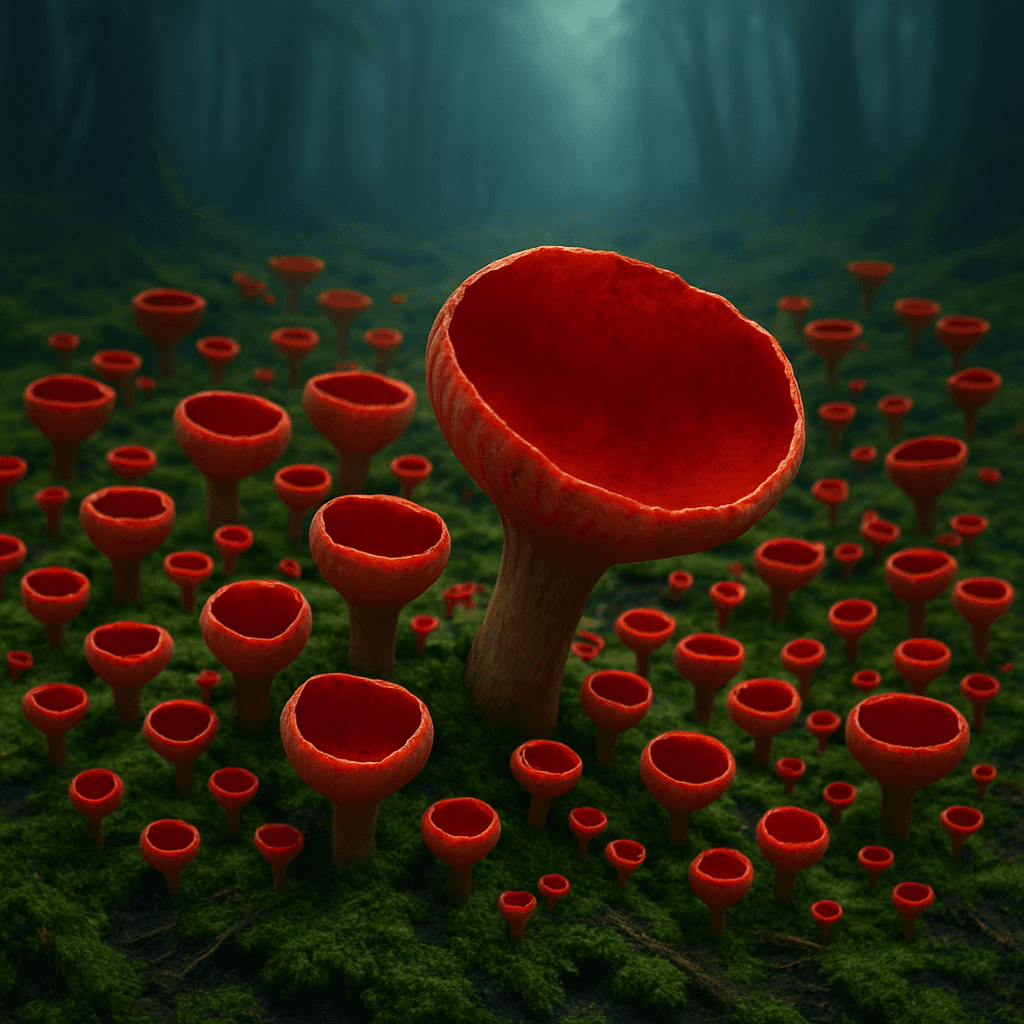
AI-generated image of fairy cup fungi
Macroscopically, S. coccinea produces cup-shaped apothecia 2–5 cm in diameter, with a bright red inner surface and a whitish outer surface covered in short hairs. One of the most diagnostic features in morphological identification is the arrangement of the hairs and the structure of the apothecial margin. Microscopically, spores are typically smooth, ellipsoidal, and measure 26–40 × 10–14 µm. Asci are inoperculate and the spore wall is generally two-layered.
These characteristics become particularly important in distinguishing S. coccinea from closely related species such as S. austriaca. Recent phylogenetic analyses based on DNA barcoding have revealed genetic differences between European and North American populations of S. coccinea.
S. coccinea typically fruits on decaying woody substrates in moist deciduous forests during late winter and early spring. This phenological timing provides an advantage by minimizing competition with other saprotrophic species. Additionally, the red color of the apothecium may serve as an adaptive trait that attracts active insects during this period, potentially aiding in spore dispersal.
The species thrives particularly in moist microhabitats and is frequently found on decaying wood of genera such as Corylus, Alnus, and Fagus. In the flora of Türkiye, it has recently been observed in Western Anatolia, in addition to its previously known occurrences in the Black Sea and Marmara regions.
Recent studies have demonstrated that S. coccinea produces phenolic compounds, polysaccharides, and certain low-molecular-weight antibacterial agents. Methanol extracts of the fungus have been reported to exhibit significant inhibitory effects against pathogens such as Staphylococcus aureus and Escherichia coli. Furthermore, due to its ability to grow on lignocellulosic material, it is predicted to possess enzymatic capabilities—such as cellulase and lactase production—that could be harnessed for the recycling of biodegradable waste. The variability of its enzymatic activity depending on substrate type suggests that this species could serve as a modifiable model organism in industrial biotechnology.
Although traditional classification places this species within the family Sarcoscyphaceae, molecular data have challenged the monophyly of this group. Studies based on ITS and LSU regions have shown that some Asian populations are sufficiently divergent from S. coccinea to warrant exclusion from the same species. This finding indicates the need for a revised taxonomic definition at the species level.
S. coccinea is scientifically significant not only for its aesthetic features but also for its biochemical production and microbial interactions. Further research on molecular systematics, enzymatic activity, and microbial antagonism will enhance our understanding of its biotechnological and ecological roles. Moreover, genetic analysis of local populations is crucial to determine whether this species encompasses cryptic species complexes.
Dzahagan, Volodymyr and Veronika Dzahagan. "Analysis of Scarlet Elf Cup (Sarcoscypha coccinea) Carotenoids In Vivo by Raman Spectroscopy." ResearchGate, December 2020. https://www.researchgate.net/publication/347022560_Analysis_of_scarlet_elf_cup_Sarcoscypha_coccinea_carotenoids_in_vivo_by_Raman_spectroscopy.
Zeng, Ming, and Eleni Gentekaki. "The Future of Natural Products as a Source of New Antibacterials." *Frontiers in Microbiology* 13 (2023): 9856026. https://www.ncbi.nlm.nih.gov/pmc/articles/PMC9856026/.
Generated with AI.
Fairy Cup Mushroom
Family | Sarcoscyphaceae | ||||||||
|---|---|---|---|---|---|---|---|---|---|
Genus | Sarcoscypha | ||||||||
Specie(s) | Sarcoscypha coccinea (Scop.) | ||||||||
No Discussion Added Yet
Start discussion for "Peri Kasesi Mushroom (Sarcoscypha coccinea)" article
Morphological Characteristics and Identification Key
Habitat Characteristics and Ecological Adaptations
Biochemical Components and Biotechnological Potential
Systematic and Phylogenetic Discussions