


This article was automatically translated from the original Turkish version.
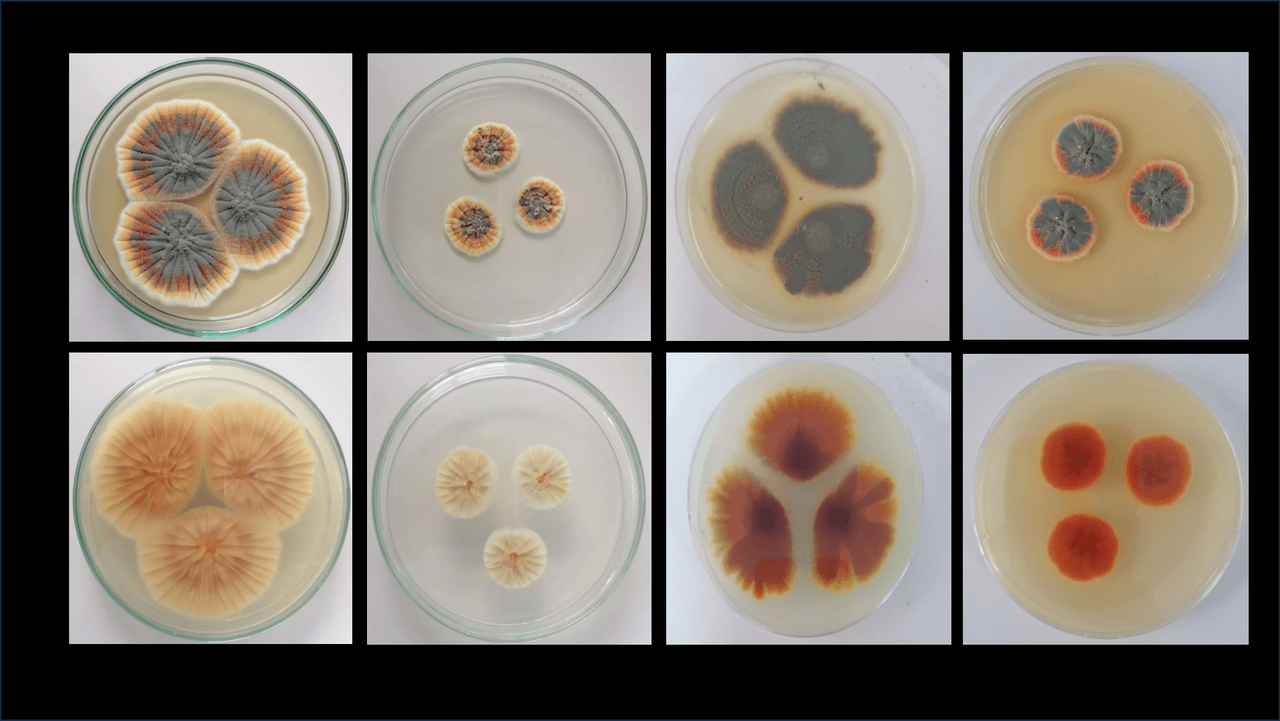
Penicillium mallochii (Photo: Pınar Güner)
World | Fungi | ||||||||
|---|---|---|---|---|---|---|---|---|---|
Branch | Ascomycota | ||||||||
Class | Eurotiomycetes | ||||||||
Team(s) | Eurotiales | ||||||||
Penicillium mallochii is a fungal species belonging to the genus Penicillium and characterized by filamentous hyphal structure. It was first described in 2011 by Houbraken, Frisvad and Samson, and introduced to the scientific literature as a new species alongside P. guanacastense. The species exhibits typical characteristics of the genus Penicillium: rapidly growing colonies, branched conidiophores, and conidia arranged in chains. P. mallochii is environmentally flexible and can thrive in both soil and insect-associated habitats.
P. mallochii was first identified during entomological research conducted in the Guanacaste region of Costa Rica. The species was isolated from the intestines and fecal material of the butterfly species Rothschildia lebeau and Citheronia lobesis. This isolation suggests that the fungus may be a natural component of the insect digestive microbiota or a symbiont. The fungal samples obtained in the study were genetically analyzed and determined to be a distinct species different from other known Penicillium species. The designated type strain (CBS 122711) is still preserved in the collection of the Westerdijk Fungal Biodiversity Institute (Netherlands).
Although first described from butterfly larvae, P. mallochii has since been isolated from various other environments. In a study conducted in China, a strain designated “CCH01” was isolated from the gut of the caterpillar Ectropis oblique; this strain was found to produce antimicrobial compounds. Additionally, a strain named “LMB-HP37” was isolated from soil samples collected in Peruvian rainforests; this strain exhibited strong alkaline cellulase activity. Some studies have also reported P. mallochii occurring within plant tissues as an endophytic fungus. This diversity demonstrates that the species is not merely a saprotroph but a versatile organism capable of forming symbiotic relationships with both insects and plants.
Under laboratory conditions, Penicillium mallochii forms typical Penicillium colonies on potato dextrose agar (PDA) and Czapek yeast extract agar (CYA). Colonies are initially white and gradually turn blue-green or turquoise as they mature. The colony surface is generally rough with wavy margins. The reverse side may develop a yellowish or pale brown pigment. Microscopically, branched hyphae, metulae and phialides are observed. Conidiophores exhibit the characteristic “penicillus” structure, bearing chains of conidia at their tips. Conidia are ellipsoidal or spherical and have a smooth surface.
P. mallochii exhibits optimal growth between 20–30 °C and reproduces well under moderate humidity levels. As a saprotrophic species, it utilizes simple sugars (glucose, maltose, fructose) as a carbon source and amino acids as a nitrogen source. Some strains, particularly those of tropical origin, have been reported to tolerate low pH conditions and produce organic acids. Furthermore, the Peruvian isolate’s ability to produce active enzymes under alkaline conditions is of considerable interest for industrial biotechnology.
Like other Penicillium species, P. mallochii is capable of synthesizing biologically active compounds. The Chinese CCH01 strain demonstrated strong antibacterial activity against bacteria such as Staphylococcus aureus and Bacillus subtilis. Additionally, some studies have reported that this species produces novel compounds with antifungal and cytotoxic potential. Tropical soil-derived isolates show promise in the production of industrial enzymes such as cellulase, protease and xylanase.
To date, there are no recorded cases of P. mallochii causing disease in humans. However, as with other Penicillium species, the potential for allergic reactions or mycotoxin production must not be overlooked. As it may occur as a contaminant in food environments, it should be considered in storage and hygiene studies.
Penicillium mallochii is a species of importance both for microbial diversity and biotechnological applications. Its origin from insects positions it as a model organism for studying microbial symbiosis and ecological adaptation. Although its industrial use has not yet been fully developed, it holds potential applications in enzyme production, natural antibiotic synthesis, and biodegradation of organic materials. Genetic characterization of this species also contributes to a better understanding of the evolution and ecological diversification of the genus Penicillium.
Coutinho, T. C., M. C. Ferreira, L. H. Rosa, A. M. de Oliveira, and E. N. de Oliveira Junior. “Penicillium citrinum and Penicillium mallochii: New Phytopathogens of Orange Fruit and Their Control Using Chitosan.” Carbohydrate Polymers 234 (2020): 115918. Accessed October 19, 2025.
Zhang, S., H. Fang, C. Yin, C. Wei, J. Hu, and Y. Zhang. “Antimicrobial Metabolites Produced by *Penicillium mallochii* CCH01 Isolated from the Gut of Ectropis oblique, Cultivated in the Presence of a Histone Deacetylase Inhibitor.” *Frontiers in Microbiology* 10 (2019): 2186. Accessed October 19, 2025. https://doi.org/10.3389/fmicb.2019.02186

Penicillium mallochii (Photo: Pınar Güner)
World | Fungi | ||||||||
|---|---|---|---|---|---|---|---|---|---|
Branch | Ascomycota | ||||||||
Class | Eurotiomycetes | ||||||||
Team(s) | Eurotiales | ||||||||
No Discussion Added Yet
Start discussion for "Penicillium mallochii" article
First Isolation and Discovery Story
Ecological Distribution and Habitat
Morphological Characteristics
Physiological Characteristics
Secondary Metabolites and Antimicrobial Activity
Human Health and Food Relations
Scientific and Industrial Significance