


This article was automatically translated from the original Turkish version.
+1 More
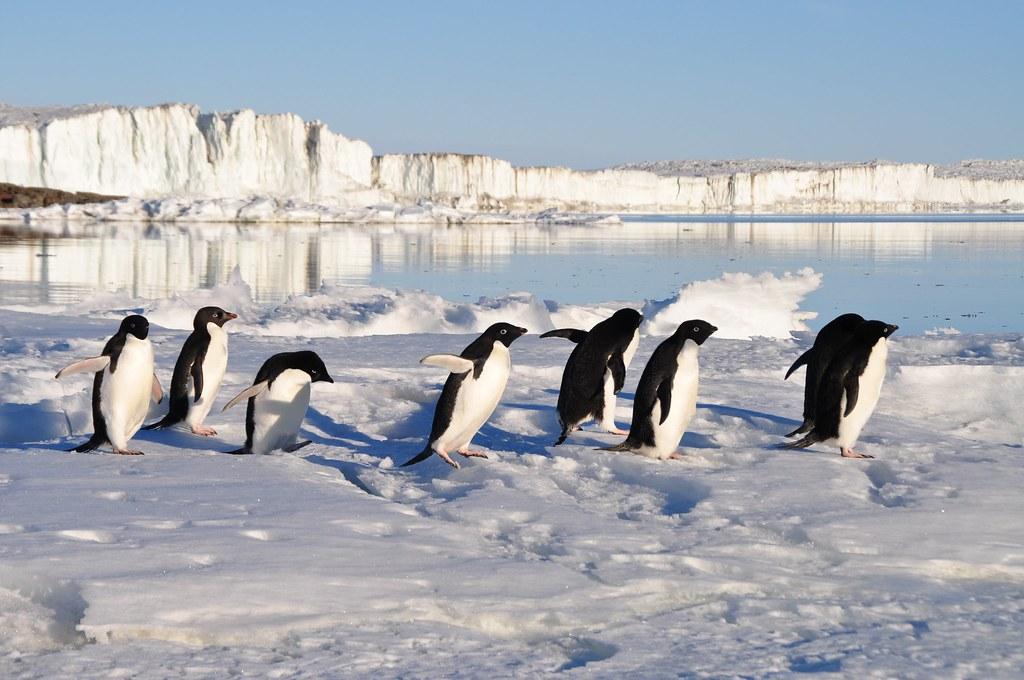
Penguin
World | Animalia (Animals) | ||||||||
|---|---|---|---|---|---|---|---|---|---|
Branch | Chordata (Chordates) | ||||||||
Class | Aves (Birds) | ||||||||
Team | Sphenisciformes (Penguins) | ||||||||
Family | Spheniscidae (Penguins) | ||||||||
Penguins are seabirds belonging to the family Spheniscidae, incapable of flight but possessing exceptional swimming abilities. Classified under the order Sphenisciformes, these birds are recognized by their upright body structure, webbed feet, and flipper-like wings. The contrasting black back and white belly feather patterns provide both camouflage and a distinctive appearance. Despite being flightless, they can move underwater as if they were flying. Penguins spend the majority of their lives at sea, and approximately 18 distinct species have been identified. These species inhabit a wide range across the Southern Hemisphere, from Antarctica to the Equator.
The origin of the word “penguin” is not definitively known, but two widely accepted theories exist. According to the first, the word derives from the Welsh words “pen” (head) and “gwyn” (white). The other theory suggests it originated from the Latin word “pinguis” (fat). The scientific term Pinguinus was used to describe the extinct great auk (Pinguinus impennis).
Although penguins vary by species, they share several key features:
Penguin sizes vary significantly by species. The smallest species, the Little Blue Penguin, weighs about 1.1 kg and measures 40 cm in length. The largest species, the Emperor Penguin, averages 115 cm in height and 40 kg in weight.
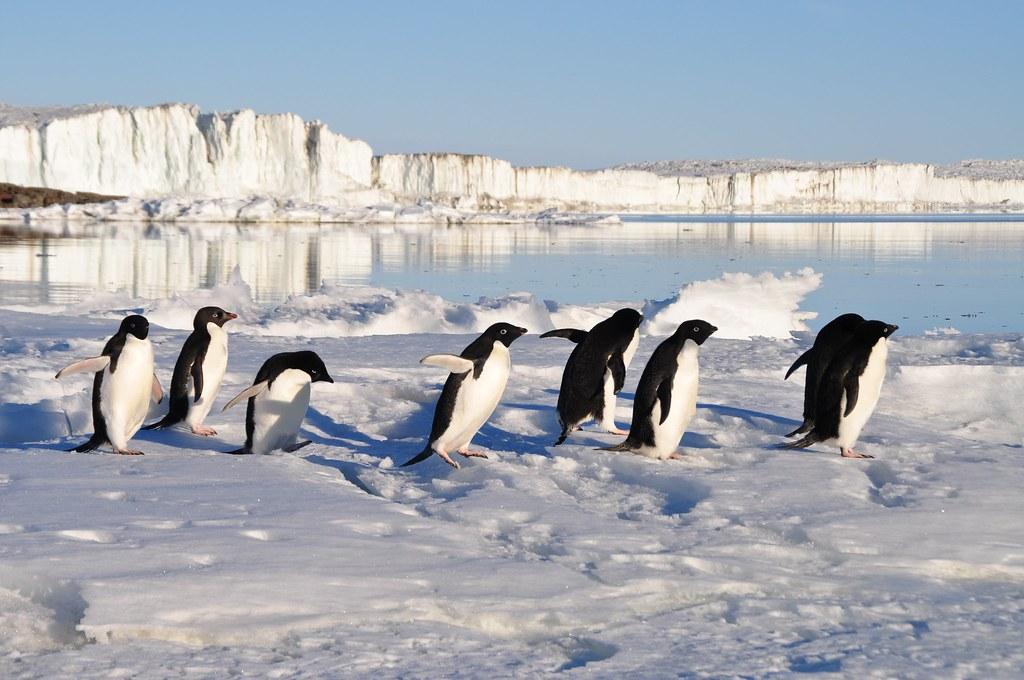
Penguins (Source: Pixabay)
Penguins live only in the Southern Hemisphere. Only two species—the Emperor and Adélie penguins—breed in the interior regions of Antarctica, while other species inhabit more temperate or tropical zones. The Antarctic Peninsula, southern coasts of South America, South Africa, New Zealand, Australia, and the Galápagos Islands are their natural habitats. Genetic studies indicate that the evolutionary history of penguins dates back approximately 22 million years.
Penguins have developed various physiological and behavioral adaptations to survive in extreme cold climates:
Emperor penguins can maintain their body temperature at 37°C even in conditions as cold as -50°C. Male penguins guard the egg on their feet for 64 days while the female goes to sea to feed. If the egg comes into contact with ice for even a short time, the chick inside may die.
Penguins are generally monogamous, and most species mate with the same partner each year. The female lays a single egg, which the male incubates using his body heat. When the female returns to feed, the parents take turns caring for the chick. In Emperor and King penguins, chicks gather in groups called “crèches.” This behavior helps chicks socialize and reduces heat loss.
Penguins feed on fish, krill, and squid. Species in Antarctica rely primarily on krill, while those in more northern regions prefer fish. The backward-pointing spiny structures in their mouths prevent slippery prey from escaping.
Penguins are exceptional swimmers. The Gentoo Penguin, the fastest underwater species, can reach speeds of up to 35 km per hour. Emperor Penguins can remain submerged for about 20 minutes and dive to depths of up to 564 meters. These abilities are made possible by their dense bone structure, oxygen-conserving circulatory systems, and slowed heart rates.
Penguins have excellent vision both on land and underwater. A third eyelid (nictitating membrane) protects their eyes during dives. Additionally, specialized structures that detect ultraviolet light allow them to see more easily on snow and ice.
Penguins oil their feathers to make them water-resistant. Air bubbles trapped between their feathers reduce underwater friction, enabling faster swimming. Some species use these air bubbles to leap out of the water’s surface.
The majority of penguin species are classified by the World Conservation Union (IUCN) as “Threatened” or “Declining Population.” The Emperor Penguin is listed as “Near Threatened.” The main causes of this status include:
Bayram, Latife Çakır. "Penguenler." In Kutup Ansiklopedisi, edited by TÜBİTAK Bilim ve Toplum Başkanlığı, 1-7. Ankara: TÜBİTAK Popüler Bilim Yayınları, 2020.
Davis, Lloyd S., and John T. Darby, ed. Penguin Biology. San Diego: Academic Press, 1990.
Okatan, Ağsenur. "İmparator Penguenler: Buzun Kralları." TÜBİTAK Bilim Genç, April 25, 2022.https://bilimgenc.tubitak.gov.tr/imparator-penguenlerAccessed July 10, 2024.
Pirge, Selcen. "Buzun İmparatorları: Penguenler | Soğuğa Nasıl Dayanıyorlar?" Atlas Dergisi, May 2015.
Sparks, John, and Tony Soper. Penguins. New York: Facts On File Publications, 1987.

Penguin
World | Animalia (Animals) | ||||||||
|---|---|---|---|---|---|---|---|---|---|
Branch | Chordata (Chordates) | ||||||||
Class | Aves (Birds) | ||||||||
Team | Sphenisciformes (Penguins) | ||||||||
Family | Spheniscidae (Penguins) | ||||||||
Etymology
Physical Characteristics
Distribution and Habitats
Cold Resistance and Physiological Adaptations
Reproduction and Chick Care
Diet
Swimming and Diving Abilities
Vision and Sensory Traits
Feather Maintenance and Hydrodynamics
Conservation Status and Threats