


This article was automatically translated from the original Turkish version.
Parkinson
Definition | A progressive neurological disorder caused by the loss of dopamine-producing neurons in the substantia nigra region of the brain. It affects movement control, muscle function, and balance. | ||||||||
|---|---|---|---|---|---|---|---|---|---|
Discovery | First described in 1817 by James Parkinson, it is named after him. | ||||||||
Frequency | Prevalent in 1-2% of the population over 60 years old, affecting approximately 10 million people worldwide. More common in men than in women. | ||||||||
Symptoms | Non-motor: Loss of smell - constipation - sleep disorders - depression - dementia (in advanced stages). Motor: Tremor at rest - slowness of movement (bradykinesia) - muscle stiffness (rigidity) - loss of balance. | ||||||||
Causes | Caused by dopaminergic neuron loss; genetic susceptibility and environmental factors (pesticides - head trauma) play a role. Coffee consumption may reduce risk. | ||||||||
Diagnosis | Diagnosed through clinical examination and medical history. Dat-Scan facilitates early diagnosis. | ||||||||
Parkinson’s disease is a progressive neurological disorder caused by the degeneration (loss of function and cell death) of dopaminergic neurons in the substantia nigra region of the brain. This disease is characterized by a reduction in the production of dopamine, a neurotransmitter critical for coordinating movement. It was first described in 1817 by British physician James Parkinson and named after him at his request. Parkinson’s disease is the second most common neurodegenerative disorder after Alzheimer’s disease and typically affects individuals aged 60 and older; however, it can rarely occur in younger individuals under 40. It is approximately twice as common in men as in women. In Türkiye, it affects 3 per 1,000 individuals over the age of 15 and 2% of those over 65. Globally, it affects approximately 10 million people.
Parkinson’s disease is a subtle and slowly progressing movement disorder that begins with the loss of nerve cells in the brain that produce dopamine. Dopamine is a chemical that enables the brain to regulate and fine-tune movements. Symptoms emerge when 60–80% of the dopaminergic neurons in the substantia nigra region are damaged or lost. The disease typically begins in middle to late life and progresses over a period of 15–25 years. Cases occurring at a young age (5–10%) are often associated with genetic factors. Symptoms usually start on one side of the body and spread to the other side over the years. Parkinson’s disease is not limited to motor symptoms; it also affects quality of life through non-motor symptoms.
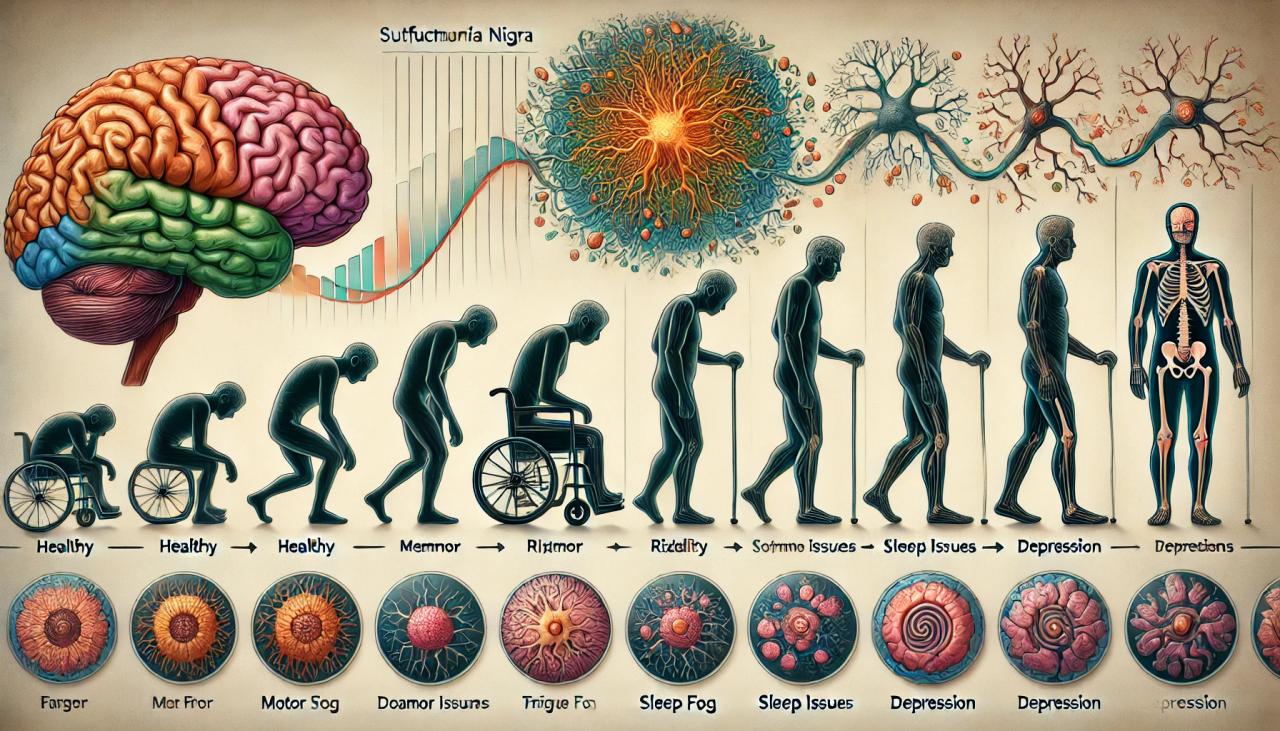
An image related to Parkinson’s disease (Designed by artificial intelligence)
The exact cause of Parkinson’s disease is unknown, but it is believed that the degeneration of dopamine-producing cells is triggered by a combination of genetic and environmental factors. Genetic predisposition plays a significant role, especially in early-onset cases; individuals with a family history of Parkinson’s have a higher risk than the general population. Environmental factors include exposure to chemicals such as pesticides, agricultural chemicals, and manganese, living in rural areas, use of well water, and head trauma (for example, from boxing). Interestingly, studies suggest that smoking and coffee consumption may reduce the risk of Parkinson’s; coffee intake is particularly proposed as a protective factor. Age is one of the most important risk factors; the prevalence of the disease increases significantly after age 60. Additionally, male gender and coexisting conditions such as diabetes may also increase risk.
The symptoms of Parkinson’s disease are divided into two main categories: motor and non-motor, and they vary throughout the course of the disease.
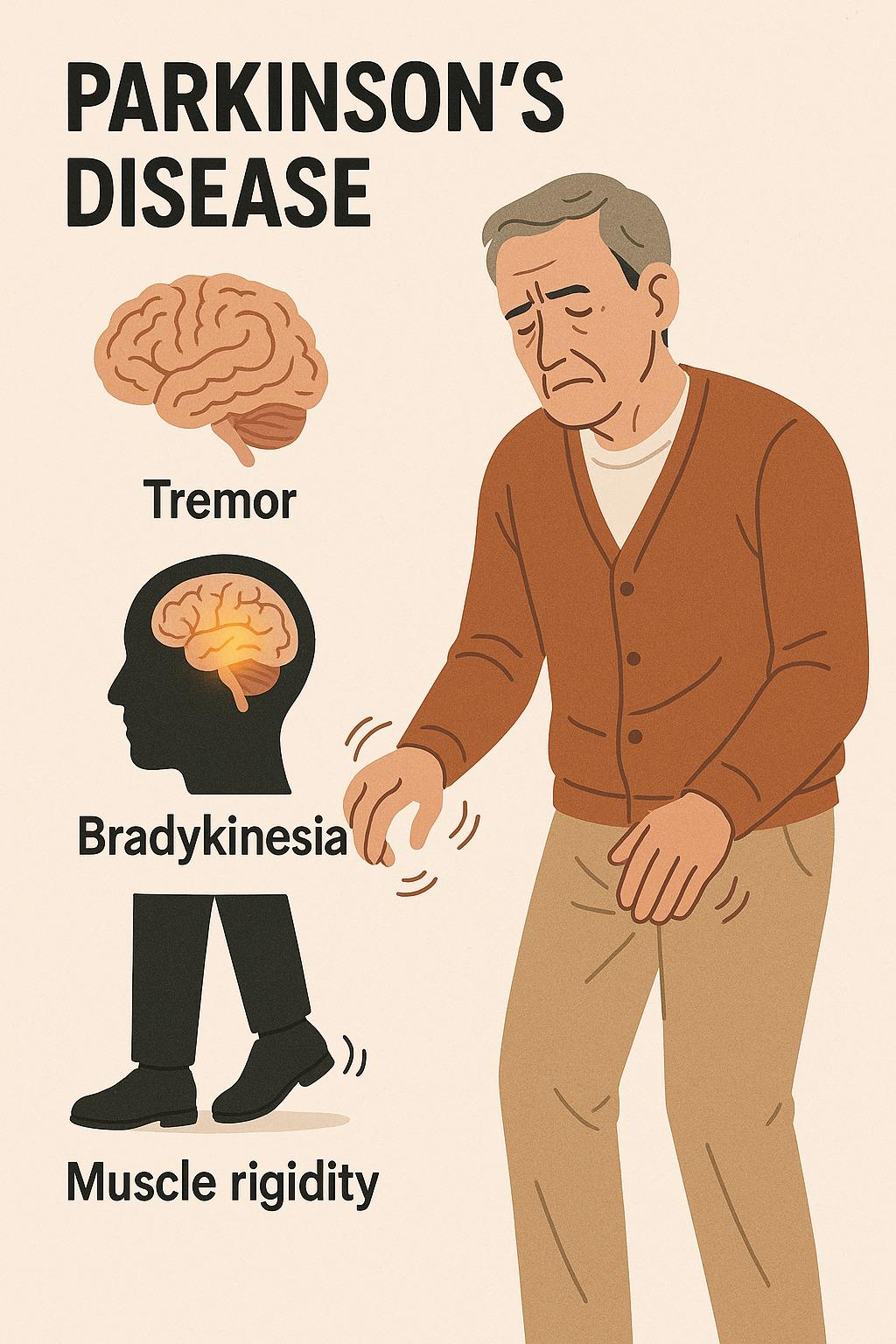
An image related to Parkinson’s disease (Designed by artificial intelligence)
Beyond motor symptoms, numerous other symptoms significantly affect quality of life. These include loss of smell (an early sign), constipation, sleep disturbances (REM sleep behavior disorder, excessive daytime sleepiness), depression, anxiety, orthostatic hypotension (drop in blood pressure upon standing), urinary incontinence, sexual dysfunction, increased sweating, swallowing difficulties, and in advanced stages, dementia. In early stages, nonspecific complaints such as fatigue, body aches, and difficulty with fine motor tasks are also frequently reported.
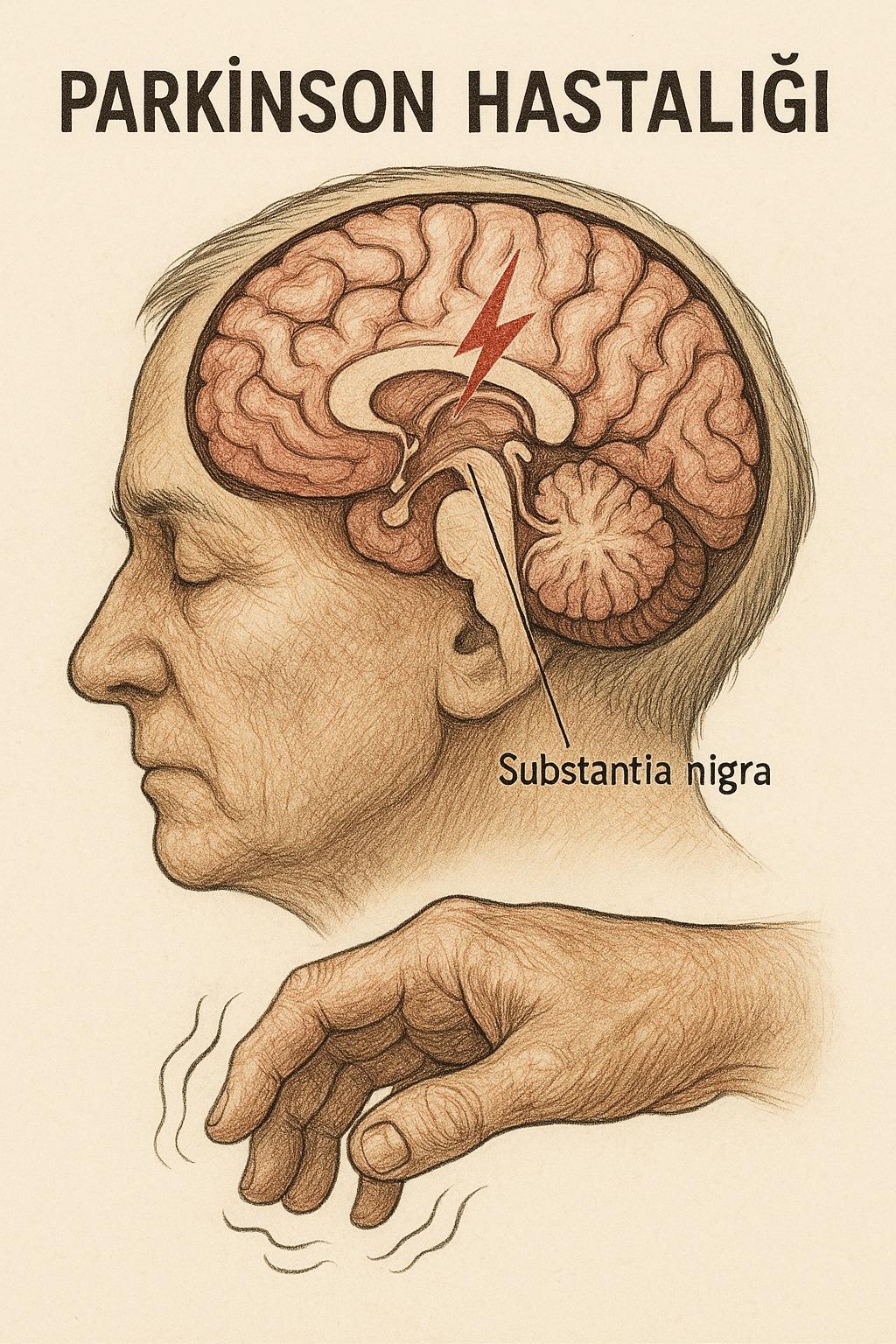
An image related to Parkinson’s disease (Designed by artificial intelligence)
Parkinson’s disease progresses through five stages, with symptom severity increasing and the patient’s level of independence decreasing in each stage:
The diagnosis of Parkinson’s disease is based on the patient’s clinical history and neurological examination; bradykinesia is an essential diagnostic criterion. Brain imaging techniques (MRI, CT) and blood tests are used for differential diagnosis to rule out other causes of parkinsonism such as cerebrovascular disease, tumors, or drug side effects. DaTscan is an imaging technique that uses a radioactive agent to label dopamine cells, facilitating early diagnosis. In Türkiye, it has been available since 2018 in limited centers and is effective in distinguishing Parkinson’s from age-related or depression-related slowing and in predicting disease progression. More advanced methods such as Positron Emission Tomography (PET) and DaT-SPECT are not yet widely used in routine clinical practice.
Although there is no cure for Parkinson’s disease, various methods are used to control symptoms and improve quality of life.
The foundation of treatment consists of drugs that increase dopamine levels. Dopamine precursors and dopamine agonists support dopaminergic transmission in the brain. Medications must be taken lifelong and regularly; abrupt discontinuation can lead to life-threatening risks. Treatment is individualized; a drug effective in one patient may be insufficient in another. Most patients respond well to medication in the first five years, but long-term use may lead to complications such as motor fluctuations (on-off periods), involuntary movements (dyskinesia), and medication resistance.
When medication response declines or side effects become prominent, surgical options are considered. Deep Brain Stimulation (brain pacemaker) regulates movement centers by delivering electrical impulses to the brain. It operates via a generator implanted in the chest wall and functions on a principle similar to a cardiac pacemaker. It is applied in patients under 65 years of age without dementia who initially responded well to medication. The device has a lifespan of 5–6 years and is replaceable. Surgery does not halt disease progression but reduces required medication dosage.
In advanced stages, oral medications are replaced by subcutaneous injections or continuous infusion via a fine tube in the intestine (using a gel-form medication pump). These methods aim to reduce motor fluctuations and dyskinesia.
Physical therapy, exercise, and additional treatments for symptoms such as depression and sleep disorders support the patient’s quality of life. Although foods rich in dopamine such as broad beans are recommended, excessive consumption may trigger involuntary movements.
Parkinson’s disease is an increasingly prevalent health issue as the population ages. In Türkiye, it is estimated that 150,000 to 400,000 individuals have the disease, with approximately 10,000 new diagnoses each year. April 11 is observed as World Parkinson’s Day to raise awareness and promote understanding of the disease. Current research is ongoing into vaccines and genetic therapies. Among neurodegenerative diseases, Parkinson’s responds best to medication and surgery. Early diagnosis is critical for slowing disease progression and extending the duration of high-quality life.
Warning: The content in this article is provided solely for general encyclopedic information purposes. The information here should not be used for diagnosis, treatment, or medical advice. Before making any decisions regarding health, you must consult a physician or qualified healthcare professional. The author and KÜRE Encyclopedia assume no responsibility for any consequences arising from the use of this information for diagnosis or treatment purposes.
Ankara Başkent Hastaneleri. "Parkinson." Accessed April 8, 2025.https://ankara.baskenthastaneleri.com/tr/saglik-rehberi/parkinson.
General Directorate of Public Health. "Dünya Parkinson Günü," Accessed April 8, 2025.https://hsgm.saglik.gov.tr/tr/haberler/dunya-parkinson-gunu.html.
Liv Hospital. "Parkinson." Accessed April 8, 2025.https://www.livhospital.com/parkinson.
Medicana. "Parkinson Hastalığı Nedir?" Accessed April 8, 2025.https://www.medicana.com.tr/saglik-rehberi-detay/9053/parkinson-hastaligi-nedir.
Memorial Hastanesi. "Parkinson Hastalığı Nedir? Belirtileri Nelerdir?" Accessed April 8, 2025.https://www.memorial.com.tr/hastaliklar/parkinson-hastaligi-nedir-belirtileri-nelerdir.
Turk Nöroloji Derneği. "11 Nisan Dünya Parkinson Günü Basın Açıklaması." Accessed April 8, 2025.https://noroloji.org.tr/haber/1522/11-nisan-dunya-parkinson-gunu-basin-aciklamasi#:~:text=Parkinson%20hastal%C4%B1%C4%9F%C4%B1%20hakk%C4%B1nda%20toplumda%20fark%C4%B1ndal%C4%B1k,D%C3%BCnya%20Parkinson%20G%C3%BCn%C3%BC%20olarak%20kutlanmaktad%C4%B1r.
Türkiye Parkinson Disease Association. "Dünya Parkinson Günü." Accessed April 8, 2025.https://www.turkiyeparkinsonhastaligidernegi.com/dunya-parkinson-gunu/.

Parkinson
Definition | A progressive neurological disorder caused by the loss of dopamine-producing neurons in the substantia nigra region of the brain. It affects movement control, muscle function, and balance. | ||||||||
|---|---|---|---|---|---|---|---|---|---|
Discovery | First described in 1817 by James Parkinson, it is named after him. | ||||||||
Frequency | Prevalent in 1-2% of the population over 60 years old, affecting approximately 10 million people worldwide. More common in men than in women. | ||||||||
Symptoms | Non-motor: Loss of smell - constipation - sleep disorders - depression - dementia (in advanced stages). Motor: Tremor at rest - slowness of movement (bradykinesia) - muscle stiffness (rigidity) - loss of balance. | ||||||||
Causes | Caused by dopaminergic neuron loss; genetic susceptibility and environmental factors (pesticides - head trauma) play a role. Coffee consumption may reduce risk. | ||||||||
Diagnosis | Diagnosed through clinical examination and medical history. Dat-Scan facilitates early diagnosis. | ||||||||
Key Features
Causes and Risk Factors
Symptoms
Motor Symptoms
Non-Motor Symptoms
Stages of the Disease
Diagnostic Methods
Treatment Methods
Medication
Surgical Treatment
Infusion Therapies
Supportive Therapies
Frequently Asked Questions and Misconceptions
Social and Scientific Dimensions