


This article was automatically translated from the original Turkish version.
Parametric and digital architecture is a contemporary architectural approach that uses computer-aided design tools to manage form generation, design decisions and spatial organization through data-driven systems. This approach has evolved particularly in the 21st century with the integration of digital technologies into design practice, replacing traditional drawing and modeling methods with algorithmic thinking and dynamic systems based on digital inputs.
In parametric design, every element guiding the design is defined as a “parameter,” and the relationships between these parameters are structured through computational systems that determine the form of the design. As a result, the design process advances not only through aesthetic concerns but also via a data-based, modifiable and optimizable structure.
Digital architecture is evaluated within a broader framework that extends beyond parametric tools to include modeling, simulation, database management, visualization and digital fabrication techniques. In this context, digital design is not merely about generating form on a computer screen; it is defined as a multilayered creative process in which memory, data and the design process are processed simultaneously, with the designer’s mental memory transferred to a digital memory.
Through parametric systems, designers can receive rapid feedback and make dynamic adjustments to form, thereby achieving efficiency in terms of time, labor and productivity. These approaches have also gained importance in architectural education; studio systems and workshop practices that combine parametric thinking with digital tools have become widespread. The relationship between students and information technologies plays a decisive role in enabling more effective participation in design processes and developing creative problem-solving skills.
The concept of “parameter” lies at the heart of parametric design. It refers to measurable and adjustable quantitative values that determine various aspects of a design. In architecture, these parameters include physical data such as height, width, light intensity, number of users and energy consumption, as well as aesthetic, functional and contextual variables. Relationships established between these variables are defined through algorithms that guide the design process.
Algorithmic thinking views design not merely as a final product but as a process, with form emerging as the outcome of this process. For example, software such as Rhino and Grasshopper enables parametric modeling while allowing designers to maintain control over each parameter. As a result, the generated form becomes dynamically updatable.
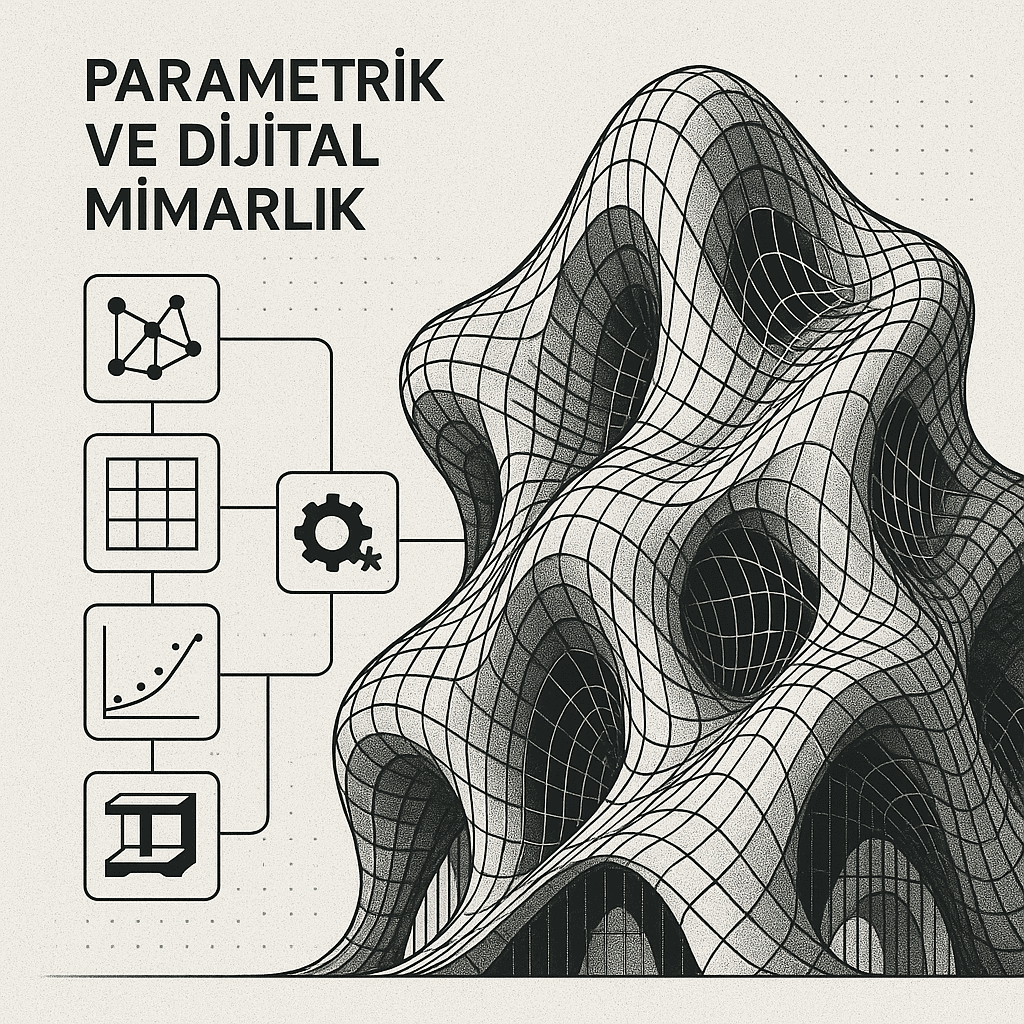
Parametrik Tasarım ve Mimarlık (Yapay Zeka İle Oluşturulmuştur.)
Digital architecture is not merely an instrumental technology; it also represents a cognitive process shaped by the transfer of mental memory into digital memory. Designers translate visual knowledge acquired from past experiences into the digital environment to create models. Data stored in memory — forms, patterns, spatial configurations — can be restructured and transformed within the computer environment through variable parameters. In this context, digital tools serve not only as drawing instruments but also as generators of modes of thought. The interaction between design memory and digital memory develops through continuous processing, updating and testing of alternative forms.
Within architectural and interior architecture education, parametric design is increasingly gaining importance. The inclusion of digital modeling and parametric production processes in curricula helps students develop computational thinking skills and enables them to generate diverse solution scenarios. However, in Türkiye, parametric design is only marginally represented, particularly in interior architecture curricula. To address this gap, some universities support digital fabrication practices through parametric design workshops, digital production studios and elective courses.
Workshops aimed at developing students’ competencies in understanding algorithmic systems, generating form through parameters and producing in digital environments have become important informal tools that complement formal education. In these practices, students are not only taught how to use digital tools but also how to integrate digital systems into their thought processes.
Akansel, Sennur, and Onur Şuta. “Mimari Tasarım Eğitiminde Enformel Eğitimin Katkısının Sorgulanması: Trakya Üniversitesi Mimarlık Fakültesi Parametrik Tasarım Atölyesi.” *E-SCALA*, Volume 1, Issue 2 (2022): 59–72. Accessed May 31, 2025.https://dergipark.org.tr/en/download/article-file/2758159
Suyabatmaz, Ebra, and İldem Aytar Sever. “İç Mekanlarda Biyomorfik Yaklaşımlarla Parametrik Tasarım.” *Yapı Bilgi Modellemesi*, Volume 5, Issue 1 (2023): 26–34. Accessed May 31, 2025.https://dergipark.org.tr/en/download/article-file/2495108
Uzun, Türkan. “Mimarlık Eğitiminde Kullanılan Dijital Tasarım Programlarının Bellek ve Tasarım Sürecine Katkıları.” Akademik Bilişim’11 - XIII. Akademik Bilişim Konferansı Bildirileri, İnönü Üniversitesi, Malatya, 2011. Accessed May 31, 2025.https://ab.org.tr/ab11/kitap/uzun_AB11.pdf
Şekerci, Ceyhun, and Yıldız, Pelin. “Parametrik Tasarım Süreci: İç Mimarlık Eğitim ve Pratiğinde Kullanımı.” *Online Journal of Art and Design* 8, no. 4 (2020): 298–302. Accessed May 31, 2025.Accessed adresi

No Discussion Added Yet
Start discussion for "Parametric and Digital Architecture" article
Parameter and Algorithmic Thinking
Digital Memory and the Design Process
Parametric Design Applications in Education