


This article was automatically translated from the original Turkish version.
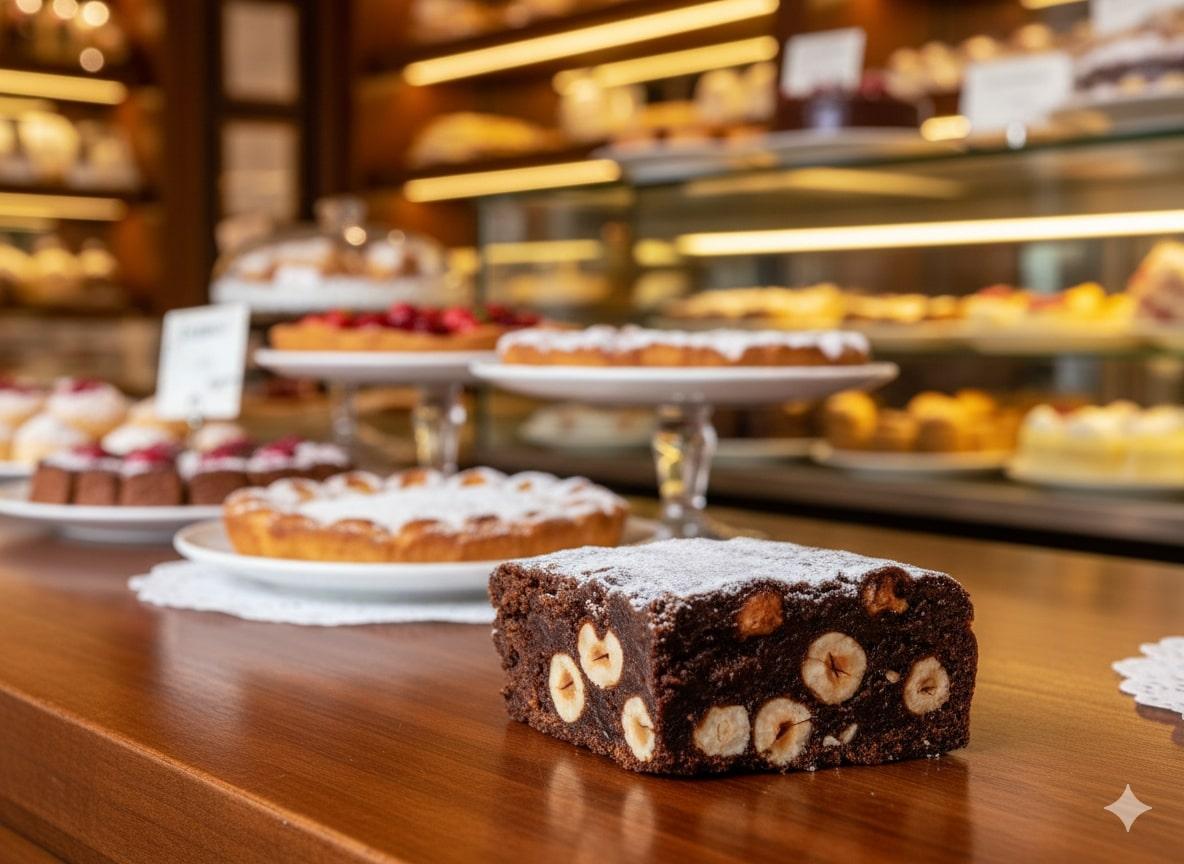
Panforte Di Siena (Generated by Artificial Intelligence.)
Name(s) | Panforte di Siena | ||||||||
|---|---|---|---|---|---|---|---|---|---|
Classification(s) | Protected Geographical Indication (PGI) | ||||||||
Basic Components | One, candied and dried fruits, sugar, honey, spices | ||||||||
Production Area | Siena | ||||||||
Panforte di Siena is an Italian dessert with origins tracing back to the Middle Ages. It is recognized as a traditional Siena dessert with Protected Geographical Indication (IGP) status.
Panforte is a symbol of Siena’s culinary culture, with its history rooted in the Middle Ages. The earliest known examples of Panforte are believed to have been breads rich in pepper and honey, which servants were required to bring to nuns as early as 1205, according to a chronicle. The use of spices in the dough conferred high symbolic value upon the sweet during that period.
The product’s reputation grew significantly by the end of the 15th century and reached European courts via trade routes such as the Via Francigena. The name “Panforte” began to be documented in the early 19th century; one record even notes that the Italian poet Ugo Foscolo received “panforti” as gifts from Siena in 1813. During this century, production expanded on a large scale and distribution beyond Siena accelerated.
The first Panforte factory was established in 1810 by Natale Pepi. The dessert was included among Siena’s sweets in the famous cookbook of Pellegrino Artusi at the end of the 19th century. The white version (“Panforte Margherita” or “panforte bianco”) was first made in 1879 in honor of Queen Margherita’s visit to Siena, using less spice and a coating of powdered sugar.
Although traditionally consumed during the Christmas season, Panforte is now produced throughout the year.
About Panforte di Siena (Piatto)
Panforte di Siena has a sweet flavor, combining the taste of candied fruits and almonds with a distinct spice aroma; the spice note is subtle in the white version and intense in the black version. The product has a dense, chewy texture with moderate resistance to cutting. Its surface is uneven and irregular. The white version is white due to the powdered sugar coating, while the black version is dark brown due to the spice topping.
To achieve the unique characteristics of Panforte di Siena, specific production conditions must be strictly followed.
Common required ingredients for both versions include type “0” wheat flour, whole and unpeeled sweet almonds and other dried nuts, various sugars (sucrose, glucose syrup, invert sugar), and starch wafers used as the base.
In both versions, no other additives, colorants, or preservatives are permitted beyond the defined required and optional ingredients.
Production begins by dissolving and cooking the sugars in water, then mixing them with cubed candied fruits. This homogeneous mixture is transferred to a mixer, where dried nuts, flour, and spices are added and blended until fully incorporated. The dough is portioned and weighed, placed on starch wafers, and wrapped with a paper band. The product is then flattened and lightly dusted with flour before being baked.
Baking is carried out in an oven preheated to 200–230°C. After baking and cooling, the product is coated: the white version with powdered sugar and the black version with the spice mixture.
Ministero dell’agricoltura, della sovranità alimentare e delle foreste. "Panforte di Siena." *MASAF*. Accessed October 21, 2025. https://www.masaf.gov.it/flex/cm/pages/ServeBLOB.php/L/IT/IDPagina/1976
Piatto. "Panforte Margherita - Dolci tradizionali natalizi di Siena (Italia): Panpepato bianco." YouTube. Accessed October 21, 2025. https://www.youtube.com/watch?v=j-nUjVEh9vg

Panforte Di Siena (Generated by Artificial Intelligence.)
Name(s) | Panforte di Siena | ||||||||
|---|---|---|---|---|---|---|---|---|---|
Classification(s) | Protected Geographical Indication (PGI) | ||||||||
Basic Components | One, candied and dried fruits, sugar, honey, spices | ||||||||
Production Area | Siena | ||||||||
History and Origins
Product Characteristics
Production Method and Ingredients
Required Ingredients
Processing