


This article was automatically translated from the original Turkish version.
+1 More
Panda Diplomacy is a foreign policy approach based on China’s practice of gifting or leasing giant pandas to other countries. While aiming to strengthen bilateral relations, this practice also serves to increase scientific research and funding for the conservation of the panda species. Countries receiving pandas typically enter into long-term cooperative care agreements that include provisions on housing conditions, health monitoring, breeding protocols, and the return of cubs to China.
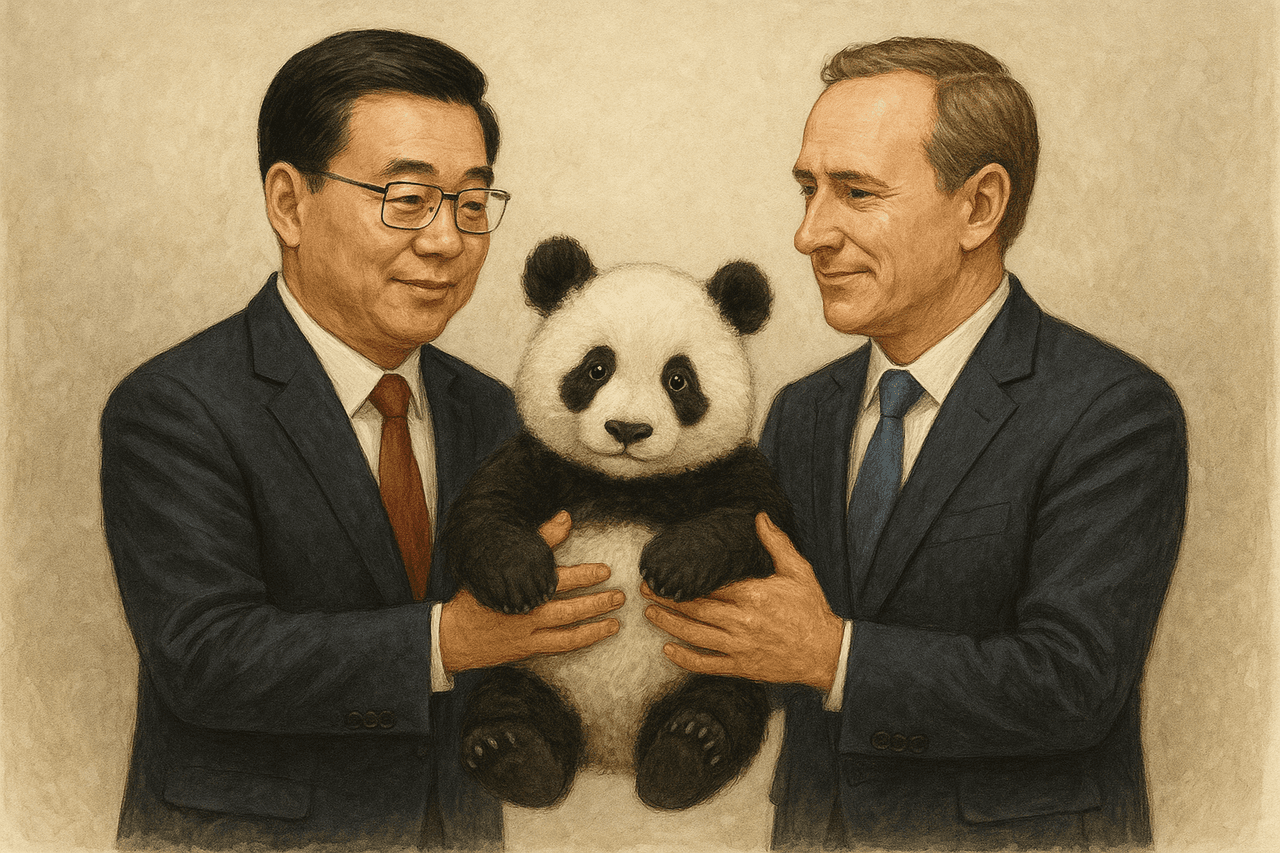
Panda Diplomacy (Generated by Artificial Intelligence)
As of 2024, it is estimated that approximately 1,900 giant pandas live in the wild, while 728 reside in zoos and breeding centers. 【1】 These figures demonstrate that panda diplomacy is not merely symbolic or diplomatic but also operates within a framework linked to conservation and breeding programs.
The use of animals as diplomatic gifts has been documented across various periods and regions. Historical records show that horses, cattle, camels, and exotic animals were employed to negotiate or display power in diplomatic relations. During ancient and medieval times, the shipment of animals to imperial centers was part of tribute and gift systems; in modern times, some heads of state have also presented animals as gifts.
Sources provide concrete examples of this practice: Nubia sent giraffes to Egypt as recorded in the Amarna letters, the Assyrians received horses and cattle as tribute, and Alexander the Great gifted elephants to allied states. It is also known that the Abbasid Caliph Harun al-Rashid sent an elephant to Charlemagne in 800 CE. In modern times, cases such as Australia receiving an echidna and Libyan leader Gaddafi gifting a camel to Slovenia illustrate the continued role of animals in diplomatic gift-giving. 【2】
During the reign of Yavuz Sultan Selim, Ottoman envoys presented lions and rhinoceroses brought from Africa to the Ming Dynasty, an example of animal diplomacy from China’s perspective as a recipient. These gifts sparked debate among Chinese officials due to their high maintenance costs and feeding challenges, highlighting that historical animal diplomacy was not merely a gesture of goodwill but also an economic and logistical burden. 【3】 Panda diplomacy occupies a place within this long historical trajectory as a specific, institutionalized example centered on a particular species.
Early examples of panda diplomacy are traced back to the Tang Dynasty (618–907). During this period, pandas were sent from the Chinese court to Japan as symbolic gifts intended to foster relations between the two countries. 【4】 These records indicate the historical roots of using pandas as symbols of friendship and goodwill in China’s foreign relations. However, a systematic and sustained panda diplomacy program only became prominent after the founding of the People’s Republic of China.
Modern panda diplomacy emerged concretely after the founding of the People’s Republic of China in 1949. In the 1950s, China primarily gifted giant pandas to countries it considered ideologically and politically close. The panda Ping Ping, sent to the Soviet Union in 1957, is cited as one of the earliest examples of this period. Subsequent years saw additional pandas sent to the Soviet Union and North Korea.
In 1972, during the normalization of relations between the United States and China, two pandas were gifted to the National Zoo in Washington following U.S. President Nixon’s visit to China. These pandas, named Hsing-Hsing and Ling-Ling, remained at the zoo for many years, with their lives and health closely followed by the public. During the same period, pandas were also gifted to Japan and several European countries, demonstrating their role as symbols of friendship and goodwill in foreign policy. At this time, pandas were transferred outright as permanent gifts to the recipient countries.

Diplomatic Panda (Anadolu Ajansı)
From the 1950s until the early 1980s, pandas were sent as unconditional gifts during official visits or at pivotal moments in bilateral relations. During this period, ownership of the pandas was transferred permanently to the host country. Between 1957 and 1982, approximately 23 pandas were gifted to nine countries, and none were returned to China. 【5】 Difficulties in adapting pandas to new environments, health issues, and concerns over lifespan led to growing criticism of this model as awareness increased regarding species conservation.
Between 1972 and 1982, China gifted a total of 16 pandas to seven countries: the United States, the United Kingdom, West Germany, France, Japan, Spain, and Mexico. Japan received four pandas, while the other countries each received one pair.【6】
In the 1980s, due to the endangered status of pandas and rising international concern for animal welfare, China shifted from gifting to short-term leasing. During this phase, pandas were sent to foreign zoos for temporary exhibitions lasting several months, with host institutions paying specified fees for the program. These displays attracted intense public interest and featured prominently in short-term events and promotions. However, the frequent travel of pandas, expectations of rapid adaptation to diverse climates and environments, and demanding schedules raised concerns about animal welfare and species conservation, forming the basis for calls to develop a more sustainable, science-based model.
In 1984, pandas were added to the list of protected animals, prompting legal adjustments to leasing practices. Some regulations stipulated that host institutions pay monthly fees of approximately $50,000 per panda, with a portion of this revenue designated for panda conservation programs. 【7】
From the 1990s onward, panda diplomacy began to be conducted under long-term, research-oriented cooperative care agreements.
Under this model:
Cooperative care agreements detail specific conditions for housing, including climate control, security, nutrition, and health care. Joint scientific research, breeding programs, and educational initiatives are incorporated into the contracts. These agreements require that cubs born abroad be returned to China once they reach a certain age, typically between two and four years. This ensures centralized genetic management and population tracking, aligning with broader conservation strategies for the species.
The 2008 earthquake in China destroyed approximately 67 percent of panda habitats. Since then, pandas have been sent to 11 countries during the 2010s and to 18 different zoos after 2014. 【9】
The United States is one of the most frequently cited examples of modern panda diplomacy. The process began in 1972 with the gift of the first panda pair and continued through cooperative care agreements signed in the 2000s. The National Zoo in Washington has maintained a long-term panda program, with cubs born there being returned to China upon reaching the age stipulated in the agreements.
U.S. First Lady Pat Nixon’s Panda Visit (US National Archives)
When certain agreements expired, the pandas in Washington returned to China, leaving only those in Atlanta for a time. Later, new agreements were made for San Diego and Washington. The pandas Yun Chuan and Xin Bao, sent to San Diego, were recorded as the first new panda pair to arrive in the United States after nearly twenty years.【10】
Yun Chuan is noted to be descended from a panda previously born in San Diego and sent back to China, illustrating biological continuity across generations under panda diplomacy. The new panda pair planned for Washington is framed in the agreements as a continuation of prior research and breeding efforts.
In the Asia-Pacific region, countries such as Japan, Malaysia, Indonesia, and Australia are notable examples of panda diplomacy. Pandas sent to Japan were exhibited for long periods in major city zoos, significantly increasing visitor numbers. Pandas sent to Malaysia coincided with a turning point in bilateral relations; their shipment was delayed following a plane crash that strained ties between the two countries, but was later carried out. For the panda pair sent to Indonesia, a large area with cool, mountainous climate conditions was developed, complete with air-conditioned enclosures, specialized nutrition, and veterinary services. Millions of dollars were invested in the facility, and the agreement stipulates that the pandas will remain in the country for ten years. 【11】
In Southeast Asia, Thailand is among the first countries to join the panda diplomacy program. The arrival of pandas coincided with an increase in reciprocal military missions and rare high-level visits, linking this soft power tool with cooperation in security and defense domains. 【12】
In Europe, long-term leasing and cooperative care agreements have been established with countries such as the United Kingdom, Germany, France, Spain, Denmark, Belgium, Austria, and the Netherlands. As of a specific date, a total of approximately 48 “diplomatic pandas” were located in 14 countries outside China, distributed among the United States, Japan, Singapore, Malaysia, Spain, the United Kingdom, France, Germany, Belgium, Austria, Canada, Australia, the Netherlands, and Thailand. 【13】
In some European zoos, the arrival of pandas led to increased visitor numbers, accompanied by educational programs, exhibitions, and cultural events organized around them.
Panda diplomacy is defined as a practice falling within the frameworks of soft power and public diplomacy.
Within this framework:
Some studies compare the timing of panda leasing or cooperative care agreements with bilateral deals in energy, mining, agricultural products, and free trade. This simultaneity is evaluated alongside the Chinese concept of “guanxi,” which emphasizes trust, loyalty, and reciprocity in relationships. According to such assessments, most countries receiving pandas are economically and politically significant partners for China, and pandas are used as instruments within these relationships.【14】
Additionally, Beijing considers factors such as the potential for expanding bilateral trade, levels of sympathy toward Chinese culture, and the relative weakness of other public diplomacy tools when selecting countries to receive pandas. The goal is to convey messages of goodwill and long-term cooperation through panda gifts to states meeting these criteria. 【15】
The economic dimension of panda diplomacy is two-sided, benefiting both the sending and host countries. For the sending country:
For host countries and zoos:
Pandas brought to zoos quickly became major attractions, with clear increases in visitor numbers and public popularity. These figures demonstrate that pandas generate indirect economic impacts on tourism and local economies beyond direct leasing fees. For example, shortly after pandas arrived in Canada, major media reports highlighted large-scale agreements on oil sands trade between China and Canada. At Edinburgh Zoo, where pandas were sent in 2011, substantial annual leasing fees were paid, and during the same period, Scotland’s exports to China reached approximately $800 million by 2013. 【16】 There are concerns regarding transparency: it is unclear how precisely the funds paid by host institutions for research and conservation are allocated in China, and critics note that these revenues are not fully disclosed to the public. 【17】
In its current form, panda diplomacy integrates conservation, breeding, and scientific research as core components. Under cooperative care agreements:
Under breeding programs, data on mating seasons, gestation, birth, and cub care are recorded and used to inform the management of both captive and wild panda populations. Joint research projects between institutions study panda behavior, feeding habits, disease profiles, and sensitivity to climate change; findings from these studies are incorporated into international conservation strategies for the species.
In panda diplomacy, the return of pandas or the rejection of offers carries significant political weight. In some cases, the non-renewal of leasing contracts, the return of pandas to China, or the postponement or cancellation of planned shipments have mirrored the trajectory of political and diplomatic relations between the two countries. Such developments reveal that pandas are not merely symbols of friendship but can also serve as symbolic indicators of tension or cooling in bilateral relations. For instance, China reportedly considered recalling pandas from Vienna’s historic zoo following its displeasure over
Aljazeera. "What is Panda Diplomacy, and Why are the Bears Going Back to China?" Accessed December 8, 2025.https://www.aljazeera.com/news/2023/10/3/what-is-panda-diplomacy-and-why-are-the-bears-going-back-to.
Anadolu Ajansı. "Çin'den ABD'ye 20 Yılı Aşkın Süre Sonra İlk Kez Panda Kiralanıyor." Accessed December 8, 2025.https://www.aa.com.tr/tr/dunya/cinden-abdye-20-yili-askin-sure-sonra-ilk-kez-panda-kiralaniyor/3145695.
Anadolu Ajansı. "Çin'in 'İyi Niyet Elçileri' Pandalar, ABD'nin Başkentine Dönüyor." Accessed December 8, 2025.https://www.aa.com.tr/tr/yasam/cinin-iyi-niyet-elcileri-pandalar-abdnin-baskentine-donuyor/3234440.
Anadolu Ajansı. "Çin’in Diplomat Pandaları Endonezya’da." Accessed December 8, 2025.https://www.aa.com.tr/tr/dunya/cin-in-diplomat-pandalari-endonezya-da/921409.
BBC. "Çin'le Malezya Arasında 'Panda Diplomasisi'." Accessed December 8, 2025.https://www.bbc.com/turkce/haberler/2014/05/140521_panda.
Diplo. “Panda Diplomacy.” DiploFoundation. Accessed December 8, 2025.https://www.diplomacy.edu/topics/panda-diplomacy/.
Durul, Tevfik. "Çin'in Diplomat Pandaları." Anadolu Ajansı. Accessed December 8, 2025.https://www.aa.com.tr/tr/dunya/cinin-diplomat-pandalari/859483.
Reuters. "Explainer: What is China’s panda diplomacy and how does it work?" Accessed December 8, 2025.https://www.reuters.com/world/china/what-is-chinas-panda-diplomacy-how-does-it-work-2024-06-18/.
Taylor, Mia. "A Brief History of 'Panda Diplomacy' - with New Additions to Global Zoos." BBC. Accessed December 8, 2025.https://www.bbc.com/future/article/20240226-a-brief-history-of-panda-diplomacy---with-new-additions-to-global-zoos.
US National Archives. "First Lady Pat Nixon Welcomes Pandas to the National Zoo." US National Archives Youtube Kanalı. Accessed December 8, 2025.https://www.youtube.com/watch?v=EQN8FJ4uQwc
Yıldırım, Utkuhan. “Çin’in Panda Diplomasisi.” *Bölgesel Araştırmalar Dergisi* 5, no. 1 (Mayıs 2021): 48–86. Accessed December 8, 2025.https://dergipark.org.tr/tr/pub/bader/issue/62628/897361
[1]
Reuters. “Explainer: What is China’s panda diplomacy and how does it work?” Reuters. Erişim Tarihi 8 Aralık 2025. https://www.reuters.com/world/china/what-is-chinas-panda-diplomacy-how-does-it-work-2024-06-18/.
[2]
Utkuhan Yıldırım. “Çin’in Panda Diplomasisi”. Bölgesel Araştırmalar Dergisi 5, sy. 1 (Mayıs 2021): 54. Erişim Tarihi 8 Aralık 2025. https://dergipark.org.tr/tr/pub/bader/issue/62628/897361
[3]
Yıldırım. “Çin’in Panda Diplomasisi”, 55-56. Erişim Tarihi 8 Aralık 2025. https://dergipark.org.tr/tr/pub/bader/issue/62628/897361
[4]
Yıldırım. “Çin’in Panda Diplomasisi”, 51. Erişim Tarihi 8 Aralık 2025. https://dergipark.org.tr/tr/pub/bader/issue/62628/897361
[5]
Tevfik Durul. "Çin'in 'Diplomat Pandaları'." Anadolu Ajansı. Erişim Tarihi 8 Aralık 2025. https://www.aa.com.tr/tr/dunya/cinin-diplomat-pandalari/859483.
[6]
Yıldırım. “Çin’in Panda Diplomasisi", 59. Erişim Tarihi 8 Aralık 2025. https://dergipark.org.tr/tr/pub/bader/issue/62628/897361
[7]
Yıldırım. “Çin’in Panda Diplomasisi”, 63-64. Erişim Tarihi 8 Aralık 2025. https://dergipark.org.tr/tr/pub/bader/issue/62628/897361
[8]
Diplo. “Panda Diplomacy.” DiploFoundation. Erişim Tarihi 8 Aralık 2025. https://www.diplomacy.edu/topics/panda-diplomacy/.
[9]
Utkuhan Yıldırım. “Çin’in Panda Diplomasisi”. Bölgesel Araştırmalar Dergisi 5, sy. 1 (Mayıs 2021): 64. Erişim Tarihi 8 Aralık 2025. https://dergipark.org.tr/tr/pub/bader/issue/62628/897361
[10]
Mia Taylor. "A Brief History of 'Panda Diplomacy' - with New Additions to Global Zoos." BBC. Erişim Tarihi 8 Aralık 2025. https://www.bbc.com/future/article/20240226-a-brief-history-of-panda-diplomacy---with-new-additions-to-global-zoos.
[11]
Anadolu Ajansı. "Çin’in Diplomat Pandaları Endonezya’da." Anadolu Ajansı. Erişim Tarihi 8 Aralık 2025. https://www.aa.com.tr/tr/dunya/cin-in-diplomat-pandalari-endonezya-da/921409.
[12]
Yıldırım. “Çin’in Panda Diplomasisi”, 67. Erişim Tarihi 8 Aralık 2025. https://dergipark.org.tr/tr/pub/bader/issue/62628/897361
[13]
Tevfik Durul. "Çin'in 'Diplomat Pandaları'." Anadolu Ajansı. Erişim Tarihi 8 Aralık 2025. https://www.aa.com.tr/tr/dunya/cinin-diplomat-pandalari/859483.
[14]
Mia Taylor. "A Brief History of 'Panda Diplomacy' - with New Additions to Global Zoos." BBC. Erişim Tarihi 8 Aralık 2025. https://www.bbc.com/future/article/20240226-a-brief-history-of-panda-diplomacy---with-new-additions-to-global-zoos.
[15]
Yıldırım. “Çin’in Panda Diplomasisi”, 51-52. Erişim Tarihi 8 Aralık 2025. https://dergipark.org.tr/tr/pub/bader/issue/62628/897361
[16]
Yıldırım. “Çin’in Panda Diplomasisi”, 67. Erişim Tarihi 8 Aralık 2025. https://dergipark.org.tr/tr/pub/bader/issue/62628/897361
[17]
Yıldırım. “Çin’in Panda Diplomasisi”, 68. Erişim Tarihi 8 Aralık 2025. https://dergipark.org.tr/tr/pub/bader/issue/62628/897361

Historical Background
The Role of Animals in Diplomatic History
Tang Dynasty and Early Panda Examples
The People’s Republic of China Era
Implementation Models
Gifting
Short-Term Leasing
Cooperative Care and Long-Term Leasing
Geographic Distribution
United States
Asia-Pacific Examples
European Countries
Diplomatic Functions
Economic Dimension
Conservation and Breeding Programs
Political Context