


This article was automatically translated from the original Turkish version.
Anadolu Ajansı
Name | Orlan-10 | ||||||||
|---|---|---|---|---|---|---|---|---|---|
Category | Military Drones | ||||||||
Country of Origin | Türkiye | ||||||||
Manufacturer / Contractor | Special Technology Center (STC) | ||||||||
First Flight Date | 1 January 2011 | ||||||||
Introduction / Service Entry Year | 2011 | ||||||||
Production Quantity (Stated) | More than 1,000 Orlan-10s by 2018 | ||||||||
Wingspan | 3.1 m | ||||||||
Length | 2.0 m | ||||||||
Empty Weight | 9 kg | ||||||||
Cruising Speed | 115 km/h | ||||||||
Endurance | 16 hours | ||||||||
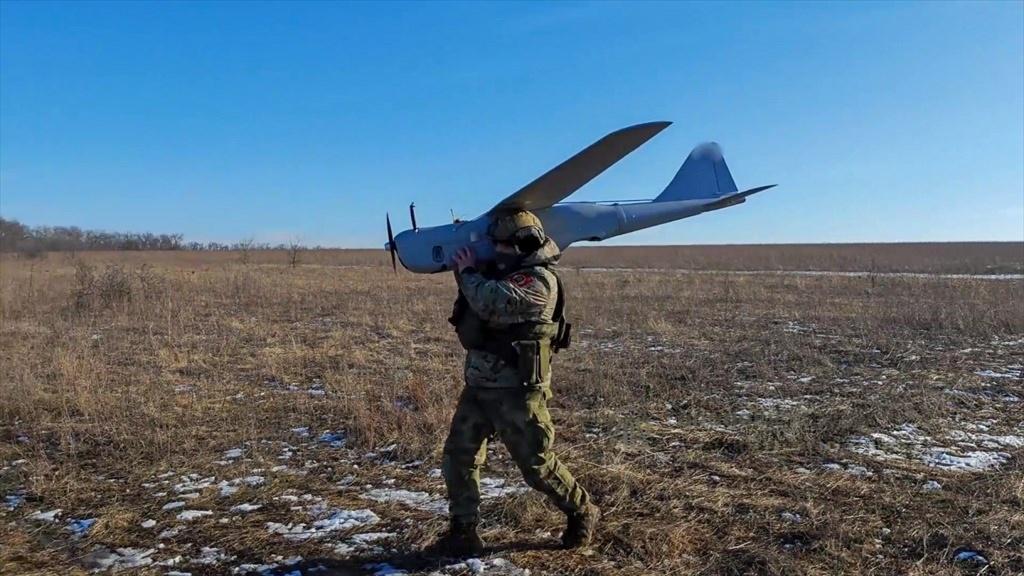
The Orlan-10 is a fixed-wing unmanned aerial vehicle (UAV) system developed by the Russian Federation, designed primarily for reconnaissance and surveillance missions. The system is capable of carrying a range of mission payloads including electro-optical sensors, electronic and signals intelligence equipment, laser imaging, and electronic warfare systems.【1】
Its manufacturer is the Special Technology Center (STC), based in Saint Petersburg. Developed for the Russian Armed Forces, the Orlan-10 was designed as a reconnaissance platform with its primary use associated with surveillance and reconnaissance functions.【2】
The first flight of the Orlan-10 took place on 1 January 2011. The system entered service in 2011. There are various records and claims linking the Orlan-10’s operational use to conflicts in Ukraine beginning in 2014. Its operational deployment became evident alongside the conflicts in Ukraine from 2014 onward. Within the Donbas region, the Orlan-10 was employed for field surveillance, target identification, and artillery fire direction. Open-source reports from this period document multiple instances of Ukrainian forces downing Orlan-10 drones.
By 2015, the Orlan-10 was actively used by the Russian Ground Forces in the Syrian civil war. In this theater, the platform performed reconnaissance, aerial imaging, terrain analysis, and three-dimensional mapping missions. By 2018, more than 1,000 units of the Orlan-10 platform had been produced. It is stated that by 2018, the Orlan-10 family included 11 different variants.【3】
In August 2022, additional orders were placed for the Orlan-10 and Orlan-30. The Orlan-30, a larger variant of the Orlan-10, was introduced in 2020. It was noted that after testing in 2019, the Orlan-30 was offered with a laser designator option. The export version of the Orlan-30 was first displayed in August 2023.
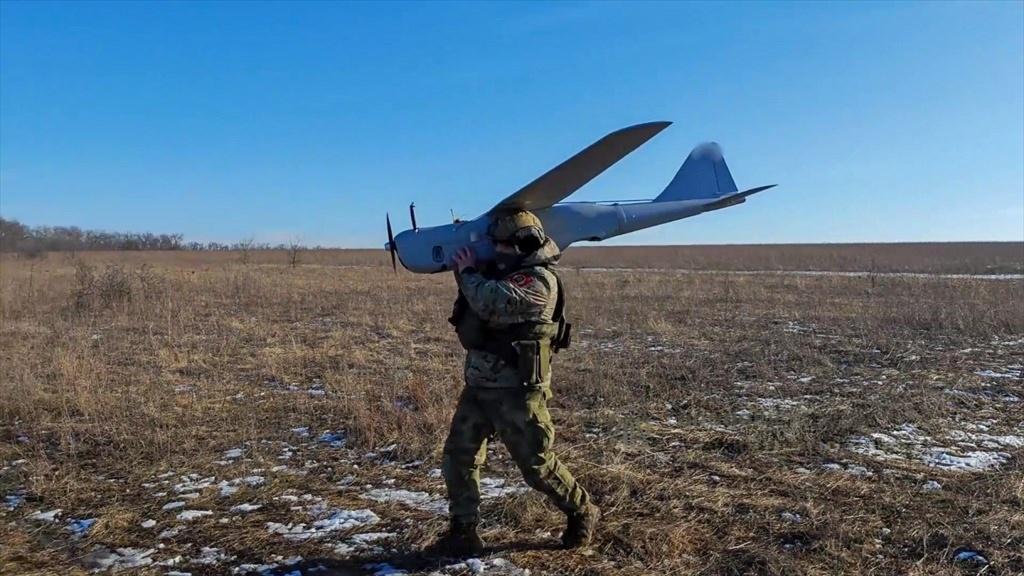
Orlan-10 UAV - Anadolu Ajansı
The key technical specifications of the Orlan-10 are as follows. 【4】
The Orlan-10 is a small, fixed-wing UAV with a conventional external design. The fuselage forms the main structural element running the length of the aircraft. The engine is mounted in the nose section and drives a two-bladed propeller to generate thrust. The wings are shoulder-mounted on the fuselage. The Orlan-10’s composite fuselage is designed to reduce radar signature.
Its maximum speed is approximately 150 km/h. The service ceiling is given as 16,400 ft (16,404 ft) and endurance is 16 hours. The platform’s mission payloads include a range of systems such as electro-optical sensors, electronic intelligence (ELINT), signals intelligence (SIGINT), laser imaging, and electronic warfare (EW) equipment. These technical characteristics are evaluated alongside a profile designed to minimize detection and avoid engagement.
The tail unit consists of a single vertical stabilizer and two horizontal stabilizers. This configuration reflects a typical fixed-wing UAV layout for flight stability and control surface functionality. The Orlan-10 is launched using a rail catapult system and recovered via parachute. This method eliminates the need for a more complex and heavier landing gear system. The system is transported in a rugged carrying case and assembled at the launch site prior to flight.
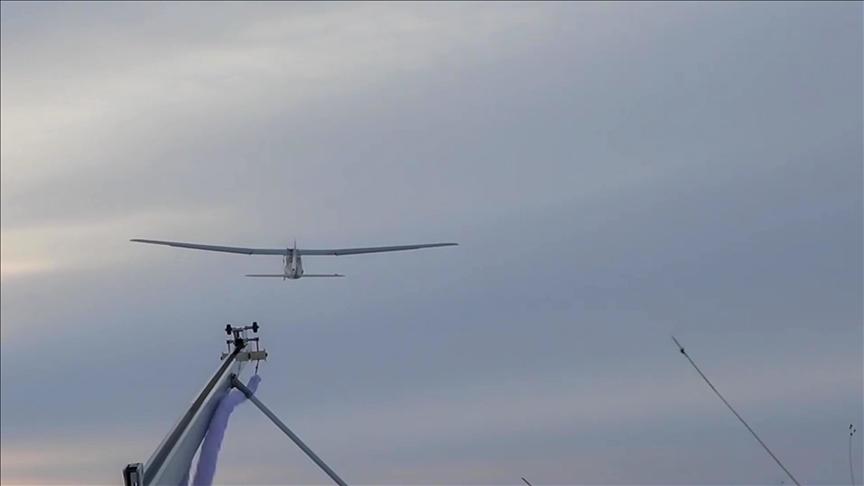
Orlan-10 After Launch (Anadolu Ajansı)
The Orlan-10 has a wingspan of 3.1 metres. Two different length values are cited: 2.0 metres and 1.8 metres. The empty weight is 9 kilograms. The maximum takeoff weight is 16 kg, with a usable payload capacity of 6 kg. The maximum payload weight is also specified as 5.5 kg.【5】
The Orlan-10 is powered by a single-cylinder, four-stroke, glow-fuel piston engine manufactured by Saito Manufacturing, model FA-62B. This engine produces an output of 0.71 kW (0.95 hp). Another propulsion option cited for the Orlan-10 is the A-95 series gasoline engine. The Orlan-10’s powerplant configuration consists of a nose-mounted power unit driving a propeller to generate thrust.
The Orlan-10 is a UAV operated via a ground control station (GCS). The mobile GCS used for the Orlan-10 has command and control capabilities to manage up to four UAVs simultaneously. The Orlan-10’s communication architecture is based on three separate radio signals, forming a system that transmits operator commands, video feeds, and navigation functions.
The Orlan-10 is a UAV equipped with electro-optical sensors among its mission payloads. It is a platform capable of carrying electronic intelligence (ELINT) and signals intelligence (SIGINT) payloads. The system can also perform missions using laser imaging and electronic warfare (EW) equipment.
The Orlan-10 operates using GLONASS. Its GPS infrastructure is described as a system with potential compatibility with Galileo and BeiDou.
For imaging, it is reported that the Orlan-10 uses a civilian Canon EOS 750D/EOS 800D digital SLR camera sourced from Western countries. The optical component paired with this camera is specified as the EF 85mm f/1.8 USM lens. For thermal imaging, the TM2005016-F19 Lynred PICO640gen2 infrared camera is used.【6】
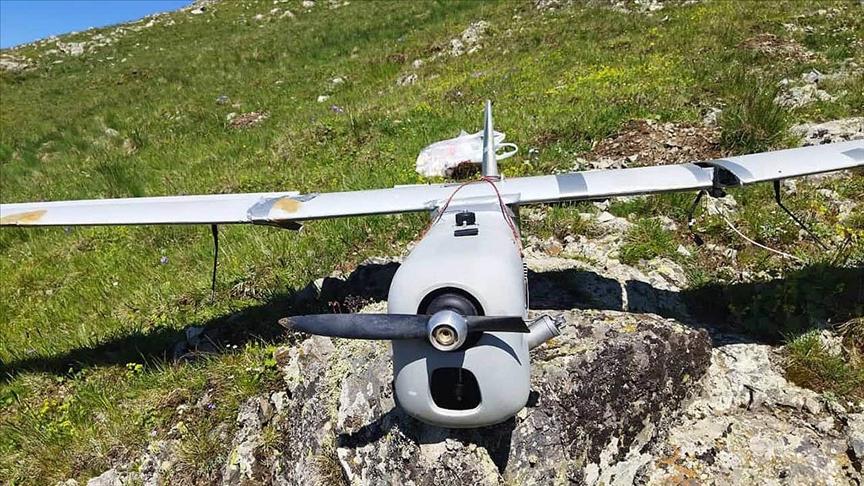
Orlan-10 Recovered in Gümüşhane, 2022 (Anadolu Ajansı)
The Orlan-10 is an unmanned aerial vehicle with Russia among its operators. The platform is also reported to be operated by Kazakhstan, Kyrgyzstan, and Myanmar. The Orlan-10 is listed as a system used by Myanmar and Russia for evaluation and operational purposes with their clients.
Airforce Technology. "Orlan-10 Unmanned Aerial Vehicle (UAV)." Accessed December 19, 2025.https://www.airforce-technology.com/projects/orlan-10-unmanned-aerial-vehicle-uav/
Byrne, James, Jack Watling, Justin Bronk, Gary Somerville, Joe Byrne, Jack Crawford, and Jane Baker. *The Orlan Complex: Tracking the Supply Chains of Russia’s Most Successful UAV*. London: Royal United Services Institute (RUSI), December 2022. Accessed December 20, 2025.https://static.rusi.org/SR-Orlan-complex-web-final.pdf
Defence Turk. “Rus yapımı Orlan-10 İHA İdlib’de düştü.” Accessed December 19, 2025.https://www.defenceturk.net/rus-yapimi-orlan-10-iha-idlibde-dustu
Dincel, Serdar. "Drone believed to be Russian found in northwestern Türkiye." Anadolu Ajansı, December 19, 2025. Accessed December 20, 2025.https://www.aa.com.tr/en/turkiye/drone-believed-to-be-russian-found-in-northwestern-turkiye/3775963
FlightGlobal. “Russia’s workhorse Orlan-10 UAV relies on western technologies.” Accessed December 19, 2025.https://www.flightglobal.com/military-uavs/russias-workhorse-orlan-10-uav-relies-on-western-technologies/151449.article
GlobalMilitary.net. "Orlan-10." Accessed December 19, 2025.https://www.globalmilitary.net/aircraft/orlan-10/
GlobalSecurity.org. "Orlan-10." Accessed December 19, 2025.https://www.globalsecurity.org/military/world/russia/orlan-10.htm
MilitaryFactory.com. "Orlan-10 UAV (aircraft_id=1877)." Accessed December 19, 2025.https://www.militaryfactory.com/aircraft/detail.php?aircraft_id=1877
ODIN (TRADOC). “Orlan-10 Russian Unmanned Aerial Vehicle (UAV).” Accessed December 19, 2025.https://odin.tradoc.army.mil/WEG/Asset/Orlan-10_Russian_Unmanned_Aerial_Vehicle_(UAV)
War & Sanctions (GUR). "UAV: Orlan-10 (ID 207)." Accessed December 19, 2025.https://war-sanctions.gur.gov.ua/en/uav/207
Yetim, Osman. "Gümüşhane'de arazide Rus yapımı İHA bulundu." Anadolu Ajansı. June 23, 2022. Accessed December 20, 2025.https://www.aa.com.tr/tr/gundem/gumushanede-arazide-rus-yapimi-iha-bulundu/2620305
[1]
FlightGlobal. “Russia’s workhorse Orlan-10 UAV relies on western technologies.” Erişim Tarihi: 19 Aralık 2025. https://www.flightglobal.com/military-uavs/russias-workhorse-orlan-10-uav-relies-on-western-technologies/151449.article
[2]
GlobalMilitary.net. “Orlan-10.” Erişim Tarihi: 19 Aralık 2025. https://www.globalmilitary.net/aircraft/orlan-10/
[3]
GlobalMilitary.net. “Orlan-10.” Erişim Tarihi: 19 Aralık 2025. https://www.globalmilitary.net/aircraft/orlan-10/
[4]
Byrne, James, Jack Watling, Justin Bronk, Gary Somerville, Joe Byrne, Jack Crawford ve Jane Baker. The Orlan Complex: Tracking the Supply Chains of Russia’s Most Successful UAV. Londra: Royal United Services Institute (RUSI), Aralık 2022. Erişim Tarihi 20 Aralık 2025. https://static.rusi.org/SR-Orlan-complex-web-final.pdf.
[5]
War & Sanctions (GUR). “UAV: Orlan-10 (ID 207).” Erişim Tarihi: 19 Aralık 2025. https://war-sanctions.gur.gov.ua/en/uav/207
[6]
GlobalMilitary.net. “Orlan-10.” Erişim Tarihi: 19 Aralık 2025. https://www.globalmilitary.net/aircraft/orlan-10/


Anadolu Ajansı
Name | Orlan-10 | ||||||||
|---|---|---|---|---|---|---|---|---|---|
Category | Military Drones | ||||||||
Country of Origin | Türkiye | ||||||||
Manufacturer / Contractor | Special Technology Center (STC) | ||||||||
First Flight Date | 1 January 2011 | ||||||||
Introduction / Service Entry Year | 2011 | ||||||||
Production Quantity (Stated) | More than 1,000 Orlan-10s by 2018 | ||||||||
Wingspan | 3.1 m | ||||||||
Length | 2.0 m | ||||||||
Empty Weight | 9 kg | ||||||||
Cruising Speed | 115 km/h | ||||||||
Endurance | 16 hours | ||||||||
No Discussion Added Yet
Start discussion for "Orlan-10 Unmanned Aerial Vehicle" article
Development History and Military Use
Technical Specifications
System Structure and Aerodynamic Configuration
Dimensions and Mass Characteristics
Propulsion System and Engine
Avionics, Communications and Optics
Operators and Users