This article was automatically translated from the original Turkish version.
Establishment Date | 3 October 2009 | ||||||||
|---|---|---|---|---|---|---|---|---|---|
Previous Name | Cooperation Council of Turkic-Speaking Countries (Turkic Council) | ||||||||
Founding Document | Nakhchivan Agreement (2009) | ||||||||
Member Countries | Türkiye, Azerbaijan, Kazakhstan, Kyrgyzstan, Uzbekistan | ||||||||
Observer Countries | Hungary, Turkmenistan, Northern Cyprus Turkish Republic | ||||||||
Official Website | https://www.turkicstates.org/tr | ||||||||
Presiding Chair | Sadyr Japarov | ||||||||
Official Language | Kazakh Turkish Uzbek Turkish Kyrgyz Turkish Azerbaijani Turkish Turkish Turkish | ||||||||
Subsidiary Organizations | Turkish Investment Fund (TIF) International Organization of Turkic Culture (TÜRKSOY) Turkish Academy Parliamentary Assembly of Turkic States (TÜRKPA) Turkish Culture and Heritage Foundation Turkish Chamber of Commerce and Industry (TCCI) | ||||||||
Turk States Organization is an international organization established to enhance political, economic, cultural, and social cooperation among Turkic-speaking states. Originally known as the Council of Cooperation of Turkic-Speaking Countries, the organization was formally established in 2009 through the Nakhchivan Agreement and renamed the Turkic States Organization at the 2021 Istanbul Summit.
The Turkic States Organization currently has five full member states: Azerbaijan, Kazakhstan, Kyrgyzstan, Uzbekistan and Türkiye. Hungary, Turkmenistan and Turkish Republic of Northern Cyprus hold observer country status within the organization.
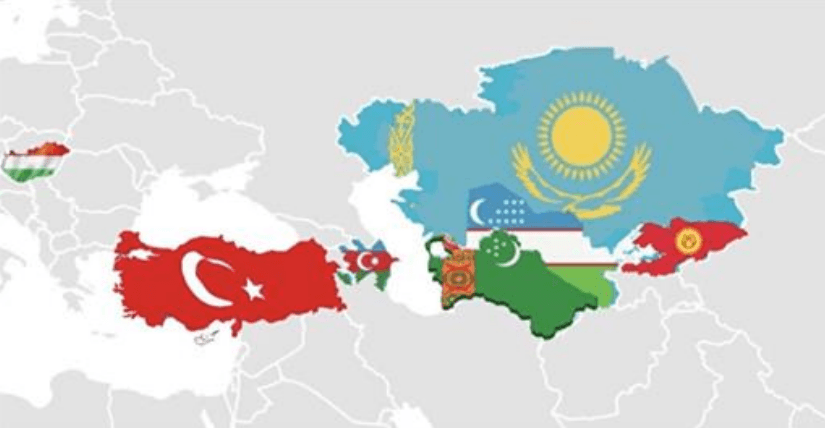
Member and Observer States of the Turkic States Organization (Turkic States Quarterly Economic Outlook)
Soviet Union’s dissolution in 1991 enabled Azerbaijan, Kazakhstan, Kyrgyzstan, Turkmenistan and Uzbekistan to gain independence; Türkiye was the first country to recognize them. Subsequently, the process of establishing the Turkic States Organization began with the Summit of Turkic-Speaking Countries held in Ankara in 1992 under Türkiye’s hosting. This summit marked the first step toward multilateral cooperation among the newly independent Turkic states. Between 1992 and 2008, summits primarily focused on culture, education, and linguistic unity.
A turning point came with the signing of the Nakhchivan Agreement on 2–3 October 2009 in Nakhchivan. Signed by the founding countries—Türkiye, Azerbaijan, Kazakhstan, and Kyrgyzstan—the agreement established the “Council of Cooperation of Turkic-Speaking Countries” and granted the organization the status of an intergovernmental organization under international law. At the 2010 Istanbul Summit, the name “Turkic Council” was adopted, and regular meetings commenced following the 2011 Almaty Summit.
Uzbekistan joined the council in 2019. Hungary acquired observer status in 2018, Turkmenistan in 2021, and the Turkish Republic of Northern Cyprus in 2022. At the Istanbul Summit in 2021, the organization adopted the name “Turkic States Organization” and transitioned into a more institutionalized structure. The organization’s headquarters is located in Istanbul.
Flag of the Turkic States Organization (Turkic States Organization)
The Turkic States Organization carries out its activities through various bodies:
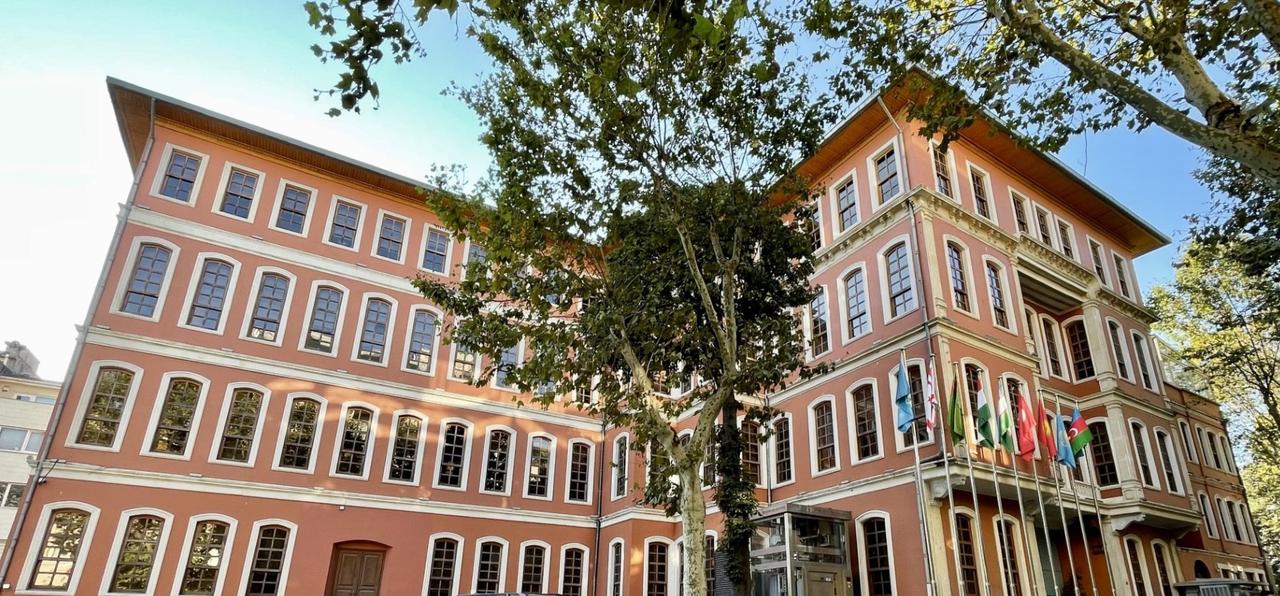
General Secretariat of the Turkic States Organization (Photo: Neriman Sena Külünk)
Established in 1993 by Azerbaijan, Kazakhstan, Kyrgyzstan, Uzbekistan, Turkmenistan, and Türkiye. Its headquarters is in Ankara. It promotes cultural ties among Turkic peoples through various cultural activities aimed at promoting shared values and transmitting them to future generations. It organizes Nowruz celebrations and declares the “Turkic World Capital of Culture”.
Founded in 2012 by Azerbaijan, Kazakhstan, Kyrgyzstan, and Türkiye. It aims to coordinate research on the Turkic language, history, and culture and to support academic projects. It produces scholarly publications and organizes international symposia.
Established in 2008 by the Speakers of the Parliaments of the Republic of Azerbaijan, the Republic of Kazakhstan, the Kyrgyz Republic, and the Republic of Türkiye. TURKPA, headquartered in Baku, is an international organization seeking to enhance political dialogue and legislative cooperation among member states through parliamentary diplomacy. It prepares joint legislative proposals and reports.
Aims to preserve and promote the cultural heritage of the Turkic world at the international level. The foundation’s charter was adopted in 2012 and it began operations in 2015. Its General Secretariat is in Baku. It undertakes activities in restoration, promotion, education, exhibitions, seminars, and workshops to safeguard Turkic culture and heritage.
Established in 2019. Its General Secretariat is in Istanbul. It aims to enhance cooperation among member states in trade and industry to elevate their development to a higher level.
The first joint financial institution established by the Turkic states, founded in 2023. Its purpose is to strengthen commercial and economic cooperation among member countries. The fund supports projects in agriculture, energy, logistics, industry, tourism, education, and the environment to contribute to the socio-economic development of member states.
Established in Istanbul in 2013 following decisions taken at the 2012 and 2013 summits. The union’s primary objective is to promote integration in higher education across the Turkic world by encouraging student and academic exchanges, conducting joint research projects, and developing joint degree programs among universities in member states.
An international student and academic exchange program developed under the Turkic States Organization to strengthen cooperation in higher education. Launched in 2017 following the establishment of the Turkic Universities Union, the Orhon Exchange Program aims to facilitate mutual exchanges of students and faculty, enable joint course offerings, simplify diploma recognition processes, and promote joint academic projects.
Within the Turkic States Organization, with contributions from the Turkish Language Association and the International Turkic Academy, the Turkic World Common Alphabet Commission was established to develop a common alphabet standard to replace the diverse alphabets used by member states. The commission held its first meeting in Astana in May 2023. This initiative aims to unify Turkic languages under a common alphabet, facilitate the preparation of joint publications and educational materials, and ease digitalization processes in software and technology.
Middle Corridor refers to an international transport route within the framework of the Turkic States Organization, stretching from China through Central Asia, the Caspian Sea, the Caucasus, and Türkiye to Europe. Officially known as the Trans-Caspian International East-West Middle Corridor, it encompasses road, sea, and rail transport. It has the capacity to reduce transit time between China and Europe to approximately 15 days and is regarded as one of the shortest and safest trade routes between Asia and Europe.
To enhance the efficiency of the corridor, the Turkic States Organization has initiated efforts to harmonize customs procedures, remove logistical barriers, and reduce costs. As part of these efforts, the “Kervansaray Project” and the Simplified Customs Corridor Agreement have been implemented.
Trans-Anatolian Natural Gas Pipeline Project (TANAP) is a strategic energy corridor developed to transport natural gas from Azerbaijan’s Shah Deniz-2 field through Georgia and Türkiye to Europe. The project forms the main backbone of the Southern Gas Corridor.
Zangezur Corridor is a transport route designed to establish a land and rail connection between western Azerbaijan and the Nakhchivan Autonomous Republic. The corridor strengthens the geographical unity of the Turkic world by enabling direct connectivity between Azerbaijan and Türkiye and serves as a complementary route enhancing the efficiency of the Middle Corridor.
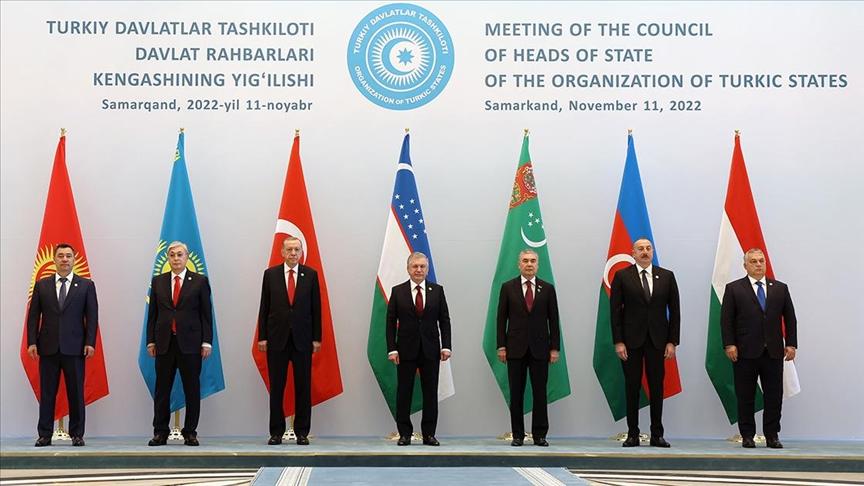
A Visual from the 14th Anniversary Celebrations of the Turkic States Organization (AA)
The organization’s fundamental goals are to strengthen integration among member states through cooperation in political, economic, cultural, and security areas, thereby contributing to regional peace and stability. In particular, the agriculture, defense and energy sectors have been identified as priority development areas. Strategic priorities have been institutionalized in the document titled “Turkic World 2040 Vision,” which envisions economic integration, development of transport and energy corridors, preservation of cultural heritage, and a more influential Turkic world presence on the global stage.
The Turkic States Organization focuses on objectives such as facilitating customs procedures and enabling free movement of goods and services to boost regional trade. In this context, the Turkic Investment Fund was established, and joint customs practices, logistics centers, and integrated trade networks have been prioritized. The Middle Corridor Project aims to enhance efficiency along trade routes connecting China to Europe.
Turkic states possess abundant oil, natural gas, and renewable energy resources. The Turkic States Organization develops common policies regarding energy security and infrastructure projects. The hydrocarbon resources of Azerbaijan, Kazakhstan, and Turkmenistan, combined with Türkiye’s role as an energy bridge to Europe, form the foundation of this cooperation. Projects such as the Baku-Tbilisi-Ceyhan Oil Pipeline and TANAP exemplify energy integration. In addition, strengthening transportation infrastructure—including rail and road connections—under the Middle Corridor remains a long-term priority for the organization.
The Turkic States Organization collaborates closely with institutions such as TÜRKSOY (International Organization of Turkic Culture) and Turkic Academy to preserve and promote the Turkic language, history, and cultural heritage. Academic cooperation is supported through student exchange programs, joint research projects, and university partnerships. Preserving Turkic history, cultural heritage, and shared values occupies a central place in the organization’s institutional agenda. The Turkic World 2040 Vision document supports joint educational initiatives, scholarship programs, and cultural festivals.
Defense industry and military cooperation are among the organization’s key priorities. Under the Turkic States Organization, joint military exercises, defense industry collaborations, and military education programs stand out. Member states also aim to cooperate on counter-terrorism, border security, and cybersecurity.
The Turkic World 2040 Vision is the foundational document outlining the long-term strategic roadmap of the Turkic States Organization. Adopted at the summit held in Istanbul on 12 November 2021, it aims to institutionalize multidimensional cooperation across the Turkic world and establish a shared future perspective by 2040.
According to the document, the priority goals are:
Concrete steps taken in line with these goals include, culturally, the Turkic World Capital of Culture program, the preparation of joint history and literature textbooks, and the institutionalization of common alphabet initiatives. In education, cooperation in higher education has been facilitated through the Turkic Universities Union (TÜRKÜNİB), and the Orhon Exchange Program has promoted mutual mobility of students and academics, initiating the creation of a “Turkic Higher Education Area”.
Among economic and development goals are the establishment of the Turkic Investment Fund, support for SMEs among member states, liberalization of trade, and strengthening of economic ties through joint projects. These goals are directly linked to transport and energy initiatives. Projects such as the Middle Corridor Project, the Kervansaray Project, and the Baku-Tbilisi-Kars Railway provide safe and rapid connectivity between Europe and Asia, while energy projects such as the Baku-Tbilisi-Ceyhan Oil Pipeline, TANAP, and future Trans-Caspian projects ensure not only the energy security of member states but also the energy supply of Europe.
In the field of youth and sports, the World Nomadic Games have been institutionalized as a brand, and it has been decided to organize symposia, competitions, and cultural events to strengthen a shared cultural identity and awareness among young people.
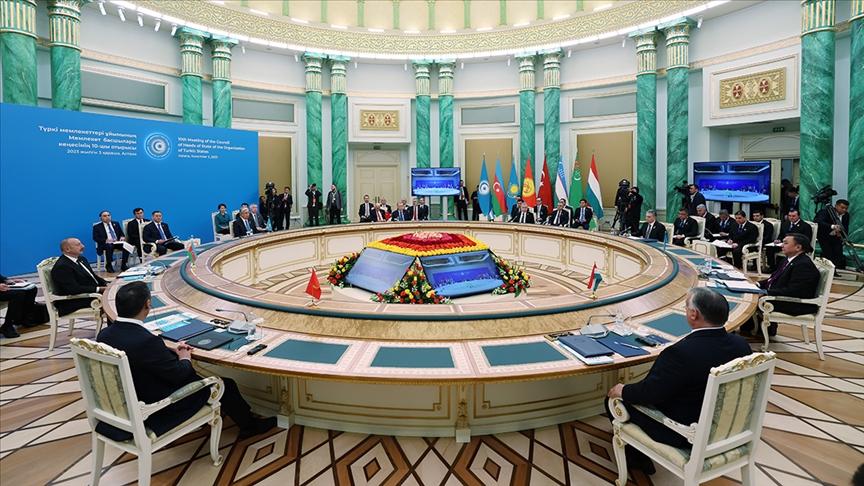
10th Summit of the Council of Heads of State of the Turkic States Organization, Astana (AA)
On 2–3 October 2009, the Nakhchivan Agreement was signed by Türkiye, Azerbaijan, Kazakhstan, and Kyrgyzstan, establishing the “Council of Cooperation of Turkic-Speaking Countries.” This decision marked a turning point in the institutionalization of relations among Turkic states.
At the summit held on 15–16 September 2010, the name “Turkic Council” was adopted. The Council of Heads of State, the Council of Foreign Ministers, the Committee of Senior Officials, and the Council of Elders were established.
According to Article 9 of the Nakhchivan Agreement, the head of state hosting the regular meeting serves as the rotating chairperson until the next meeting. Accordingly, the organization’s rotating chairpersons are as follows:
"Turkic States Organization."TDT Resmi Website. Accessed March 16, 2025.https://www.turkicstates.org/tr.
Akçapa, Mevlüt. "Türk Devletleri Teşkilatı’nın Tarihsel Gelişimi: Teşkilatın Dünü, Bugünü ve Yarını." *Avrasya Uluslararası Araştırmalar Dergisi* 11, no. 34 (2023): 473-491. Accessed March 16, 2025.https://dergipark.org.tr/en/pub/avrasyad/issue/76170/1223099
Altymyshova, Zukhra, and Camıykat Omurova. “Türk Devletleri Teşkilatı’nın Tarihi Gelişimi Ve Gelecek Vizyonu”. *Marmara Türkiyat Araştırmaları Dergisi*, 12 (March 2025): 41–64. Accessed August 18, 2025.https://dergipark.org.tr/tr/pub/mtad/issue/88621/1624391
Alyılmaz, Cavid, and Şehnaz Demirkol. "Türk Devletleri Teşkilatı Ülkelerinin Turizm Politikaları ve Stratejilerinin Analizi." *Uluslararası Türk Dünyası Turizm Araştırmaları Dergisi* 8, no. 2 (2023): 172-178. Accessed March 16, 2025.https://dergipark.org.tr/tr/pub/tdtad/issue/81665/1349540
Anadolu Ajansı. "TDT Devlet Başkanları Konseyi 10. Zirvesi'nin Astana Bildirisi kabul edildi." Accessed August 18, 2025.https://www.aa.com.tr/tr/dunya/tdt-devlet-baskanlari-konseyi-10-zirvesinin-astana-bildirisi-kabul-edildi/3042474
Anadolu Ajansı. "TDT Devlet Başkanları Konseyi Toplantısı Yapıldı." Accessed March 16, 2025.https://www.aa.com.tr/tr/dunya/turk-devletleri-teskilati-devlet-baskanlari-konseyi-toplantisi-yapildi/2735028.
Arıkan, Naime Feyza. "Türk Devletleri Teşkilatı Bünyesinde Ekonomik İş Birliği: Potansiyel ve Hedefler." PhD thesis, Ankara Hacı Bayram Veli Üniversitesi, 2024. Accessed August 18, 2025.https://tez.yok.gov.tr/UlusalTezMerkezi/TezGoster?key=1pwTzRXnomYf6jwqVORfUcoBw4Jluuy0UCofPDUogBPUmenFkIQXo3W1hH0wFHh1
Aydilek, Emre. "Türk Devletleri Teşkilatının Siyasi ve Ekonomik Potansiyeli." Uluslararası Yönetim Akademisi Dergisi 5, no. 3 (2022): 716-728. Accessed March 16, 2025.https://dergipark.org.tr/en/pub/mana/article/1192419
Can, Ahmet Selçuk. "Türkiye ve Türk Dünyası Bütünleşmesi: Kurumsal İnceleme." PhD thesis, İstanbul Üniversitesi, 2024. Accessed August 18, 2025.https://tez.yok.gov.tr/UlusalTezMerkezi/TezGoster?key=cr4SkWLaRMhkDRBjqthpsRmAaunKeXukNbUfXLfSL9j7AK6kXg2H-PwKojn_lb3N
Ekici, Kübra Deren. "Türk Devletleri Teşkilatı ve Tarihçesi." *TURAN-SAM* 53 (2022): 325-328. Accessed March 16, 2025.https://www.ceeol.com/search/article-detail?id=1028542
Emeklier, Bilgehan, Taner Taş, and Kubilay Çağrı Yılmaz. "Türk Devletleri Teşkilatı: Bütünleşme Sürecine Nereden Başlamalı ve Ne Yapmalı?" *Güvenlik Stratejileri Dergisi* (2022): 73–107. Accessed March 16, 2025.https://dergipark.org.tr/tr/pub/guvenlikstrtj/issue/72404/1112874
Erkiner, Hakkı Hakan, and İlayda Eray. “Uluslararası Hukuk Bakımından Bir Uluslararası Örgüt Olarak Türk Devletleri Teşkilatı”. *Güvenlik Stratejileri Dergisi*, TDT Özel Sayısı (August 2022): 217–50. Accessed August 18, 2025.https://dergipark.org.tr/tr/pub/guvenlikstrtj/issue/72404/1112918
Gündoğdu, Serkan. "Türkiye’nin Jeopolitik Açılımı: Bir Uluslararası Örgüt Olarak Türk Devletleri Teşkilatı". Manisa Celal Bayar Üniversitesi Sosyal Bilimler Dergisi 21, no. 3 (2023): 266-279. Accessed August 18, 2025.https://dergipark.org.tr/tr/pub/cbayarsos/issue/80074/1263177
Kocatepe, Ömer Faruk. "Neoklasik Realist Çerçevede Politik ve Askerî İş Birliğinin İncelenmesi: Türk Devletleri Teşkilatı." PhD thesis, Ankara Hacı Bayram Veli Üniversitesi, 2022. Accessed August 18, 2025.https://tez.yok.gov.tr/UlusalTezMerkezi/TezGoster?key=CG8WvdvvxJP04Unr7Yecf58tRKOWxELd5MYGSNAcfQJ7TJs2XCoQeXO2Ul8T5Vge
Küçükdoğan, Onur. "Türk Devletleri Teşkilatı'nın Kuruluş Süreci." Master's thesis, Gebze Teknik Üniversitesi, 2024. Accessed August 18, 2025.https://tez.yok.gov.tr/UlusalTezMerkezi/TezGoster?key=UjlM15wKZGQW6TLC0pvCtxFsrothHtQrnNZ6A_OKvjpwL16uiCk0k8a12QdArybO
Mert, Osman. "Türk Konseyi (Keneşi) Türk Üniversiteler Birliği ve Türk Üniversiteler Birliği I. Genel Kurulu." *Atatürk Üniversitesi Türkiyat Araştırmaları Enstitüsü Dergisi*, 53, (2015): 273-290. Accessed August 18, 2025.https://dergipark.org.tr/tr/pub/ataunitaed/issue/2892/40148
Organization of Turkic States. “Turkic States Quarterly Economic Outlook: 1st Quarter 2025” Center for Analysis of Economic Reforms and Communication of the Republic of Azerbaijan. (June 2025). Accessed August 18, 2025.
TRT Avaz YouTube Channel. "Türk Devletleri Teşkilatı." YouTube. Accessed March 16, 2025.https://www.youtube.com/watch?v=oU0L8XtKczE.
Turkic States Organization Official Website. "Nakhchivan Agreement on the Establishment of the Council of Cooperation of Turkish-Speaking Countries." Accessed August 18, 2025.
Turkic States Organization Official Website. "Turkic World 2040 Vision." Accessed August 18, 2025.
Turkish Language Association Official Website. "Türk Dünyası Ortak Türk Alfabesinde Uzlaştı." Accessed August 18, 2025.
Yılmaz, Emir. "Türk Devletleri Teşkilatı: Tarihsel Bir Analiz". Sakarya Üniversitesi Türkmer (2024). Accessed August 18, 2025.https://turkmer.sakarya.edu.tr/sites/turkmer.sakarya.edu.tr/file/Turk_Devletleri_Teskilati_Tarihsel_Bir_Analiz.pdf
Zengin, Alperen Kürşad. “Türkiye’nin Büyük Stratejisi ve Türk Devletleri Teşkilatı”. *Marmara Türkiyat Araştırmaları Dergisi*, 12 (March 2025): 306–17. Accessed August 18, 2025.https://dergipark.org.tr/tr/pub/mtad/issue/88621/1628123
Çınar, Yusuf, and Yılmaz Ulvi Uzun. "Köklü Geçmişten Güçlü Geleceğe Türk Devletleri Teşkilatı: Küresel Ekonomik-Siyasal Potansiyeli ve Teşkilatın Geleceğine Dair Öngörüler." *Manas Sosyal Araştırmalar Dergisi* 12 (2023): 141-156. Accessed March 16, 2025.https://dergipark.org.tr/en/pub/mjss/issue/80599/1296831
Özsoy, Bahar. "‘Türk Dünyası’ Söylemi İçinde Türk Devletleri Teşkilatı’nın Rolü ve Önemi." *Anasay Dergisi* (2023): 40-55. Accessed March 16, 2025.https://dergipark.org.tr/tr/pub/anasay/issue/79763/1324953

Establishment Date | 3 October 2009 | ||||||||
|---|---|---|---|---|---|---|---|---|---|
Previous Name | Cooperation Council of Turkic-Speaking Countries (Turkic Council) | ||||||||
Founding Document | Nakhchivan Agreement (2009) | ||||||||
Member Countries | Türkiye, Azerbaijan, Kazakhstan, Kyrgyzstan, Uzbekistan | ||||||||
Observer Countries | Hungary, Turkmenistan, Northern Cyprus Turkish Republic | ||||||||
Official Website | https://www.turkicstates.org/tr | ||||||||
Presiding Chair | Sadyr Japarov | ||||||||
Official Language | Kazakh Turkish Uzbek Turkish Kyrgyz Turkish Azerbaijani Turkish Turkish Turkish | ||||||||
Subsidiary Organizations | Turkish Investment Fund (TIF) International Organization of Turkic Culture (TÜRKSOY) Turkish Academy Parliamentary Assembly of Turkic States (TÜRKPA) Turkish Culture and Heritage Foundation Turkish Chamber of Commerce and Industry (TCCI) | ||||||||
No Discussion Added Yet
Start discussion for "Organization of Turkic States" article
History
Organizational Structure
Administrative Structure
Subsidiary Bodies
International Organization of Turkic Culture (TÜRKSOY)
Turkic Academy
Turkic States Parliamentary Assembly (TÜRKPA)
Turkic Culture and Heritage Foundation
Turkic Chamber of Commerce and Industry (TTSO)
Turkic Investment Fund (TYF)
Supported Institutions and Projects
Turkic Universities Union (TÜRKÜNİB)
Orhon Exchange Program
Common Alphabet Initiatives
Middle Corridor Project (Trans-Caspian International Transport Route)
Kervansaray Project
Trans-Anatolian Natural Gas Pipeline Project (TANAP)
Zangezur Corridor
Goals and Strategic Priorities
Economic Cooperation
Energy and Infrastructure Projects
Cultural and Academic Cooperation
Defense and Security Cooperation
Turkic World 2040 Vision
Turkic States Organization Summits and Decisions
Summits of Turkic-Speaking Countries (1992–2008)
2009 Nakhchivan Summit
2010 Istanbul Summit
Turkic Council Summits (2011–2021)
Turkic States Organization Summits (2022–Present)
Turkic States Organization Rotating Chairpersons