


This article was automatically translated from the original Turkish version.
+1 More
Fırsat Signals (Signal of Opportunity – SoOP) is a technique based on the principle of detecting existing electromagnetic signals in the environment (radio, television, satellite, Wi-Fi, mobile phone signals, etc.) to enable positioning, tracking, and environmental analysis for various purposes. This method enables information extraction by evaluating existing signals without requiring classical sensors or dedicated signal transmitters. SoOP, used as an alternative or complementary technology to traditional global positioning systems (GPS, GNSS, etc.) or radar systems, offers significant advantages especially in challenging environmental conditions and indoor environments. Today, with the integration of 5G, IoT (Internet of Things), and AI-supported signal processing techniques, opportunity signal-based systems have become more precise and reliable.
SoOP (Signal Source-Based Positioning) systems derive positioning or environmental data by analyzing the physical and temporal characteristics of electromagnetic signals in the surroundings. These systems typically determine location and perform environmental analysis by leveraging various existing signal sources. SoOP technologies evaluate signals that are commonly available in daily life without requiring expensive infrastructure such as GPS or other dedicated signal sources.
These signal sources are generally obtained through mobile communication infrastructure and wireless networks. In particular, mobile networks (such as 4G and 5G) play a critical role in the positioning processes of SoOP systems. Mobile networks provide high-frequency signals that can cover wide geographic areas. These signals are transmitted via cellular base stations and, when received by devices, can be used to determine the receiver’s location. Key parameters analyzed by SoOP systems to identify user location include the distance between base stations, signal strength, and signal propagation time.
In addition, local wireless network technologies such as Wi-Fi and Bluetooth also play an important role in SoOP systems. Wi-Fi is particularly effective as a signal source for precise positioning in urban areas and indoor environments. Wi-Fi networks transmit signals through a series of routers, and SoOP systems can determine device locations by analyzing the direction and strength of these signals. Bluetooth technology is similarly widely used for location tracking and proximity-based applications, especially in enclosed spaces such as shopping malls and airports.
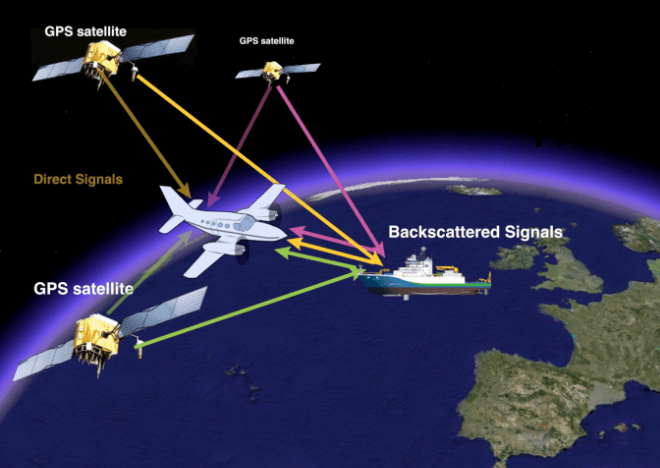
Identification of Opportunity RF Signal Sources (Credit: Clarizia, M.)
Satellite communication systems are another important signal source that enhances the positioning accuracy of SoOP systems. The Global Navigation Satellite System (GNSS) is the most widely used satellite system for global positioning. GNSS signals provide high-accuracy location information to receivers worldwide. In addition to these signals, other satellite communication systems such as Iridium and Starlink can be used for positioning in remote and isolated areas, including land or sea transportation. Such systems can accurately determine user locations, particularly in areas where GPS signals are weak.
VHF Omnidirectional Range (VOR) signals are a critical radio navigation system used in aviation, and their integration with SoOP technologies can be used to determine the position of aircraft and other aerial vehicles. VOR signals are radio waves emitted from a station that cover a wide, omnidirectional area. Aircraft use these signals to determine the location and direction of a VOR station. Signals from VOR stations, when received by a receiver, allow calculation of the signal’s direction and distance. This method is primarily used in aviation to track flight paths and enhance safety. By integrating VOR signals, SoOP systems can perform more precise analyses to determine the positions of aircraft or vehicles near airports.
In conclusion, SoOP systems represent a technology capable of highly accurate positioning by utilizing a broad spectrum of signal sources. Mobile networks, Wi-Fi, Bluetooth, satellite systems, and VOR enable effective positioning and environmental analysis under diverse environmental conditions and applications. The integration of these signals provides SoOP systems with versatile data processing capabilities, enabling their use in numerous fields beyond positioning, including security, logistics, and environmental monitoring.
SoOP systems offer a highly useful alternative for positioning in environments where GPS signals are weak or completely blocked. For example, in enclosed spaces, canyons, tunnels, or underwater environments, GPS signals are typically weak or entirely lost. In such cases, accurate positioning can be achieved using opportunity signals such as radio, television, Wi-Fi, and mobile networks. These systems provide effective positioning even in areas unreachable by GPS by leveraging existing signal sources.
Additionally, in technologies such as autonomous vehicles and drones, opportunity signals can serve as a critical secondary verification source when GPS signals are interrupted or spoofed (e.g., by jamming or spoofing attacks). These signals enable vehicles and drones to navigate accurately and reach their destinations safely. The use of opportunity signals beyond GPS enhances the security of autonomous systems and makes them more resilient to external interference. Atmospheric and climate observations can also utilize opportunity signals to study how electromagnetic waves are affected by variations in different atmospheric layers and the ionosphere. Radio signals are influenced by changes in atmospheric moisture, temperature, and ionospheric density. These interactions provide valuable data for weather forecasting and monitoring atmospheric conditions. Furthermore, ionospheric research can be conducted using these signals, as this layer affects the propagation of electromagnetic waves.
Opportunity signals can also be applied in maritime and hydrographic applications. Monitoring sea surface changes, detecting underwater movements, and tracking sea level variations can be more effectively achieved using opportunity signals. For instance, radio signals may reflect differently due to sea surface waves, providing information about sea surface conditions. Thus, monitoring sea surface changes in maritime and hydrographic fields can be accomplished through a more economical and efficient method. Passive radar systems represent another significant application area where opportunity signals are utilized. Traditional radar systems actively transmit signals and detect targets by analyzing their reflections. In contrast, passive radar systems perform detection by passively using existing signals (radio, television, mobile phone, etc.). Such a system enables surveillance without being detected by an enemy. Passive radars are particularly used in military operations or security missions where detection by enemy radar systems must be avoided. Due to their structure—neither transmitting signals nor emitting energy—they provide a more covert and secure form of monitoring.
Electronic Intelligence (ELINT) enables the acquisition of location, speed, and direction information by analyzing signals emitted by enemy elements. ELINT plays a vital role in gathering strategic intelligence by monitoring enemy radars, communication systems, and other electromagnetic transmitters. This data can be critical for military operations and security strategies. SoOP systems and opportunity signals serve as important tools in ELINT studies, as they allow the determination and tracking of target entities by analyzing existing signals. The concept of smart cities refers to the integration of various technologies to optimize environmental, social, and economic factors. Opportunity signals are applied in various smart city applications to enable more efficient and secure urban operations. For instance, in traffic management, opportunity signals can track the movement of vehicles and pedestrians. By identifying the locations of vehicles and individuals through radio, mobile, or Wi-Fi signals, traffic flow can be more effectively regulated. Additionally, these systems can detect events such as heavy traffic, traffic accidents, or emergencies, enabling faster resolution of urban traffic issues.
Disaster management is another critical application area for opportunity signals. During natural disasters such as earthquakes or floods, when telecommunication infrastructure collapses, communication can be maintained using existing signals. For example, signals obtained through mobile networks or Wi-Fi systems can be used to locate survivors in disaster zones and coordinate rescue operations. Such communication helps save lives by enabling rapid response after disasters. This feature provides an alternative communication infrastructure when conventional systems fail, accelerating rescue operations.
SoOP (Signal Source-Based Positioning) systems determine location and extract environmental data by analyzing the physical properties of existing signals. These systems have numerous advantages and specific limitations. SoOP systems typically perform positioning by utilizing existing signal sources in the environment. They require no additional signal source; instead, they leverage existing infrastructure such as mobile networks, Wi-Fi, Bluetooth, satellite communication systems, and VOR signals. As a result, users or devices can perform location determination using existing signals without any additional hardware or infrastructure installation. This feature enhances efficiency in local and wide-area positioning without incurring additional costs. One of the main limitations of SoOP systems is their dependence on the availability of signals. For the system to operate effectively, a specific signal source must be present. For example, if a region lacks base stations, Wi-Fi networks, or satellite signals, system performance can significantly degrade. This situation can pose challenges, particularly in rural areas or regions with weak signal coverage. In areas with insufficient signals, positioning accuracy may decrease and system reliability may be compromised.
SoOP systems operate on a passive working principle. That is, these systems do not transmit signals; they only detect and analyze existing signals. This feature makes SoOP systems more covert and provides a security advantage. Due to passive operation, it is more difficult to detect the system’s location or launch an attack against it. This is a significant advantage for military and security applications. Passive signal detectors are less detectable than active signal-transmitting systems, enabling enhanced security measures. While GPS signals provide highly accurate positioning in open areas, signal loss can occur in urban centers, enclosed spaces, or underground locations. SoOP systems can fulfill positioning functions in areas where GPS signals are blocked or weak by using alternative signal sources such as Wi-Fi, Bluetooth, or mobile networks. Although with lower accuracy, these alternative sources enable positioning in areas where GPS signals are unavailable, offering a significant advantage in enclosed spaces or densely built urban areas. For SoOP systems to operate effectively, advanced signal processing algorithms are required. Analyzing data from diverse signal sources is a complex process. In situations where signals are strong or weak, multipath propagation occurs, or interference is present, signal processing algorithms are critical to accurately interpret the signals. These algorithms are used to resolve signals correctly, minimize noise and interference effects, improve positioning accuracy, and perform environmental analysis. Therefore, SoOP systems require robust and sophisticated signal processing software to function efficiently.
L. Zheng and R. Xue, "Signals of opportunity navigation methods for complex lower airspace flight," 2011 IEEE 5th International Conference on Cybernetics and Intelligent Systems (CIS), Qingdao, China, 2011, pp. 272-276, doi: 10.1109/ICCIS.2011.6070340.
M.-P. Clarizia, P. Braca, C. S. Ruf and P. Willett, "Target detection using GPS signals of opportunity," 2015 18th International Conference on Information Fusion (Fusion), Washington, DC, USA, 2015, pp. 1429-1436.
Q. Liang, X. Cheng and D. Chen, "Opportunistic Sensing in Wireless Sensor Networks: Theory and Application," 2011 IEEE Global Telecommunications Conference - GLOBECOM 2011, Houston, TX, USA, 2011, pp. 1-5, doi: 10.1109/GLOCOM.2011.6134471.

No Discussion Added Yet
Start discussion for "Opportunity Signals (Signal of Opportunity - SoOP)" article
Identification of Signal Sources
Applications
Advantages and Disadvantages