


This article was automatically translated from the original Turkish version.
Ocean acidification is the process by which the pH of seawater decreases due to the dissolution of increasing amounts of carbon dioxide (CO₂) gas from the atmosphere into ocean waters. This process leads to seawater becoming more acidic and is recognized as one of the most significant environmental impacts of global climate change.
The in the atmosphere spreads across the ocean surface and reacts with water to form carbonic acid ():
Carbonic acid rapidly dissociates in water into bicarbonate and hydrogen ions :
The increase in hydrogen ions lowers the pH of the water, increasing its acidity (acidification). This chemical change also affects the alkalinity of seawater and the concentration of carbonate ions .
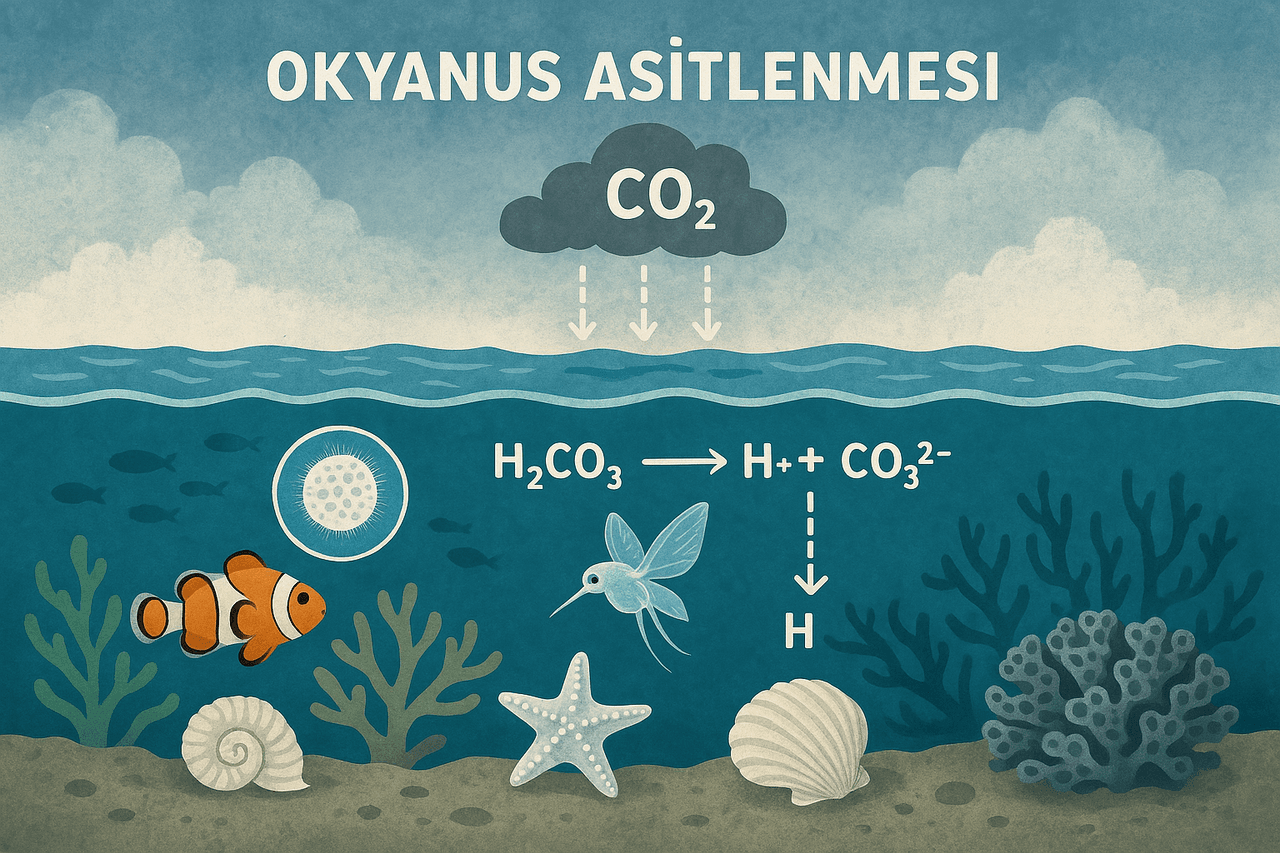
Okyanus Asitlenmesi Oluşumunu Temsil Eden Bir Görsel (Yapay Zeka İle Oluşturulmuştur.)
Ocean acidification has adverse effects on marine organisms with calcium carbonate structures, such as shellfish and skeletal organisms. Creatures like corals, mussels, sea snails, and certain plankton species build their hard external skeletons using carbonate ions. Increased acidity reduces the solubility of carbonate ions, making it harder for organisms to form shells and weakening existing structures.
The degradation of coral reefs poses a serious threat to marine biodiversity, as these structures provide habitat for numerous marine species. Additionally, declines in species unable to form shells or skeletons may disrupt the marine food chain.
Acidification also reduces survival rates by affecting the metabolism, reproduction, and development of marine organisms. Behavioral changes and growth problems have been observed in some fish species.
Ocean acidification has accelerated significantly since the Industrial Revolution, as human activities intensified. Today, atmospheric levels have risen from approximately 280 ppm to over 420 ppm, directly altering ocean chemistry.
The National Oceanic and Atmospheric Administration (NOAA) and the European Environment Agency (EEA) continuously monitor parameters such as , alkalinity, and carbonate ion concentration to track ocean acidification. These data reveal regional variations and support the development of global models.
For example, acidification is progressing more rapidly in the North Atlantic and North Pacific Oceans, while changes are slower in tropical seas. Additionally, the risk of acidification is higher in polar regions because cold water absorbs more CO₂.
Ocean acidification is closely linked to climate change. Rising greenhouse gas emissions not only increase ocean temperatures but also enhance the oceans’ capacity to absorb carbon, thereby accelerating acidification.
Scientific models predict that if current carbon emissions are not reduced, the ocean’s could drop by 0.3 to 0.4 units by 2100, posing a severe threat to marine life.
The most effective way to mitigate the effects of ocean acidification is a substantial reduction in global carbon emissions. Transitioning to renewable energy sources, improving energy efficiency, and protecting forests are top priorities in this context.
In addition, local strategies must be developed to protect ocean health and reduce the impacts of acidification. These include coral reef restoration, expanding marine protected areas, and preventing pollution.
International cooperation and legal frameworks also play a critical role in combating ocean acidification. Global climate agreements such as the Paris Agreement provide essential platforms for limiting greenhouse gas emissions.
European Environment Agency. "Ocean Acidification." Accessed May 26, 2025.https://www.eea.europa.eu/en/analysis/indicators/ocean-acidification.
NOAA. “Ocean Acidification.” National Oceanic and Atmospheric Administration. Accessed May 26, 2025.https://www.noaa.gov/education/resource-collections/ocean-coasts/ocean-acidification.

No Discussion Added Yet
Start discussion for "Ocean Acidification" article
Chemical Mechanism
Effects on Ecosystems
Global and Regional Monitoring
Relationship with Climate Change and Future Scenarios
Solution Pathways and Policy Recommendations