This article was automatically translated from the original Turkish version.
Team(s) | Rodents (Rodentia) | ||||||||
|---|---|---|---|---|---|---|---|---|---|
Family | Echimyidae | ||||||||
Habitat | Marshes reed beds lake and river shores | ||||||||
Occurrence in Türkiye | Individuals escaped into the natural environment since the 1980s | ||||||||
Body Length | 40–60 cm | ||||||||
Weight(s) | 5–9 kg | ||||||||
Diet(s) | Herbivorous → Aquatic plants (reeds can be harmful in areas near agricultural land etc.) rushes | ||||||||
Reproduction(s) | Breeding year-round | ||||||||
Conservation Status | Declared a pest species in some countries local monitoring and control efforts are underway limited population in Türkiye | ||||||||
Coypu (Myocastor coypus) is a mammalian species belonging to the order Rodentia and the family Myocastoridae, adapted to a semi-aquatic lifestyle. Native to South America, this species has been introduced to various continents due to human-driven translocations primarily for fur and meat production, and has been classified as an invasive species in several regions. Due to its distinctive morphological structure and environmental impacts, this animal occurs in limited populations in wetland areas of countries such as Türkiye.
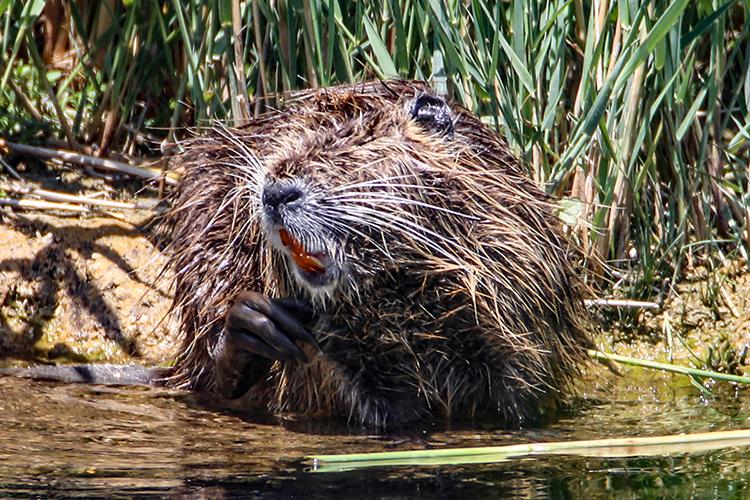
The coypu’s body is large and cylindrical. Body length typically ranges between 40 and 60 centimetres, while the tail can reach 30 to 45 centimetres. Weight varies among individuals but averages between 5 and 9 kilograms. The body is covered with a thick, water-repellent fur that protects it against environmental conditions. One of its most notable adaptations for efficient movement along water edges is the webbed structure on its hind feet, which enhances swimming ability and supports its semi-aquatic lifestyle. Sensory organs such as the eyes, ears, and nose are positioned near the top of the head, allowing the animal to maintain environmental awareness while swimming at the surface. The prominent, orange-hued incisors are a distinguishing feature related to its feeding and gnawing behaviour.
The natural habitats of the coypu are river-dominated wetlands of South America, including marshes, reed beds, and the shores of lakes and rivers. However, since the late 19th century, it has been introduced to Europe, North America, Asia, and Africa for commercial fur production. As a result, in some regions it has attained the status of an invasive species, disrupting local ecological balances. In Türkiye, the species was first introduced in the 1980s through captive breeding programs, after which individuals released or escaped into the wild established small populations in wetland areas. Their spread as far as the foothills of Mount Ağrı reflects the species’ ecological flexibility.
Coypus exhibit an herbivorous diet, primarily consuming aquatic and semi-aquatic vegetation such as reeds and rushes. Their feeding can lead to significant losses in plant cover within their habitats. In cases of overpopulation, the destruction of vegetation negatively affects nesting sites for water birds and the living areas of native species. Individuals living near agricultural areas can cause economic damage by physically damaging irrigation systems and reducing crop yields. This demonstrates the species’ potential to act as an ecosystem engineer.
Coypus are capable of breeding throughout the year. Females can give birth to 2 to 13 young per litter and may produce more than one litter annually. Gestation lasts approximately 130 days, and newborns are born in a highly developed state. Young coypus begin swimming shortly after birth and start feeding soon thereafter. This rapid reproductive cycle facilitates rapid population growth and expansion into new habitats.
In several countries worldwide, the coypu is classified as a pest due to the damage it causes to agricultural production and wetland ecosystems. Consequently, various control strategies have been developed, including hunting incentives and the use of biological, chemical, or mechanical methods to suppress populations. In Türkiye, coypu populations remain limited and are primarily observed in specific wetland areas of Eastern Anatolia. This situation necessitates the development of local-level ecosystem monitoring and habitat-based management plans.
The coypu is a mammalian species with significant biological and environmental characteristics. Its high reproductive capacity, adaptation to aquatic environments, and resilience to environmental disturbances reveal its potential to dominate native ecosystems. Controlling coypu populations in Türkiye and monitoring their habitat-based impacts are essential for the conservation of biological diversity.
Anadolu Ajansı. "Ağrı Dağı'nda karaya çıkan su maymunu görüntülendi." Accessed July 21, 2025. https://www.aa.com.tr/tr/yasam/agri-daginda-karaya-cikan-su-maymunu-goruntulendi/2036180
Anadolu Ajansı. "Ağrı Dağı'nda yaşayan su maymununun temizlenme anları görüntülendi." Accessed July 21, 2025. https://www.aa.com.tr/tr/gundem/agri-daginda-yasayan-su-maymununun-temizlenme-anlari-goruntulendi/2930022
Animal Diversity Web. "Myocastor coypus." Accessed July 20, 2025. https://animaldiversity.org/accounts/Myocastor_coypus/
Bilim Genç. "Yeryüzü: Türkiye'nin Yarı Sucul Memelisi Su Maymunu." Accessed July 20, 2025. https://bilimgenc.tubitak.gov.tr/yeryuzu-turkiyenin-yari-sucul-memelisi-su-maymunu
Columbia University. “Myocastor coypus: Nutria.” Accessed July 20, 2025. http://www.columbia.edu/itc/cerc/danoff-burg/invasion_bio/inv_spp_summ/Myocastor_coypus2.html

Team(s) | Rodents (Rodentia) | ||||||||
|---|---|---|---|---|---|---|---|---|---|
Family | Echimyidae | ||||||||
Habitat | Marshes reed beds lake and river shores | ||||||||
Occurrence in Türkiye | Individuals escaped into the natural environment since the 1980s | ||||||||
Body Length | 40–60 cm | ||||||||
Weight(s) | 5–9 kg | ||||||||
Diet(s) | Herbivorous → Aquatic plants (reeds can be harmful in areas near agricultural land etc.) rushes | ||||||||
Reproduction(s) | Breeding year-round | ||||||||
Conservation Status | Declared a pest species in some countries local monitoring and control efforts are underway limited population in Türkiye | ||||||||
No Discussion Added Yet
Start discussion for "Nutria (Myocastor coypus)" article
Morphological Structure and Anatomical Features
Habitat Preference and Geographic Distribution
Feeding Behaviour and Ecological Impacts
Reproductive Characteristics and Life Cycle
Conservation Status and Management Strategies