


This article was automatically translated from the original Turkish version.
+2 More
The North Bridge, as a component of the computer system's chipset, is a fundamental hardware component that manages the data flow between high-speed components such as the processor (CPU), memory (RAM), and graphics card (GPU). In chipset architecture, the North Bridge typically works in conjunction with a second component known as the South Bridge, and together these two structures form the core of the motherboard's processing and data flow architecture.
Motherboards, which constitute the heart of computer systems, are complex communication platforms that manage data exchange between different hardware components. One of the most strategic components of this platform is the chipset, a collection of integrated circuits that enable interaction among essential functional components other than the processor. Historically, chipset architecture consisted of two main sections: the North Bridge and the South Bridge. This structure ensures that data traffic in computer systems is managed through two primary channels.
In the traditional architecture widely used during the 1990s and early 2000s, the North Bridge chipset was designed to control high-speed components, while the South Bridge was responsible for managing low-speed peripheral devices. The direct impact of the North Bridge on system performance is felt across many critical areas, including the processor's speed, memory access times, graphics processing performance, and bus bandwidth.
The North Bridge is an integrated circuit (IC) chip located close to the processor and responsible for managing high-speed data pathways. It is typically positioned near the top of the motherboard and very near the processor socket. This proximity minimizes electrical signal delays and ensures high performance in data transmission between components with strict timing requirements, such as RAM and GPU.
The North Bridge functions like a central hub connecting the processor to the external world: it acts as an intermediary for the processor's access to the graphics card, memory, and input/output controllers. This structure, present in nearly all motherboards from the 1990s through the late 2000s, formed the foundation of modern system architectures.
The primary function of the North Bridge is to facilitate data exchange between the processor and other system components, particularly RAM and GPU. This is primarily achieved through a structure known as the Front Side Bus (FSB). The FSB directs data from the processor through the North Bridge to either memory or the graphics card.
The North Bridge operates as a memory controller between the processor and system memory. Parameters such as memory access speed, type (DDR, DDR2, DDR3, etc.), timing, and channel configuration (single/dual channel) are determined by the capabilities of the North Bridge. The operating clock frequency and bandwidth of RAM are directly dependent on the specifications of this chipset.
High-performance graphics cards communicate with the system through a data bus interface connected to the North Bridge. In older systems, this interface was AGP (Accelerated Graphics Port); in newer systems, it is the PCI Express (PCIe) standard. Because the North Bridge directly manages data transfer between the graphics card and the processor, it plays a decisive role in tasks such as gaming, graphics processing, and video editing.
The North Bridge also communicates with the South Bridge chipset, which manages low-speed peripheral devices. The South Bridge controls components such as hard drives, USB ports, sound cards, and network interfaces, while data from these components is typically routed to the processor via the North Bridge. Communication between these two chips is usually facilitated through a dedicated data bus, such as Intel's Hub Interface.
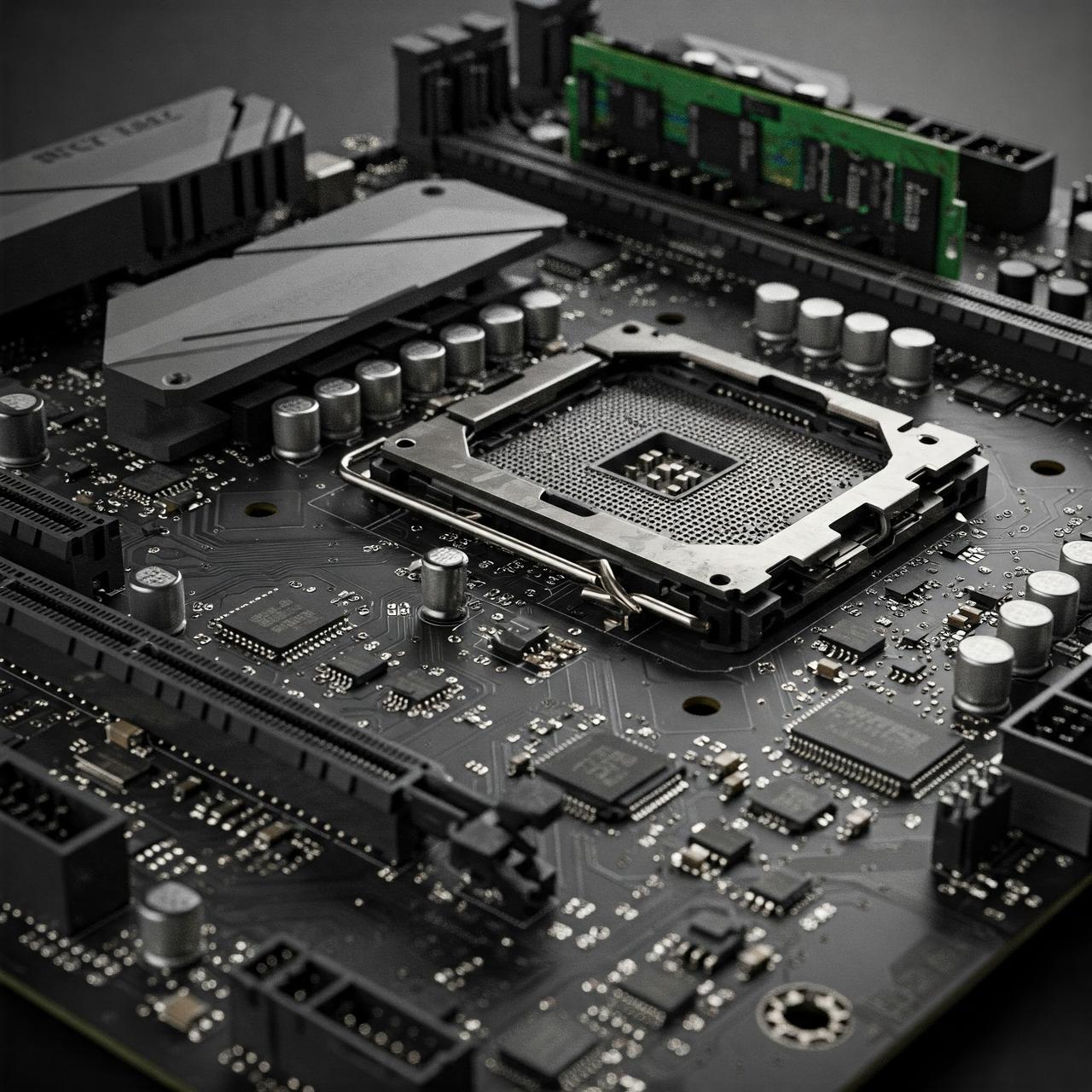
Bir chipset (Yapay zeka tarafından oluşturulmuştur.)
During this period, the North Bridge chipset handled all high-bandwidth tasks, including memory control and graphics interface management. Processors were typically connected to the North Bridge via the FSB, and this architecture was widely adopted by manufacturers such as Intel, AMD, VIA, and NVIDIA.
With Intel's Nehalem architecture (2008), the memory controller was integrated directly into the processor. This eliminated dependency on the North Bridge for communication between the processor and RAM, significantly reducing memory access latency. AMD followed a similar transition, adopting integrated memory controllers starting with the Athlon 64 series.
With Intel's Sandy Bridge architecture (2011), the graphics unit and PCIe controller were also integrated into the processor. As a result, all functions of the North Bridge were transferred to the CPU. Concurrently, the responsibilities of the traditional South Bridge were expanded and rebranded as the Platform Controller Hub (PCH). AMD adopted a similar structure called the Fusion Controller Hub (FCH).
Although a physical North Bridge chip is no longer present in most modern systems, its functions continue to be actively performed within contemporary processors. Components now integrated into modern CPUs—such as specific PCIe lanes, memory controllers, and graphics units (iGPUs)—have assumed the roles once handled by the North Bridge. Meanwhile, other tasks previously managed by the North Bridge are now handled by the PCH (Platform Controller Hub).
Abzug, Charles, Adrian Romano, Andrew Kennedy, and Pat Robertson. 2004. “Chipsets: The Northbridge and Southbridge.” James Madison University. Accessed July 19, 2025.https://users.cs.jmu.edu/abzugcx/Public/Student-Produced-Term-Projects/Computer-Organization-2004-SPRING/Chipsets-by-Adrian-Romano-Andrew-Kennedy-Pat-Robertson-2004-Spring.doc.
Conway, Pat, and Bill Hughes. "The AMD Opteron northbridge architecture." IEEE Micro 27, no. 2 (2007): 10-21.https://ieeexplore.ieee.org/abstract/document/4287392.
Radhakrishnan, Sivakumar, Sundaram Chinthamani, and Kai Cheng. "The blackford northbridge chipset for the intel 5000." IEEE Micro 27, no. 2 (2007): 22-33.https://ieeexplore.ieee.org/abstract/document/4287393.
T.C. Millî Eğitim Bakanlığı. 2012. *Anakartlar ve Kasalar*. Bilişim Teknolojileri Modülü. Ankara: Millî Eğitim Bakanlığı. Accessed May 3, 2025.https://www.lisebilisim.com/moduller/sistem-bakim-ve-onarim/1-%20Anakartlar%20Ve%20Kasalar.pdf.

No Discussion Added Yet
Start discussion for "North Bridge (Northbridge)" article
Definition and Physical Location of the North Bridge Chipset
Core Functions of the North Bridge
Bridging the CPU and the System
Memory Control (RAM)
Graphics Interface Management
Connection to the South Bridge
Evolution of North Bridge Architectures
Classic Architecture (1990–2008)
Integrated Memory Controller (2008–2010)
Full Integration and PCH Architecture (After 2010)
Legacy of the North Bridge in Modern Systems