This article was automatically translated from the original Turkish version.
Type(s) | Game of intelligence and strategy | ||||||||
|---|---|---|---|---|---|---|---|---|---|
Purpose(s) | Form a triple alignment | ||||||||
Category | Traditional game | ||||||||
Area(s) of Use | Educational and cultural | ||||||||
Number of Players | 2 players | ||||||||
Winning | Leave the opponent without a move | ||||||||
Tools | 9 stones each, a marked playing area | ||||||||
Dokuz Taş Oyunu is a traditional strategy game played by two players, rooted in Turkish folk culture and based on mental skills. The game is typically played using lines drawn on the ground or on a pre-prepared board, with nine stones placed by each player on the intersections of these lines. The objective is to reduce the opponent’s number of stones or render them unable to make a move, according to specific rules. Dokuz Taş Oyunu has been transmitted orally from generation to generation and has persisted across different regions with minor variations in name and practice.
The origins of Dokuz Taş Oyunu lie in the traditional intellectual and strategy games prevalent in Turkish communities. The game was commonly played by children and young people as an educational and entertaining activity, serving as an important social interaction tool in rural areas during leisure time. Over time, it was introduced into educational institutions and recognized as an element of cultural heritage.
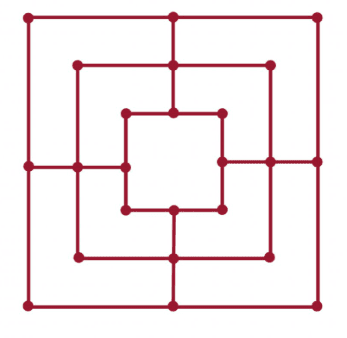
Dokuz Taş Oyunu is played on a board consisting of three nested squares connected by lines, creating a total of twenty-four intersection points. Each player has nine stones, typically made of small pebbles, wooden pieces, or similar simple materials. The game board and stones can be easily prepared according to the available resources of the playing environment.
The game consists of two phases. In the first phase, players take turns placing their stones on empty intersections. The goal during this phase is to align three of one’s own stones in a straight line, forming a “three-in-a-row.” A player who achieves this may remove one of the opponent’s stones from the board. In the second phase, after all stones have been placed, players move their stones along the lines to create new three-in-a-row formations. The game ends when an opponent’s stones are reduced to three or when a player is unable to make a legal move.
Dokuz Taş Oyunu contributes to the development of strategic thinking, attention, planning, and problem-solving skills. In this regard, it is cited as an example of the instructional role of traditional games in educational settings. At the same time, as a folk game passed down through generations, it is regarded as part of the cultural heritage, contributing to cultural continuity 【1】.
Today, Dokuz Taş Oyunu is introduced in schools under the Ministry of National Education as part of traditional children’s games and is featured in various cultural events. Local authorities and cultural initiatives are also working to increase awareness of the game. Through these efforts, the game is being preserved as both an educational and cultural value.
Millî Eğitim Bakanlığı. "9 Taş (Cüz) Oyunu." Artvin İl Millî Eğitim Müdürlüğü. Accessed January 1, 2026. https://artvin.meb.gov.tr/www/9-tas-cuz-oyunu/icerik/2639
Millî Eğitim Üzerine Yazılar. *Geleneksel Çocuk Oyunları*. Accessed January 1, 2026. https://d1wqtxts1xzle7.cloudfront.net/58872546/MilliEgitimUzerineYazilar20190412-99382-1upnpql.pdf
Ministry of National Education. "9 Taş (Cüz) Oyunu."Artvin İl Directorate of National Education. Accessed January 1, 2026. https://artvin.meb.gov.tr/www/9-tas-cuz-oyunu/icerik/2639
Ministry of National Education. *Dokuz Taş Oyunu*.Yayalar Ortaokulu School. Accessed January 1, 2026. https://yayalar.meb.k12.tr/meb_iys_dosyalar/73/05/720108/dosyalar/2020_03/09135959_9taoyunu.pdf
[1]
Millî Eğitim Üzerine Yazılar. Geleneksel Çocuk Oyunları. Erişim tarihi 1 Ocak 2026. https://d1wqtxts1xzle7.cloudfront.net/58872546/MilliEgitimUzerineYazilar20190412-99382-1upnpql.pdf

Type(s) | Game of intelligence and strategy | ||||||||
|---|---|---|---|---|---|---|---|---|---|
Purpose(s) | Form a triple alignment | ||||||||
Category | Traditional game | ||||||||
Area(s) of Use | Educational and cultural | ||||||||
Number of Players | 2 players | ||||||||
Winning | Leave the opponent without a move | ||||||||
Tools | 9 stones each, a marked playing area | ||||||||
Historical Background
Game Board and Equipment
Rules of Play
Educational and Cultural Significance
Dokuz Taş Oyunu Today