


This article was automatically translated from the original Turkish version.
+1 More
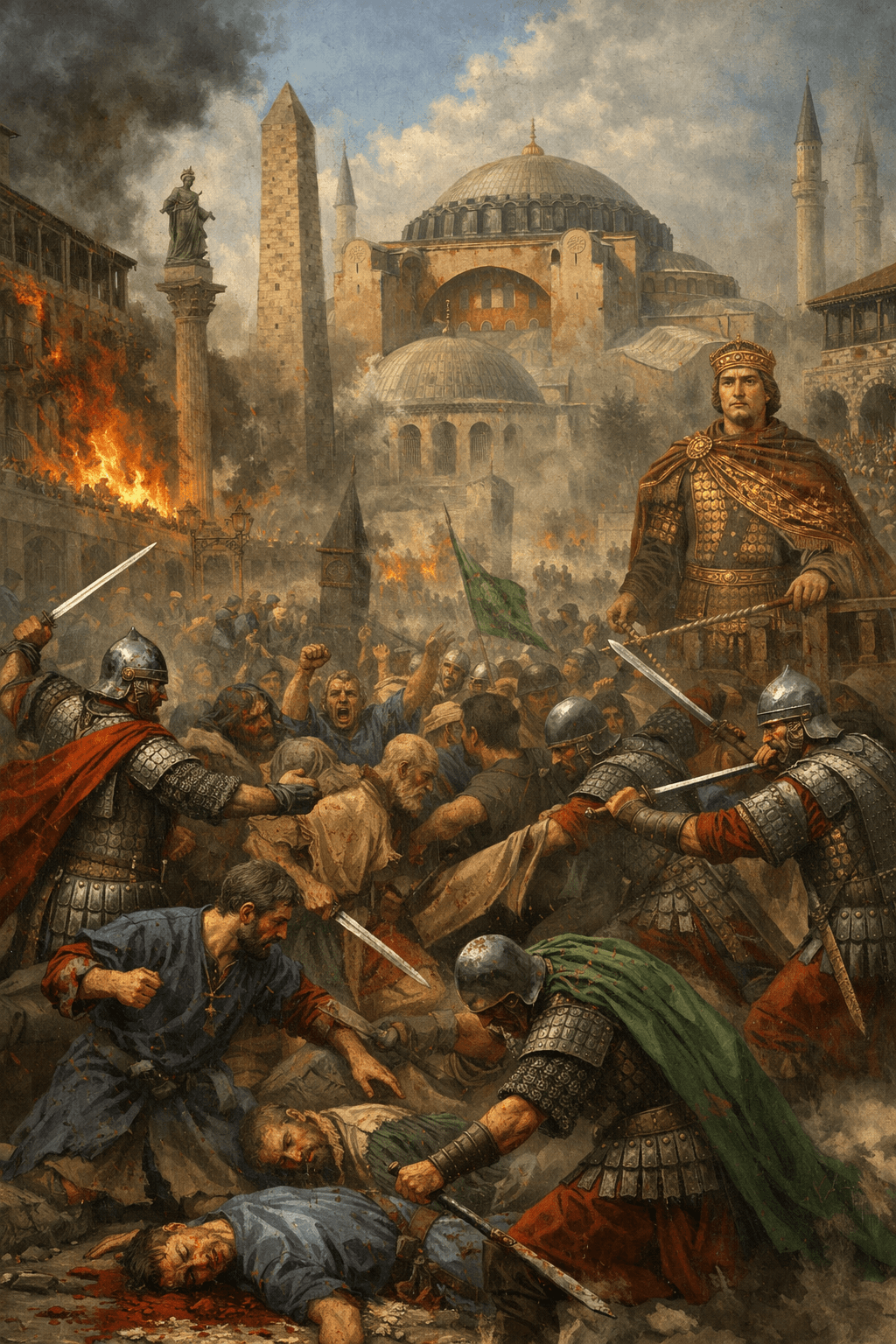
Nika Revolt (Generated by Artificial Intelligence.)
History | January 532 | ||||||||
|---|---|---|---|---|---|---|---|---|---|
Location | Constantinople (Eastern Roman / Byzantine Empire) | ||||||||
Emperor of the Period | Justinian I (527–565) | ||||||||
Groups Involved in the Uprising | Blues (Venetoi), Greens (Prasinoi) | ||||||||
Point of Origin | Hippodrome of Constantinople | ||||||||
Casualties | Approximately 30,000 people | ||||||||
The Nika Revolt was a large-scale urban uprising that took place in January 532 in Constantinople, the capital of the Eastern Roman (Byzantine) Empire, during the reign of Emperor Justinian I. 【1】 The revolt began as a joint action by the circus factions, the Blues and the Greens, organized around the Hippodrome; it soon evolved into a political crisis that directly challenged the imperial administration, the imperial bureaucracy, and the legitimacy of the throne.
The Nika Revolt (GZT)
In the 6th century, Constantinople was not only the political, military, and administrative center of the Eastern Roman (Byzantine) Empire but also one of the largest and most densely populated cities in the Mediterranean world. The city housed the imperial palace, the principal institutions of the central bureaucracy, high-ranking military commanders, and the upper echelons of the church hierarchy. This made Constantinople not merely a capital but a tangible manifestation of imperial power in daily life.
Administrative mechanisms in the city encompassed tax collection, law enforcement, public order, and control of food supplies. The effectiveness of the treasury, judiciary, and police forces created a palpable sense of state presence in the daily lives of citizens. Comprehensive legal and financial reforms undertaken during Justinian I’s reign intensified economic and social pressures on the lower and middle classes; artisans and small producers were directly affected by these measures.
The social structure of Constantinople exhibited a clear division between the imperial court and aristocracy on one side and the broad masses of the populace on the other. Groups close to the court and bureaucracy maintained direct ties to imperial authority, while the wider urban population often expressed its demands through indirect and collective means. In this context, public spaces such as the Hippodrome became the primary venues through which the people gained political visibility.
Constantinople Hippodrome in the 6th century was not merely a venue for chariot races but also a public space where direct communication between the emperor and the people occurred. The Hippodrome, with a capacity of approximately 100,000 spectators, brought together crowds from diverse social strata of the city.【2】
On race days, the emperor sat in the imperial box (kathisma) adjacent to the palace, where the populace could voice complaints directly through cheers, slogans, or collective petitions.【3】 This environment gradually developed into formalized ceremonial patterns, establishing a political communication tradition centered on the Hippodrome between the emperor and the people.
Races were contested between four main factions: the Blues, the Greens, the Reds, and the Whites. Over time, the Blues and the Greens surpassed the others in both spectator numbers and organizational capacity. Competition between these groups frequently led to riots in the stands and violent incidents in the streets.
The Hippodrome functioned not only as a place of entertainment but also as a space where the populace could convey demands to the emperor, call for the dismissal of officials, and organize collective grievances. Even before the Nika Revolt, the Hippodrome had become the primary site where opposition to the regime, led by the circus factions, intensified and where imperial authority was publicly tested.
In Byzantine society, the Blues and the Greens emerged as sports teams but gradually transformed into organized structures with political, social, and even religious dimensions. Each faction had its own leaders, networks of supporters, and urban connections.
The Blues generally maintained closer ties with the aristocracy, high bureaucracy, and imperial circles, while the Greens represented a broader and more heterogeneous segment of the urban population. Both factions were frequently at the center of violent disturbances that disrupted public order and played decisive roles in the city’s internal balance of power.
Sources indicate that the fan groups originally consisted of four factions: the Greens, the Blues, the Whites, and the Reds. The Whites and Reds eventually disappeared, leaving only the Greens and the Blues. Sixth-century sources also associate these colors with the four classical elements: green with earth, blue with water, white with air, and red with fire. The Greek names Prasinoi and Venetoi are used for the Greens and the Blues respectively.【4】
According to Procopius in his work “Wars,” the Greens entered the Hippodrome through the northeast gate and occupied the eastern section, while the Blues entered through the northwest gate and occupied the western section; during disputes over seating, they violently pushed each other.【5】
It is noted that at one point, the fan groups cut their hair in styles distinct from other Byzantines, cultivated long mustaches and beards in the Iranian style, and this fashion was sometimes referred to as the “Hun style.”【6】
The financial and legal reforms implemented under Justinian I heightened social tensions in the city. High tax rates, harsh judicial practices, and bureaucratic punitive mechanisms generated widespread discontent among the population of Constantinople.
The execution of several individuals affiliated with the circus factions and the refusal to pardon them brought accumulated grievances to the surface. These developments were decisive in transforming previously sports-related protests into a full-scale political revolt.【7】
On 10 January 532, the prefect Eudemonos ordered the execution of seven supporters in Sykai (Galata) for murder; one supporter from each of the Blues and the Greens survived when the ropes broke during their hanging. They were taken to a nearby monastery and later besieged by soldiers.【8】
On Tuesday, 13 January, the factions at the Hippodrome demanded the release of the prisoners; the emperor refused to respond. Near the end of the races, the Blues and the Greens united under the chant “Nika,” launched violent actions, and forced the emperor and his retinue to barely escape back to the palace. By evening, when the release of the prisoners remained unfulfilled, the prefect’s headquarters was set on fire.【9】
The emperor attempted to ease tensions by resuming the games on Wednesday; in response, crowds set fire to the area surrounding the Hippodrome.【10】
The Nika Revolt and Hagia Sophia | Muhayyelat (TRT2)
In January 532, protests that began during the chariot races at the Hippodrome coalesced into a mass uprising as the Blues and Greens united around common slogans. The term “Nika,” meaning “Victory,” ceased to be merely a cheer and acquired the clear political meaning of a direct challenge to imperial authority.【11】
The revolt spread beyond the boundaries of the Hippodrome to other districts of the city; public buildings, palace structures, and churches became targets. Fires and looting disrupted the administrative functioning of Constantinople.
Extensive physical destruction occurred during the revolt. On the night of 14 January to 15 January, buildings around the palace—including the Chalke Gate, the Senate House, barracks for palace guards, the Forum of Augustus, and the church that preceded Hagia Sophia—were set ablaze.【12】
Large parts of the palace complex, along with Hagia Sophia and the Church of St. Irene, were reduced to ashes by the fire. The area between Hagia Sophia, the Zeuxippus Baths, the imperial palace, and the Field of Mars, as well as the long colonnade stretching across the Constantinople Square and numerous other structures, were destroyed.【13】
The second Hagia Sophia (Ayasofya) Church, destroyed by fire during the Nika Revolt of 532, was among several major buildings consumed in the same blaze, including Hagia Eirene, the Zeuxippus Baths, and part of the Imperial Palace.【14】
In the later stages of the revolt, Justinian I’s authority was openly challenged; the rebels proclaimed Hypatios, a relative of the former emperor Anastasius, as emperor.【15】
At the most critical moment of the revolt, Justinian I considered fleeing the capital. It was Empress Theodora’s resolute stance that played a decisive role in convincing the imperial administration to pursue a military solution.
To restore order, commanders were ordered to enter the Hippodrome, where the crowd had gathered to proclaim Hypatios emperor; simultaneously, the eunuch general Narses attempted to bribe members of the factions to support Justinian.【16】
Belisarius was placed in command of the attack; by the end of the day, a massacre had claimed approximately 30,000 lives. On Monday, 19 January, Hypatios and Pompeius were executed; senators involved in the revolt had their property confiscated; and plans for the reconstruction of the city center were immediately drawn up.【17】
It is noted that Narses succeeded in winning over some members of the Blues faction through bribery; Belisarius and Mundus’s forces killed between 30,000 and 35,000 people in the Hippodrome; subsequently, priority was given to the reconstruction of the destroyed Hagia Sophia; and for a period after the revolt, chariot racing festivals were suspended at the Hippodrome.【18】
Following the suppression of the revolt, the imperial administration strengthened its control over the city. The political influence of the circus factions was curtailed, and central authority was reinforced. The destroyed buildings were reconstructed during Justinian’s reign with a more monumental architectural vision. After the revolt, the empire intensified its oversight of the city and launched reconstruction programs.【19】
The first Hagia Sophia basilica was constructed in 360 and destroyed in a fire in 404. A second Hagia Sophia was built in 415; part of this structure was burned during the Nika Revolt, leaving only a raised column standing.【20】
The Hagia Sophia Church, completed in 5.5 years by Isidore of Miletus and Anthemius of Tralles, was consecrated on 27 December 537. Isidore and Anthemius are described as experts in physics and mathematics.【21】
Beygirlioğlu, Esra. “I. Justinianus Dönemi’nde Konstantinapol’un İmarı.” *Edebiyat Fakültesi Dergisi* 8, no. 1 (2023): 143–150. Accessed December 29, 2025.https://dergipark.org.tr/en/download/article-file/3187406
GZT. "Nika Ayaklanması: Mor en soylu kefendir." YouTube, 04:45. Accessed December 29, 2025.https://youtu.be/LwArPgtP2FM
Greatrex, Geoffrey. “Nika Ayaklanması.” *Büyük İstanbul Tarihi.* Accessed December 29, 2025. Accessedhttps://istanbultarihi.ist/38-nika-ayaklanmasi
Kaya, Erkan. “I. Iustinianus Döneminde Sosyal Durum ve Dini Mimariye Etkileri.” *Amisos* 9, no. Özel Sayı (2024): 138–162. Accessed December 29, 2025.https://dergipark.org.tr/en/download/article-file/4051160
TRT2. "Nika Ayaklanması ve Ayasofya | Muhayyelat." YouTube, 09:27. Accessed December 29, 2025.https://youtu.be/gegGP-lWJ0g
Taşkın, Mert Can. “Bizans’ın Muhafazakâr Partisi: Maviler (Venetoi), Justinianus Dönemi Mavi Partisi ve Nika İsyanı.” Independent Researcher / Academia.edu, 2022: 3–12. Accessed December 29, 2025. Accessedhttps://d1wqtxts1xzle7.cloudfront.net/93111770/Mertcan_Task%C4%B1n_BIZANS_IN_MUHAFAZAKAR_PARTISI_MAVILER-libre.pdf?1666819818=&response-content-disposition=inline…
Yatcı, Cihat. “Roma’nın Hengâmesi Bizans’ın İlk Nefesi: I. Justinianus.” *Firaset Dergisi / Journal of Foresight* 1, no. 1 (2018): 1–14. Accessed December 29, 2025.https://www.academia.edu/40735355/ROMANIN_HENG%C3%82MES%C4%B0_B%C4%B0ZANSIN_%C4%B0LK_NEF
[1]
Büyük İstanbul Tarihi. “Nika Ayaklanması.” Büyük İstanbul Tarihi. Erişim Tarihi: 29 Aralık 2025. Erişim: https://istanbultarihi.ist/38-nika-ayaklanmasi
[2]
Büyük İstanbul Tarihi. “Nika Ayaklanması.” Büyük İstanbul Tarihi. Erişim Tarihi: 29 Aralık 2025. Erişim: https://istanbultarihi.ist/38-nika-ayaklanmasi
[3]
Mertcan Taşkın, “Bizans’ın Muhafazakâr Partisi: Maviler (Venetoi), Justinianus Dönemi Mavi Partisi ve Nika İsyanı,” akademik makale, (2022), syf 4, https://d1wqtxts1xzle7.cloudfront.net/93111770/Mertcan_Task%C4%B1n_BIZANS_IN_MUHAFAZAKAR_PARTISI_MAVILER-libre.pdf
[4]
Mertcan Taşkın, “Bizans’ın Muhafazakâr Partisi: Maviler (Venetoi), Justinianus Dönemi Mavi Partisi ve Nika İsyanı,” akademik makale, (2022), syf 4, https://d1wqtxts1xzle7.cloudfront.net/93111770/Mertcan_Task%C4%B1n_BIZANS_IN_MUHAFAZAKAR_PARTISI_MAVILER-libre.pdf
[5]
Mertcan Taşkın, “Bizans’ın Muhafazakâr Partisi: Maviler (Venetoi), Justinianus Dönemi Mavi Partisi ve Nika İsyanı,” akademik makale, (2022), syf 4, https://d1wqtxts1xzle7.cloudfront.net/93111770/Mertcan_Task%C4%B1n_BIZANS_IN_MUHAFAZAKAR_PARTISI_MAVILER-libre.pdf
[6]
Mertcan Taşkın, “Bizans’ın Muhafazakâr Partisi: Maviler (Venetoi), Justinianus Dönemi Mavi Partisi ve Nika İsyanı,” akademik makale, (2022), syf 10, https://d1wqtxts1xzle7.cloudfront.net/93111770/Mertcan_Task%C4%B1n_BIZANS_IN_MUHAFAZAKAR_PARTISI_MAVILER-libre.pdf
[7]
Erkan Kaya. “I. Iustinianus Döneminde Sosyal Durum ve Dini Mimariye Etkileri.” Amisos 9, no. Özel Sayı (2024): 138–162. Erişim: https://dergipark.org.tr/en/download/article-file/4051160
[8]
Büyük İstanbul Tarihi. “Nika Ayaklanması.” Büyük İstanbul Tarihi. Erişim Tarihi: 29 Aralık 2025. Erişim: https://istanbultarihi.ist/38-nika-ayaklanmasi
[9]
Büyük İstanbul Tarihi. “Nika Ayaklanması.” Büyük İstanbul Tarihi. Erişim Tarihi: 29 Aralık 2025. Erişim: https://istanbultarihi.ist/38-nika-ayaklanmasi
[10]
Büyük İstanbul Tarihi. “Nika Ayaklanması.” Büyük İstanbul Tarihi. Erişim Tarihi: 29 Aralık 2025. Erişim: https://istanbultarihi.ist/38-nika-ayaklanmasi
[11]
Mertcan Taşkın, “Bizans’ın Muhafazakâr Partisi: Maviler (Venetoi), Justinianus Dönemi Mavi Partisi ve Nika İsyanı,” akademik makale, (2022), syf 10, https://d1wqtxts1xzle7.cloudfront.net/93111770/Mertcan_Task%C4%B1n_BIZANS_IN_MUHAFAZAKAR_PARTISI_MAVILER-libre.pdf
[12]
Mertcan Taşkın, “Bizans’ın Muhafazakâr Partisi: Maviler (Venetoi), Justinianus Dönemi Mavi Partisi ve Nika İsyanı,” akademik makale, (2022), syf 10, https://d1wqtxts1xzle7.cloudfront.net/93111770/Mertcan_Task%C4%B1n_BIZANS_IN_MUHAFAZAKAR_PARTISI_MAVILER-libre.pdf
[13]
Erkan Kaya. “I. Justinianus Döneminde Sosyal Durum ve Dini Mimariye Etkileri,” Amisos 9, özel sayı (2024), syf 143, https://dergipark.org.tr/en/download/article-file/4051160
[14]
Erkan Kaya. “I. Justinianus Döneminde Sosyal Durum ve Dini Mimariye Etkileri,” Amisos 9, özel sayı (2024), syf 143, https://dergipark.org.tr/en/download/article-file/4051160
[15]
Mertcan Taşkın, “Bizans’ın Muhafazakâr Partisi: Maviler (Venetoi), Justinianus Dönemi Mavi Partisi ve Nika İsyanı,” akademik makale, (2022), syf 10, https://d1wqtxts1xzle7.cloudfront.net/93111770/Mertcan_Task%C4%B1n_BIZANS_IN_MUHAFAZAKAR_PARTISI_MAVILER-libre.pdf
[16]
Büyük İstanbul Tarihi. “Nika Ayaklanması.” Büyük İstanbul Tarihi. Erişim Tarihi: 29 Aralık 2025. Erişim: https://istanbultarihi.ist/38-nika-ayaklanmasi
[17]
Büyük İstanbul Tarihi. “Nika Ayaklanması.” Büyük İstanbul Tarihi. Erişim Tarihi: 29 Aralık 2025. Erişim: https://istanbultarihi.ist/38-nika-ayaklanmasi
[18]
Büyük İstanbul Tarihi. “Nika Ayaklanması.” Büyük İstanbul Tarihi. Erişim Tarihi: 29 Aralık 2025. Erişim: https://istanbultarihi.ist/38-nika-ayaklanmasi
[19]
Erkan Kaya. “I. Justinianus Döneminde Sosyal Durum ve Dini Mimariye Etkileri,” Amisos 9, özel sayı (2024), syf 143, https://dergipark.org.tr/en/download/article-file/4051160
[20]
Erkan Kaya. “I. Justinianus Döneminde Sosyal Durum ve Dini Mimariye Etkileri,” Amisos 9, özel sayı (2024), syf 143, https://dergipark.org.tr/en/download/article-file/4051160
[21]
Erkan Kaya. “I. Justinianus Döneminde Sosyal Durum ve Dini Mimariye Etkileri,” Amisos 9, özel sayı (2024), syf 143, https://dergipark.org.tr/en/download/article-file/4051160

Nika Revolt (Generated by Artificial Intelligence.)
History | January 532 | ||||||||
|---|---|---|---|---|---|---|---|---|---|
Location | Constantinople (Eastern Roman / Byzantine Empire) | ||||||||
Emperor of the Period | Justinian I (527–565) | ||||||||
Groups Involved in the Uprising | Blues (Venetoi), Greens (Prasinoi) | ||||||||
Point of Origin | Hippodrome of Constantinople | ||||||||
Casualties | Approximately 30,000 people | ||||||||
Constantinople in the 6th Century: Social and Administrative Structure
The Political and Social Function of the Hippodrome
Circus Factions: The Blues and the Greens
The Path to the Revolt
Outbreak and Spread of the Revolt
Urban Destruction and Architectural Damage
Throne Crisis and the Proclamation of Hypatios
The Stance of Justinian and Theodora
Suppression of the Revolt
Historical Consequences