


This article was automatically translated from the original Turkish version.
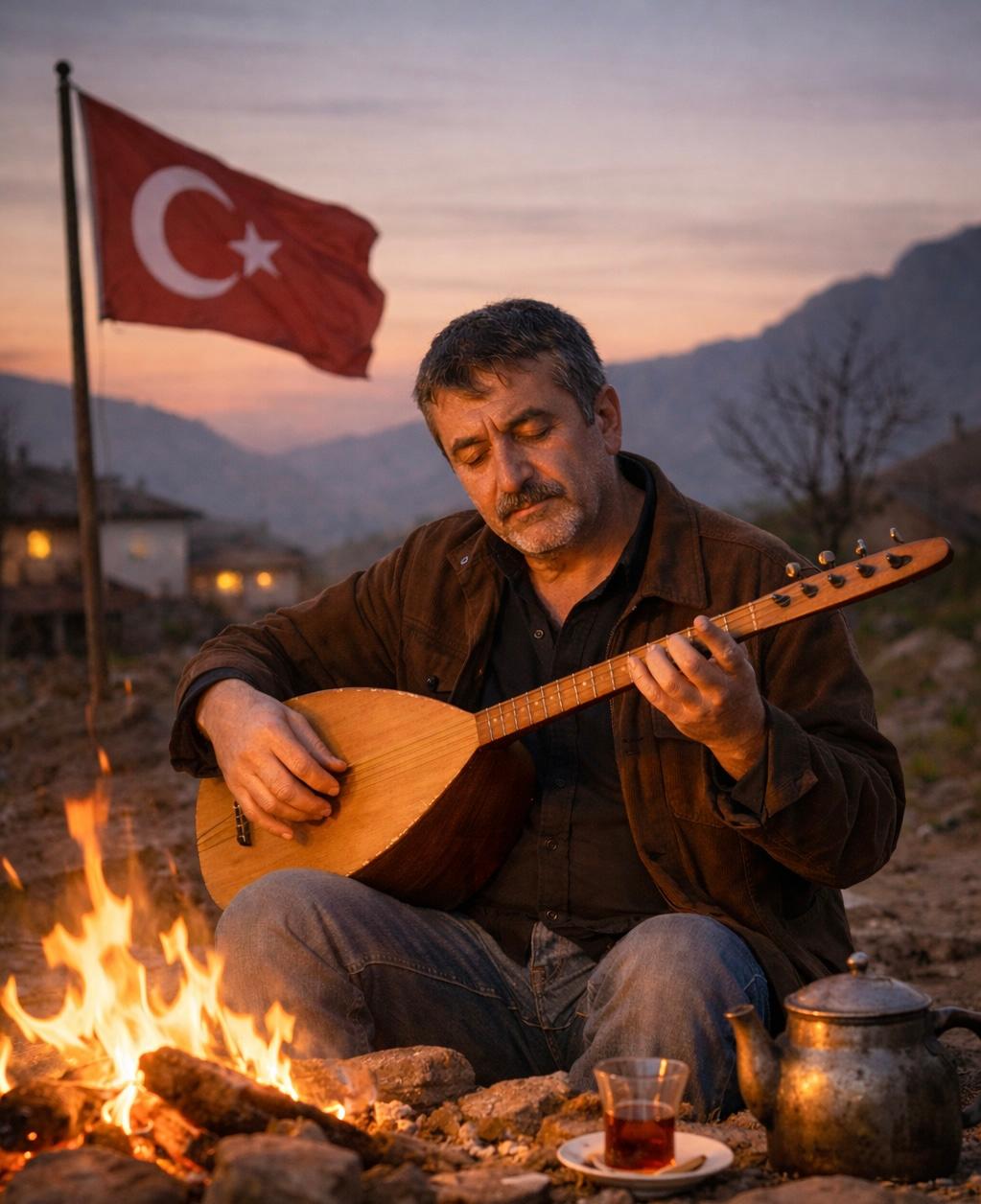
(Image generated by artificial intelligence.)
My Cry of Rebellion (Folk Song)
Primary Source Text | Feryad Û İsyan (poetry book) | ||||||||
|---|---|---|---|---|---|---|---|---|---|
Lyrics | Ozan Emekçi | ||||||||
Performance Tradition | Alevi-Bektaşi devotional and protest music repertoire | ||||||||
Theme | poverty Labor social revolt justice | ||||||||
Music | Mazlum Çimen | ||||||||
Feryad-ı İsyanım is a contemporary folk song with lyrics by Ozan Emekçi and music by Mazlum Çimen, shaped around themes of individual and collective suffering, the pursuit of justice, and testimony. The song first emerged as a poem and later gained widespread popularity within the oral music tradition after being set to music.
Feryad-ı İsyanım is derived from the epic poem of the same name, a long-term literary work by Ozan Emekçi. The poem was written based on the poet’s personal life experiences, eyewitness accounts, and observations of political and social events. 【1】 The text adopts a structure that speaks from an individual narrative to collective memory. The language employed in the poem unites elements of lament, rebellion, and call to action, and is thus regarded as a modern continuation of oral folk literature.
The poem’s transformation into a musical form was achieved through Mazlum Çimen’s composition. The melody was designed to preserve the poem’s lengthy and narrative-driven structure; during performance, the narrative is maintained alongside the melody as the central focus. This approach has led the work to be perceived not merely as a musical piece but as an oral narrative.
Mazlum Çimen - Feryad-ı İsyanım (Çimen's Yapım)
What haven’t hearts sacrificed for the fire of love?
Didn’t Mount Ferhat break open for Shirin’s dream?
The fault is in remembering you every second, everywhere
Didn’t Majnun swear enough for Leyla’s sake?
Every place your eyes touch is my homeland
Let me rest, so my exile and servitude may not stretch on
Ahmet Arif’s longing has worn out the shackles
If your shackled longing could wear me out like this
I burned again for you, Nesimi too, last night
Let me be lost in your gaze, let me be consumed
Thus have the gods decreed in their divine council
Either I was sent for you, or Muhammad’s mace
I am the hammer on every beautiful face in the world
Your gaze has become the hammer within me
The storms in my soul have tired the sun
Tell Noah to bring forth the flood
Mazlum Çimen was born on 18 June 1958 in the village of Sevdilli, Elbistan. He grew up in an environment rich with writers and artists. He received extensive violin training and completed his studies in ballet, later serving as a ballet artist at the Istanbul State Opera and Ballet. He is currently a composer, performer, and musician active in the field of contemporary Turkish folk music and original music. Throughout his artistic career, he has drawn inspiration from the folk music tradition while renewing it through contemporary interpretations.
Alevi-Bektashi culture, devotional poems, and socially engaged texts hold a significant place in Çimen’s musical repertoire. Çimen is known for setting poems by various poets to music, establishing a narrative-driven relationship between text and melody. In Feryad-ı İsyanım, as a composer, he has paid particular attention to preserving the integrity and dramatic structure of the poem.【2】
Ozan Emekçi, whose real name is Ali Haydar Levendiz, is a poet, writer, and musician trained in the tradition of Turkish folk minstrelsy. His poetry prominently addresses themes of social justice, labor, exile, oppression, and testimony. Emekçi has composed music for a significant portion of his poems, though some of his works have also been set to music by other musicians, reaching broader audiences.【3】
The poetry collection titled Feryad-ı İsyan is among Emekçi’s most well-known works and serves as the textual source for the song Feryad-ı İsyanım. The poet describes this work as one in which he “spent everything he had.”【4】
Feryad-ı İsyanım occupies a prominent place in the repertoire of contemporary Turkish folk music as a narrative-driven composition. With its extended poetic structure, direct mode of expression, and dramatic storytelling, it diverges from the classical folk song form, integrating elements of epic, lament, and protest narrative.
Alevi Haber Ajansı. “Emekçi’nin ‘varımı yoğumu döktüm’ dediği destanı: Feryad-ı İsyanım-VİDEO.” *PİRHA*, December 28, 2017. Accessed January 28, 2026.https://pirha.org/emekcinin-varimi-yogumu-doktum-dedigi-destani-feryad-i-isyanim-video-98596.html/28/12/2017/
Emekçi, Ozan. Feryad Ü İsyan. Istanbul: Kaldıraç Yayınevi, 2002. Accessed January 28, 2026.https://www.nadirkitap.com/feryad-u-isyan-ozan-emekci-kitap40092558.html?srsltid=AfmBOoqe8l44U8dKp2kMmaPRCOkIhxhhgI6uxeFEwAE1BLfUOGs2QFYa
Emekçi, Ozan. “Feryad-ı İsyanım.” YouTube video, 5:12. Çimen’s Yapım, August 14, 2014. Accessed January 28, 2026.https://youtu.be/IZ-KSzseKh0?si=IDBVxlbn_wltFbIN
Han Bali, Abuzer. “Ozan Emekçi.” Rupelanu.org, December 4, 2023. Accessed January 28, 2026.https://www.rupelanu.org/ozan-emekci-27789h.htm
Kral Müzik. “Mazlum Çimen Kimdir?” Kral Müzik. Accessed January 28, 2026.https://www.kralmuzik.com.tr/biyografisi/mazlum-cimen
Milliyet. "Mazlum Çimen Kimdir? Mazlum Çimen Nereli, Kaç Yaşında?" Milliyet, May 28, 2023. Accessed January 28, 2026.https://www.milliyet.com.tr/galeri/mazlum-cimen-kimdir-mazlum-cimen-nereli-kac-yasinda-6954401/
Yazıcı, Hakan. “Feryad û İsyan – Ozan Emekçi.” *Sevdiklerim*, Hakan Yazıcı, May 10, 2019. Accessed January 28, 2026.https://hakanyazici.com.tr/sevdiklerim/feryad-i-isyanim-ozan-emekci/
[1]
Alevi Haber Ajansı. “Emekçi’nin ‘varımı yoğumu döktüm’ dediği destanı: Feryad-ı İsyanım-VİDEO.” PİRHA, 28 Aralık 2017. Erişim tarihi: 28 Ocak 2026. https://pirha.org/emekcinin-varimi-yogumu-doktum-dedigi-destani-feryad-i-isyanim-video-98596.html/
[2]
Kral Müzik. “Mazlum Çimen Kimdir?” Kral Müzik. Erişim tarihi: 28 Ocak 2026. https://www.kralmuzik.com.tr/biyografisi/mazlum-cimen
[3]
Han Bali, Abuzer. “Ozan Emekçi.” Rupelanu.org, 4 Aralık 2023. Erişim tarihi: 28 Ocak 2026. https://www.rupelanu.org/ozan-emekci-27789h.htm
[4]
Emekçi, Ozan. Feryad Ü İsyan. İstanbul: Kaldıraç Yayınevi, 2002. Erişim tarihi: 28 Ocak 2026. https://www.nadirkitap.com/feryad-u-isyan-ozan-emekci-kitap40092558.html?srsltid=AfmBOoqe8l44U8dKp2kMmaPRCOkIhxhhgI6uxeFEwAE1BLfUOGs2QFYa

(Image generated by artificial intelligence.)
My Cry of Rebellion (Folk Song)
Primary Source Text | Feryad Û İsyan (poetry book) | ||||||||
|---|---|---|---|---|---|---|---|---|---|
Lyrics | Ozan Emekçi | ||||||||
Performance Tradition | Alevi-Bektaşi devotional and protest music repertoire | ||||||||
Theme | poverty Labor social revolt justice | ||||||||
Music | Mazlum Çimen | ||||||||
No Discussion Added Yet
Start discussion for "My Cry of Rebellion (Folk Song)" article
Origin and Story of the Song
Lyrics of the Song
Who is Mazlum Çimen?
Who is Ozan Emekçi?
Its Place in the Turkish Folk Music Repertoire