


This article was automatically translated from the original Turkish version.
Muskat Cultivation in the Ottoman Empire
Origin | 14th century | ||||||||
|---|---|---|---|---|---|---|---|---|---|
Type | Talisman | ||||||||
Purpose of Use | To protect To be freed from a misfortune To harm an enemy To be freed from psychological problems To attain a position or rank To find healing To make oneself liked | ||||||||
Amulet Makers | Astrologers, sorcerers, and charmers | ||||||||
Amulets are among the most widespread talismans used by people to protect themselves from visible and invisible malevolent entities or to attract blessing, fortune, and good. As evidenced even by the recently uncovered Göbeklitepe, amulets had already taken root at the foundation of civilization long before the invention of writing, dating back to the Sumerians, humanity’s first civilization.
The tradition of amulet-making, originally emerging in ancient societies as a means of protection against the wrath of supernatural forces, later manifested in various forms and shapes within medieval, early modern, and recent societies. No religion or culture has ever entirely purged itself of amulets. In the Ottoman Empire, the tradition of amulet-making developed closely in connection with ilmi nücum, ilmi cifr, and ilmi reml【1】, permeating society not only among the common people but also among state officials, eventually evolving into an institutional structure akin to astrology.
Muska etymologically derives from the Turkish corruption of the Arabic word şey, meaning “written object.” The conceptual scope of what the term muska encompasses—and what it does not—is highly complex. The only point on which scholarly literature reaches consensus is the purpose of the amulet.
Amulets can be created to protect individuals from all forms of physical or spiritual harm and threat, or to bring luck, open fortune, foster affection between hearts, or fulfill a desire. Those created up to this point are generally described as white writings, while writings intended to cause harm to a person or thing are called black writings. While there is little disagreement regarding the amulet up to this point, definitions of what an amulet actually is vary widely beyond this.
Especially among schools closer to ancient history, the term muska has been equated with the Latin word “amulet,” and defined as “anything believed to possess supernatural power capable of protecting humans from the evil of concrete and abstract entities.” Under this definition, depictions of gods, sphinxes and statues believed to have protective powers, and any object, image, or word inscribed with protective inscriptions all qualify as amulets. This definition greatly expands the concept and leads us to the point where “everything magical is an amulet.”
Schools closer to Islamic history associate the term muska with “nüşha” and while their definitions are similar, they center the written word. Thus, the general definition becomes: “Any written object possessing protective power is an amulet.” Here too, confusion arises regarding the definitions of vefk, cifr, and rukye. It remains uncertain whether each of these constitutes a separate amulet, or whether they become amulets only when written on paper and carried by people.
In light of all these debates, it is understood that the amulet is one of the subcategories of talismans, which denote all magical objects. Vefk, rukye, and cifr are distinct sciences that constitute the components of an amulet. An amulet may contain all three—vefk, rukye, and cifr—or only one of them. Thus, the amulet refers to the totality composed of the material on which writing is inscribed, the writing itself, and the ritual.
According to general consensus, amulets emerged as a concept from ancient societies’ desire to counter natural disasters they could not comprehend with a supernatural force of equal power. The earliest known amulets are found in the geography of Egypt. These were created by engraving symbols of protective deities such as Ka and Ra onto precious metals and are regarded as the earliest protective amulet examples. Subsequently, this culture was also found among all ancient civilizations including the Greeks, Hittites, Assyrians, Sumerians, and Babylonians.
Amulet-making was also widespread among the Bedouin Arab tribes of Arabia. During the Jahiliyya period, amulet practices manifested especially in the form of deity depictions, but were partially eradicated after Islam prohibited them. However, in the 9th century, they found new ground through pioneers such as Ja‘far al-Sadiq and Jabir ibn Hayyan, particularly among the Mu‘tazila and Kharijite sects. By the 10th century, they had firmly established themselves within the Sunni world through the works of Ibn Wāḥshiyya and Ahmed ibn Hilal, titled Kitabü’r-ruk’a ve’t-tevaiz【2】.
Many Islamic scholars permitted the making and carrying of amulets on the condition that they avoided shirk and did not believe in the amulet’s protective power itself. Since the Ottoman Empire upheld the Sunni Islamic tradition, the practice continued under the names of rukye-hanlık or nüshacılık, and ultimately acquired official status with the establishment of the office of müneccimbaşı in the 15th century. It is even recorded that Ottoman sultans embarked on campaigns wearing such amulet-laden shirts.
Especially from the mid-19th century onward, increasing European pressure and modernization initiatives led to attempts to ban certain practices and astrological books. However, this effort failed to eradicate the deeply rooted amulet culture among the populace.
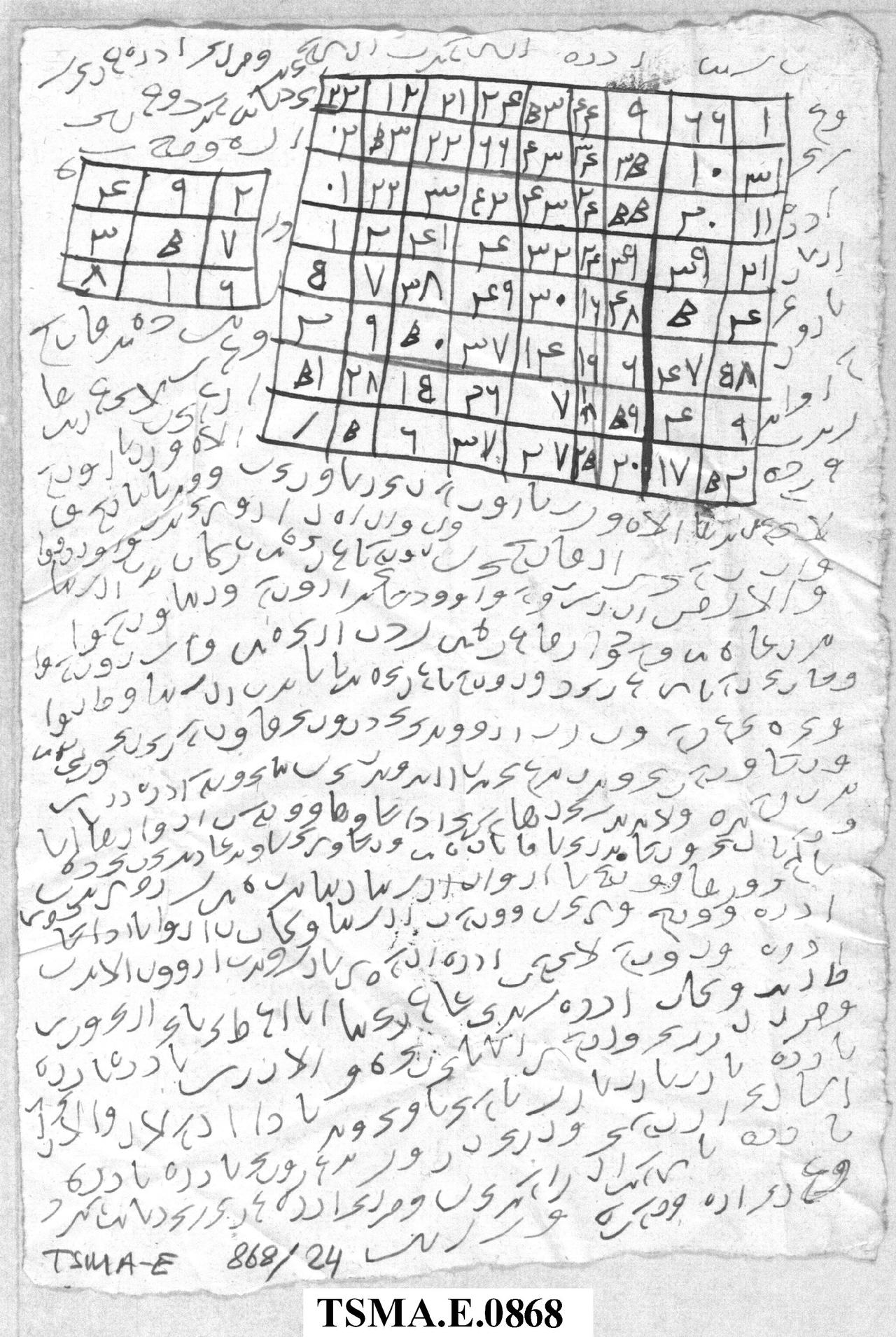
Cifr refers to the science of assigning numerical values to each letter of the Arabic alphabet and using these values to derive hidden knowledge or interpret signs (Appendix 5). These numerical values were frequently used in literature and historiography, often replacing direct numerical notation for dates, with dates instead written using cifr calculations. Additionally, arranging the cifr values of couplets to correspond with the dates of the Hijra, the birth of Prophet Muhammad, and the conquests became an art form. Since each letter was believed to possess distinct numerical properties, the numbers and letters used in amulets were always arranged according to cifr calculations.
Vefk means “harmony” in Arabic. It typically refers to a rectangular grid—usually 3x3, 4x4, or 5x5—containing letters or numbers arranged according to cifr calculations. Into these grid cells, numbers or letters could be placed, as well as verses, surahs, or symbolic forms.
The reason this grid is called “vefk” is due to the arrangement of letters, verses, or symbols in a specific pattern. Depending on whether the purpose was to bring good or ward off evil, various verses or names were divided and placed within the vefk according to cifr calculations, or undivided fragments of names or surahs were arranged. These were generally identical when read vertically or diagonally. For example, when viewed diagonally, all matching letters or numbers appear in the same sequence, whereas when viewed vertically or horizontally, different shapes or letters are combined (Appendix 1).
The foundation of this arrangement rests on two questions: For whom is the amulet being made? And for what purpose? Depending on the answers to these questions, odd or even numbers are used within the vefk, and specific symbols are selected. For instance, in an amulet intended for healing, Surah Al-Fatiha or its cifr equivalent is used predominantly, whereas in protective amulets, Ayat al-Kursi, Al-Mu‘awwidhatayn, or Surah An-Nas are used primarily.
Amulets made in the Ottoman Empire and the symbols used in them are highly diverse and not uniform. The age, gender, and religion of the person for whom the amulet is made can influence its design, as can the purpose for which it is created. Excluding the generic amulets given by those with little knowledge of this science, amulets were custom-made according to the individual and purpose, involving specific cifr calculations and sometimes drawing on the science of astrology.
Amulets can be broadly categorized into three types: those written on paper, those inscribed on metals, and those made on natural materials. Since amulets were generally worn on the person, durable materials were preferred. Consequently, the most common type consisted of writings on high-quality thick paper, covered with prayer cloth. However, paper was not a necessary material for making an amulet.
An amulet could be made from any material, provided it was clean and unused. Thus, amulets were made from wood, silver, clay, leather, and even stone. Among these, amulets made from metals such as iron and silver were the second most common, while those made from materials like stone and wood were the least common. These natural material amulets likely did not survive to the present day because they decayed quickly or were burned as incense, hence their scarcity.
An amulet could be created based on cifr calculations, data derived from astrology, or simply by writing appropriate verses, surahs, and symbols. In rare cases, all these sciences were used simultaneously, requiring extensive expertise. Astrologers who observed and interpreted the movements of the stars to create amulets possessed the highest level of knowledge in this field and generally employed cifr calculations within the amulets.
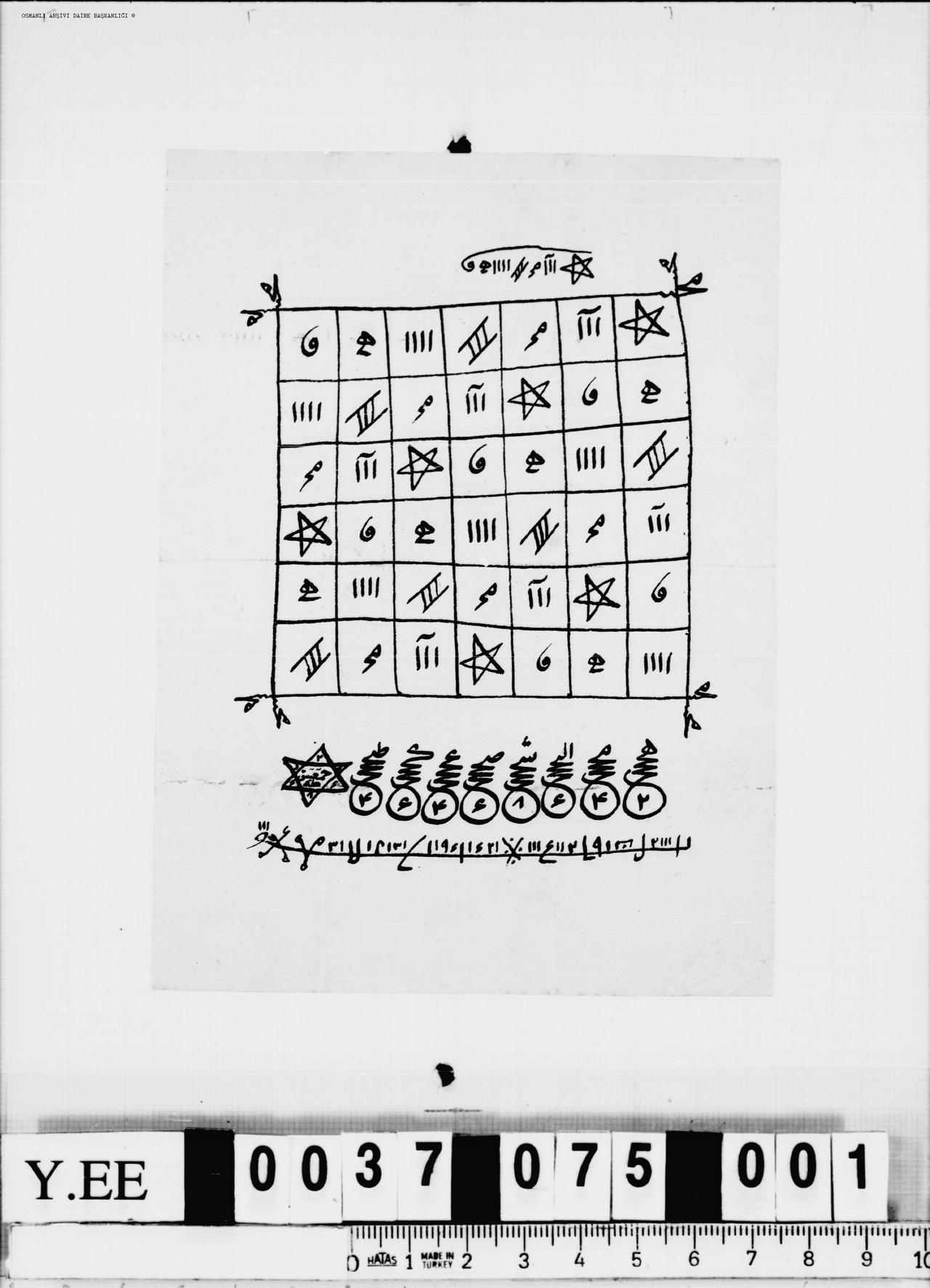
Amulets created solely through cifr calculations are the second most difficult to produce. For such amulets, merely knowing the numerical values of letters is insufficient; one must also understand the meanings of numbers, when to use them, and which bring good or evil. Amulets made solely with verses and symbols (Appendix 7) are the easiest to produce, since their meanings are already known. This method was most commonly used by those seeking to profit from amulet-making without possessing knowledge of these sciences.
Among the most common symbols used are: the six-pointed star seal of Prophet Sulayman, believed to have dominion over jinn and nature; the hand of Aisha, believed to bring healing 【3】; the letter mim, representing Prophet Muhammad; three lines symbolizing Jesus; and the ladder symbolizing the miraculous ascent. In addition, many other shapes and symbols with unresolved meanings are also used.
An amulet could be used not only for protection but also to foster affection between people. Such amulets typically contained vefks arranged according to cifr calculations, including the names of both the person for whom the amulet was made and the person who commissioned it, along with their mothers’ names.
Example Text
Izzetlü, saâdetlü, şerâfetlü, muhabbetlü nûr-ı aynım oğlum Mehmed Efendi hazretleri, vakt-ü şerifiniz saîd ve ömr-ü devletiniz mezîd olsun. Benim oğlum, benim canım bu defa siz oğlumuzun saâdeti ve cümleye sevgüli ve şirin görünmeniz içün devletiniz dâima müzdâd olmaklık içün ve matlûbunuz olan murâdınız istediğiniz gibi hâsıl olmaklık içün ve sâirler ve cümleye şirin görünmek içün ve şevketlü efendimize ve silahdar ağa efendimize şirin görünmek içün ve an-karîb mukarreb olmanız içün bu def’a bir sâhib-i kemâlin bir vefkini tarafınıza memhûren göndermişizdir. Hulûsan sıdk ile boynunuzda taşıcaksınız. Manzûrunuz olup ve içindekini sırren, ihtibâen sarıp hammal köse ile tarafımıza gönderüp kendi elim ile bir gümüş muskaya koyup ve kapağını dahi lahm edüp gine tarafınıza irsâl edelüm. Heamân hakk teâlâ hazretleri te’sirini halk eylesün âmin ve cümlesine şirin göründürsün ve muhabbetler ve sevgüleri senin üzerine olsun. Benim oğlum adeti ve şurûtı üzere min-bâd babanın dergahına bu vefk-i şerif içün on iki buçuk guruş nisâbını ben verdim. Yine vefk-i şerîfi gönderdiğiniz vakit ol on iki buçuk guruşı gönderesiz. Ve bi’l- ihtifâ muskası içün de bir mikdar pâre ve bu muska-i şerîfi yazan sizin ve benim cümlemizin pederi makamında olan Seyfeddin çerağ olup ve otuz beş senede dâr-ı bekâ edüp bu sahib-i mühr, sadrâzam efendimizin silahdârlığında dizdârlığını bırakup ve siz gibi dermiyân olup harc-ı hass hesâbından mâhiyye yüz guruşa kâin olan sâbık Kütahya dizdârı Mehmed Efendi’ye verildü. Bizim merhum Beşir ağanın içerüde iken lalası ve sen oğlumu bile evlatlığa kabul etdi ve bu vefk-i şerîfi ziyade hıfzetmenizi niyâz etdi ve cümleden ketm etmenizi niyâz ederler ve husûsen size minnet ederler ve hayr duandadırlar ve bu vefk-i şerîfin kabı(?) yapılmağa gönderdüğünüzde hammal köse yine benim elime versin sâire vermesün hemân sağ olasın, gönder ki ne müşahadesin görürürsün ve ne müşahade olunur ise tarafımıza bildüresiz...
This document, dated approximately 1214 AH/1799 CE, provides valuable information on amulet use. As clearly indicated in the text, the amulet was written to help Mehmed Efendi, who belonged to the elite group of arms-bearers, gain favor with his superiors. The primary purpose of this amulet was to foster affection toward Mehmed Efendi. The key point here is the distinction made in the text between vefk and amulet: the written portion is called the vefk, while the small silver container into which the vefk is placed is referred to as the amulet. Thus, the amulet here refers to the container holding the vefk.
The text also describes rituals associated with the amulet. Mehmed Efendi’s mother requested that he return the vefk to her so she could place it herself into a silver amulet. Why did she not simply have the vefk placed directly into the amulet and send it? Several possibilities exist. Particularly in amulets designed to foster affection, it was common to include a personal item of the intended recipient—such as hair or nails—within the amulet. Thus, the vefk may have first been sent to Mehmed Efendi. Another possibility is the principle that only the intended recipient could open the cloth-wrapped vefk, so it was sent back to his mother for him to open and convert into an amulet. A more likely explanation is financial: crafting a silver amulet involved considerable cost, as silver is both durable and easily worked, making it the highest-quality material for an amulet. In the letter, Mehmed Bey’s mother states she paid for the vefk and insists that when returning it, he must also send the cost of the amulet itself.
Beyond this, the most important ritual associated with the amulet is secrecy. The amulet was sent secretly, Mehmed Bey was instructed to open it secretly and wear it secretly, and he was repeatedly warned not to reveal its presence to anyone. There are two reasons for this. First, the amulet’s efficacy is believed to be lost if it falls into another’s hands. Second, such objects associated with magic were generally disapproved of, and possessing them could lead to trouble. Additionally, the mother’s request for confirmation of the amulet’s effectiveness indicates that amulets were not blindly believed in, but their efficacy was actively tested. Finally, the mention of the price of an amulet in 18th-century Ottoman society is another significant detail.
Since amulets are writings inscribed on materials with the intention of bringing good or warding off evil, writings composed using cifr calculations to interpret signs from the future also fall within the category of amulets. The purpose here is to foresee future dangers, warn the recipient, and protect them from these threats.
Example Text
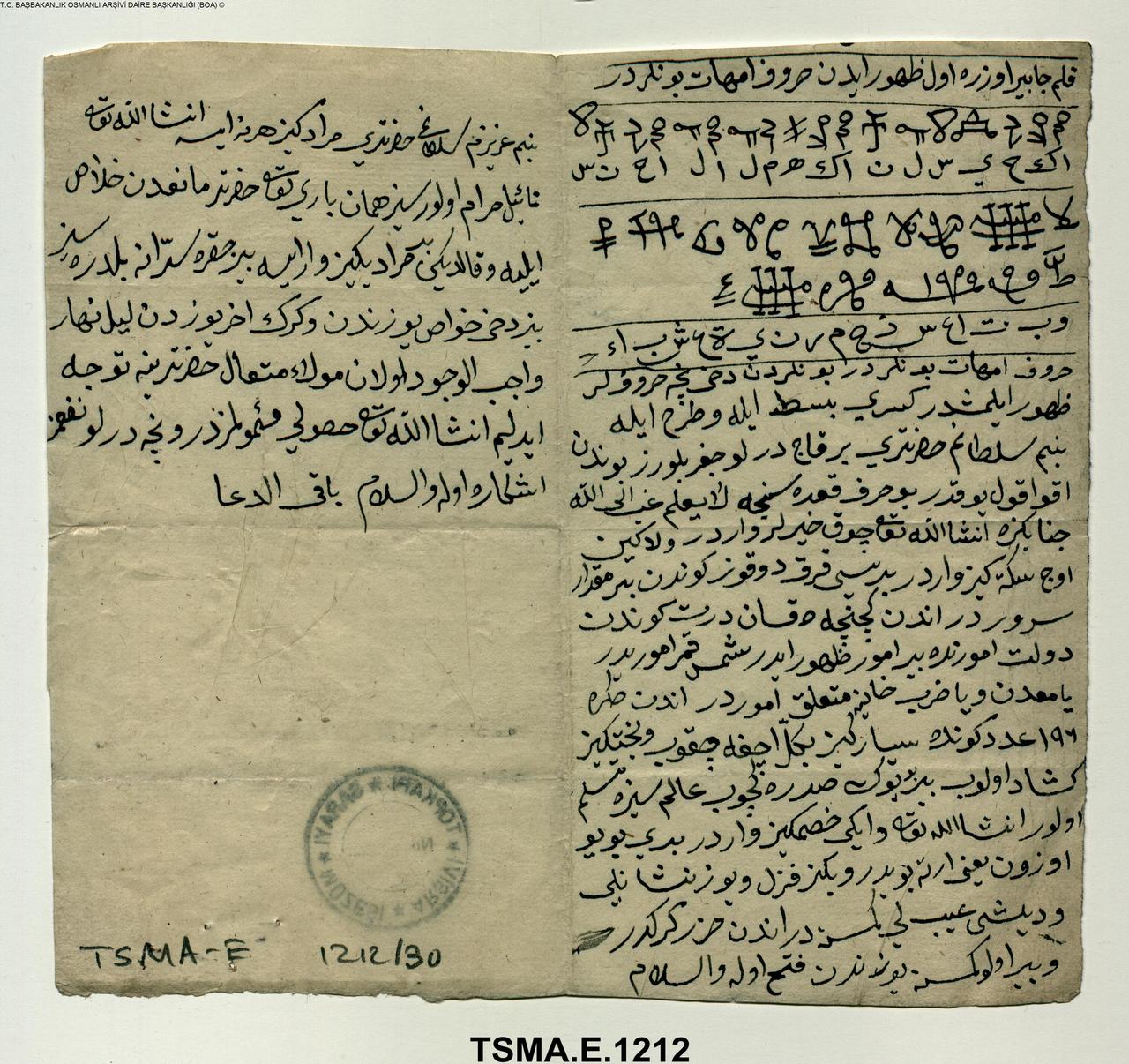
Benim azîzim sultânım hazretleri, murâdınız her ne ise inşallâh-ü tealâ nâil-i murâd olursız, hemân bâri-i tealâ hazretleri ma’niden halâs eyleye ve kaldı ki bir murâdınız var ise biz hâkire sırren bildiresiz, biz dahî havass yüzünden ve gerek ahar yüzünden leyl-i nehâr, vâcibü’l-vücûd olan mevlâ-i müteâl hazretlerine teveccüh edelim. İnşallâhü teala husûlü me’mulünüzdür ve nice dürlü nefhamız aşikâre ola vesselam, bâkiü’d-duâ. Hurûf-ı ümmehât bunlardır, bunlardan dahî nice hurûflar zuhûr eylemiştir. Kesr-i bast ile ve tarh ile benim sultânım hazretleri, birkaç türlü cifr buluruz, bundan akvâ kavl yoktur. Bu cifr kâidesince "ala yağlem gaybi alellah" cenâbınıza inşallâh-ü teâlâ çok hayrlar vardır ve lâkin üç sekteniz vardır. Birisi kırk dokuz günden bir mikdâr sürûrdur. Ondan geçince, doksan dört günde devlet umûrunda bir umûr zuhûr eder. Şems-kamer umurudur ya ma’den veya darp haline müteallik umûrdur andan sonra 196 aded günde seyyârınız (yıldız manasında) bi-külli açığa çıkup ve bahtınız küşâd olup bir büyük sadra geçüp âlem size teslim olur inşallahu teâlâ, ve iki hasmınız vardır. Biri boyu uzun yani arpa boydur ve benzi kızıl ve boz nişanlı ve dişi ayıplı kimesnedir, andan hazer gerekdir ve bir ulu kimesne yüzünden feth ola vesselâm.
Example Text
Devletlü sultânım, hâk-i pây-ı saâdet-bahş-ı kemâ-âsârlarınıza vaz’-ı mâlum ola ki... Sultanımın himmet-i berekâtıyla benim mütalaa-i ilm-i remlden ve hem mütalaa-i ilm-i cifrden ve ulûm-ı garâibden ve acâibden esrârlar zâhir oldu ki neşâtımdan gece ve gündüz karârım yoktur ki hâk-i pâyınıza arz edeyim ki bu asl müjdegâni ve muştuluk peygamber Aleyhisselam zamanından beri üç kimesneden gayrı hiç kimesne vaki olunmamıştır ve bil ki sultânımın esrâr-ı acâibi anlardan irtikâ va’ki olmuştur ki nihâyeti yoktur, bu asl muştuluk hiç padişaha vaki olmamıştır.
The first text, dated approximately 1255 AH/1839 CE, presents a cifr calculation directly composed for the sultan. The practice of using cifr to interpret signs from the future has existed since ancient civilizations. However, in Islam, since only Allah is believed to know the future, this cifr practice in the Ottoman context was not presented as direct foretelling but rather as interpreting signs and warnings. This difficulty is clearly evident in the text: the person performing the cifr felt compelled to preface his interpretation with “ala yağlem gaybi alellah.”
How was this type of amulet applied? The cifr practitioner briefly explained it to the sultan, writing out the symbols and the resulting numbers and letters. Based on this, the primary letters derived from cifr calculations were arranged according to specific rules to generate new letters, from which predictions about the future were made using astrology. The emphasis on the “seyyara”—the recipient’s star—suggests that the practitioner was a skilled astrologer. Thus, producing such an amulet required more than ordinary rukye-han knowledge; mastery of astrology was essential. This type of amulet therefore belongs to the most difficult category. The phrase “three sekteniz vardır” in the text has become a popular tradition still used today in folk fortune-telling, meaning “within three time periods.”
The second text, dated approximately 1100 AH/1689 CE, is significant because it explicitly states which sciences are associated with this type of amulet. According to this text, to create an amulet for receiving news or good tidings from the future, one must be knowledgeable in cifr and reml, as well as in the sciences of acâib and garâib. Combining this with the previous text, producing such an amulet required mastery of vefk, cifr, nücum, and reml—perhaps making it the most complex amulet to create.
Amulets could also be used to ward off evil or to achieve healing. In amulets designed to ward off evil, the aim is to prevent an existing or potential harm. In healing amulets, the aim is either to prevent illness before it occurs or to cure an existing illness.
Example Text
Rikâbdan vârid olmağla icrâsı matlûb-ı hazret-i cihandârîdir. İşbu nüshalar Osman Efendi’ye irsâl olunmak içün irsâl olunmuştur. Bunların ameli sulh nizâm bulmayup avdet olunur ise Orlof ve İrşikof ve Romançuk’un geçecekleri mahalle ber-karîb Osman Efendi defn ettürmeğe say’ eylesün. Üzerinden geçerler ise elbette firara mecbûr olurlar...
Example Text
...Benim inâyetlü velinimetim efendime bergüzâr olarak merhum Nusret Efendi hazretlerinin be-risâlesinden gerek veba ve şirpençe ve sâir çıbanlar zuhur etmemesi içün nüshasını çıkarup duhâncı başınız Mehmed Ağa kulları yediyle taraf-ı devletlerinize irsal olunmuştur. Vusûlünde iç kısmına diküp bu kullarını derûn-ı hatırdan ferâmuş buyurmamanız recâ ve niyâzımızdır...
The first text, dated approximately 1151 AH/1738 CE, describes an interesting amulet composed during peace negotiations of the Ottoman-Russian War of 1735–1739. According to the text, the order to prepare and apply this amulet was transmitted by the Rikab Kaymakamı to the army and explicitly stated to be the sultan’s own request. The amulet’s purpose was to force the Russian peace delegation’s generals to flee if the peace talks failed. Thus, the amulet was fundamentally created to ward off evil.
The ritual involved burying the amulet along the path the targeted individuals would take. This practice, like fumigation, mixing with water for drinking, or wearing on the body, is common because it was generally believed that for the amulet to be effective, it must be close to or on the person.
The second text provides detailed information on healing amulets. Dated approximately 1228 AH/1813 CE, this text describes Osman Efendi sending a protective amulet as a thank-you gift for receiving fabrics from the palace (likely from the Grand Vizier). The ritual of making the amulet is noteworthy: Osman Bey likely created it using a vefk or cifr from the Risale of Nusret Efendi. The work referred to here is the Mucerrebat-ı Nusret, Risale-i Mahzar, or Mahzar Fi’t-tıb, a medical text that begins with healing methods involving vefks and prayers. Osman Efendi probably took one of the vefk examples from this book to create the amulet. Thus, amulets could be custom-made from scratch or constructed using pre-existing vefk templates from such texts.
The instruction to sew the amulet inside the garment aligns with the principle that amulets must be kept close to and hidden from the person. The fact that the illnesses mentioned—plague, smallpox, and boils—were difficult to treat and often fatal further underscores the amulet’s significance.
Even today, amulets are used for conditions such as jaundice, insanity, and depression, and their efficacy is widely accepted among practitioners. Similarly, in Ottoman society, amulets were accepted as one of the methods for coping with psychological problems.
Example Text
Rumili ordu-yı hümâyûnu mensûbânından Girid ceziresinde bulunan Piyâde ikinci nizâmiye alayında Hanya mevki’inde olan üçüncü taburunda birinci bölük beşinci onbaşının birinci neferi Tiranlı Hasan’ın cinci Mehmet Efendi’den almış olduğı nüshanın adem-i te’siriyle nefer-i merkûm kendüsini deryâya ilkâ edere muahharan dahî hamama gidüp ustura ile kendüsini telef etmiş olduğundan mirliva saâdetlü Mehmed Paşa tarafından makâm-ı âli-i cenâb-ı sipahsalâriye takdim kılınan meclis-i askerî mazbatası üzerine fi 18 receb sene 1278 tarihiyle ve on dokuzuncu numeru ile daire-i meclis-i vâlâ-yı ahkâm-ı adliyeden tastıîr buyrulan emrnâme-i sâmi-i cenâb-ı vekâletpenâhîden mûmaileyh Mehmed Efendinin bu bâbda bir fiil-i cismânisi olup şer’an ve kânûnen kâbil-i sübût ise murafaa-i şer’i ve mahkeme-i nizâmisinin rüesâ-yı askerî hâzır bulundukları halde kebîr-i eyâletde mahkeme-i şer’iyyesinin icrâsıyla karar-bend ve nefer-i merkûm cünûn-u sürâba mübtelâ olup mumâileyh Mehmed Efendi’den nüshayı bunun için mi almıştır? Burasının bâ-mazbata ve ilâm-ı şer’i arz-ü inhâ olunması emr-ü femân buyrulmuştur. Ve her bir emr-i fermân-ı ali-i vekâletpenâhîden infâz ve icrâsı müntehim-i zimmet-i refîkimiz bulunmuş ise de merkûm Arap Mehmed ufki fukarâdan olup nefs-i Hanya’da (...) ile (...) ider makûleden olup ve hiçbir ilm-ü hızzda kat’an mâlaûmatı olmayup, bayağı cahilden bulunduğu halde gine muskacılıkta malumatı olduğunu bazı cahil nassa inandırup şu vesile ile bazen ehad-ı nassdan kendüsine müraca’at edenlerin beş on guruşunu ahz ile güyâ müessir nüsha viregelmekte bulunduğı misillü nefer-i merkûmla dahî buluşarak bir nüsha vermiş ise de bir güne tesiri olmadığın üzerine, verdiği nüsha ücretinin istirdâdı hakkında nefer-i merkûmla miyânlarında münaza’a ve mudarebe vuku’ bulmuş ve Merkum Mehmed zabtiye karakolu tarafından ahz ve kirfetle tevkif olunmuş ise de icrâ-yı muhakemesine dair hiçbir tarafdan ifade ve şikâyet vuku’ bulmayup müddet-i hapsi dahî uzamış, vefk-i hali mülasebesiyle duçar-ı müzâyaka olunmuş idüğinden sebeble bi’t-tahliye bundan beş buçuk mâh mukaddem bu tarafdan muhârefet iderek memleketi olan Edirne’ye azîmet etmiş ve bu defa tahkikat-ı lâzıme dahi icrâ olunmuş ise de nefer-i merkum illet-i cünûn-ı sürâba mübtelâ olmasından dolayı merkûmdan bunun içün nüsha aldığına dair bir güne malumat-ı sahihâ dahi istihsâl olunamadığı gibi münazaa-i mezkûrın vukuından tahminen bir mâh mürûrundan sonra nefer-i merkûm hamamda kendi kendine kasd eylediği anlaşılmış olduğundan vuku-ı hâlin arz-ı hikayesine ictisâr kılındı...
This document, dated 1278 AH/1861 CE, presents an example of an amulet created to address psychological distress. Although no details are given on how the amulet was made, two points stand out. First, the accusation against Cinci Mehmed Efendi is striking: he is accused because his amulet failed to work, and it is formally questioned whether he wrote the amulet to treat the soldier’s insanity. Moreover, he was later sued by Hasan, who eventually committed suicide. Thus, making amulets was not an unregulated practice; rather, those who made them were expected to deliver results and were subject to scrutiny. Here, it is implied that if Mehmed Efendi had proven he wrote the amulet for the soldier’s insanity, he would have been punished.
The same text also emphasizes that Mehmed Efendi had no knowledge of this field. Conversely, this implies that others with such knowledge did exist and were believed to produce effective amulets. Another important point is the term “cinci.” In Ottoman documents, those who made amulets are typically called nüshacı, muskacı, remmal, müneccim, or rukye-han. The fact that a “cinci” was consulted in this case of insanity suggests that such practitioners were more commonly associated with psychological phenomena.
In conclusion, muskacılık—the art of making amulets, a subcategory of magic and talisman-making—has been influential across all cultures since ancient civilizations. In the Ottoman Empire, it emerged as nüshacılık, rukye-hanlık, or remmallık. The various forms of amulets created by muskacılar were used for a wide range of purposes: warding off evil, attracting blessings, opening fortune, curing insanity, achieving healing, fulfilling desires, receiving signs from the future, and fostering affection between people—and they continue to be used for these purposes today.
Appendix-1
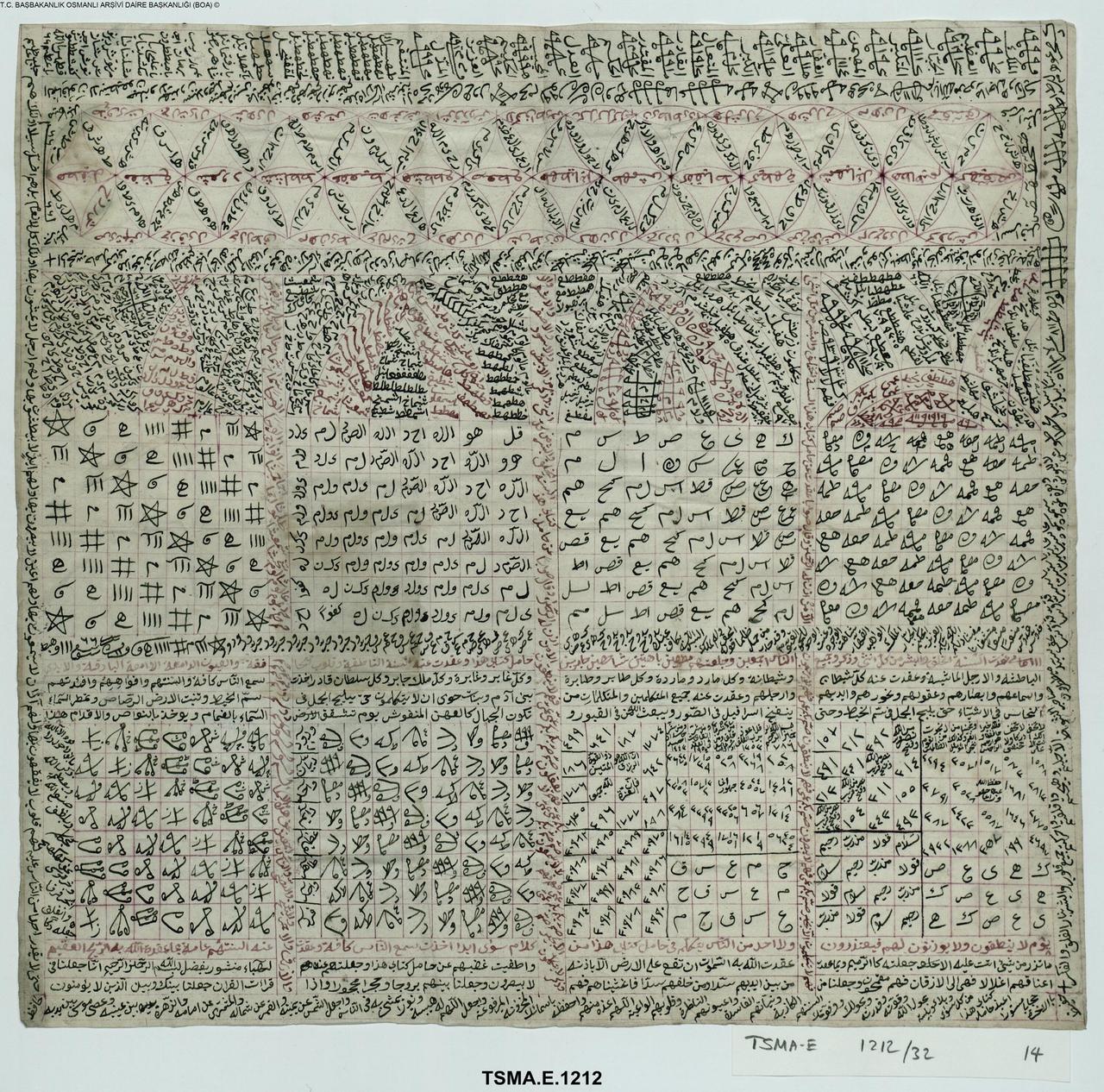
A highly complex amulet example incorporating vefk, cifr, and nücum calculations, along with numerous known and unknown symbols, names, numbers, and verses. The six-pointed star of Sulayman, the letter mim, the ladder, and the four lines on the left center are common symbols, while the symbols immediately below are rarer.
Appendix-2
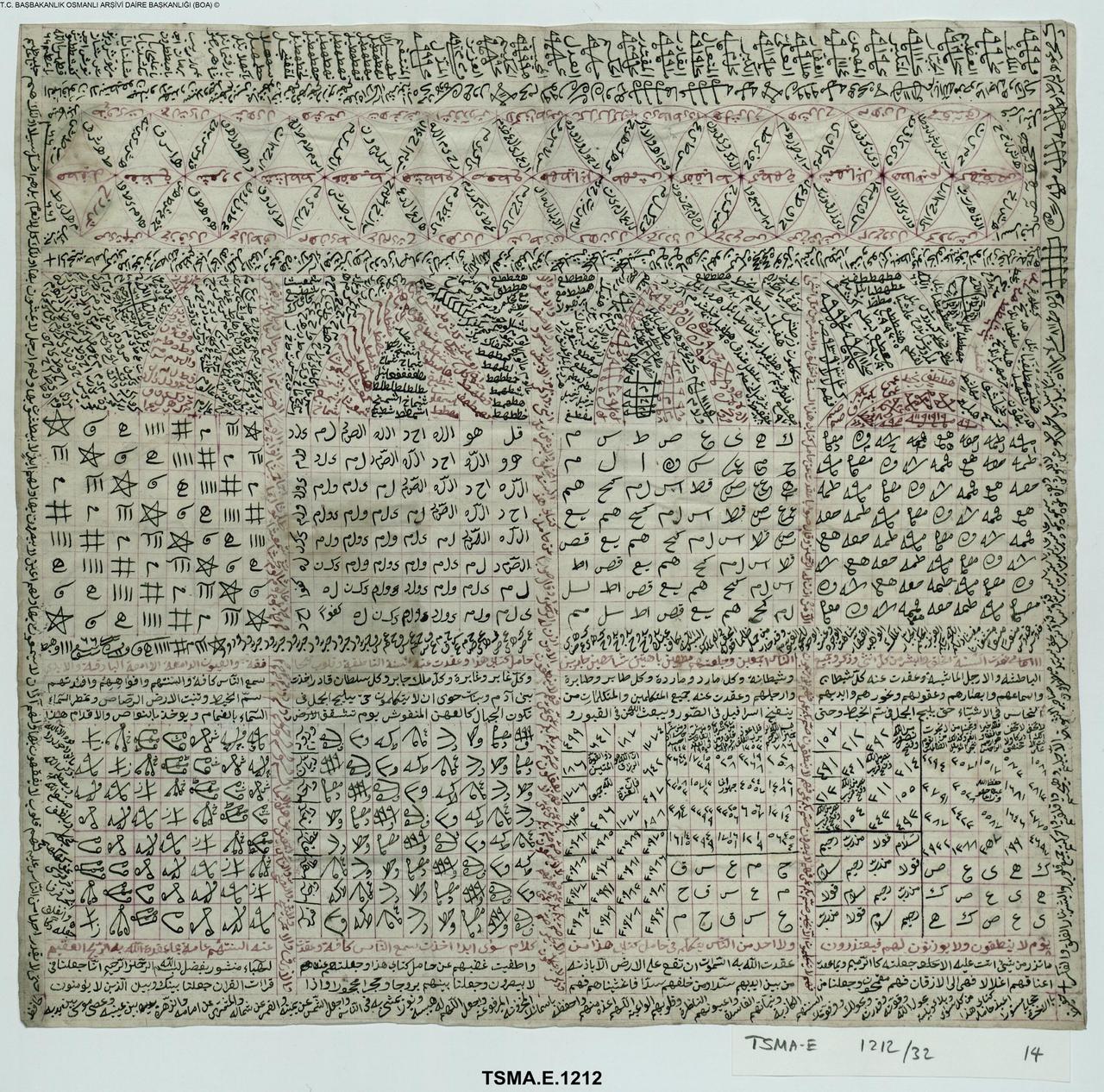
An amulet example with a 7x7 vefk created by dividing the verses of Surah Al-Fatiha and writing their cifr numerical values (left to right: 1-Bismillahirrahmanirrahim, 2-elhamdulillahi rabbil alemin errahmanirrahim, 3-maliki yevmiddin, 4-iyyake nağbudu ve iyyake nestain, 5-ihdinessıratal müstakim sıratellezine, 6-enamte aleyhim, 7-gayril mağzubi aleyhim veleddallin; center: Allahım ilka-i devleti ve kudreti ve kuvveti vermesi bi-inayetallahu teala zikr).
Appendix-3
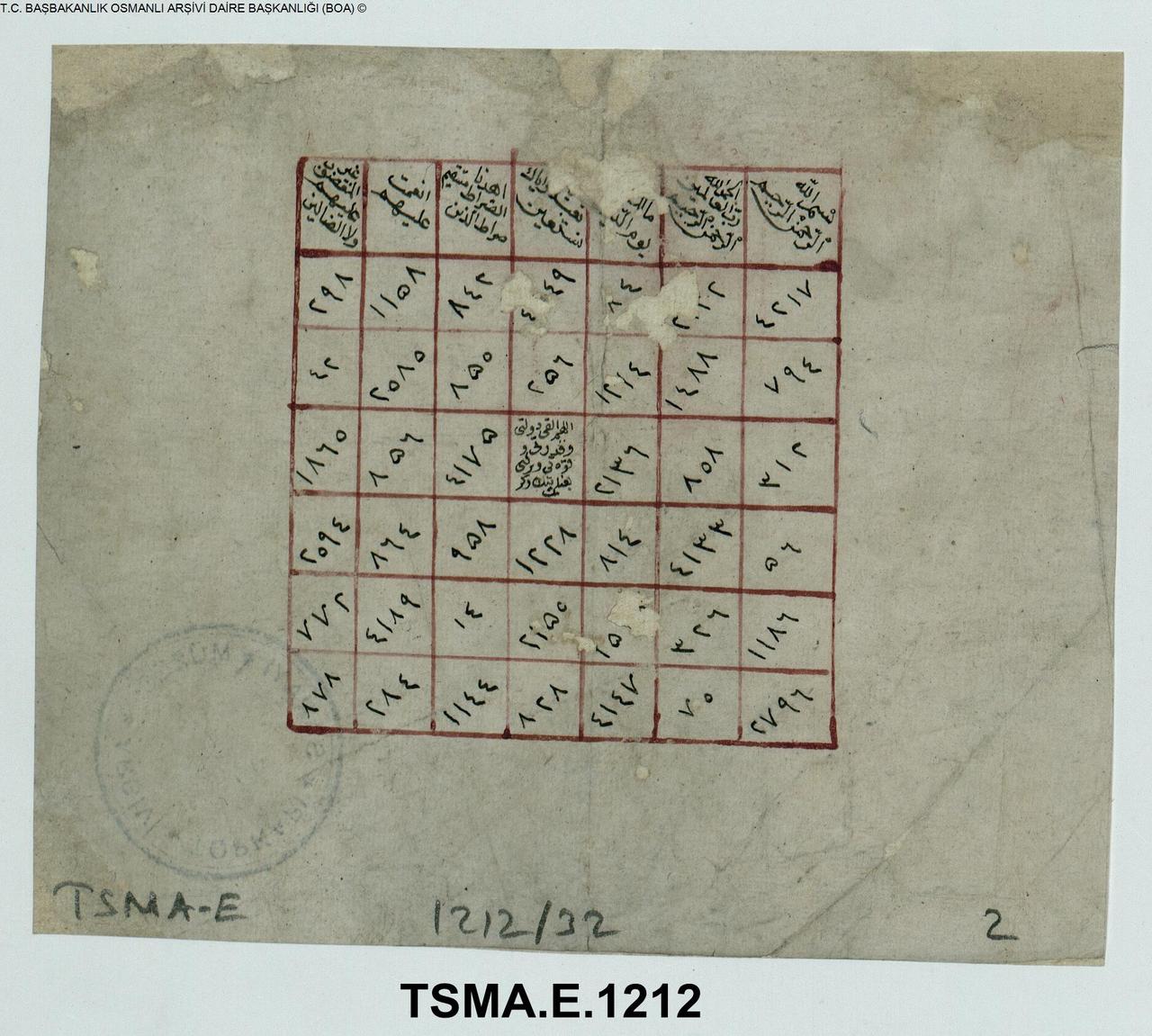
An example of a vefk created by deriving numbers and corresponding letters from the days of the month and week according to cifr calculations.
Appendix-4
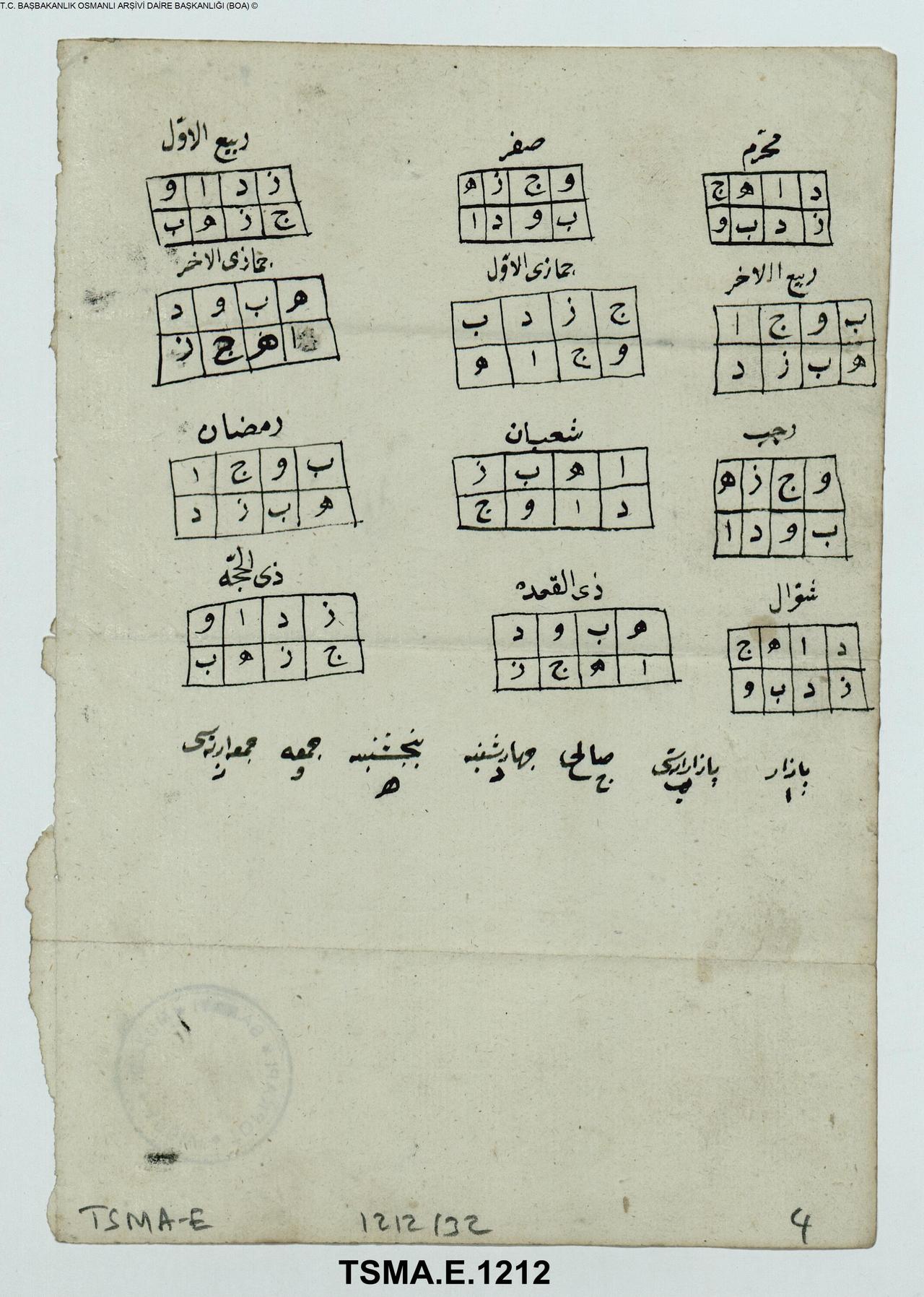
An amulet example featuring a 9x8 vefk arranged according to cifr calculations and containing inscriptions. The irregularity of the vefks and writings suggests they were hastily made or not produced by a professional hand.
Appendix-5
A document containing the written and diagrammatic explanation of a cifr calculation composed for the sultan.
Appendix-6
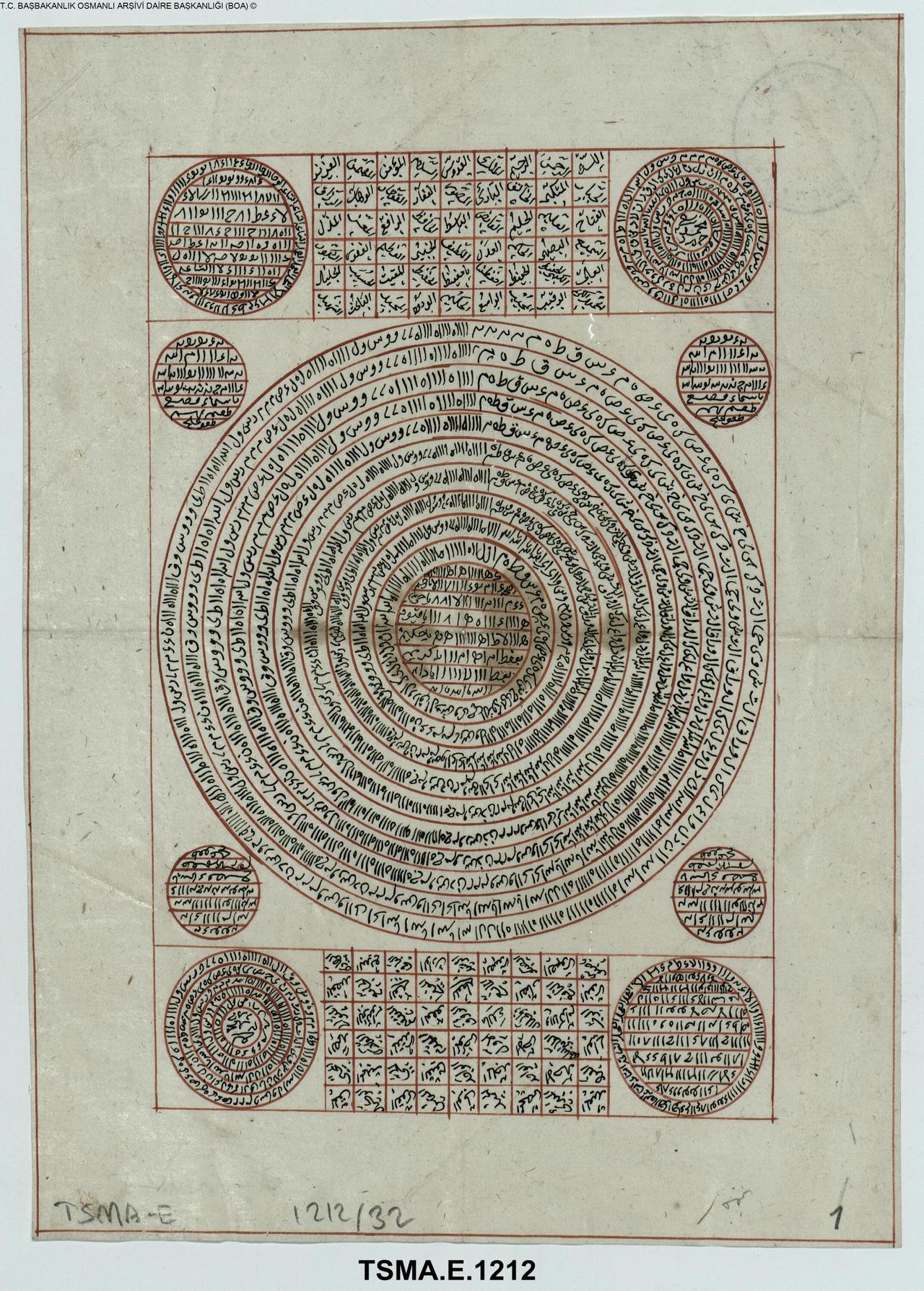
An amulet example featuring a 9x6 vefk with two opposing vefks, incorporating the names of Allah, cifr, and nücum calculations. The use of circular vefks and the presence of twelve circles in the center indicate heavy reliance on astrological knowledge. It is likely that the cifr equivalents of Allah’s names were used in the cifr calculations.
Appendix-7
An amulet example featuring a 7x6 vefk composed primarily of symbols.
Archival Sources
Ayşe, Yanardağ. "Osmanlı Devleti’nde Islahatlar Bağlamında Muska ve Falcılıkla Mücadele Örnekleri", Milli Folklor Dergisi, no. 30, (Sivas 2018)
BOA, Ottoman Archives. Meclis-i Vala [MVL]. File No. 788, Shirt No. 22.
BOA, Ottoman Archives. Nezaret veDevair Evrakı [A.MKT.NZD.]. File No. 295, Shirt No. 62.
BOA, Ottoman Archives.Topkapı Sarayı Museum Archives [TS.MA.e]. File No. 1212, Shirt No. 30.
BOA, Ottoman Archives.Topkapı Sarayı Museum Archives [TS.MA.e]. File No. 1212, Shirt No. 32.
BOA, Ottoman Archives.Topkapı Sarayı Museum Archives [TS.MA.e]. File No. 304, Shirt No. 69.
BOA, Ottoman Archives.Topkapı Sarayı Museum Archives [TS.MA.e]. File No. 655, Shirt No. 19.
BOA, Ottoman Archives.Topkapı Sarayı Museum Archives [TS.MA.e]. File No. 671, Shirt No. 27.
BOA, Ottoman Archives.Topkapı Sarayı Museum Archives [TS.MA.e]. File No. 865, Shirt No. 72.
BOA, Ottoman Archives.Topkapı Sarayı Museum Archives [TS.MA.e]. File No. 868, Shirt No. 24.
BOA, Ottoman Archives.Yıldız Esas Documents [Y..EE..]. File No. 37, Shirt No. 75.
Hayrunnisa, Turan. "Kudüs ve Yafa’daki Bazı Örnekler Işığında Osmanlı Tılsımları", Uluslararası Sosyal Araştırmalar Dergisi, Volume 11, no. 55, (2018)
Hikmet Tanyu, "Büyü", DİA, VI, 501-506
Kürşat Demirci, "Muska", DİA, XXXI, 265-267.
Metin Yurdagür, "Cefr", DİA, XXII, 124-126.
Research Works
Serkan, Çınar. "Ebubekir Nusret Efendi’nin Risale-i Nusret Efendi Adlı Eseri", Karabük Üniversitesi Sosyal Bilimler Enstitüsü, Türk Dili ve Edebiyatı Anabilim Dalı, Master's thesis, (Karabük 2019)
Tevfik Fehd, "İlm-i Ahkam-ı Nücum", DİA, XXXV, 219-222.
İlyas Çelebi, "Muska", DİA, XXXI, 267-269.
İlyas Çelebi, "Rukye", DİA, XXXV, 219-222.
İlyas Çelebi, "Sihir", DİA, XXXVII, 170-172.
İlyas Çelebi, "Tılsım", DİA, XLI, 91-94.
İlyas Çelebi, "Vefk", DİA, XLII, 605-607.
[1]
İlm-i nücum: Yıldızlar ilmi demektir. Bugünkü astronomi ve astrolojinin bir birleşimidir.
İlm-i cifr: Sayılar ve harfler ilmidir. Arapça her bir harfin bir sayı değerine sahip olduğuna inanıldığından ortaya çıkmıştır. Sayılar ve harflerin uyum içinde kullanılarak belli etkiler elde edilmesine dayanır.
İlm-i reml: Fal ilmidir. Gelecekten haber alma ile ilgili her türlü mesele ile alakalıdır.
[2]
Bu ikisinin eserlerinin ismi aynı olduğundan bir arada yazılmıştır.
[3]
Pençe-i âl-i âbâ olarak da bilinir.

Muskat Cultivation in the Ottoman Empire
Origin | 14th century | ||||||||
|---|---|---|---|---|---|---|---|---|---|
Type | Talisman | ||||||||
Purpose of Use | To protect To be freed from a misfortune To harm an enemy To be freed from psychological problems To attain a position or rank To find healing To make oneself liked | ||||||||
Amulet Makers | Astrologers, sorcerers, and charmers | ||||||||
No Discussion Added Yet
Start discussion for "Muskat Cultivation in the Ottoman Empire" article
Definition of the Amulet
A Brief History of the Amulet
Vefk and Cifr
Types of Amulets and Symbols Used in Amulets
1. Amulets According to Material Used
2. Amulets According to Method of Writing
Purposes and Rituals of Amulets
1. Amulets Used to Foster Affection Between People
2. Amulets Used to Receive Signs from the Future
3. Amulets Used to Ward Off Evil and for Healing
4. Use and Efficacy of Amulets in Psychological Disorders
Appendices