This article was automatically translated from the original Turkish version.
+1 More
Location | Muş Türkiye | ||||||||
|---|---|---|---|---|---|---|---|---|---|
Building Sections | Archaeological Halls, Ethnographic Hall, Sultan Alparslan and Battle of Manzikert Hall, Children's Education Area | ||||||||
Collections | Archaeological artifacts spanning from the Chalcolithic Age to the Ottoman Empire; ethnographic objects from the Ottoman period | ||||||||
Muş Museum is a museum established in Muş Province, in Türkiye’s Eastern Anatolia Region, with the aim of preserving, researching, and exhibiting the region’s archaeological and ethnographic heritage. The museum opened in 2021 after the restoration of the Atatürk Primary School building, which was constructed in 1937 and completed in 1938. Operating under the Ministry of Culture and Tourism, the institution presents the region’s historical continuity through its chronological archaeological collections, ethnographic artifacts, and specialized thematic galleries.
The museum’s building was originally constructed during the early years of the Republic as an educational institution—the Atatürk Primary School. After being used for educational purposes for many years, the structure underwent a functional transformation, was restored, and acquired its identity as a museum. Since its opening to the public in 2021, the museum has been used to display the city’s cultural heritage and to preserve artifacts recovered from the region.
At its opening, the museum’s primary objective was to ensure the in-situ preservation of artifacts obtained through archaeological excavations, surface surveys, and acquisitions in Muş and its surroundings. Previously, many finds from the region had been sent to museums in other provinces, but with the establishment of Muş Museum, these artifacts began to be exhibited within their original geographical context.
The ground floor of Muş Museum houses archaeological exhibition halls, displaying artifacts spanning a broad historical range from the Chalcolithic Age to the Ottoman period.
The collection includes finds from the Early, Middle, and Late Bronze Age; objects from the Iron Age—particularly those associated with the Urartian culture; Hellenistic and Roman period artifacts; examples from the Eastern Roman (Byzantine) era; and remnants from the Seljuk and Ottoman periods. This section features terracotta figurines, votive tablets, tombstones, stone endowments, seals, pottery samples, and various metal objects.
The exhibited artifacts are significant not only for their aesthetic value but also for the insights they provide into the lifestyle, belief systems, and social organization of their respective eras. The chronological arrangement enables visitors to trace the cultural development of Muş and its surroundings throughout history.
The second floor of the museum contains an ethnographic gallery displaying everyday objects from the Ottoman period. This section consists primarily of artifacts reflecting Ottoman culture of the 19th and 20th centuries.
The exhibited objects include necklaces, belts, belt buckles, bracelets, headpieces, healing bowls, vases, candlesticks, coffee pots, mouthpieces, coffee grinders, swords, scabbards, powder flasks, and pistols. Most of these items are made of silver, bronze, and brass, reflecting the craftsmanship and aesthetic sensibilities of the period. They also offer economic, social, and cultural insights into Ottoman societal life.
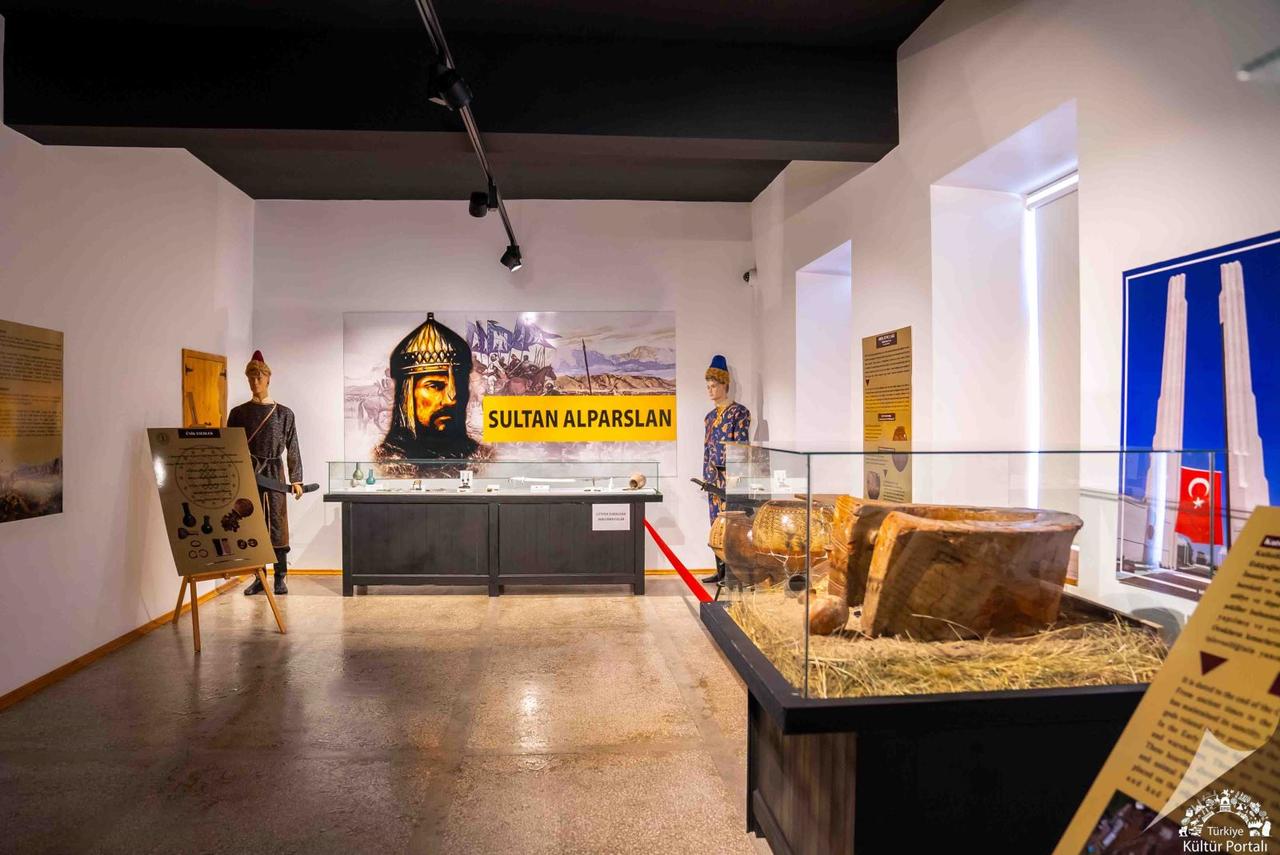
One of the most notable sections of Muş Museum is a dedicated gallery honoring Sultan Alparslan and the 1071 Battle of Manzikert. This gallery features informational panels on Sultan Alparslan, visual materials illustrating the strategic importance of the battle, and explanatory materials.
In addition, artifacts uncovered through the project “Identification, Historical and Archaeological Surface Survey of the Manzikert Battlefield” will also be displayed in the museum. In this way, the museum fulfills not only an archaeological function but also assumes a thematic historical narrative role.
In addition to preserving and promoting cultural heritage, Muş Museum serves an educational purpose. A dedicated educational space for children has been established within the museum. This area is designed to foster historical awareness and cultivate interest in archaeology and ethnography among young visitors. Workshops and hands-on activities strengthen the museum’s pedagogical dimension.
Muş Museum is an important center that exhibits not only archaeological and ethnographic artifacts but also the historical layers of Anatolia. The museum is open to visitors six days a week, from 08:00 to 17:00, and is closed on Mondays. Admission is free.
The historical journey offered by the museum illuminates Muş’s role in the transitions of civilizations in Anatolia. Visitors have the opportunity to examine both local finds and broader historical contexts, and to gain information on significant historical events such as the Battle of Manzikert through special exhibition areas.
Engin, Hatice. “Muş Müzesi.” *Türkiye Turizm Ansiklopedisi*, 2025. Accessed August 16, 2025. https://turkiyeturizmansiklopedisi.com/mus-muzesi.
Muş Museum Directorate. "Cultural Assets and Museums General Directorate," Ministry of Culture and Tourism of the Republic of Turkey. Accessed August 16, 2025. https://kvmgm.ktb.gov.tr/TR-292570/mus-muze-mudurlugu.html.
“Museums in Muş Set Out on a Journey from the Battle of Malazgirt to the National Struggle.” *Anadolu Ajansı*, May 23, 2023. Accessed August 16, 2025. https://www.aa.com.tr/tr/kultur/mustaki-muzeler-malazgirt-zaferinden-milli-mucadeleye-uzanan-donemde-yolculuga-cikariyor/2903958.
“Muş Müzesi.” Turkish Museums. Accessed August 16, 2025. https://www.turkishmuseums.com/museum/detail/22346-mus-muzesi/22346/1.
“Muş Müzesi.” Türkiye Kültür Portalı. Accessed August 16, 2025. https://www.kulturportali.gov.tr/turkiye/mus/gezilecekyer/mus-muzesi.
Location | Muş Türkiye | ||||||||
|---|---|---|---|---|---|---|---|---|---|
Building Sections | Archaeological Halls, Ethnographic Hall, Sultan Alparslan and Battle of Manzikert Hall, Children's Education Area | ||||||||
Collections | Archaeological artifacts spanning from the Chalcolithic Age to the Ottoman Empire; ethnographic objects from the Ottoman period | ||||||||
History
Archaeological Galleries
Ethnographic Gallery
Sultan Alparslan and the Battle of Manzikert Gallery
Educational and Pedagogical Function
Muş Museum Today