


This article was automatically translated from the original Turkish version.
MQTT (Message Queuing Telemetry Transport)
Principle(s) of Operation | Publish-subscribe | ||||||||
|---|---|---|---|---|---|---|---|---|---|
Field of Use | Smart Homes Agricultural Technologies Medical Devices Industry | ||||||||
MQTT (Message Queuing Telemetry Transport) is a lightweight and efficient messaging protocol designed to enable communication between devices with limited bandwidth and power. Embedded systems, Internet of Things (IoT) devices, and industrial automation systems widely use this protocol, which is based on a client-server model.
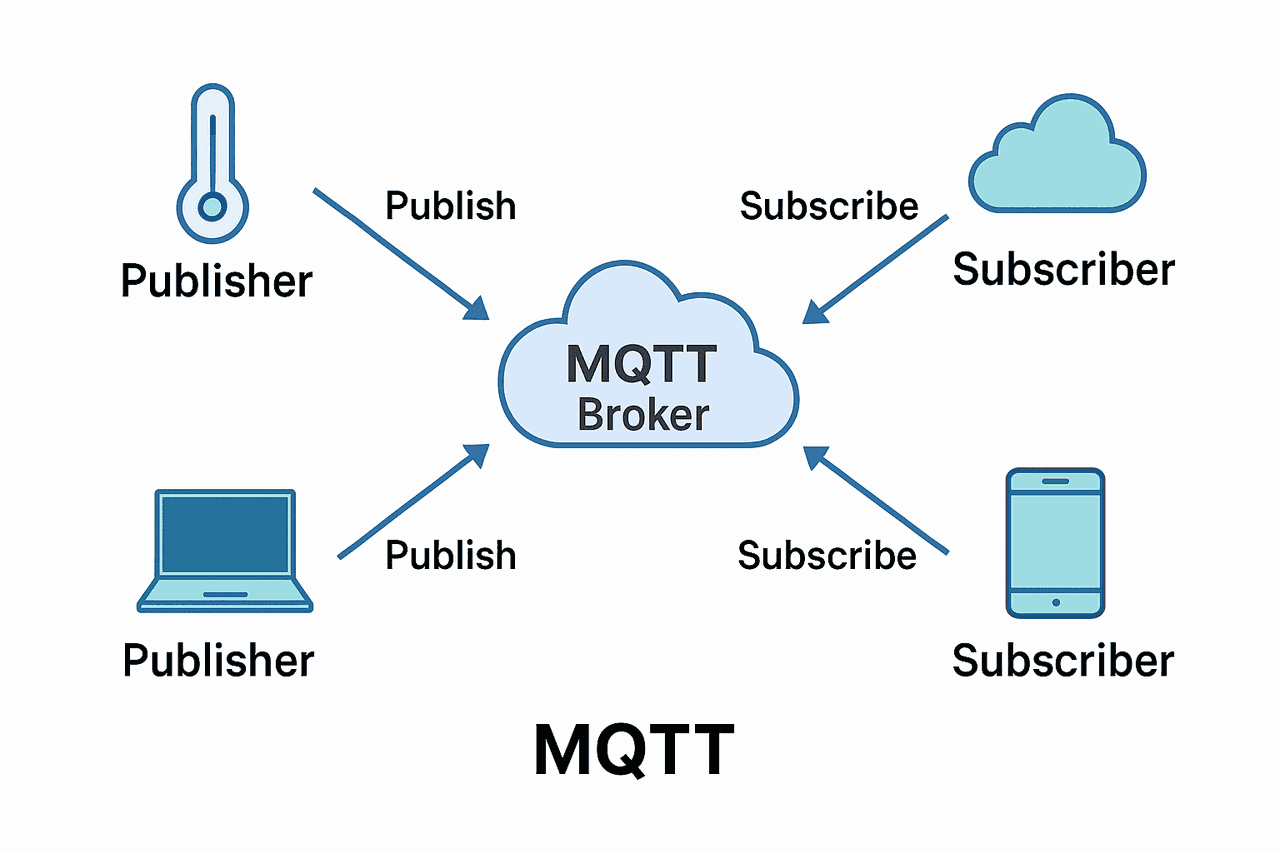
MQTT operates on a messaging logic between clients and a server (broker). In this structure, messages are published over a specific topic and received by subscribers. This mechanism is known as the publish/subscribe model.
The broker is the central component that manages the transmission of MQTT messages. Its role is to deliver published messages to the relevant subscribers. By preventing clients from communicating directly with each other, the broker optimizes network traffic and regulates data flow.
MQTT clients are applications that communicate with the broker by publishing messages or subscribing to them. Clients are typically IoT devices, sensors, mobile applications, or desktop programs.
MQTT enables communication based on the publish/subscribe model. When a client publishes a message to a specific topic, other clients subscribed to that topic receive the message.
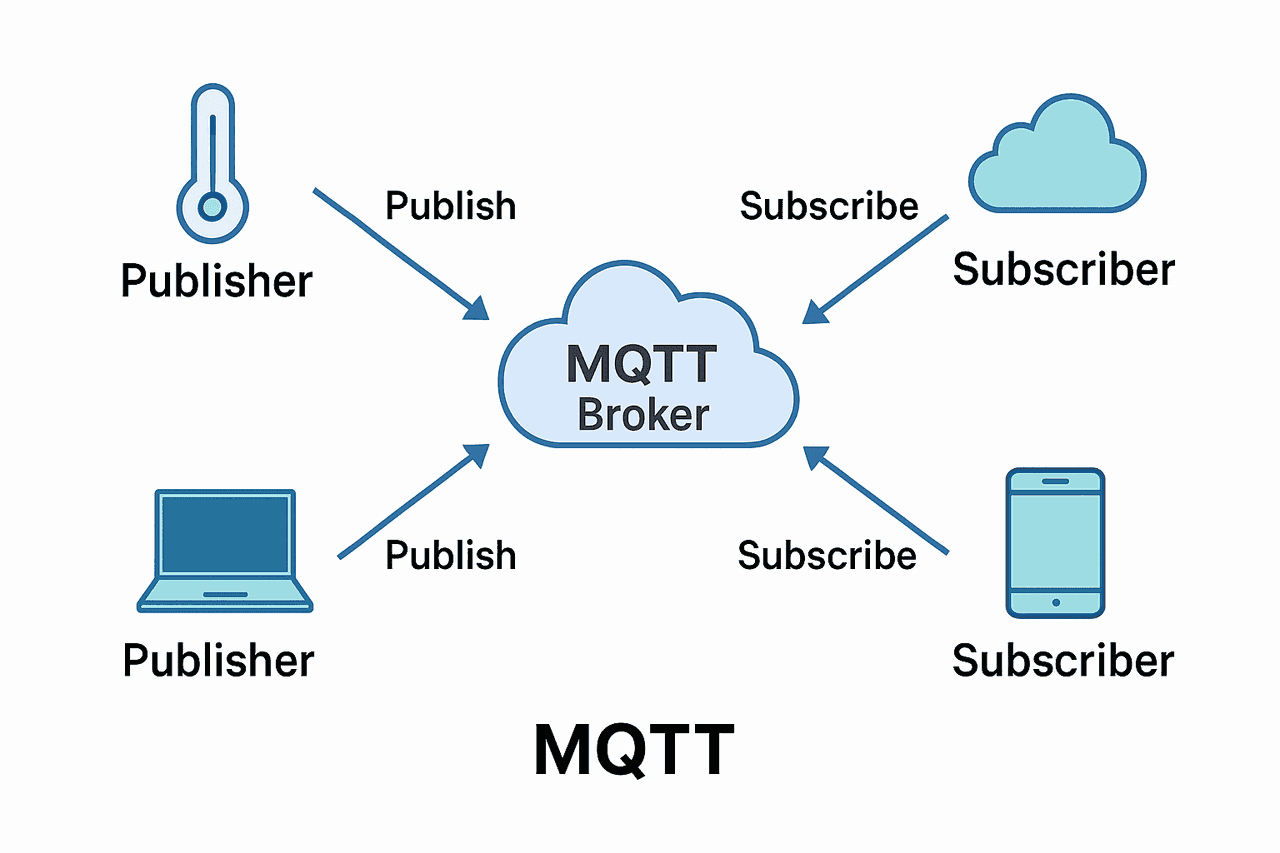
MQTT protocol diagram showing how it works. (Drawn with YZ)
MQTT offers three different quality of service levels for message delivery:
MQTT provides flexibility in connection states through the "clean session" and "persistent session" features, rather than requiring clients to maintain constant connections.
MQTT is widely used across various industries:
MQTT’s advantages include its bandwidth-friendly design, simple messaging model, and support for security. However, it also has certain limitations such as network security and scalability. To ensure secure use of MQTT, additional measures such as TLS/SSL must be implemented.
MQTT.org. "MQTT: The Standard for IoT Messaging." Accessed April 1, 2025.https://mqtt.org.
Oğuz, O., and V. C. Güngör. "IoT Sistemlerinde MQTT ve CoAP Protokollerinin Karşılaştırılması." Ostim Teknik Üniversitesi Mühendislik Fakültesi Dergisi 4, no. 2 (2021): 85–99.
T.C. Sanayi ve Teknoloji Bakanlığı. Nesnelerin İnterneti Teknoloji Raporu. Ankara: Sanayi ve Teknoloji Bakanlığı Yayınları, 2022.

MQTT (Message Queuing Telemetry Transport)
Principle(s) of Operation | Publish-subscribe | ||||||||
|---|---|---|---|---|---|---|---|---|---|
Field of Use | Smart Homes Agricultural Technologies Medical Devices Industry | ||||||||
No Discussion Added Yet
Start discussion for "MQTT (Message Queuing Telemetry Transport)" article
General Structure of MQTT
Broker
Client
Core Components of MQTT
Message Publishing and Subscription
Quality of Service (QoS) Levels
Persistent Connections
Use Cases
Advantages and Limitations