This article was automatically translated from the original Turkish version.
+1 More
Official Name | Mostar Bridge | ||||||||
|---|---|---|---|---|---|---|---|---|---|
Location | Bosnia and Herzegovina Mostar | ||||||||
Architect | Architect Hayreddin | ||||||||
Construction Date | 1557 - 1566 | ||||||||
Architectural Style | Classical Ottoman Architecture | ||||||||
Material | Tenelija (Local limestone) Iron clamps Lead | ||||||||
Demolition Date | 9 November 1993 | ||||||||
Reopening | 23 July 2004 | ||||||||
UNESCO Status | World Heritage List since 2005 | ||||||||
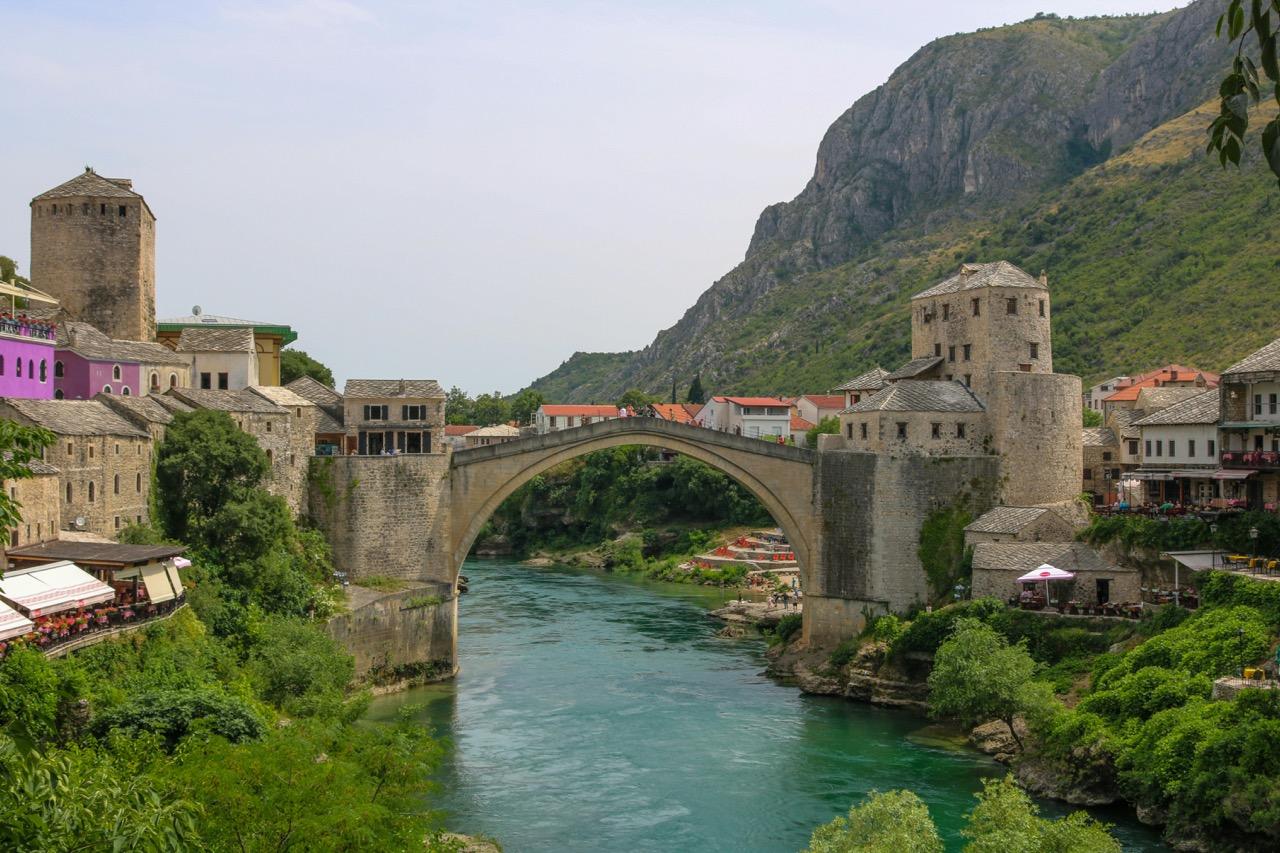
Mostar Bridge is a monumental stone bridge located over the Neretva River in the city of Mostar, Bosnia and Herzegovina, constructed in the 16th century by the Ottoman State.
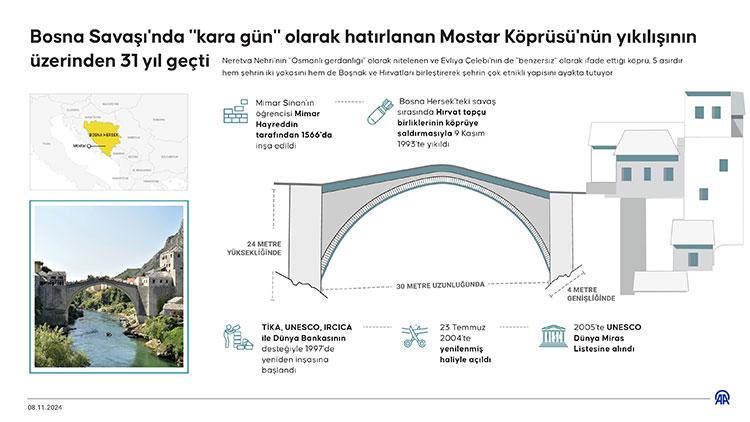
Mostar Bridge’s construction dates back to the mid-16th century. In Mostar, the central city of Herzegovina, the previous wooden bridge could no longer meet strategic and commercial needs. As a result, the reigning sultan, Kanuni Sultan Süleyman, ordered the construction of a new stone bridge. The project was entrusted to Mimar Hayreddin, a student of Mimar Sinan, one of the greatest names in Turkish architectural history. Construction began in 1557 under the supervision of Karagöz Bey. Due to the river’s flow and challenging geographical conditions, the construction lasted nine years and was completed in 1566.
Mimar Hayreddin applied his master Sinan’s engineering principles to place a stone arch at the narrowest and steepest point of the river. Upon completion, the structure was initially called “Kudret Kemeri” by Aşık Çelebi and later described by the famous traveler Evliya Çelebi as “Kavs-i Kuzah” (Rainbow). 【1】 The stones used in construction, known locally as “tenelija,” were bound together with iron clamps and poured lead, ensuring the bridge’s resilience against natural disasters and wars for centuries. Standing for 427 years from 1566 until its destruction in 1993, the bridge was reconstructed in 2004 according to its original design.
class=\
Built in the classical Ottoman architectural style as a single-arched pointed bridge, it was carefully positioned at the narrowest point of the Neretva River, resting on steep rocky banks on both sides through precise static calculations. The bridge’s architectural feature is its design, rising approximately 24 meters above river level and spanning 28.59 meters with a single arch. The 456 specially cut limestone blocks known as “tenelija” hardened upon exposure to air, enhancing the bridge’s strength. The stones were bound together with iron clamps and poured molten lead, making the structure resistant to vibrations and currents. The walkway, approximately 4 meters wide, was paved with stepped stones to prevent slips by pedestrians and animals, and stone railings 95 cm high were installed on both sides.
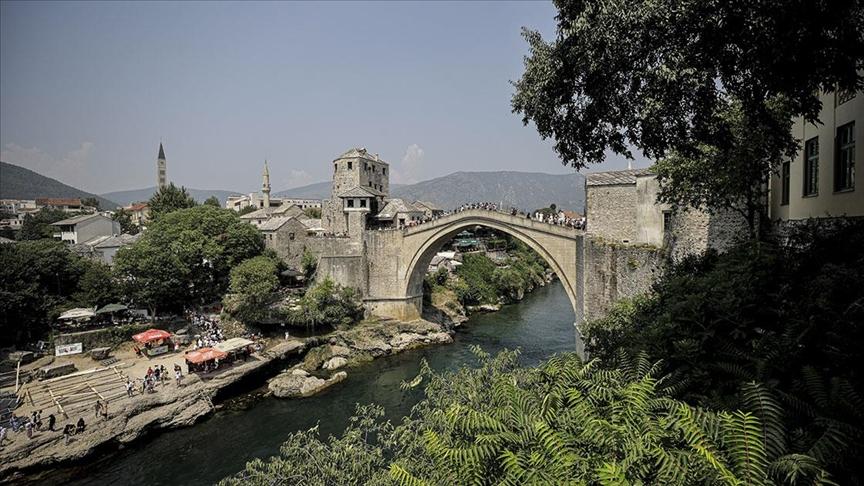
On both sides of Mostar Bridge, two small fortresses were built during the Ottoman period. The Herceguša (Tara) Fortress on the left and the Čelovina (Halebinovka) Fortress on the right served to support the bridge’s defensive and control functions. On the left bank stands a mosque attributed to Sultan Selim II, which had no minaret; it is reported that until 1878 the muezzin recited the call to prayer from the center of the bridge. 【2】 Historical sources also indicate that at one time a water channel ran across the bridge. 【3】
class=\
For centuries, Mostar Bridge has been regarded as a symbol of tolerance, multiculturalism and coexistence in Bosnia and Herzegovina. Evliya Çelebi described the bridge as “unique” in his Seyahatnâme, stating that he had never seen its like among all the bridges he had encountered. 【4】 During the Ottoman period, the bridge served as a unifying element bringing together different ethnic and religious communities, including Bosniaks and Croats. Indeed, the public regarded the bridge as “a piece of themselves,” embedding it deeply in collective memory.
Since the Ottoman period, Mostar Bridge has also been known as a site where young men demonstrated their courage by diving into the Neretva River. According to tradition, local men would jump from the bridge before their weddings to prove their bravery to their fiancées. After World War II, this practice evolved into a sporting activity and today has become a tourist spectacle. Currently, young divers perform the jump in exchange for a fee paid by tourists, continuing the tradition.
During the wars in the Balkans in the 1990s, Mostar Bridge became a military target due to its cultural and symbolic value. In 1992, during the Mostar phase of the Bosnian War, clashes erupted between the Croatian Defence Council (HVO) and the Army of the Republic of Bosnia and Herzegovina. The bridge, which ensured the city’s logistical integrity, was subjected to systematic bombardment by Croatian artillery units on 8 November 1993. As a result of sustained attacks using tanks and heavy weapons, the 427-year-old Ottoman structure lost its structural integrity and collapsed completely into the Neretva River on the morning of 9 November 1993 at 10:16. 【5】
class=\
Efforts to reconstruct Mostar Bridge according to its original design began in 1997 with the support of the Turkish Cooperation and Coordination Agency (TİKA), UNESCO, the World Bank, and other international organizations. 【6】 During reconstruction, original stones recovered from the riverbed by Hungarian divers were reused. The bridge was rebuilt by a Turkish company using traditional techniques. A total of 456 stone molds were used in the reconstruction. 【7】 The bridge was officially reopened on 23 July 2004 in a ceremony attended by high-level representatives from numerous countries.
class=\
Following its reconstruction, Mostar Bridge, together with the old town of Mostar, was inscribed on the UNESCO World Heritage List in 2005. 【8】 Today, Mostar Bridge is one of the most visited historical sites in the Balkans and in Bosnia and Herzegovina.
Anadolu Ajansı. "Bosna Hersek'teki Osmanlı mirası Mostar Köprüsü'nün yeniden açılmasının 19'uncu yılı." Accessed December 25, 2025.https://www.aa.com.tr/tr/kultur/bosna-hersekteki-osmanli-mirasi-mostar-koprusunun-yeniden-acilmasinin-19uncu-yili/2952372
Anadolu Ajansı. "Bosna Hersek'teki Osmanlı mirası Mostar Köprüsü'nün yıkılışının 32. yılı." Accessed December 25, 2025.https://www.aa.com.tr/tr/kultur/bosna-hersekteki-osmanli-mirasi-mostar-koprusunun-yikilisinin-32-yili/3738238
Anadolu Ajansı. "Bosna Savaşı'nda "kara gün" olarak hatırlanan Mostar Köprüsü'nün yıkılışının üzerinden 31 yıl geçti." Accessed December 25, 2025.
Aruçi, Muhammed. "MOSTAR KÖPRÜSÜ." *TDV İslam Ansiklopedisi*. Accessed December 25, 2025.https://islamansiklopedisi.org.tr/mostar-koprusu
Büyükokuroğlu, Muhterem Esma. "Mostar, Federation of Bosnia and Herzegovina, Bosnia and Herzegovina." Pexels. Accessed December 25, 2025.https://www.pexels.com/tr-tr/fotograf/evler-binalar-yapilar-dag-12722622/
SERT, Halide. "MOSTAR KÖPRÜSÜ/BOSNA-HERSEK." Atatürk Kültür, Dil ve Tarih Yüksek Kurumu, pp. 2735–2750. Accessed December 25, 2025.https://www.ayk.gov.tr/wp-content/uploads/2015/01/SERT-Halide-MOSTAR-K%C3%96PR%C3%9CS%C3%9C-BOSNA-HERSEK.pdf
T.C. Ministry of Foreign Affairs. "Mostar Başkonsolosluğu the Historical Sites in and around Mostar." T.C. Ministry of Foreign Affairs – Consulate General of Mostar. Accessed December 25, 2025.https://mostar-bk.mfa.gov.tr/Mission/ShowInfoNote/338102
TRT Avaz. "Mostar Köprüsü." YouTube Video, October 16, 2024. Accessed December 25, 2025.https://www.youtube.com/watch?v=D2hUAKzdUZo
TRT Haber. "Hırvat birliklerinin 30 yıl önce Mostar Köprüsü'nü yıktığı o anlar." YouTube Video. Date Published: May 7, 2023. Accessed December 25, 2025.https://www.youtube.com/watch?v=C1lVMOZkAUM
Ünal, Özkan. "Savaş Sonrası Dönemde Mostar’da Entegrasyon Problemi." I. Uluslararası Bir Bilge Bir Ülke Sempozyumu Bildiriler Kitabı, pp. 634-747. Accessed December 25, 2025.Accessed adresi
[1]
Halide SERT, "MOSTAR KÖPRÜSÜ/BOSNA-HERSEK," Atatürk Kültür, Dil ve Tarih Yüksek Kurumu, syf 2739, https://www.ayk.gov.tr/wp-content/uploads/2015/01/SERT-Halide-MOSTAR-K%C3%96PR%C3%9CS%C3%9C-BOSNA-HERSEK.pdf
[2]
Muhammed Aruçi, "MOSTAR KÖPRÜSÜ," TDV İslam Ansiklopedisi, erişim 25 Aralık 2025, https://islamansiklopedisi.org.tr/mostar-koprusu
[3]
Muhammed Aruçi, "MOSTAR KÖPRÜSÜ," TDV İslam Ansiklopedisi, erişim 25 Aralık 2025,
[4]
"Bosna Savaşı'nda "kara gün" olarak hatırlanan Mostar Köprüsü'nün yıkılışının üzerinden 31 yıl geçti," Anadolu Ajansı, erişim 25 Aralık 2025, https://www.aa.com.tr/tr/kultur/bosna-savasinda-kara-gun-olarak-hatirlanan-mostar-koprusunun-yikilisinin-uzerinden-31-yil-gecti/3388200
[5]
"Bosna Hersek'teki Osmanlı mirası Mostar Köprüsü'nün yıkılışının 32. yılı," Anadolu Ajansı, erişim 25 Aralık 2025, https://www.aa.com.tr/tr/kultur/bosna-hersekteki-osmanli-mirasi-mostar-koprusunun-yikilisinin-32-yili/3738238
[6]
“Mostar ve Mostar Civarında Bulunan Tarihi Mekanlar,” T.C. Dışişleri Bakanlığı – Mostar Başkonsolosluğu, erişim 25 Aralık 2025, https://mostar-bk.mfa.gov.tr/Mission/ShowInfoNote/338102
[7]
Halide SERT, "MOSTAR KÖPRÜSÜ/BOSNA-HERSEK," Atatürk Kültür, Dil ve Tarih Yüksek Kurumu, sayfa: 2747, Erişim 25 Aralık 2025,
[8]
“Mostar ve Mostar Civarında Bulunan Tarihi Mekanlar,” T.C. Dışişleri Bakanlığı – Mostar Başkonsolosluğu, erişim 25 Aralık 2025,

Official Name | Mostar Bridge | ||||||||
|---|---|---|---|---|---|---|---|---|---|
Location | Bosnia and Herzegovina Mostar | ||||||||
Architect | Architect Hayreddin | ||||||||
Construction Date | 1557 - 1566 | ||||||||
Architectural Style | Classical Ottoman Architecture | ||||||||
Material | Tenelija (Local limestone) Iron clamps Lead | ||||||||
Demolition Date | 9 November 1993 | ||||||||
Reopening | 23 July 2004 | ||||||||
UNESCO Status | World Heritage List since 2005 | ||||||||
History and Construction Process
Architectural Features
Ancillary Structures and Environmental Elements
Cultural and Symbolic Significance
Traditions and Social Practices
Destruction and the Bosnian War Period
Reconstruction Process
UNESCO World Heritage Status