This article was automatically translated from the original Turkish version.
+1 More
Official Standard | TS 13137 – Inventory Selection Rules and Marking Standard for Monumental Trees (TSE) | ||||||||
|---|---|---|---|---|---|---|---|---|---|
Classification | Folkloric Monumental Trees Mystical Monumental Trees Dimensional Monumental Trees Historical Monumental Trees | ||||||||
Number in Türkiye | 9,369 registered monumental trees | ||||||||
Registration Criteria | Biodiversity provider Erosion preventer Microclimate regulator Carbon sink | ||||||||
International References | Bern Convention (1979) Convention on Biological Diversity (1992) European Landscape Convention (2000) | ||||||||
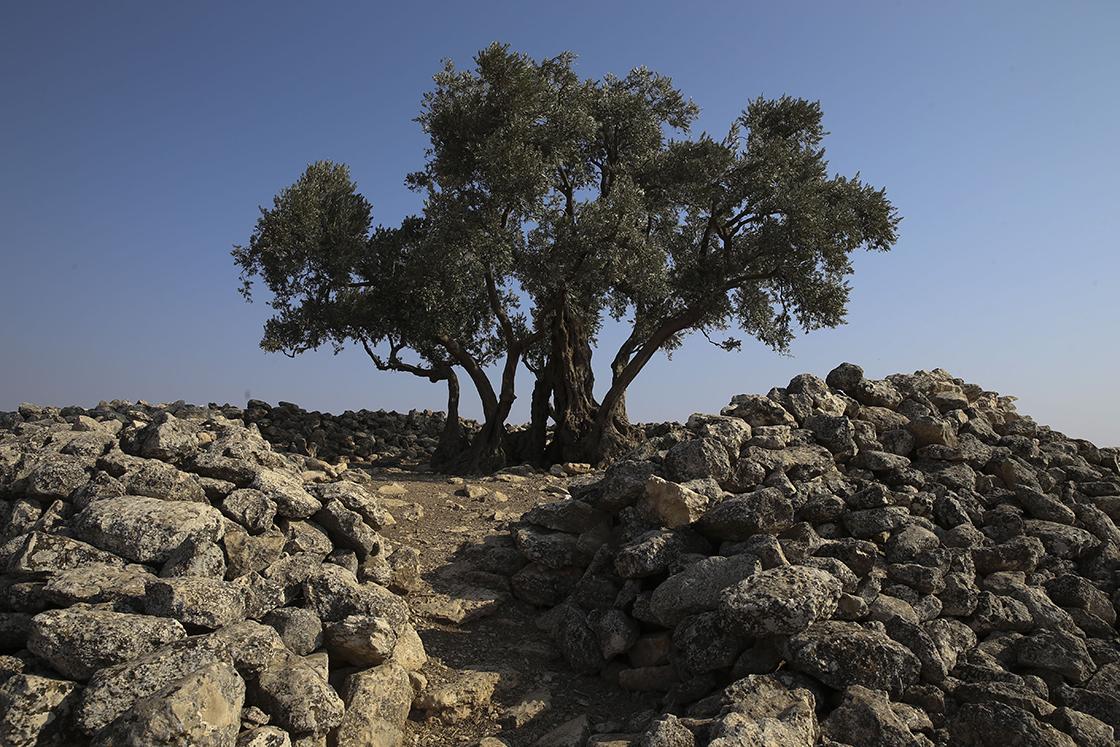
Monumental Trees are natural entities that reach values exceeding the average physiological limits of their species in terms of age, trunk diameter, crown width, and height, and which have sustained their existence for centuries throughout their natural lifespan, thereby providing continuity between the past, present, and future. In addition, individuals associated directly or indirectly with the historical events, cultural heritage, beliefs, and folkloric values of their regions are also regarded as monumental trees.
Turkish Standards Institution’s TS 13137 “Standards for Selection Criteria and Marking of Monumental Trees” defines a monumental tree as: “a tree with a natural lifespan long enough to serve as a bridge between the past and the present, and the present and the future, which reaches values far exceeding the typical measurements of its species in terms of age, trunk diameter, crown diameter, and height, or which holds a special place in regional history, mystical culture, and folklore.”【1】
The historical background of monumental trees reflects a development parallel to human history. Throughout history, the relationship between humans and nature has been symbolized concretely through the tree figure; the tree has become a universal symbol of life, continuity, fertility, and rebirth. From ancient times onward, trees in many civilizations have been regarded not merely as biological entities but as symbols imbued with sacred, spiritual, and social values.
From antiquity, in Sumerian, Assyrian, Hittite, Persian, Greek, and Roman civilizations, the tree was viewed as the center of the universe, and the belief in the “tree of life” became embedded in mythological narratives. In Central Asian cultures, particularly in Turkic tribal mythologies, the concept of the “world tree” or “tree of life” emerges as a sacred symbol, positioned at the center connecting the realms of sky, earth, and underworld.
Anatolian civilizations are also representatives of this tradition. During the Hittite, Phrygian, and Lydian periods, long-lived trees such as oak and plane were regarded as symbols of sacred spaces. Particularly, the plane tree was adopted as a symbol of state power and justice due to its durability and structure. The olive tree has been considered sacred since antiquity as an expression of peace, abundance, and immortality. These cultural symbols acquired mystical and religious meanings following the adoption of Islam, becoming symbols of “immortality” and “wisdom” in Sufi culture.
During the Ottoman Empire period, the tree retained its significance as a symbolic element of social and political life. The empire’s longevity, power, and concept of justice were commonly expressed through the metaphor of the “plane tree.” Plane trees planted in palace gardens, külliyes, squares, and village centers became focal points of community life, serving both as shaded resting areas and gathering spaces. Additionally, certain trees were regarded by the public as “sacred” or “blessed” due to their association with specific historical events or figures. Rituals such as prayer, making wishes, or offering vows were performed around these trees.
During the Republic era, monumental trees continued to be regarded as part of cultural continuity and natural heritage. The old plane tree in the village square, the oak in the town center, or the olive tree in the mosque courtyard are seen by local communities as silent witnesses to social life. Meetings were held under their shade, decisions were made, and a sense of social solidarity and unity was strengthened.
The cultural significance of monumental trees has also found expression in art and literature. The image of the tree has been used in poetry, folk songs, epics, and visual art. Poets associated long-lived plane trees with wisdom; olive trees with peace and tranquility; and cypress trees with death and eternity.
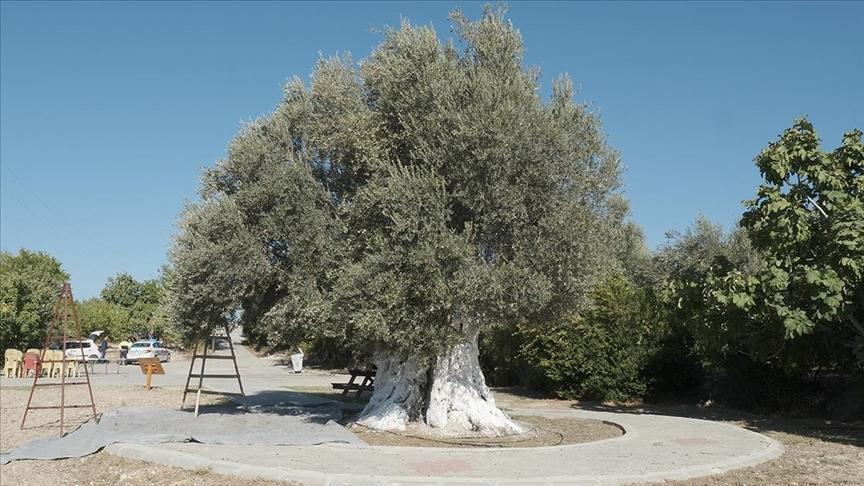
The Olive Tree, Considered Sacred Since Antiquity as an Expression of Peace, Abundance, and Immortality (Anadolu Ajansı)
Monumental trees occupy a prominent place among nature’s remarkable living entities due to their long lifespans, morphological resilience, and high ecological adaptability. It is known that they have survived for centuries, and in some species for millennia, resisting environmental changes. These qualities also make them biological resources essential for the genetic continuity of their species.
Ecologically, monumental trees play a fundamental role in maintaining the balance of their habitats. Through photosynthesis, they absorb carbon dioxide from the atmosphere and produce oxygen, contributing to the sustainability of the carbon cycle. Particularly due to their large trunks and extensive leaf surfaces, these trees possess high carbon storage capacity and function as natural “carbon sinks” in mitigating the effects of climate change. Simultaneously, they improve air quality by filtering pollutants, enhance water retention on soil surfaces, and prevent erosion.
Their extensive and deep root systems support soil structure and assist in balancing the groundwater cycle. Thanks to these features, monumental trees create a regulating effect on microclimatic conditions in their surroundings. Especially in hot and arid regions, they provide shade, reduce local temperatures, increase humidity, and enable the healthy development of surrounding vegetation.
Another factor enhancing the biological importance of monumental trees is their provision of habitat for numerous species. Cavities, fissures, and natural hollows in trunks and branches serve as shelters, nesting sites, and feeding grounds for birds, insects, bats, small mammals, and fungal species. Particularly, epiphytic plants, lichens, and mosses growing on old trees ensure the continuity of micro-level components within ecosystems.
From a scientific perspective, monumental trees are among the primary sources for obtaining data on natural history. By examining the growth rings in tree trunks using dendrochronology (the science of tree rings), precise information about past climatic, geological, and environmental events can be obtained. These rings record specific years of droughts, fires, frost events, or other natural disasters.
Monumental trees are classified according to specific criteria outlined in the Turkish Standards Institution (TSE) standard TS 13137 “Standards for Selection Criteria and Marking of Monumental Trees,” taking into account their morphological, historical, cultural, and spiritual characteristics. This standard ensures the objective evaluation of the scientific, cultural, and ecological qualities of monumental trees and their systematic recording in inventories.
According to this standard, monumental trees are categorized into four main groups: dimensional monumental trees, historical monumental trees, folkloric monumental trees, and mystical monumental trees.
For a tree to be registered as monumental, it must meet at least one of the four categories mentioned above. Trees possessing cultural (historical, folkloric, or mystical) qualities are directly registered as monumental regardless of their species or physical characteristics. In contrast, trees exhibiting only dimensional traits undergo scientific evaluation prior to registration, based on the CMV-MMV scoring system as specified in the TSE standards.
Türkiye is one of the world’s significant natural heritage areas due to its geomorphological structure, climatic diversity, biogeographical position, and vegetation cover. The Anatolian region, situated at the intersection of different climatic zones, offers ecological conditions favorable for the growth of a wide variety of tree species. This natural richness has enabled the existence of monumental trees across the country that have lived for centuries, even millennia, and possess high historical, cultural, and ecological value. These trees throughout Türkiye constitute not only biological but also historical and cultural components of collective memory.
According to the most recent data from the Ministry of Environment, Urbanization and Climate Change, there are 9,369 registered monumental trees nationwide. These trees are classified as “natural assets” for the purpose of conserving both natural and cultural heritage and are registered by the General Directorate of Nature Conservation. Registered monumental trees are found in nearly every region of the country, but are especially concentrated in the Mediterranean, Aegean, Black Sea, and Marmara regions.
One of the country’s notable monumental trees is the yew tree (Taxus baccata) located in Alaplı district of Zonguldak province. Estimated to be 4,117 years old, this tree is recognized as one of the five oldest trees in the world. Dating back to the Bronze Age, it holds both scientific and cultural importance and is internationally acknowledged as a natural heritage example embodying “living history.”
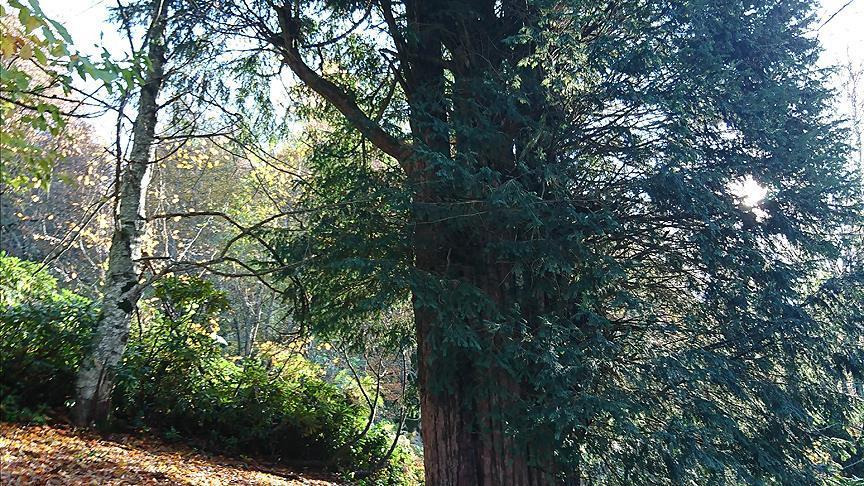
The 4,117-Year-Old Yew Tree in Alaplı District of Zonguldak Province (Anadolu Ajansı)
Another example is the cedar tree (Cedrus libani) known locally as “Ambar Katran,” located within the boundaries of Kumluca district in Antalya province. This individual, approximately 2,327 years old, stands 25 meters tall with a trunk diameter of 262 centimeters, drawing attention due to its structure and longevity. Locally, its wide trunk led to it being called “tree like a warehouse,” a name that eventually became permanently established as “Ambar Katran.” In the same region, in Elmalı district, the 1,701-year-old “Fetid Juniper” (Juniperus foetidissima) is also protected as one of Türkiye’s oldest junipers.
The “Musa Çınarı” in Samandağ district of Hatay province is one of Anatolia’s best-known mystical monumental trees. It is believed by locals that this tree sprouted when Prophet Moses planted his staff in the ground. Thought to be over 2,000 years old, this plane tree is regarded as sacred by the local community due to its religious and folkloric significance. In the same province, in Payas district, a 1,351-year-old olive tree (Olea europaea) located in the courtyard of the II. Selim Külliyesi was registered as a monumental tree in 1976 and continues to bear fruit.
The 1,501-year-old olive tree within the boundaries of the Lagina Ancient City in Yatağan district of Muğla province holds a special position in both historical and archaeological contexts. This tree is viewed as a symbol of a continuous life cycle extending from antiquity to the present, in a region once a center of pagan belief. Additionally, the plane tree in Cumhuriyet Square in Ağlasun district of Burdur, which has become a symbol of the local community, and the cedar tree at the entrance of Karanlıkdere Canyon in Altınyayla district are other notable examples distinguished by their structures.
The 1,146-year-old pedunculate oak (Quercus robur) in Sekiören village of Kütahya province is one of the oldest registered oaks in Türkiye’s interior regions. This 20-meter-tall tree, with a trunk diameter of 201 centimeters and wide branches, draws attention and forms an important ecological area for local wildlife. The 1,147-year-old plane tree in Palu district of Elazığ province, along with three other small old plane trees in the area, forms a natural monumental group.
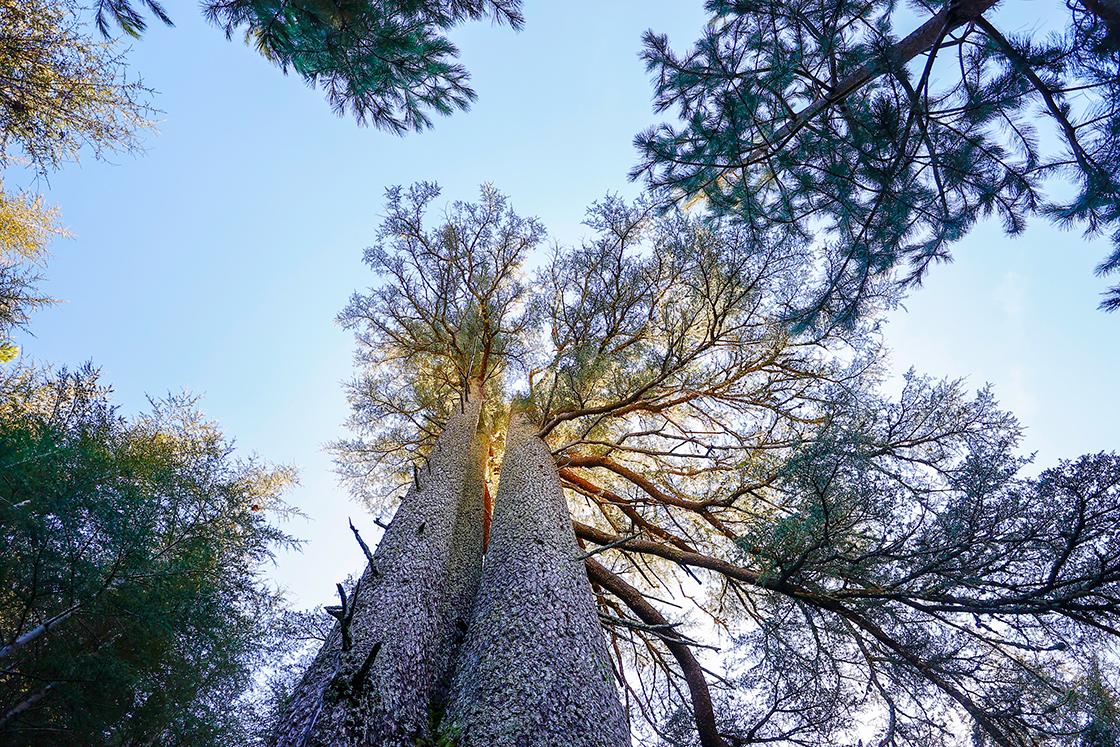
The 1,146-Year-Old Pedunculate Oak in Sekiören Village, Kütahya Province (Anadolu Ajansı)
Additionally, numerous olive trees registered in Akçakale (Şanlıurfa), Kırkağaç (Manisa), and Mut (Mersin) districts; the juniper in Taşağıl (Konya); the plane tree in Onikişubat (Kahramanmaraş); and the monumental plane trees in Sarıyer (İstanbul) constitute other protected examples across different regions of the country. These trees are tangible natural assets representing the historical, cultural, and natural identity of their respective regions.
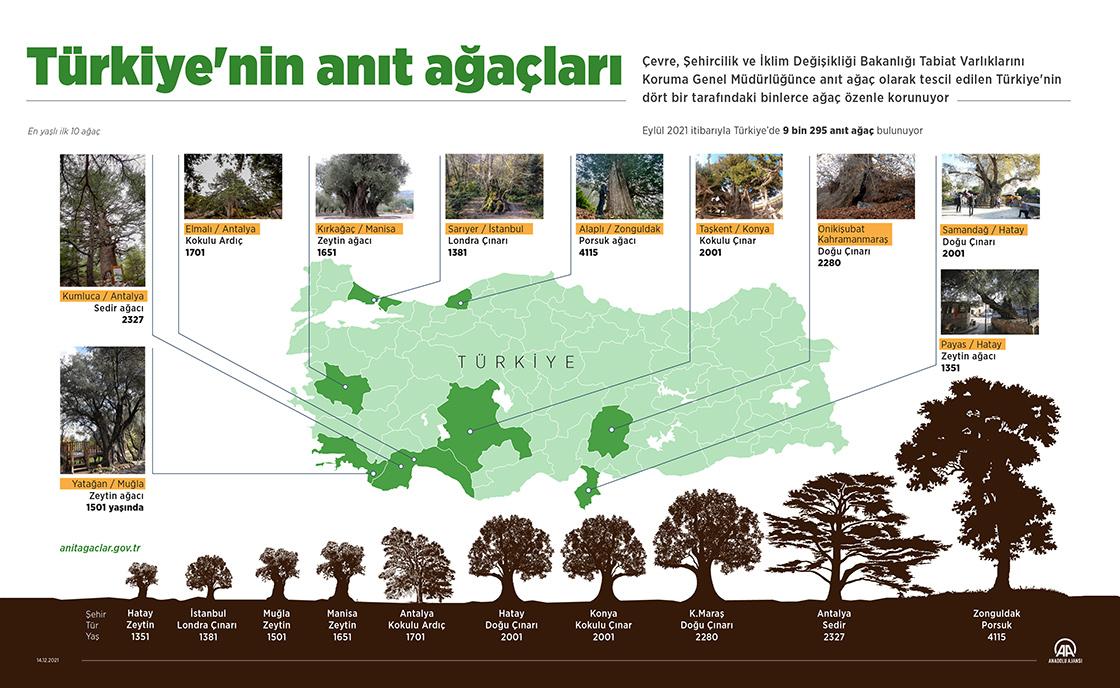
Monumental Trees of Türkiye (Anadolu Ajansı)
The conservation of monumental trees in Türkiye is a process based on legal, administrative, and scientific principles, carried out by the General Directorate of Nature Conservation under the Ministry of Environment, Urbanization and Climate Change. The identification, registration, protection, maintenance, and monitoring of monumental trees are addressed within the framework of environmental policies, cultural heritage conservation principles, and scientific standards.
The legal basis for the conservation of monumental trees is the “Regulation on Procedures and Principles for the Determination, Registration, and Approval of Protected Areas,” published in the Official Gazette No. 28358 on July 19, 2012. This regulation was issued under Article 13/A of the Law Decree No. 644 on the Organization and Duties of the Ministry of Environment and Urbanization and regulates procedures and principles for the protection of natural assets. According to the regulation, the identification and registration of monumental trees fall within the responsibilities and authority of the General Directorate of Nature Conservation.
Under this regulation, the registration process for monumental trees follows a multi-stage administrative and scientific procedure. First, a scientific evaluation is conducted to determine whether a tree qualifies as monumental. This evaluation is carried out based on the Turkish Standards Institution’s TS 13137 “Standards for Selection Criteria and Marking of Monumental Trees”.
For a tree to be registered as monumental, its Current Monumental Value (CMV) score must equal or exceed the predetermined Minimum Monumental Value (MMV) score for its species. The CMV score is calculated as the sum of points assigned to the tree’s height, trunk diameter, crown width, age, site characteristics, and positive attributes. Based on the evaluation, decisions regarding eligible trees are made by the Regional Nature Conservation Commissions. The commission’s decision is submitted to the Minister of Environment, Urbanization and Climate Change for approval, and registration is formally completed upon ministerial endorsement.
Once registered, monumental trees acquire the status of “natural assets,” and all activities related to their protection and maintenance are conducted under the supervision of the Ministry. A protection zone is established around each monumental tree, and necessary measures are taken to prevent environmental damage. Activities such as construction, excavation, or chemical use in the vicinity are restricted; and when deemed necessary, technical interventions such as rehabilitation, pruning, structural support, and soil improvement are applied.
The maintenance, monitoring, and inspection activities conducted by the Ministry are scientifically demanding processes carried out with the contributions of forestry engineers, biologists, and ecology experts. Additionally, the condition of registered monumental trees is regularly assessed, and protection plans are updated when life-threatening conditions arise.
Another aspect of conserving monumental trees in Türkiye is raising public awareness. The sustainability of the conservation process depends on public consciousness. In this context, the Ministry has established a national inventory system to collect data on monumental trees. This system provides the public with information on age, species, location, registration date, and photographs of all registered monumental trees across Türkiye.
The conservation of monumental trees also encompasses the protection of natural heritage. Activities undertaken in this regard are aligned with international agreements to which Türkiye is a party. In particular, the Convention on Biological Diversity (1992), the European Landscape Convention (2000), and the Bern Convention (1979) establish general principles for the protection of natural and cultural landscape elements and provide a legal foundation for the conservation of monumental trees.
The conservation of monumental trees is not limited to registration and legal status but encompasses scientific research, systematic documentation, continuous monitoring, and public awareness creation. In Türkiye, inventory work on monumental trees is coordinated by the General Directorate of Nature Conservation and implemented with contributions from regional directorates, universities, and relevant institutions. Within this framework, information on each tree—species, age, height, trunk and crown diameter, location, ecological characteristics, and historical-cultural context—is compiled to establish a national Monumental Tree Information System. This system serves as a fundamental database for both scientific research and administrative decision-making.
A key dimension of conservation efforts involves monitoring tree health and implementing maintenance practices. Regular periodic inspections are conducted on elderly or physically damaged monumental trees, and technical interventions such as restoration, pruning, trunk support, or root zone management are applied as needed. Additionally, a protection boundary is established around each monumental tree, and safety measures are taken to prevent construction, soil compaction, or human-caused damage.
The sustainable conservation of monumental trees also depends on public awareness. Therefore, various awareness and educational initiatives organized by local administrations, universities, and civil society organizations serve as complementary elements of conservation policy. These activities include nature education programs for children and youth, environmental workshops, documentary productions, photographic exhibitions, and thematic walking tours.
Moreover, monumental trees are also considered in terms of tourism and environmental education. In some regions, eco-tourism routes and information areas have been developed around registered monumental trees to enhance the economic and cultural contributions of local communities.
The continuity of inventory work is essential in the conservation process. The identification of new trees for registration, updating existing records, and monitoring damaged individuals require systematic and ongoing efforts.
Anadolu Ajansı. “Mersin’de 1300 yıllık anıt ağaçta yetişen zeytinler toplandı.” Accessed November 11, 2025.https://www.aa.com.tr/tr/yasam/mersinde-1300-yillik-anit-agacta-yetisen-zeytinler-toplandi/2719004
Anadolu Ajansı. “Türkiye’nin Anıt Ağaçları Zamana Meydan Okuyor.” Accessed November 11, 2025.https://www.aa.com.tr/tr/gundem/turkiyenin-anit-agaclari-zamana-meydan-okuyor/2437488
Anadolu Ajansı. “Zonguldak’ta 4 113 Yaşındaki Porsuk Ağacı Tescillendi.” Anadolu Ajansı. Accessed November 11, 2025.https://www.aa.com.tr/tr/turkiye/zonguldakta-4113-yasindaki-porsuk-agaci-tescillendi/1109012
Ministry of Environment, Urbanization and Climate Change of the Republic of Türkiye. "Proje Hakkında." *Anıt Ağaçlar Projesi.* Accessed November 11, 2025.https://www.anitagaclar.gov.tr/proje-hakkinda
Polat, Zöhre. “Doğanın Mirası: Anıt Ağaçlar.” *Turkish Journal of Agriculture - Food Science and Technology* 5, no. 8 (August 2017): 908–916. Accessed November 11, 2025.https://www.researchgate.net/publication/319309873_Doganin_Mirasi_Anit_Agaclar
T.C. Ministry of Urbanization and Climate Change. "Anıt Ağaçlar." T.C. Ministry of Urbanization and Climate Change Official Website. Accessed November 11, 2025.https://www.csb.gov.tr/anit-agaclar-makale
Çimen Bulut, İpek. “Avrupa Birliği ve Türk Hukuku Perspektifinden Doğanın Emaneti: Anıt Ağaçlar*.” *İzmir Sosyal Bilimler Dergisi* 6, no. 2 (2024): 42–55. Accessed November 11, 2025.https://dergipark.org.tr/en/download/article-file/3956294
[1]
T.C. Şehircilik ve İklim Değişikliği Bakanlığı, “Anıt Ağaçlar,” T.C. Şehircilik ve İklim Değişikliği Bakanlığı Resmi İnternet Sitesi, Erişim tarihi 11 Kasım 2025, https://www.csb.gov.tr/anit-agaclar-makale

Official Standard | TS 13137 – Inventory Selection Rules and Marking Standard for Monumental Trees (TSE) | ||||||||
|---|---|---|---|---|---|---|---|---|---|
Classification | Folkloric Monumental Trees Mystical Monumental Trees Dimensional Monumental Trees Historical Monumental Trees | ||||||||
Number in Türkiye | 9,369 registered monumental trees | ||||||||
Registration Criteria | Biodiversity provider Erosion preventer Microclimate regulator Carbon sink | ||||||||
International References | Bern Convention (1979) Convention on Biological Diversity (1992) European Landscape Convention (2000) | ||||||||
History and Cultural Significance
Biological and Ecological Characteristics
Classification of Monumental Trees
Notable Monumental Trees in Türkiye
Conservation of Monumental Trees in Türkiye
Conservation, Inventory, and Awareness Initiatives