This article was automatically translated from the original Turkish version.
+2 More
Location | Sarajevo Maršala Tita | ||||||||
|---|---|---|---|---|---|---|---|---|---|
Construction Date | 27 November 1947 | ||||||||
Architect (Monument) | Prof. Juraj Najthart | ||||||||
Architect (Building) | Karl Paržik | ||||||||
Dedicated Group | The liberators of Sarajevo from World War II, the martyrs of World War II | ||||||||
Symbolic Meaning | Anti-fascist resistance, multi-ethnic structure, ideal of freedom | ||||||||
Popular Name | Burning Tire | ||||||||
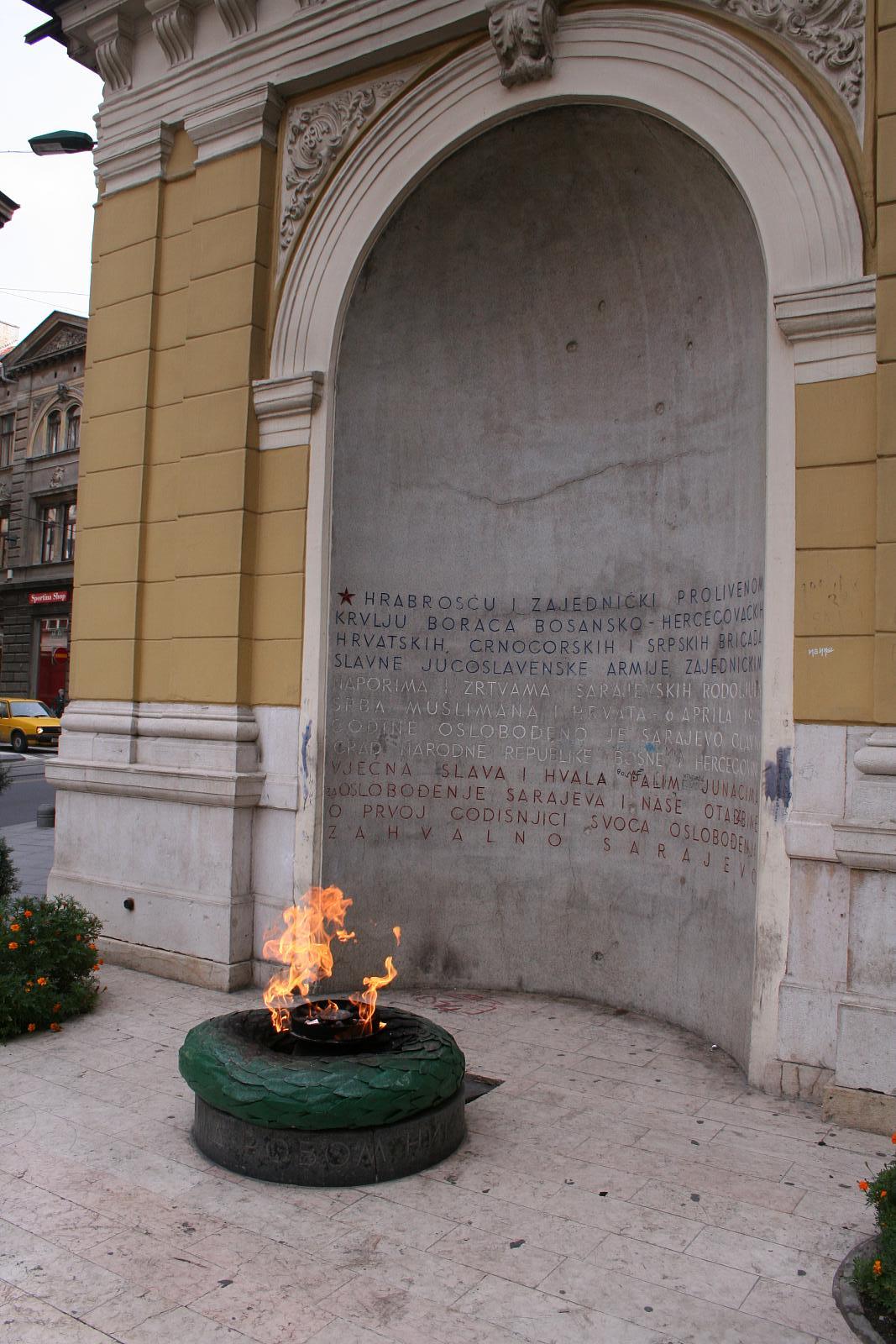
Monument of the Eternal Flame (Vječna Vatra) is a monumental structure in Bosanski Šamac, Sarajevo, symbolizing the military and ideological victory of World War II.
The Monument of the Eternal Flame is located in the center of Bosnia and Herzegovina’s capital, Sarajevo, on the main thoroughfare now known as Marshal Tito Street. During the Ottoman period, this street was one of the city’s key residential and commercial areas. It acquired its name, Ćemaluša, from the mosque built in the 16th century by Ćemal-beg and widely known by that name. The entire neighborhood soon became known by this name, and it was used as the official designation of the street during the Ottoman era.【1】 On 6 April 1946, the street was renamed Marshal Tito Street.
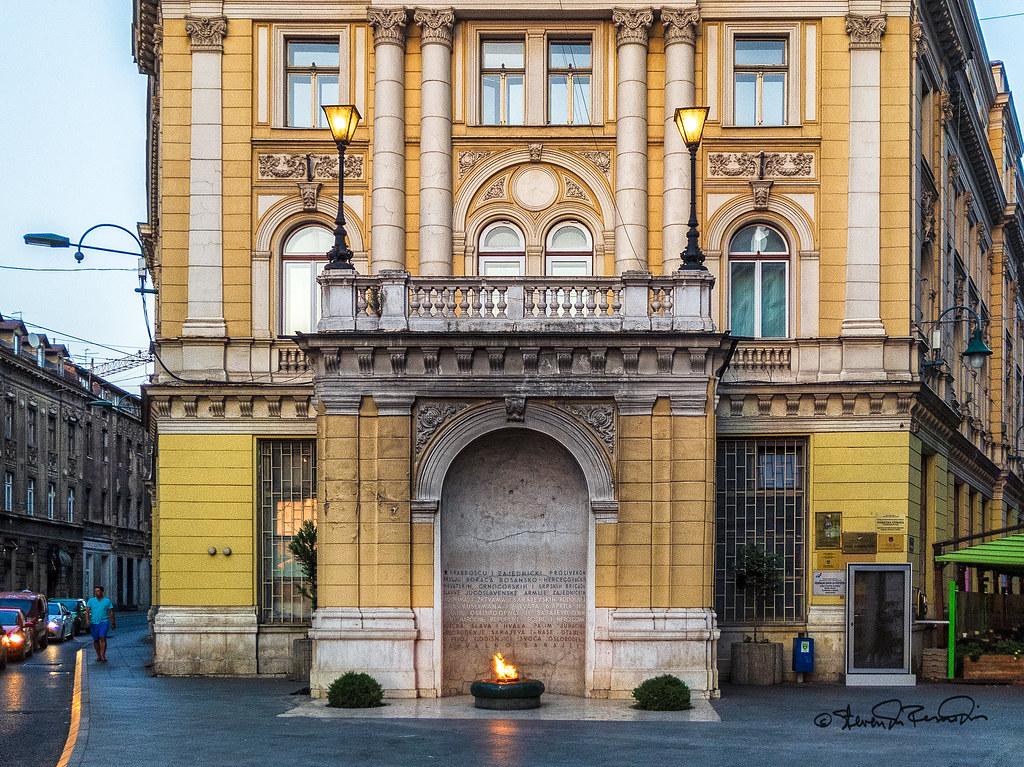
Monument of the Eternal Flame (Flickr)
The building housing the monument was originally designed in the late 19th century by the renowned architect Karl Paržik as a hotel.【2】 This building, distinguished by its profiled columns and arched structure that dominate the street, was later integrated into a monument design by Professor Juraj Najthart. For the monument commemorating the opening of the Bosanski Šamac–Sarajevo railway, Najthart enclosed the building’s main entrance with a niche, creating a space beneath the terrace. This design preserved Karl Paržik’s historic structure while adding three colored texts and a flame, transforming the building into a focal point for cultural events and collective memory.【3】
The structure bears the signature of the renowned architect Karl Paržik from 1985. Its architectural composition features profiled columns connected by arches, forming a prominent balcony that overlooks the street. The building has three separate entrances on its south, west, and north facades.【4】
The idea of creating a monument to honor the liberators of Sarajevo in connection with the opening of the Bosanski Šamac–Sarajevo railway was put forward, and the task was entrusted to Professor Juraj Najthart, a Zagreb-born architect and one of Sarajevo’s most prominent designers. Najthart developed a design that seamlessly integrated with the existing urban fabric. This approach strengthened the monument’s symbolic meaning while preserving the surrounding architectural heritage. In Najthart’s design, the main entrance of the Karl Paržik building was recessed beneath the terrace and enclosed by a niche, within which a text in three different colors was installed.【5】 The flame at the center of the niche serves as a gesture of respect for fallen soldiers and was also conceived as a symbol of the Yugoslav coat of arms.【6】 Additionally, the terrace on which the monument stands has functioned over time as a public space hosting speeches, cultural events, and various performances.
Monument of the Eternal Flame (iCityClips)
The continuously burning flame of the monument suffered its longest interruption at the beginning of the 1990s, during the military siege that encircled the city.【7】 Although the flame was relit after the war, the years it remained extinguished during the siege added a new layer to the monument’s historical narrative. Today, the “Eternal Flame” plays a significant role in the redefinition of Bosnia and Herzegovina as a war tourism destination.【8】 For tourists and researchers, this site represents both the city’s rich architectural continuity from the Ottoman and Austro-Hungarian periods (influenced by Paržik and Najthart) and the hardships endured during the siege, as well as the spiritual resilience of its people.
The Monument of the Eternal Flame serves as a tribute to the soldiers who defended Sarajevo during World War II and fell in that cause. The flame also symbolizes the unity and coat of arms of Yugoslavia. The monument was quickly embraced by the local population and became a popular meeting place for youth. The darkening of the metal ring due to prolonged burning, combined with the local sense of humor, led the public to nickname the monument “The Burning Tire” (Guma koja gori).【9】
Anadolu Ajansı. "Saraybosna kuşatmasının kurbanları anıldı." Accessed December 27, 2025.https://www.aa.com.tr/tr/pg/foto-galeri/saraybosna-kusatmasinin-kurbanlari-anildi
Bilginoğlu, Elif. "Bir Karanlık Turizm Türü Olarak Savaş Turizmi ve Bosna-Hersek’in Bir Savaş Turizmi Destinasyonu Olarak Yeniden Tanımlanması." *SEFAD*, 2024; (52): 203-234. Accessed December 27, 2025.https://dergipark.org.tr/en/download/article-file/3797310
Grad Sarajevo. “Vječna vatra.” Sarajevo.ba. Accessed December 27, 2025.https://www.sarajevo.ba/bs/article/5789/vjecna-vatra
Muhedinović, Ajdin. "Amra Čusto, Uloga spomenika u Sarajevu u izgradnji kolektivnog sjećanja na period 1941. – 1945. i 1992. – 1995.: komparativna analiza Institut za historiju." Kantonalni zavod za zaštitu kulturno-historijskog i prirodnog naslijeđa, Sarajevo, pp. 212–218. Accessed December 27, 2025.https://hrcak.srce.hr/file/321364#page=1.00
Vine, Peter. "Vječna Vatra." Flickr. Accessed December 27, 2025.https://www.flickr.com/photos/prestwick/2897978773/
dosRemedios, Steven. "Vjecna vatra War Memorial." Flickr. Accessed December 27, 2025.https://www.flickr.com/photos/sdosremedios/51547513333/
iCityClips. "Sarajevo Clips - 4K (Vječna vatra), Sarajevo, Bosnia and Herzegovina." YouTube Video, November 8, 2022. Accessed December 27, 2025.https://www.youtube.com/watch?v=nGhrQyNu_jo
Çağ, Galip. "“Balkanlar’a Nasıl Bakmalıyız?” Sorusuna Dair Bir Analiz - II Tarihsel Bütünlüğün İhmali Sorunu." TASAM. Accessed December 27, 2025.https://tasam.org/tr-TR/Icerik/56680/balkanlara_nasil_bakmaliyiz_sorusuna_dair_bir_analiz_-_ii_tarihsel_butunlugun_ihmali_sorunu
[1]
“Vječna vatra.” Sarajevo.ba, erişim 27 Aralık 2025, https://www.sarajevo.ba/bs/article/5789/vjecna-vatra
[2]
“Vječna vatra.” Sarajevo.ba, erişim 27 Aralık 2025,
[3]
“Vječna vatra.” Sarajevo.ba, erişim 27 Aralık 2025,
[4]
“Vječna vatra.” Sarajevo.ba, erişim 27 Aralık 2025,
[5]
Bu metin günümüze kadar ulaşmıştır. “Vječna vatra.” Sarajevo.ba, erişim 27 Aralık 2025,
[6]
“Vječna vatra.” Sarajevo.ba, erişim 27 Aralık 2025,
[7]
“Vječna vatra.” Sarajevo.ba, erişim 27 Aralık 2025,
[8]
Bilginoğlu, Elif, "Bir Karanlık Turizm Türü Olarak Savaş Turizmi ve Bosna-Hersek’in Bir Savaş Turizmi Destinasyonu Olarak Yeniden Tanımlanması," SEFAD, 2024; (52): 203-234, sayfa 223, erişim 27 Aralık 2025, https://dergipark.org.tr/en/download/article-file/3797310
[9]
“Vječna vatra.” Sarajevo.ba, erişim 27 Aralık 2025,

Location | Sarajevo Maršala Tita | ||||||||
|---|---|---|---|---|---|---|---|---|---|
Construction Date | 27 November 1947 | ||||||||
Architect (Monument) | Prof. Juraj Najthart | ||||||||
Architect (Building) | Karl Paržik | ||||||||
Dedicated Group | The liberators of Sarajevo from World War II, the martyrs of World War II | ||||||||
Symbolic Meaning | Anti-fascist resistance, multi-ethnic structure, ideal of freedom | ||||||||
Popular Name | Burning Tire | ||||||||
No Discussion Added Yet
Start discussion for "Monument of the Everlasting Fire (Vječna Vatra)" article
Historical Background and Location
Architectural Structure and Design Process
The Karl Paržik Building and Architectural Features
The Monument’s Design and Juraj Najthart
War Period and Extinguishing of the Flame
Symbolism and Social Meaning