


This article was automatically translated from the original Turkish version.
The Monty Hall Problem is one of the most striking and counterintuitive examples in probability theory. It is named after Monty Hall, the host of the American television program Let's Make a Deal, which aired in the 1960s. This problem goes beyond being a mere mathematical puzzle; it vividly reveals the limitations of human intuition when faced with probability calculations.
The Monty Hall Problem is defined as follows:
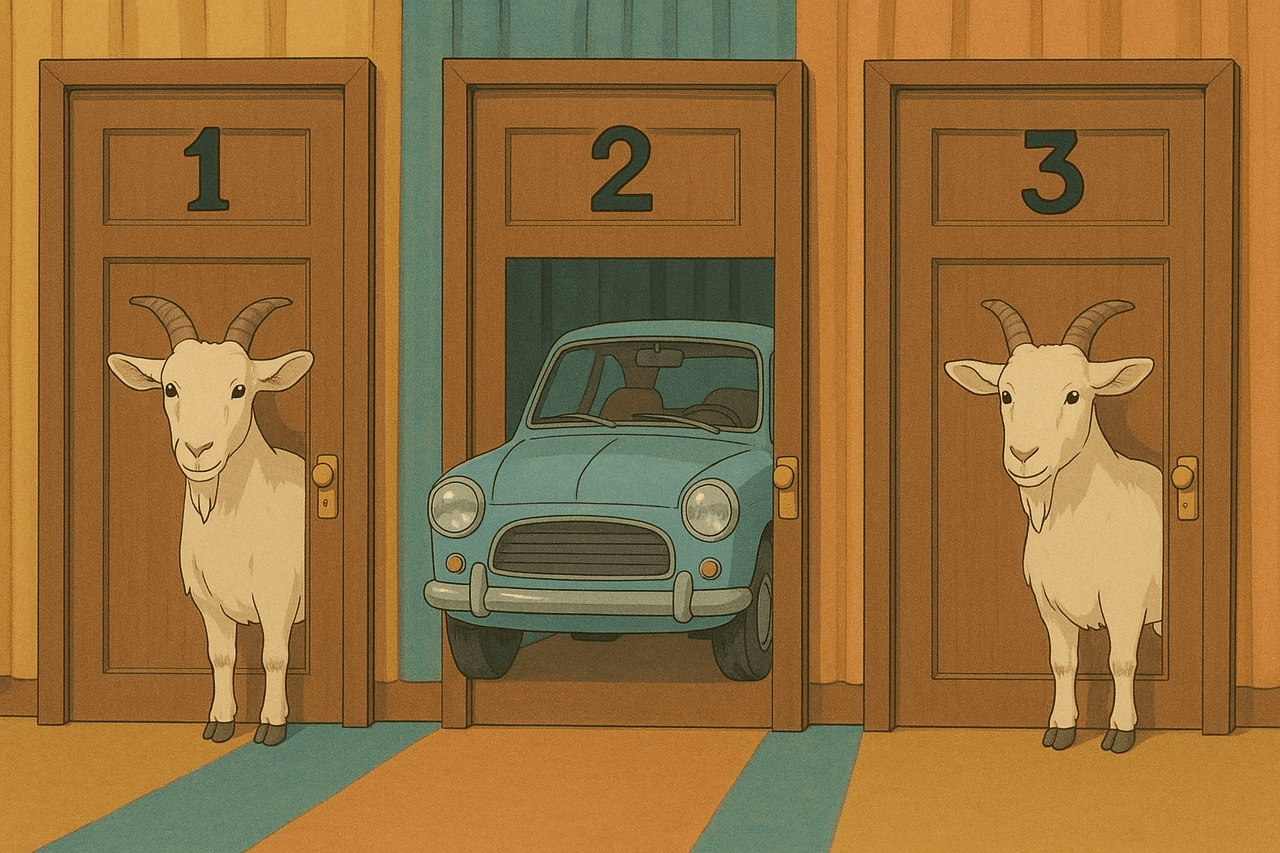
(Generated by artificial intelligence.)
Most people assume that once the host reveals a goat, the two remaining doors have equal probability (1/2) of hiding the car, leading them to conclude that switching or staying makes no difference. However, this intuitive reasoning is incorrect. Mathematically, switching increases the probability of winning.
Initially, the probability that the contestant has selected the correct door is 1/3. Therefore, the probability that the contestant has selected a wrong door is 2/3. Since the host always opens a door revealing a goat, if the contestant’s initial choice was wrong—which occurs with a 66.7% probability—the car must be behind the other unopened door. Thus, switching increases the probability of winning to 2/3.
Bayes’ Theorem is used to calculate conditional probabilities and helps provide a deeper understanding of the Monty Hall Problem. If the contestant’s initial choice is correct (probability 1/3), the host can open either of the two remaining doors at random. However, if the initial choice is wrong (probability 2/3), the host has no choice but to open the only remaining goat door. When this information is analyzed using Bayes’ Theorem, it becomes clear that switching offers a higher probability of winning.
Computer simulations can also be used to understand the solution to the Monty Hall Problem. For instance, simulations conducted using the Python programming language show that contestants who switch their choice win approximately 66.7% of the time. These results align with theoretical calculations and confirm empirically the advantage of switching.
The Monty Hall Problem also highlights the difficulties human psychology faces in processing probability. Many people intuitively believe that the two remaining options are equally likely and therefore choose not to switch. However, experiments have demonstrated that people systematically make incorrect decisions in this scenario.
In an alternative scenario, if the host offered the contestant the choice between their original door and the combined option of the other two doors—without revealing a goat first—most contestants would likely accept the offer, recognizing that the combined probability of the two doors hiding the car is higher (66.7%). However, the act of revealing a goat behind one door exerts a powerful psychological effect that distorts this rational assessment.
The Monty Hall Problem uses a simple game scenario to illuminate complex concepts in probability theory and the limitations of human intuition. Mathematical analysis and empirical simulations clearly demonstrate that switching increases the chance of winning. Beyond probability theory, this problem offers important insights into human psychology and decision-making processes.
Cornell University. "The Monty Hall Problem Using Bayes' Theorem." Cornell University Blog. Accessed April 25, 2025. Link
Mitzenmacher, Michael. "The Monty Hall Problem: A Study." Research Science Institute, 1986.
PMC. "Why Humans Fail in Solving the Monty Hall Dilemma: A Systematic Review." Accessed April 25, 2025. Link
Selvin, Steve. "A Problem in Probability." The American Statistician 29, no. 1 (1975): 67. Link
Vos Savant, Marilyn. "Ask Marilyn." Parade Magazine, February 17, 1990. Link
Problem Definition
Mathematical Solution
Explanation Using Bayes’ Theorem
Simulations and Empirical Evidence
Psychological Perspective
