This article was automatically translated from the original Turkish version.
+1 More
Location | Eyüpsultan, İstanbul | ||||||||
|---|---|---|---|---|---|---|---|---|---|
Year of Discovery and Restoration | 1987 | ||||||||
Person Buried in the Tomb | Lutfullah (Molla Lütfü) | ||||||||
Title | Molla | ||||||||
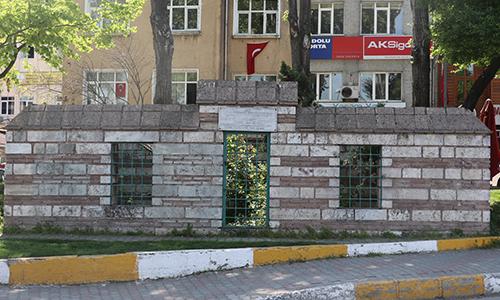
Molla Lütfü Türbesi is an open tomb structure located in the Eyüpsultan district of Istanbul, discovered in 1987.【1】
Molla Lütfü, whose real name was Lutfullah, was born in Tokat in the mid-15th century and is one of the prominent figures of the Ottoman scholarly world. He received his initial education from his father, Kutbüddin Hasan, and later studied logic, philosophy, theology and mathematics under Sinan Pasha and Ali Kuşçu.【2】
During the reign of Fatih Sultan Mehmet, he was appointed in 1470 to the palace library (Hafız-ı Kütüp). During this tenure, he had the opportunity to study rare manuscripts and developed a close friendship with the sultan. Under Bayezid II, he continued his educational activities as a professor at the Bursa Yıldırım, Edirne Dar’ül Hadis, and Istanbul Sahn-ı Seman medreses. However, while serving in the palace library, he was accused of betraying waqf books and was consequently removed from his position and imprisoned. Later, his reputation was restored and he resumed teaching at various medreses.【3】
In 1494–1495, Molla Lütfü was put on trial on charges of “zındıklık” and “ilhâd” (apostasy). Although hundreds of witnesses were heard during the trial, it is widely accepted that the primary motive for his death sentence was the envy and hostility of his rivals. It is reported that shortly before his execution, he recited the shahada to affirm his faith.【4】
Molla Lütfü produced works in both Arabic and Turkish, contributing to the fields of literature, philosophy and religious sciences. Among these works is his treatise titled Harname.【5】
He maintained a distant attitude toward poetry, regarding engagement with poetry by virtuous individuals as an activity to be avoided to some extent. Among his students were notable figures such as Kemalpaşazâde (İbn-i Kemal) and the son of Molla Halebi.【6】
Molla Lütfü’s grave remained lost for many years until it was discovered in 1987 during urban renewal projects in Istanbul Eyüpsultan. During this period, when factories along the Eyüp shore were demolished, the grave was found within the interior of the Defterdar Mensucat Factory. Following the discovery of the long-lost grave, the site was reorganized and the tomb was restored. The structure is currently located in the Eyüpsultan district.【7】
Dijital İstanbul. "Molla Lütfü Türbesi." Accessed July 20, 2026.https://dijitalistanbul.org/molla-lutfu-turbesi
Eyüpsultan Belediyesi. "Molla Lütfü Türbesi." Accessed July 20, 2026.https://www.eyupsultan.bel.tr/tr/main/pages/molla-lutfu-turbesi/977
[1]
Eyüpsultan Belediyesi. "Molla Lütfü Türbesi." Erişim Tarihi 20 Temmuz 2026. https://www.eyupsultan.bel.tr/tr/main/pages/molla-lutfu-turbesi/977
[2]
Dijital İstanbul. "Molla Lütfü Türbesi." Erişim Tarihi 20 Temmuz 2026. https://dijitalistanbul.org/molla-lutfu-turbesi
[3]
Eyüpsultan Belediyesi. "Molla Lütfü Türbesi."
[4]
Dijital İstanbul. "Molla Lütfü Türbesi."
[5]
Eyüpsultan Belediyesi. "Molla Lütfü Türbesi."
[6]
Dijital İstanbul. "Molla Lütfü Türbesi."
[7]
Eyüpsultan Belediyesi. "Molla Lütfü Türbesi."

Location | Eyüpsultan, İstanbul | ||||||||
|---|---|---|---|---|---|---|---|---|---|
Year of Discovery and Restoration | 1987 | ||||||||
Person Buried in the Tomb | Lutfullah (Molla Lütfü) | ||||||||
Title | Molla | ||||||||
No Discussion Added Yet
Start discussion for "Molla Lütfü Türbesi" article
Early Life
Academic Career and Teaching Activities
Trial and Execution
Literary Legacy and Students
Discovery, Architecture and Location of the Tomb