


This article was automatically translated from the original Turkish version.
Modulation in architecture is the process of creating a building’s overall composition by systematically repeating and organizing a specific unit of measurement, known as a module. The module is commonly applied in structural elements, façade arrangements, and interior spatial organization. This approach is employed not only to achieve aesthetic harmony but also to ensure structural balance and functional integrity.

Mimari Yapı Elemanlarında Modülasyon (Pexels)
The origins of modulation extend back to Ancient Greek and Roman architecture. In Greek temples, the spacing between columns, column height, and structural proportions were based on specific modular systems. This systematic ordering ensured both aesthetic and structural balance. In Vitruvius’s work De Architectura, the concept of the module was linked to human body proportions and defined as a standard measure in architecture.

Mimaride Yapı Elemanları ile Modülasyon (Pexels)
In Islamic art and architecture, modulation holds significant importance not only in structural systems but also in decorative and ornamental programs. Particularly in Anatolian Seljuk architecture, the ratio of 2/3 was preferred over the Golden Ratio, and this ratio was used as an aesthetic organizing principle in façade designs, arch openings, and decorative elements.

Mimaride Modülasyon Erzurum Çifte Minareli Medrese (Pexels)
During the Renaissance, classical proportions and modulation principles were revived, and architectural designs began to employ measurement systems based on human scale. Le Corbusier developed this understanding in modern architecture through his Modulor system, proposing a standardized module based on human body proportions to generate both aesthetic and functional spatial solutions.
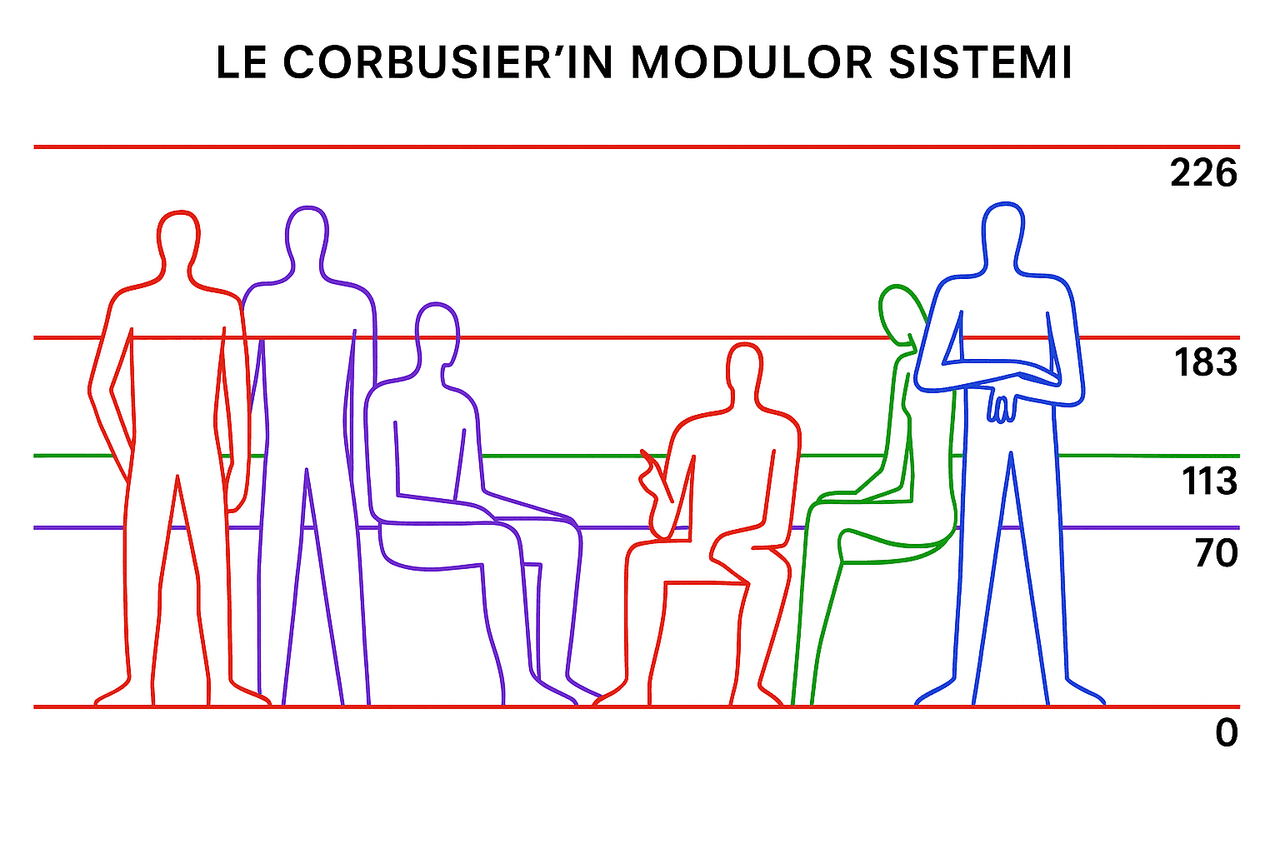
Le Corbusier's Modulor Measurement System (Generated by Artificial Intelligence)
Modulation is a fundamental design tool in architectural structures, serving both to achieve structural balance and to organize spatial order. Load-bearing columns, beams, arches, and domes are arranged according to specific modular intervals, creating a unified whole that satisfies both static requirements and interior spatial organization.
This is especially evident in classical Ottoman architecture. For instance, in the works of Mimar Sinan such as the Süleymaniye Camii and Mihrimah Sultan Camii, the main prayer space, half-domes, galleries, and arcades are constructed through repeated modular frameworks. Thanks to this modulation, harmony is achieved between the building’s structural system and its architectural aesthetics; structural elements become not merely technical components but spatially meaningful elements. Thus, the building gains both structural continuity and visual unity.
In façade design, modulation creates aesthetic composition through proportion, rhythm, and hierarchy. Windows, doors, columns, eaves, and decorative elements are positioned according to specific modules. This approach maintains a balanced ratio of openness to solidity, fulfilling functional requirements while establishing visual continuity on the exterior surface.
Especially in Islamic architecture, façade modulation combines with geometric patterns, muqarnas, and calligraphic ornamentation to produce highly sophisticated aesthetic examples. These decorations are not random; they are constructed within a modular system that is symmetrical, repetitive, and largely based on mathematical ratios. Thus, the façade becomes not merely a surface but a meaningful representational field.
In modern architecture, modulation has become a functional necessity within the context of industrial production, prefabrication, and modular building systems. The serial production of standardized building components and their assembly on-site accelerates construction and enhances economic efficiency.
Prefabricated housing, school buildings, temporary shelter units, and modular office systems are designed according to this approach. Wall panels, floor slabs, roof elements, and other components are manufactured in specific modular dimensions, enabling the system to be easily disassembled, transported, or reconfigured. Furthermore, this modular approach allows flexible planning tailored to user needs; thus, design evolves not only for ease of production but also in accordance with adaptability and sustainability principles.
Modulation is a fundamental design principle in architectural education, serving as a vital tool that enables students to develop the ability to plan space systematically and consciously. This concept, which refers to the design of building elements within a defined order, proportion, and repetition, is directly related to other design components such as scale, rhythm, hierarchy, and structural balance.
In the educational process, modulation helps students make more conscious decisions regarding spatial perception, functional organization, and formal harmony. Modulation-based approaches applied in foundational design studios develop in students not only the ability to generate form but also conceptual thinking, analytical reasoning, and systematic design skills. In this sense, modulation is not merely a technical tool in architectural education; it is regarded as a methodological approach that nurtures critical thinking and imparts structure to the design process.
Today, modulation lies at the heart of current architectural approaches such as sustainable design, energy efficiency, and flexible spatial solutions. Particularly with advances in industrial production, prefabricated and modular buildings are widely favored for their ability to enable rapid construction and cost-effectiveness. These structures offer adaptable planning solutions that can easily respond to diverse usage scenarios, allowing spaces to quickly meet changing needs.
Modulation is also an important instrument in human-centered architectural approaches. As in Le Corbusier’s Modulor system, design criteria based on human scale generate spaces that are balanced both aesthetically and functionally. In contemporary architecture, this approach enhances user comfort while strengthening the building’s relationship with its surroundings.
With the advancement of parametric design and digital fabrication techniques, the concept of modulation has evolved beyond mere structural repetition to become a tool for exploring complex geometries and formal innovations. Specifically, computational design methods have enabled the development of novel modulation strategies, resulting in innovative structures. In this context, modulation has transcended aesthetic and structural functionality to become an integral part of dynamic, multi-layered design processes supported by technological innovation.
In line with these contemporary approaches, modulation both adapts traditional architectural heritage to current conditions and integrates into new design paradigms, shaping the future of built form.
Alioğlu, E. Füsun, and Nil Köroğlu. "Mimar Sinan Camilerinde Modüler Sistem." Sigma 3 (2011): 331–340. Accessed May 28, 2025.
Çetintaş, Kemal Ferit, and Azadeh Rezafar. "Binalarda Pasif Soğutma Yöntemleri ve Geleneksel Mimarideki Uygulamalarının İncelenmesi." KAPU Trakya Journal of Architecture and Design 2, no. 2 (2022): 37–56. Accessed May 14, 2025.
Özçakı, Meltem. "İstanbul Kapalıçarşı’nın Temel Tasarım Yönünden İncelenmesi." Sanat Eğitimi Dergisi 10, no. 1 (Spring 2022): 47–65. Accessed May 14, 2025.
Şaman Doğan, Nermin, and Metin Kuşçu, Hatice. "Sivas Buruciye Medresesi (1271) Ön Yüz Düzeninde Orantı ve Modüler Sistem Arayışı Üzerine Bir Deneme." USAD 13 (Fall 2020): 27–78. Accessed May 14, 2025.


No Discussion Added Yet
Start discussion for "Modulation in Architecture" article
Historical Development
Ancient Period and Classical Architecture
Islamic and Anatolian Seljuk Architecture
Renaissance and Modern Period
Applications of Modulation
Structural System and Structural Design
Façade Organization and Aesthetic Composition
Industrial and Prefabricated Structures
The Role of Modulation in Architectural Education
Contemporary Approaches