


This article was automatically translated from the original Turkish version.

Model | MobileNet | ||||||||
|---|---|---|---|---|---|---|---|---|---|
Year | 2019 (V3) 2018 (V2) 2017 (V1) | ||||||||
Developer(s) | |||||||||
Base Component | (V3) Neural Architecture Search (V2) Inverted Residual Block (V1) Depthwise Separable Convolution | ||||||||
Variants | MobileNet V3 MobileNet V2 MobileNet V1 | ||||||||
MobileNet is a deep learning architecture developed by Google and specifically optimized to run on mobile and embedded devices. This architecture aims to significantly reduce computational cost and model size while preserving the performance of traditional convolutional neural networks (CNNs). MobileNet models are widely used in applications requiring low latency and low power consumption.
The foundational building block of the MobileNet architecture is the depthwise separable convolution technique, which makes the standard convolution operation more efficient.
In classic convolutional layers, each filter is applied across the entire depth of the input. This requires a large number of multiply-add operations and increases computational cost.
Depthwise separable convolution consists of two steps:
This structure can reduce computational load by approximately 8 to 9 times. The following image summarizes how depthwise separable convolution works.
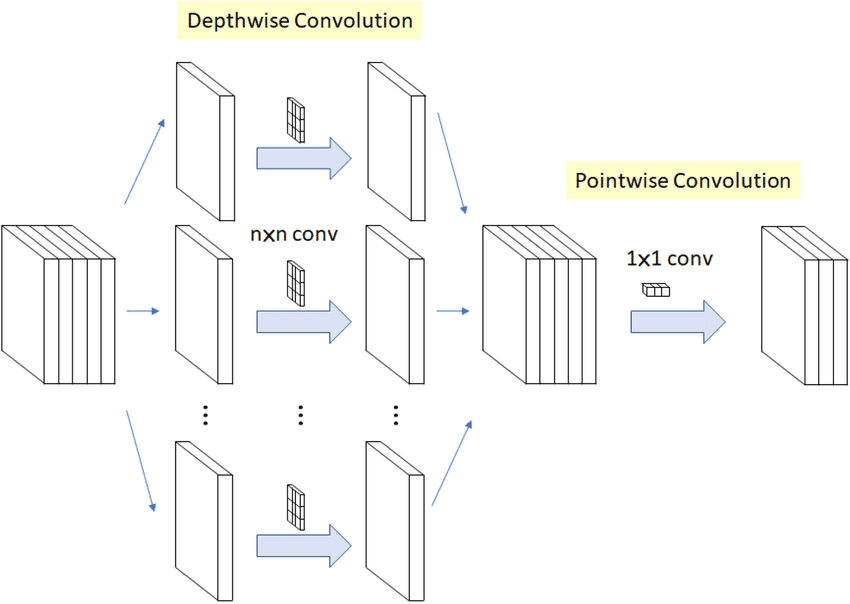
Depthwise and Pointwise Convolution (Source =
Depthwise separable convolution requires significantly fewer parameters and computations compared to standard convolution.
The MobileNet architecture has been developed over time through successive versions, each offering new improvements to the speed-performance trade-off.
MobileNet is a preferred architecture especially in resource-constrained environments. Some of its application areas include:
Howard, Andrew G., Menglong Zhu, Bo Chen, Dmitry Kalenichenko, Weijun Wang, Tobias Weyand, Marco Andreetto, and Hartwig Adam. “MobileNets: Efficient Convolutional Neural Networks for Mobile Vision Applications.” Last modified 2017. https://arxiv.org/abs/1704.04861.
Howard, Andrew, Mark Sandler, Bo Chen, Weijun Wang, Liang-Chieh Chen, Mingxing Tan, Grace Chu, et al. “Searching for MobileNetV3.” *Proceedings of the IEEE/CVF International Conference on Computer Vision (ICCV)*, October 1, 2019. https://doi.org/10.1109/ICCV.2019.00140.
Junejo, Imran, and Naveed Ahmed. “Depthwise Separable Convolutional Neural Networks for Pedestrian Attribute Recognition.” SN Computer Science 2, no. 2 (2021). https://doi.org/10.1007/s42979-021-00493-z
Sandler, Mark, Andrew Howard, Menglong Zhu, Andrey Zhmoginov, and Liang-Chieh Chen. “MobileNetV2: Inverted Residuals and Linear Bottlenecks.” Last modified 2018. https://arxiv.org/abs/1801.04381.

Model | MobileNet | ||||||||
|---|---|---|---|---|---|---|---|---|---|
Year | 2019 (V3) 2018 (V2) 2017 (V1) | ||||||||
Developer(s) | |||||||||
Base Component | (V3) Neural Architecture Search (V2) Inverted Residual Block (V1) Depthwise Separable Convolution | ||||||||
Variants | MobileNet V3 MobileNet V2 MobileNet V1 | ||||||||
Depthwise Separable Convolution
Computational Load of Standard Convolution
Structure of Depthwise Separable Convolution
MobileNet Variants
MobileNetV1
MobileNetV2
MobileNetV3
Application Areas