


This article was automatically translated from the original Turkish version.
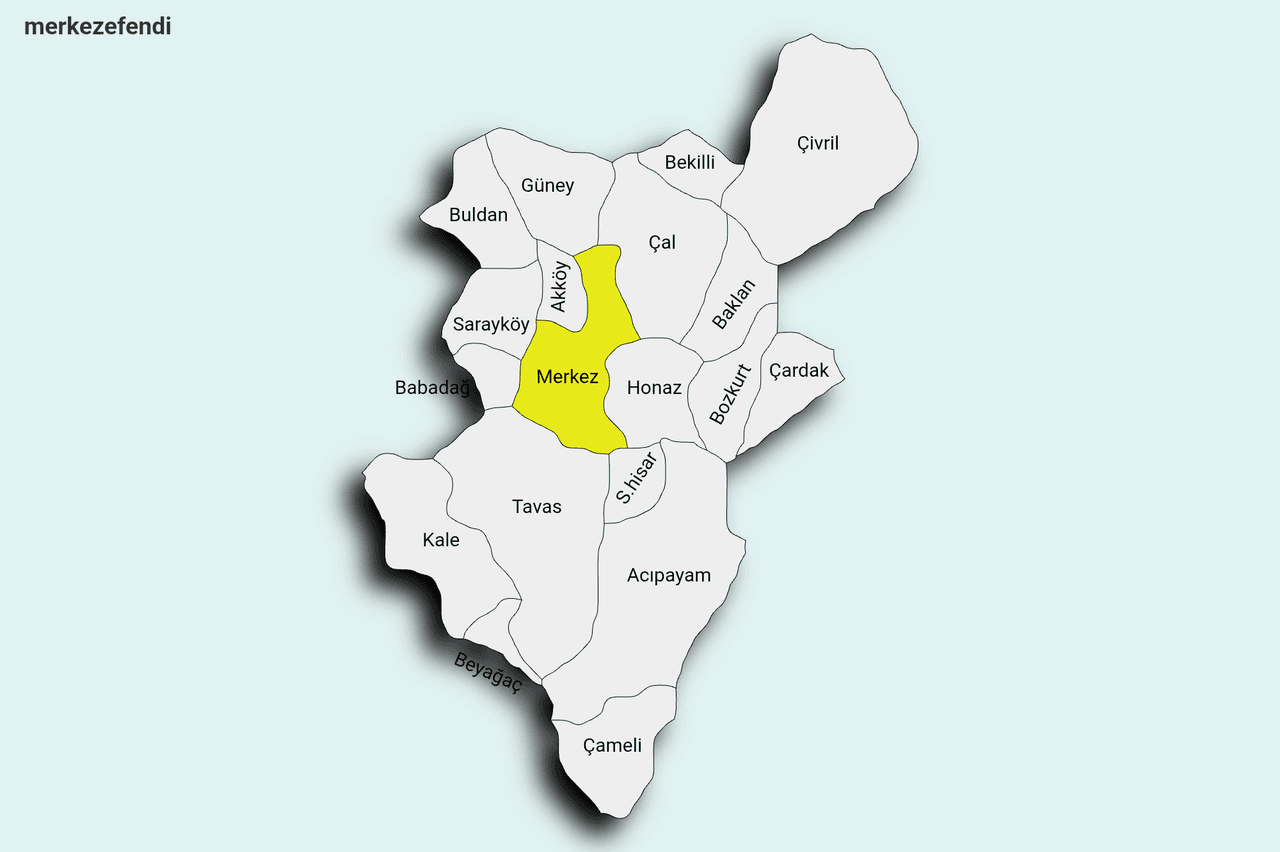
Created with Paintmaps.
Merkezefendi
Mayor(s) | Şeniz Doğan | ||||||||
|---|---|---|---|---|---|---|---|---|---|
Province(s) | Denizli | ||||||||
Population | 351.085 | ||||||||
Geographical Region | Aegean Region | ||||||||
District Governor | Abdullah Demir | ||||||||
Merkezefendi is one of the central districts of Denizli Province in the Aegean Region. The district was established on 6 December 2012 in accordance with Law No. 6360 published in the Official Gazette, following Denizli’s acquisition of metropolitan municipality status.【1】 The district’s boundaries consist of 50 neighborhoods formed by abolishing the legal personality of 42 neighborhoods, two municipalities, and six villages within the central area and incorporating them as neighborhoods. The district is named after Merkez Efendi, a physician and Sufi scholar who lived during the 15th and 16th centuries.
Located at an elevation of 354 meters in the center of Denizli Province, Merkezefendi covers an area of approximately 336,000 decares.【2】 To the east and north, the district borders Pamukkale; to the west, Sarayköy and Babadağ; and to the south, Tavas. Administered by the Merkezefendi Subprovince, the district has a five-story Government House, inaugurated on 13 June 2018, with a covered area of 8,912 square meters. Local administrative structures include municipal organizations, and Merkezefendi is among the most densely populated urban areas in Denizli.【3】
Within the district’s boundaries lies the archaeological site of Laodikeia, an ancient city situated south of the Lykos (Çürüksu) River. Founded between 261 and 263 BCE by Antiochus II, the city derived its name from Queen Laodike and became one of Anatolia’s principal centers of art and trade by the 1st century BCE. Its religious significance was enhanced by hosting one of the Seven Churches of Early Christianity. The city’s architectural heritage includes a 20,000-seat Great Theatre, a 15,000-seat Small Theatre, a 350-meter-long Stadium, a Gymnasium, and the Monumental Fountain, which was restored during the Byzantine period.【4】
The Historical Kaleiçi Bazaar, recognized as Denizli’s earliest settlement center, is another historical focal point of the district. Although the current fortress structure was built between 1243 and 1250, settlement traces in the region extend back to the Roman and Byzantine periods. Today, this area remains a commercial hub sustaining traditional crafts such as textiles, shoemaking, and coppersmithing.
Figures from the Seljuk and Ottoman periods play a significant role in the district’s cultural identity. Servergazi, a Seljuk commander active at the end of the 12th century and beginning of the 13th century, led military campaigns that brought the region under Turkish rule. His tomb, now registered as a turbe, is located in the neighborhood named after him.
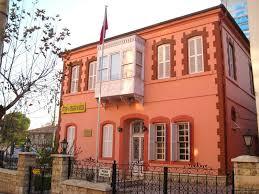
Etnografya Müzesi (Kültür Portalı)
Merkez Efendi (Mûsâ), after whom the district is named, was born in Denizli in 1463–64, received his education in Bursa and Istanbul, and became a representative of the Halvetiyye-Sünbüliyye Sufi order.【5】 Merkez Efendi, who had connections with Sultan Süleyman the Magnificent, served at the Hafsa Sultan Külliyesi in Manisa and entered popular culture as the inventor of the traditional Mesir Macunu.
An example of the Republican era’s heritage is the Atatürk House Ethnography Museum located in Saraylar Neighborhood. This two-story building, constructed in the late 19th century and identified in architectural literature as being in the Sakız style, served as the residence of Mustafa Kemal Atatürk during his visit to Denizli on 4 February 1931. Opened as a museum in 1984, the ground floor displays ethnographic artifacts, while the upper floor exhibits Atatürk’s personal belongings and a traditional Denizli household arrangement. The museum’s inventory also includes banners used during the National Struggle and clothing belonging to local figures.【6】
T.C. Merkezefendi Kaymakamlığı. "Merkez Efendi." Accessed May 1, 2026. https://www.merkezefendi.gov.tr/merkez-efendi.
T.C.Merkezefendi Kaymakamlığı Governorship. "Mahalli İdareler." Accessed May 1, 2026. https://www.merkezefendi.gov.tr/mahalli-idareler.
T.C.Merkezefendi Kaymakamlığı Governorship. “Atatürk Evi Etnografya Müzesi.” Accessed May 1, 2026. https://www.merkezefendi.gov.tr/ataturk-evi-etnografya-muzesi.
T.C.Merkezefendi Kaymakamlığı Governorship. “Hükümet Konağı Tarihçesi.” Accessed May 1, 2026. https://www.merkezefendi.gov.tr/hukumet-konagi-tarihcesi.
T.C.Merkezefendi Kaymakamlığı Governorship. “Laodikya.” Accessed May 1, 2026. https://www.merkezefendi.gov.tr/laodikya.
T.C.Merkezefendi Kaymakamlığı Governorship. “Servergazi Türbesi.” Accessed May 1, 2026. https://www.merkezefendi.gov.tr/servergazi-turbesi.
T.C.Merkezefendi Kaymakamlığı Governorship. “Tarihi Kaleiçi Çarşısı.” Accessed May 1, 2026. https://www.merkezefendi.gov.tr/tarihi-kaleici-carsisi.
[1]
T.C. Merkezefendi Kaymakamlığı, “Hükümet Konağı Tarihçesi,” erişim 1 Mayıs 2026, https://www.merkezefendi.gov.tr/hukumet-konagi-tarihcesi.
[2]
T.C. Merkezefendi Kaymakamlığı, “Hükümet Konağı Tarihçesi,” erişim 1 Mayıs 2026, https://www.merkezefendi.gov.tr/hukumet-konagi-tarihcesi.
[3]
T.C. Merkezefendi Kaymakamlığı, “Mahalli İdareler,” erişim 1 Mayıs 2026, https://www.merkezefendi.gov.tr/mahalli-idareler.
[4]
T.C. Merkezefendi Kaymakamlığı, “Laodikya,” erişim 1 Mayıs 2026, https://www.merkezefendi.gov.tr/laodikya.
[5]
T.C. Merkezefendi Kaymakamlığı, “Merkez Efendi,” erişim 1 Mayıs 2026, https://www.merkezefendi.gov.tr/merkez-efendi.
[6]
T.C. Merkezefendi Kaymakamlığı, “Atatürk Evi Etnografya Müzesi,” erişim 1 Mayıs 2026, https://www.merkezefendi.gov.tr/ataturk-evi-etnografya-muzesi.

Created with Paintmaps.
Merkezefendi
Mayor(s) | Şeniz Doğan | ||||||||
|---|---|---|---|---|---|---|---|---|---|
Province(s) | Denizli | ||||||||
Population | 351.085 | ||||||||
Geographical Region | Aegean Region | ||||||||
District Governor | Abdullah Demir | ||||||||
No Discussion Added Yet
Start discussion for "Merkezefendi (District)" article
Historical Development and Ancient Heritage
Turk-Islamic Period and Notable Figures
Cultural Structures and Museums