This article was automatically translated from the original Turkish version.
Type of Geographical İndication | Place of Origin | ||||||||
|---|---|---|---|---|---|---|---|---|---|
Application Date | 09.08.2017 | ||||||||
Registration Number | 370 | ||||||||
Registration Date | 30.07.2018 | ||||||||
Product / Product Group(s) | Processed and Unprocessed Fruits Vegetables and Mushrooms | ||||||||
Province(s) | Burdur | ||||||||
Applicant/Registrant(s) | Bucak Municipality | ||||||||
Melli fig is a local fig variety registered by its place of origin, cultivated within the geographic boundaries defined around the Kocaaliler Village in the Bucak district of Burdur province in Türkiye. It was officially registered as a geographical indication on 30 July 2018 under Law No. 6769 on Industrial Property, with registration carried out by the Bucak Municipal Council and the Bucak District Directorate of Agriculture and Forestry.
The Melli fig naturally grows in areas between 300 and 700 meters above sea level, primarily as a boundary tree in its natural habitat. Its ability to yield fruit over many years even on non-agricultural land, its natural propagation without the introduction of saplings from outside, and the absence of other fig varieties in the region are key factors preserving its endemic character. Historically used as a boundary plant between plots, this fig variety has also been cultivated in orchards established through cutting propagation. As of 2010, production was carried out by 570 producers across approximately 61,000 trees, yielding about 400 tons annually.
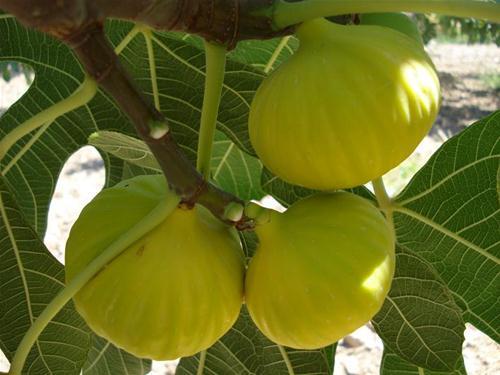
The Melli fig is recognized by its thin, smooth skin, pleasant aroma, light green to yellowish exterior color, and red interior. The fruits, with an average diameter of 3 cm, have a skin that is easily peeled and a seed structure that causes minimal tooth contact. There is no internal cavity, the apex is flat, and there is no neck. The average fresh fruit weight is 38.4 grams. It is suitable for both drying and fresh consumption. As a mid-season variety, the Melli fig is valued for table use and drying due to its drought-resistant nature.
Its leaves are five-lobed, narrowly sinuate, and green in color. The trees have a spreading and pendulous habit with moderate growth vigor. Leaf emergence occurs between 1 and 10 April, and fruit ripening takes place between 25 July and 15 September. No parthenocarpic fruit formation is observed. The variety requires pollination.
The chemical composition and physical measurements of the Melli fig are as follows:
Element content (mg/kg):
Potassium (K): 184.2
Magnesium (Mg): 275.5
Manganese (Mn): 0.559
Iron (Fe): 4.387
Sugar and pH levels:
Total sugar: 20.17% (AOAC-1984-31.048)
pH: 4.62 (TS 1813)
Physical measurements:
Fruit width: 43.72 mm
Fruit length: 35.40 mm
Fruit index: 1.23 (polar flattening)
Epidermis thickness: 2.90 mm
Ostiole diameter: 5.10 mm
Fruit stalk length: 3.76 mm
Water-soluble dry matter (WSDM): 22.3%
Titration acidity (TA): 0.19%
While general fig cultivation techniques are applied in Melli fig production, adherence to certain local rules is mandatory:
The Bucak region is favorable for fig production due to its mild winters and hot, dry summers. The average annual temperature ranges from 18 to 20°C, rising to as high as 30°C during the ripening and drying periods. The region’s clayey, humus-rich, and sandy soil structure, along with its natural vegetation, are the primary environmental factors responsible for the Melli fig’s distinctive aroma and flavor.
The production, storage, transportation, and marketing of the Melli fig are monitored by a three-member oversight body composed of representatives from the Bucak Municipal Council and the Bucak Chamber of Agriculture, under the coordination of the Bucak District Directorate of Agriculture and Forestry. Inspections are conducted during planting and harvest periods, with emphasis on preserving the variety’s endemic nature, preventing contamination with other varieties, and ensuring compliance with production techniques. Inspection reports are submitted annually to the Turkish Patent and Trademark Office.
Turkish Patent and Trademark Office. "Melli İnciri Coğrafi İşaret Tescil Belgesi." Accessed August 16, 2025. https://ci.turkpatent.gov.tr/Files/GeographicalSigns/b570e0a4-d234-4553-bc84-72a836d9b144.pdf.
Türk Patent ve Marka Kurumu. "Melli İnciri." Coğrafi İşaretler Portalı. Accessed August 16, 2025. https://ci.turkpatent.gov.tr/cografi-isaretler/detay/38312.

Type of Geographical İndication | Place of Origin | ||||||||
|---|---|---|---|---|---|---|---|---|---|
Application Date | 09.08.2017 | ||||||||
Registration Number | 370 | ||||||||
Registration Date | 30.07.2018 | ||||||||
Product / Product Group(s) | Processed and Unprocessed Fruits Vegetables and Mushrooms | ||||||||
Province(s) | Burdur | ||||||||
Applicant/Registrant(s) | Bucak Municipality | ||||||||
Geographical Distribution and Natural Growth Characteristics
Distinctive Characteristics
Chemical and Physical Properties
Production Method
Ecological Compatibility
Monitoring Process