


This article was automatically translated from the original Turkish version.
Mehmet Akif Ersoy (1873–1936) emerged as a poet deeply engaged with social responsibility during the Second Constitutional Era and the National Struggle years in Turkish literature. In his poetry, he prioritized reflecting societal issues over individual emotions, aiming to educate the public, raise awareness, and sustain moral values in his works.
In his conception of art, the principle that “art serves society” was fundamental. He placed particular emphasis on Islamic values, morality, poverty, ignorance, the disintegration experienced in relation to the West, and the ideal of liberation. In this context, poetry for Ersoy was more than an aesthetic object—it functioned as an intellectual and social instrument. The poet closely observed the social and political atmosphere of his time and composed his poems in clear, simple language accessible to the masses, seeking broad public reach. Although he did not depart formally from classical poetic conventions, he adopted a modern and realistic style in content. Religious texts, especially the Qur’an, and particularly Surah Al-Shu’ara, served as key reference points in shaping his understanding of poetry.
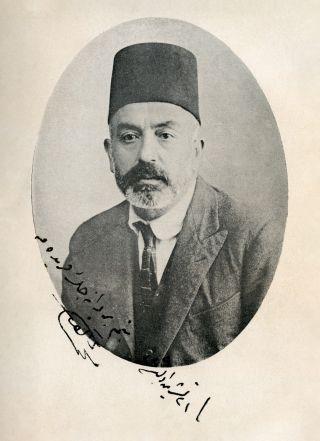
Mehmet Akif Ersoy (İslam Ansiklopedisi)
The poetic language of Mehmet Akif Ersoy is simpler, clearer, and more natural compared to the literary norms of his time, designed to be comprehensible to the general public. The poet developed a discourse that prioritized meaning over ornate expression. This preference was driven by his view of poetry as a tool for proclamation and guidance. Consequently, Ersoy’s language served the function of educating and enlightening the people.
In his literary outlook, closeness to spoken language was essential. Although his poems occasionally include words of Arabic and Persian origin, these usages are more limited and controlled than typical in the literary circles of his era. He frequently incorporated expressions reflecting popular speech; proverbs, idioms, and common vernacular phrases appear naturally within his texts. In this respect, Akif’s poetic language avoids literary elitism and is openly oriented toward direct communication with the people.
In terms of style, Mehmet Akif’s poetry exhibits a pronounced rhetorical structure. The didactic tone, apostrophic address, and instructional discourse dominate. He frequently employed direct address, question-and-answer techniques, comparisons, and narrative excerpts to effectively convey his ideas. This style reflects his influence by the tradition of sermons and religious oratory. His use of dramatic narrative techniques and dialogues in poetry adds a vivid and thought-provoking dimension to his works.
Realism occupies a prominent place in Akif’s style. He sought to evoke credibility and sincerity in readers by incorporating observations from within society, everyday life, and lived experiences. In this context, he often employed the technique of poetic narrative, enriching his poems with plot, character, and environmental descriptions. This approach is systematically evident in his work Safahat.
Mehmet Akif Ersoy’s language and style were built not on the aesthetic priorities of his artistic circles but on a functional approach aimed at direct and effective communication with the people. This perspective reflects the moral, social, and religious concerns at the core of his poetic vision.
The central themes in the poetry of Mehmet Âkif Ersoy focus largely on the social, political, and moral issues of the final period of the Ottoman Empire. The poet positioned poetry as an instrument of ideas and struggle, placing societal concerns above individual emotions. Key recurring themes in his work include morality, religion, the fight against ignorance, poverty, justice, freedom, civilization, national consciousness, and the problem of Westernization.
Ersoy frequently emphasized the spiritual decline and loss of values in society, arguing that salvation could only be achieved through a return to moral and religious values. Islamic faith was not merely a path to individual redemption but also the foundational pillar of social order. His poetry consistently stressed the need to understand Islam authentically, free from blind imitation. During the National Struggle, he prominently addressed concepts such as love of homeland, the desire for independence, and sacrifice. These poems underscored the necessity of national unity and cultivated a powerful spirit of resistance against despair and surrender. The İstiklâl Marşı is the most concrete embodiment of this outlook.
Social injustice, destitution, and ignorance were among the issues Akif consistently addressed. He repeatedly highlighted the responsibility of rulers toward the people and the necessity of educating and empowering the populace. In this context, his poems often carry a critical social dimension. His attitude toward Western civilization was dualistic: while he praised its technological and scientific achievements, he warned against moral corruption and cultural disintegration. He advocated for development aligned with Islamic civilization rather than mere imitation.
Mehmet Akif’s poetry also examines the relationships between the individual, society, and the state; the transformation of urban life; the inadequacies of the education system; and cultural decay. This multidimensional thematic world has rendered his works both historical documents of his era and intellectual guides.
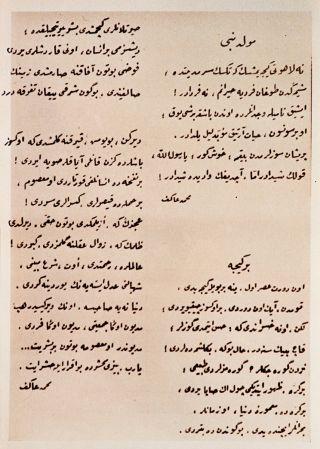
Two Poems Written by Mehmed Akif in Tâhirülmevlevî Script (Islamic Encyclopedia)
Although Mehmet Akif Ersoy developed his poetic vision in a highly individual manner, he was influenced by the literary, cultural, and political environment of his time and by certain intellectual currents. This process of influence enabled him to forge a unique poetics in both form and content. His poetry shows a clear inclination toward realism and social thought, distancing itself from the influence of the Servet-i Fünun circle.
The most significant intellectual foundation shaping his poetry is the Islamism movement. This approach, which gained momentum from the reign of Abdülhamid II onward, aimed to unify Ottoman society through a sense of ummah consciousness. Ersoy viewed Islam as the key to both individual and collective salvation, placing Islamic morality and values at the center of his poetry. In this regard, his work aligns with the intellectual climate of the journals Sırât-ı Müstakîm and Sebîlürreşâd.
Formally, Mehmet Akif chose the classical aruz meter but adapted it to spoken language, developing a distinctive usage. While this places him formally within the tradition of Divan literature, his content and purpose transcend it. Indirect influences from classical poets such as Fuzûlî, Nabî, and Şeyh Galip can be felt. However, Ersoy did not merely imitate this tradition—he transformed and reinterpreted it.
Mehmet Akif was notably influenced by his contemporaries, especially Tanzimat-era poets such as Namık Kemal and Ziya Paşa. Their approach to using literature to educate the public and explore concepts of rights and justice resonated with Ersoy’s own poetic vision. In particular, Namık Kemal’s themes of freedom, homeland, and nation were reinterpreted in Ersoy’s poetry with a stronger religious dimension.
It is also known that he was not indifferent to Western literature and thought. He followed the works of Western poets and thinkers such as Victor Hugo and Alphonse de Lamartine, but evaluated them not as direct poetic models but as intellectual perspectives. Ersoy adopted a selective stance toward the West: he embraced its progress in technology and science while maintaining a critical attitude toward its moral values.
Islam Ansiklopedisi. "Mehmed Akif Ersoy." Accessed May 7, 2025.https://islamansiklopedisi.org.tr/mehmed-akif-ersoy.
Karabulut, Mustafa. “Mehmet Akif Ersoy ve Hikmetli Şiir.” Hikmet - Akademik Edebiyat Dergisi 2021 (67676): 34–44.https://dergipark.org.tr/tr/pub/hikmet/issue/67676/974900
Kelebek, Aykut Nasip. "Mehmet Akif Ersoy’un Poetikası." *Dil ve Edebiyat Araştırmaları* 2021 (66469): 239–257.https://dergipark.org.tr/tr/pub/diledeara/article/1017818
Küçük, Murat. “Mehmet Âkif Ersoy ve Türkçe.” Türkoloji Dergisi 2014 (43310): 93–112.https://dergipark.org.tr/tr/pub/turkoloji/issue/43310/526648
Yıldırım, Ramazan. “Mehmet Akif’in İslam Tasavvuru.” Şarkiyat Mecmuası, no. 15 (November): 161–75. Accessed May 7, 2025.https://dergipark.org.tr/tr/pub/iusarkiyat/issue/998/11233.

No Discussion Added Yet
Start discussion for "Mehmet Akif Ersoy's Understanding of Poetry" article
His Language and Style
Major Themes in His Poetry
Influences and Poetic Predecessors