


This article was automatically translated from the original Turkish version.

Mustafa ibn Ali al-Muvakkit was one of the leading Ottoman astronomers and chief timekeepers of the 16th century. Renowned for his work in astronomy, mathematics, and the science of timekeeping (ʿilm al-mīqāt), he played a pivotal role in advancing observational astronomy in the Ottoman Empire and in institutionalizing this knowledge within official structures.
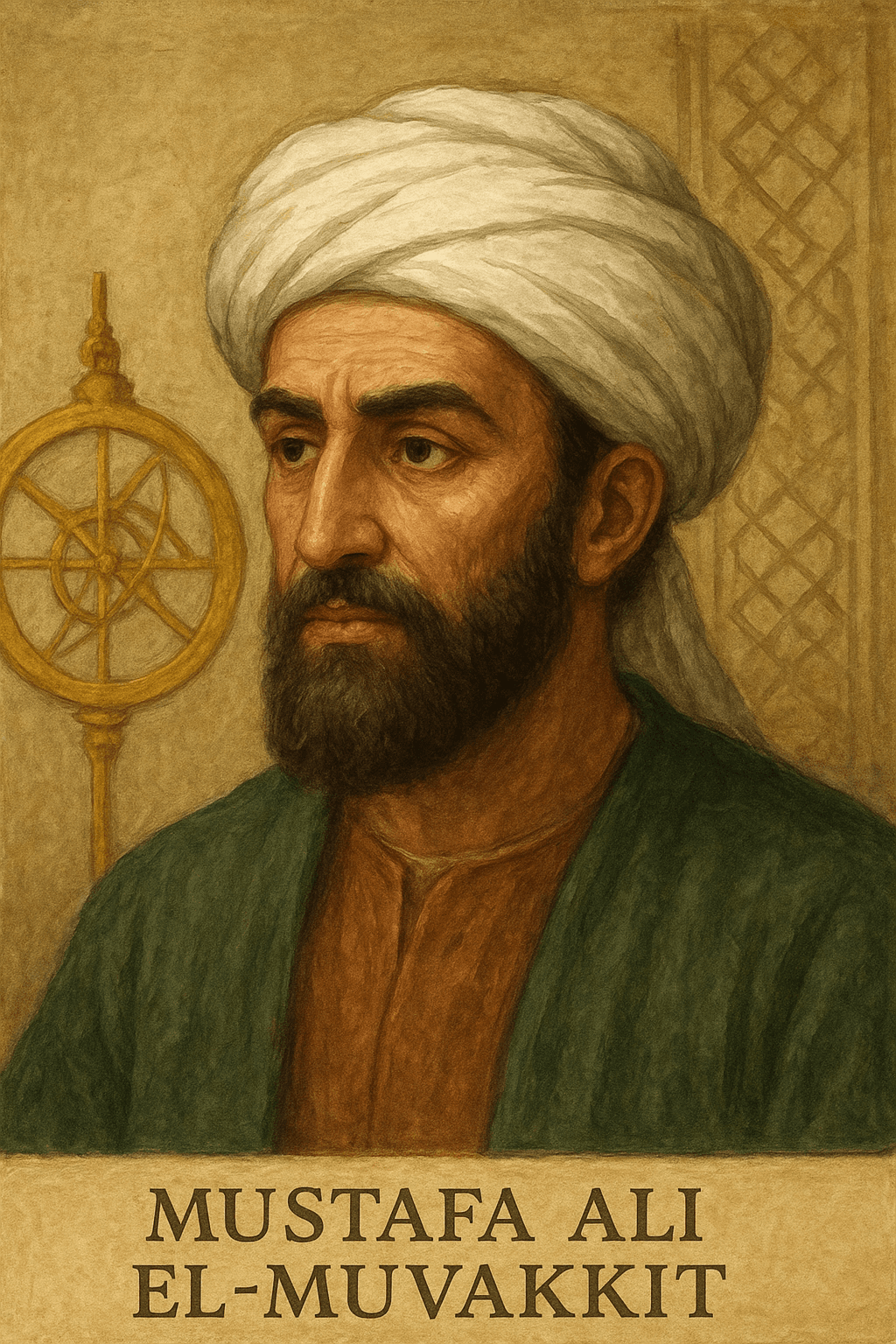
Representational image of Mustafa Ali ibn al-Muvakkit (generated by AI)
Although his exact date of birth is unknown, he is believed to have been born in Istanbul in the early 16th century. Mustafa ibn Ali received his early education in the madrasa system and studied under the leading astronomers and mathematicians of his time, particularly influenced by the scholarly circle of Mîrim Çelebi. The muvakkithanes, timekeeping centers attached to mosques, became the focal point of his scientific activities. There he conducted astronomical calculations and expanded the accumulated knowledge on the construction of instruments used for time measurement. Although trained in the madrasa tradition, Mustafa ibn Ali emphasized the importance of practical observational knowledge, distinguishing himself within classical astronomical education.
Mustafa ibn Ali was among the first scholars in the Ottoman Empire to systematize the construction and use of the astrolabe. The astrolabe is a complex astronomical instrument used to measure the altitude and position of celestial bodies. In his 1544 treatise, Risâle-i Usturlâb-ı Selîmî (in Arabic, Risâle fî’l-Usturlâb), he provided a detailed account of the astrolabe’s structure, types, and methods of use.
Dedicated to Şehzade Selim, son of Sultan Süleyman the Magnificent, this treatise was enriched with practical examples demonstrating how the astrolabe could be employed in observations of the sun, stars, and planets. The work is one of the rare Ottoman texts that unite instrument-making with theoretical astronomy.
Al-Muvakkit also authored significant works in the fields of the science of timekeeping (ʿilm al-mīqāt) and geography. Among these, Teshîlü’l-Mîkât (Facilitation of Time Calculation) deals with the construction and use of practical observational instruments such as the Rubʿ-ı Müceyyeb (sine/tangent quadrant).
In another treatise, Fethü’l-Mîzân, he systematically presented trigonometric methods for time calculation. These texts served as practical textbooks for officials working in the muvakkithanes. Mustafa ibn Ali’s writings represent an original tradition that integrated theoretical astronomy with applied observational practice in the Ottoman context.
Another of Mustafa ibn Ali’s important works is the geographical treatise İʿlâmü’l-ʿibâd fî aʿlâmi’l-bilâd, presented to Sultan Süleyman the Magnificent. In this work, he calculated the latitudes and longitudes of cities in Iran, Arabia, and Anatolia, verifying geographic coordinates through astronomical observations. In this regard, he was a pioneer in the Ottoman geographical tradition for employing observational data. Al-Muvakkit’s geographic measurements enhanced the importance of empirical data in cartography of the period and contributed to the development of the empirical method in Ottoman science.
Al-Muvakkit’s intellectual legacy extended beyond his writings; he also laid the groundwork for the institutionalization of the chief timekeeper (müneccimbaşı) office in the Ottoman Empire. His students, trained in the muvakkithanes, continued to apply his calculation methods and instrument-making techniques. This institutional framework provided the foundation for the observational and timekeeping systems later implemented by Takiyyüddîn er-Râsıd at the Istanbul Observatory toward the end of the 16th century.
Mustafa ibn Ali’s institutional contributions helped establish observational astronomy in the Ottoman Empire as a sustained and formally recognized scientific discipline.
Mustafa ibn Ali al-Muvakkit, who died in 1571, is regarded as one of the figures who bridged scientific astronomy with everyday life in the Ottoman Empire. Thanks to his work, time awareness in Ottoman cities became aligned with astronomical measurements; science ceased to be confined to palace circles and became a functional part of mosques, madrasas, and urban centers. In this sense, al-Muvakkit is remembered as a pioneering figure who unified the practical and theoretical dimensions of Ottoman astronomy. His legacy demonstrates that Ottoman science did not merely observe the heavens but also regulated the rhythms of daily life; his name became synonymous not only with measuring time but with bringing science to the broader society.
Accessed November 12, 2025. https://bilig.yesevi.edu.tr/yonetim/icerik/makaleler/3342-published.pdf
Aydüz, Salim. "Uluğ Bey Zîci'nin Osmanlı Astronomi Çalışmalarındaki Yeri ve Önemi." Bilig Bahar 25 (2003): 139-172
Aydüz, Salim. “Osmanlı Astronomi Müesseseleri.” *Türkiye Araştırmaları Literatür Dergisi* 2, no. 4 (2004): 411–453. Accessed November 12, 2025. https://dergipark.org.tr/tr/download/article-file/652087
Fazlıoğlu, İhsan. “Mustafa b. Ali el-Muvakkit.” *Türkiye Diyanet Vakfı İslâm Ansiklopedisi.* Accessed November 12, 2025. https://islamansiklopedisi.org.tr/mustafa-b-ali-el-muvakkit
Tağman, Süleyman Ertan. *Mustafa b. Ali el-Muvakkit’in Usturlâb Risalesi.* Master's thesis, Ankara University Institute of Social Sciences, 2007. Accessed November 12, 2025. https://www.academia.edu/53317568
Özer, Hasan, and Semra Sever. “Osmanlı Döneminde Yazılmış Bir Astronomi Eseri: Muvakkit Mustafa Bin Ali’nin Teshîlü’l-Mîkāt’ı.” Sosyal Bilimler Araştırmaları Dergisi 13, no. 1 (2018): 141–155. Accessed November 12, 2025. https://dergipark.org.tr/en/download/article-file/803432
Life and Education
Works and Scientific Contributions
Geography and Observational Studies
Role in the Ottoman Astronomical Tradition
Scientific Legacy and Influence