


This article was automatically translated from the original Turkish version.
+2 More
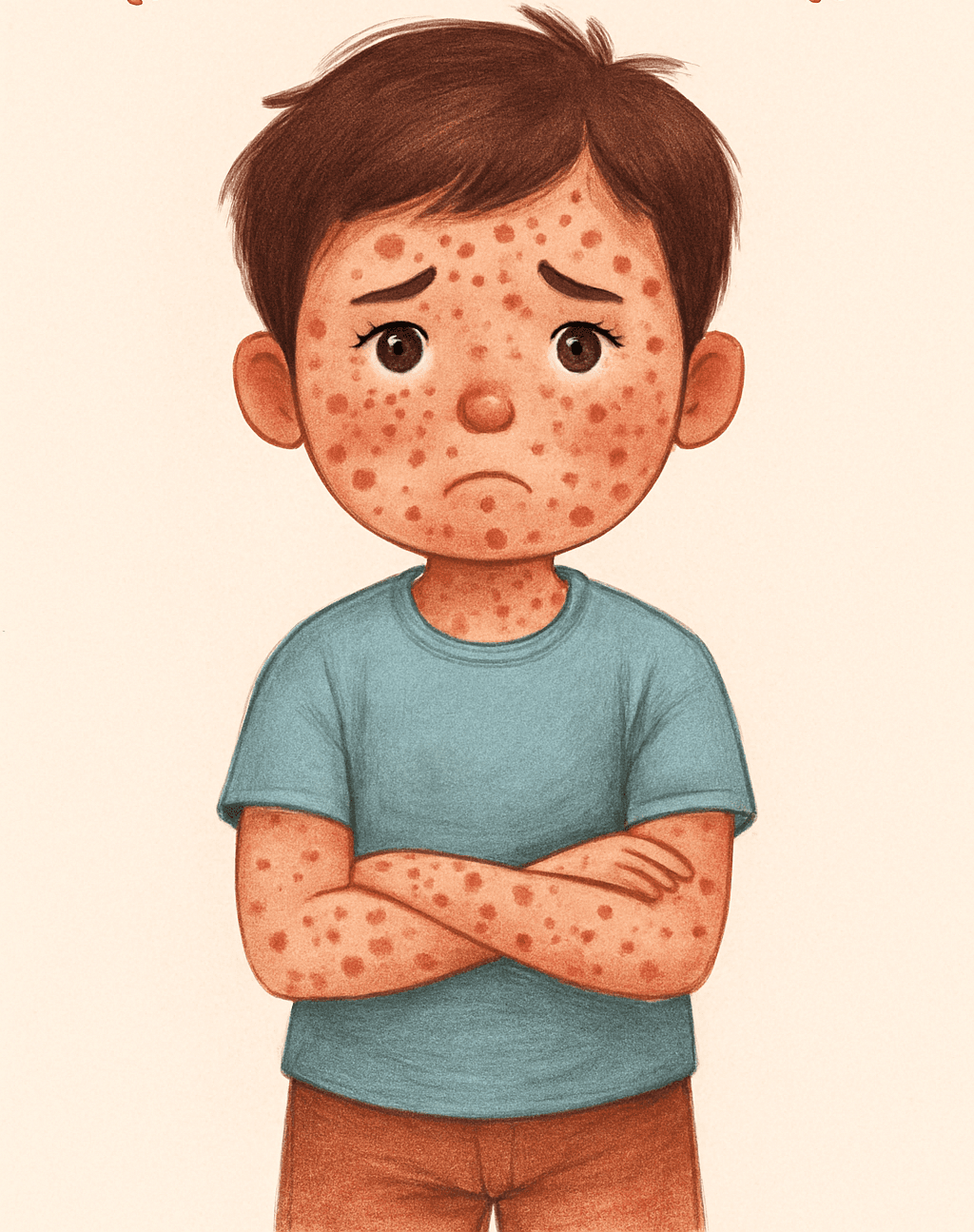
Measles
Initial Symptom | conjunctivitis runny nose cough High fever | ||||||||
|---|---|---|---|---|---|---|---|---|---|
Prevention | MMR vaccine (two doses, >95% herd immunity required) | ||||||||
Transmission Route | Respiratory droplet infection | ||||||||
Agent | Morbillivirus (family Paramyxoviridae) | ||||||||
Disease Name | Measles | ||||||||
Measles is an acute viral infectious disease caused by the Morbillivirus species, highly contagious and responsible for periodic epidemics. Although most commonly seen in childhood, it can also occur in adults lacking immunity and may lead to severe complications. Transmitted via the respiratory route, this disease poses significant epidemiological and socioeconomic risks to global health systems. Although vaccination programs have brought the disease under control, in recent years there has been a resurgence in measles cases due to factors such as vaccine hesitancy, migration mobility, and inequalities in access to health services.
The measles virus is a single-stranded negative-sense RNA virus belonging to the Paramyxoviridae family and the Morbillivirus genus. Two key glycoproteins embedded in the viral envelope play a critical role in the infection process: the hemagglutinin (H) protein and the fusion (F) protein. The H protein mediates attachment to host cells, while the F protein facilitates fusion between the host cell membrane and the viral envelope. Two receptors play a pivotal role in the virus’s entry into human cells:
After entering through these receptors, the measles virus replicates in the respiratory tract, then spreads to lymphoid tissues where it induces a systemic infection characterized by immunosuppression.
Measles is a droplet-transmitted infection. Viral particles released into the environment through coughing or sneezing by an infected individual can remain infectious in the air for up to two hours. The virus’s basic reproduction number (R₀) ranges between 12 and 18, placing measles among the most contagious infectious diseases known. This value varies according to population density, immunity levels, and social interaction rates. For example:
Infected individuals are contagious from approximately four days before the onset of rash until four days after its appearance. The risk of infection among unvaccinated individuals following exposure to the virus exceeds 90%.
The clinical course of measles typically consists of four phases:
1. Incubation Period
This period lasts between 10 and 14 days and is asymptomatic. The virus replicates and enters systemic circulation.
2. Prodromal Phase
High fever (38.5–40.5°C), cough, runny nose, and conjunctivitis are observed. Whitish spots on the buccal mucosa opposite the molars (Koplik spots) are a distinctive diagnostic feature of the disease.
3. Rash Phase
Maculopapular rashes appear, starting on the scalp and spreading downward. They typically last 3 to 5 days, and fever persists during this period.
4. Recovery Phase
This phase is marked by fading and resolution of the rash and subsiding fever. However, the risk of complications may still persist during this stage.
Measles infection can cause serious complications affecting multiple systems. Their frequency is as follows:
Risk factors: Children under five years of age, immunocompromised individuals, malnutrition (particularly vitamin A deficiency), pregnancy, and healthcare workers.
Diagnosis is often made clinically based on symptoms. Definitive diagnostic methods include:
The most effective way to prevent measles is vaccination. The widely administered worldwide MMR vaccine (Measles-Mumps-Rubella) is given in two doses:
The vaccine’s efficacy is 93–97%. To achieve herd immunity, vaccination coverage must reach at least 95%. However, in 2019, global measles cases increased by 300% compared to the previous year. The main causes of this increase are:
Measles vaccination was first introduced in Türkiye in the 1970s, and the MMR vaccine was incorporated into the national childhood immunization program in 2006. In the early 2000s, case numbers in Türkiye declined dramatically, but increases were noted in 2013 and 2019. In 2019, approximately 2,800 cases were reported.
Kahraman and Kaplan’s (2020) study identifies the following causes for this increase:
In developing countries, vitamin A deficiency is a decisive factor in the severity of measles cases. As noted by Uysal and Doğru (1994):
A 1998 study, later retracted, falsely claimed a link between the MMR vaccine and autism. Although this claim has been repeatedly refuted scientifically, it contributed significantly to the global spread of vaccine hesitancy. As noted by Ümit (2019):
Warning: The content in this article is provided solely for general encyclopedic information purposes. The information herein should not be used for diagnosis, treatment, or medical advice. Before making any decisions regarding health matters, you must consult a physician or qualified healthcare professional. The author and KÜRE Encyclopedia assume no responsibility for any consequences arising from the use of this information for diagnostic or therapeutic purposes.
Cılız, Nuray, Hacer Gökçe, Ersin Özçiftçi, Gülay Yalınbaş Kaya, Özlem Kocagöz, and Nuriye Özdemir. "Sağlık Çalışanlarında Kızamık, Kızamıkçık, Kabakulak, Suçiçeği, Difteri, Tetanos ve Hepatit B Seroprevalansı." *Klimik Journal/Klimik Dergisi* 25, no. 4 (2013). https://www.academia.edu/download/108284393/f159f1e814e6a9cfcf861f364674ab262662.pdf.
Dilli, Dilek, Ayşegül Zenciroğlu, Banu Karaaslan, Yelda Leventoğlu, Erhan Gökalp, and Nurullah Okumuş. "Ergenlerde kızamık, kızamıkçık, kabakulak ve suçiçeği seroprevalansı." *Journal of Child* 8, no. 3 (2008): 172–178. https://dergipark.org.tr/en/pub/jchild/issue/57112/805519.
Kahraman, Selma, and Ferhat Kaplan. "Türkiye’de kızamık hastalığının son yıllarda artma nedenleri." *Bandırma Onyedi Eylül Üniversitesi Sağlık Bilimleri ve Araştırmaları Dergisi* 2, no. 3 (2020): 175–183. https://dergipark.org.tr/tr/doi/10.46413/boneyusbad.757720.
Pahsa, Alaaddin, H. Dursun, E. Alp, E. Tükek, and F. Kutsal. "Erişkinlerde kızamık: 284 olgunun retrospektif değerlendirilmesi." *Flora* 4, no. 3 (1999): 200–205. https://www.floradergisi.org/managete/fu_folder/1999-03/1999-4-3-200-205.pdf.
Uysal, Gülnar, and Ülker Doğru. "Kızamık ve A vitamini." *Türkiye Klinikleri Journal of Pediatrics* 3, no. 1 (1994): 39–41. https://www.turkiyeklinikleri.com/article/en-kizamik-ve-a-vitamini-51172.html.
Ümit, Zühal. "Kızamık, Kızamıkçık, Kabakulak Aşısı ve Otizm." *Çocuk Enfeksiyon Dergisi* 13, no. 2 (2019): 118–119. https://search.proquest.com/openview/bdc3b1d37dbfb151ad094fa9dfa17d50/1?pq-origsite=gscholar&cbl=106060.

Measles
Initial Symptom | conjunctivitis runny nose cough High fever | ||||||||
|---|---|---|---|---|---|---|---|---|---|
Prevention | MMR vaccine (two doses, >95% herd immunity required) | ||||||||
Transmission Route | Respiratory droplet infection | ||||||||
Agent | Morbillivirus (family Paramyxoviridae) | ||||||||
Disease Name | Measles | ||||||||
The Causative Virus and Molecular Characteristics
Transmission Mechanism and Epidemiological Features
Clinical Course and Symptoms
Complications and Risk Rates
Diagnostic Methods
Vaccination and Prevention Strategies
Measles in Türkiye
Measles in Special Populations
Vitamin A Supplementation
Measles and Vaccine Hesitancy