


This article was automatically translated from the original Turkish version.
Maxwell's equations are four fundamental equations that describe the relationship between electricity and magnetism. Developed by James Clerk Maxwell in the 19th century, these equations laid the foundation for modern theories of electric and magnetic field. These equations explain how electricity and magnetism work together and hold great importance not only for theoretical physics but also for engineering and technological applications.
In the 19th century, science researchers sought to understand how electric and magnetic fields interacted. Discoveries by scientists such as Michael Faraday and André-Marie Ampère were synthesized by James Clerk Maxwell and expressed as four equations. While formulating these equations, Maxwell demonstrated that electric and magnetic fields dynamically influence each other and defined the fundamental laws governing this interaction.
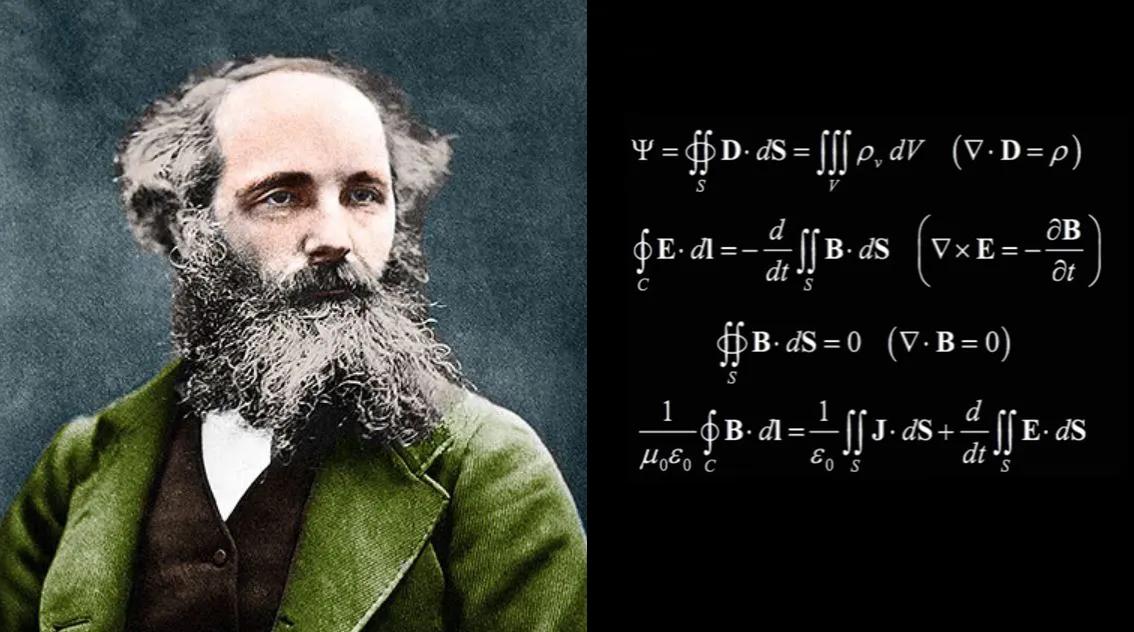
James Clerk Maxwell
Maxwell's equations consist of four main equations:
These equations explain how electric charges and currents produce electric and magnetic fields.
Gauss's law describes how the electric field generated by electric charges spreads out. The total electric charge enclosed within a closed surface is equal to the integral of the electric flux through that surface. Mathematically, it is expressed as:
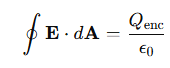
enc
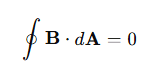
Gauss's law for magnetic fields states that magnetic monopoles do not exist. That is, magnetic field lines always form closed loops. According to this law, the total magnetic flux through any closed surface is zero:
Faraday's law explains that a time-varying magnetic field induces an electric current. This is the foundation of electromagnetic induction and is expressed as:
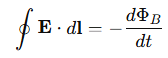
B
Ampere's law states that electric currents produce magnetic fields. However, Maxwell extended this law by adding that time-varying electric fields also generate magnetic fields, making the equation more general. This law is expressed as:
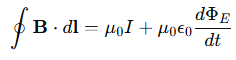
0
Maxwell's equations have numerous important applications both theoretically and practically. They play a fundamental role in understanding the propagation of electromagnetic waves, including radio waves, light, and other waves within the electromagnetic spectrum. Technological applications such as electric circuits, motors, generators, and wireless communication can also be explained using these equations.
Maxwell's equations represent a scientific revolution by unifying electricity and magnetism. They laid the foundation for electromagnetic theory and paved the way for many advances in modern physics and engineering. Maxwell's work was not only instrumental in combining electric and magnetic fields but also enabled the understanding of light as an electromagnetic wave. For this reason, Maxwell's equations remain a cornerstone of both scientific and technological progress.
Griffiths, David J. Introduction to Electrodynamics. 3rd ed., Prentice Hall, 1999, pp. 559–562. ISBN 978-0-13-805326-0.
Hampshire, Damian P. "A Derivation of Maxwell's Equations Using the Heaviside Notation." Philosophical Transactions of the Royal Society A: Mathematical, Physical and Engineering Sciences, vol. 376, no. 2134, October 29, 2018, arXiv:1510.04309. Bibcode:2018RSPTA.37670447H. doi:10.1098/rsta.2017.0447. ISSN 1364-503X. PMC 6232579. PMID 30373937.
Jackson, John. "Maxwell's Equations." Science Video Glossary, Berkeley Lab. Archived from the original on January 29, 2019. Retrieved June 4, 2016.
Šolín, Pavel. Partial Differential Equations and the Finite Element Method. John Wiley and Sons, 2006, p. 273. ISBN 978-0-471-72070-6.

No Discussion Added Yet
Start discussion for "Maxwell's Equations" article
Maxwell's Equations
Gauss's Law (Electric Field)
Gauss's Law (Magnetic Field)
Faraday's Law of Induction
Ampere-Maxwell Law
Applications of Maxwell's Equations