


This article was automatically translated from the original Turkish version.
Mass communication is a form of communication that encompasses all processes enabling messages to reach large audiences. Newspapers, television, radio, cinema, the internet and social media are among the tools through which social information is shared. Mass communication fulfills various needs of individuals and societies including access to information, entertainment, guidance and education.
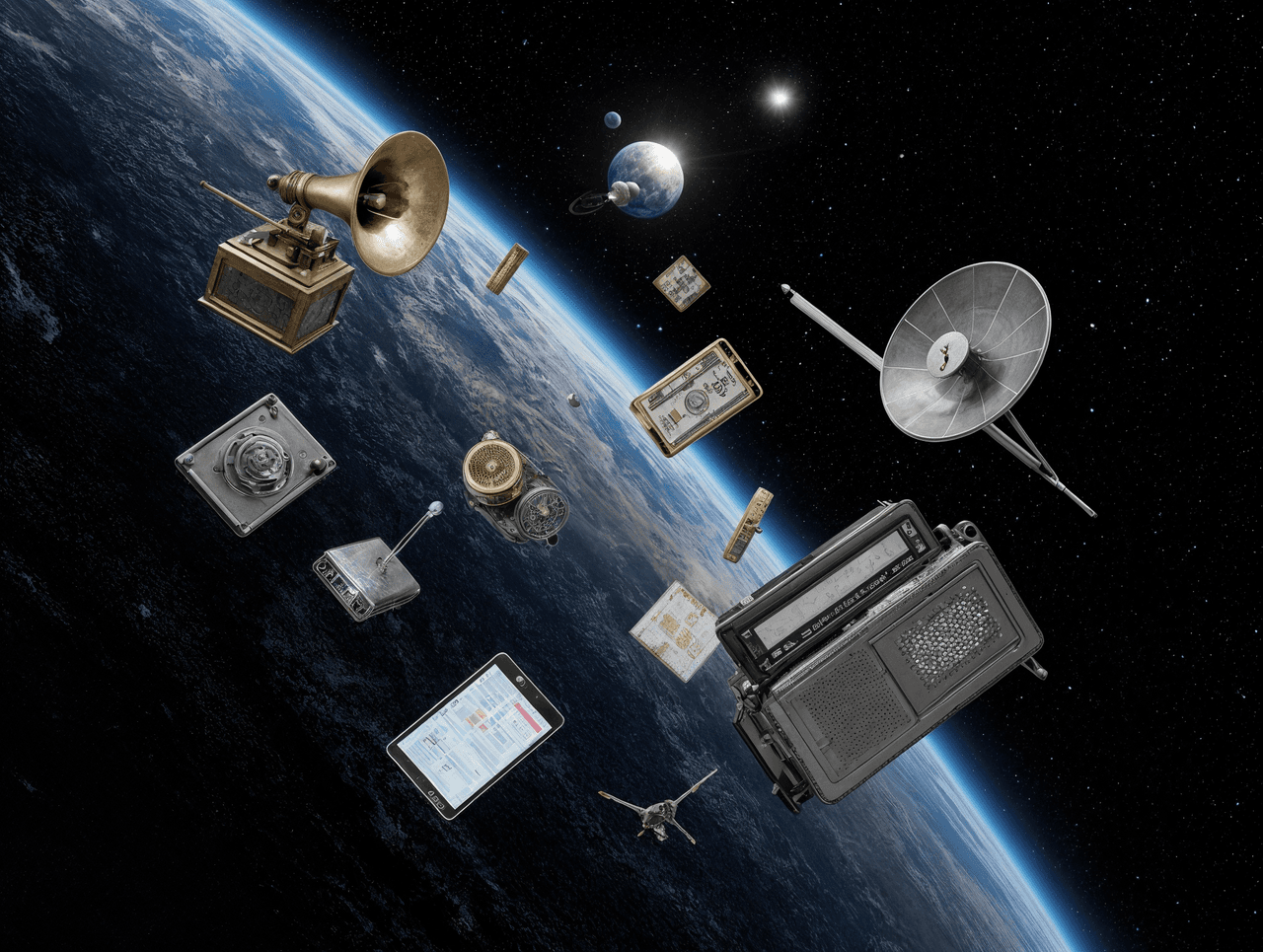
Generated by artificial intelligence
The invention of the printing press is considered one of the pivotal turning points in the development of mass communication. The German inventor Johannes Gutenberg developed a printing machine based on a movable type system in the mid-15th century, creating a revolution in information production. This invention not only enabled the mass production of printed materials but also made it possible for knowledge to reach wider audiences more quickly and economically.
Before the invention of the printing press, written works were primarily produced by hand. Handwritten manuscripts:
This situation meant that books were accessible only to the nobility, clergy and aristocracy. The control of knowledge by a limited segment of society hindered the widespread development of education and freedom of thought.
Gutenberg, with his printing machine developed around 1440, made written text printing significantly faster and more efficient. The innovations introduced by the printing press:
Thanks to these innovations, knowledge began to reach much broader audiences. One of the first books printed was the Gutenberg Bible (1455), and this work demonstrated the power of the printing press in Europe. The invention of the printing press did not merely increase book production; it paved the way for profound changes in education, science, religion, politics and media. By accelerating the spread of knowledge, it laid the foundation for modern media and mass communication systems and became the precursor to today’s digital age.
The invention of radio and television in the early 20th century created a major revolution in mass communication. Radio, especially during the 1920s, was adopted as an important medium for news and entertainment. Television, from the 1950s onward, became one of the most effective tools for mass information and cultural dissemination.
Radio operates on the principle of wireless transmission of sound via electromagnetic waves. Radio technology developed in the early 20th century was initially used for military and communication purposes. However, within a short time it became one of the most important tools of mass communication. In 1920, the United States’ KDKA radio station became the first commercial radio station to broadcast regularly. During these years, radio became a vital tool that accelerated public access to information through content such as news, music, weather reports and sports broadcasts.
Television emerged as a communication medium that combined moving images and sound to make information delivery more effective and engaging. Radio and television revolutionized news and information dissemination by enabling real-time transmission of events such as wars, elections and natural disasters to wide audiences. Television, in particular, played a major role in the development of the entertainment industry, contributing to the shaping of cultural norms through series, talk shows and competition programs. Moreover, television had significant political influence; the first televised presidential debate in the 1960 U.S. election between John F. Kennedy and Richard Nixon became a decisive factor in shaping voter perceptions and influencing election outcomes.
Beginning in the 1990s, the widespread adoption of the internet brought about a fundamental transformation in mass communication by making information accessible on a global scale. Initially used only by academic circles and state institutions, the internet quickly became an indispensable part of social life as its commercial and personal use expanded. Websites, email, forums and later social media platforms fundamentally changed communication patterns by enabling individuals and organizations to access information faster and more directly. Unlike traditional media, which relied on one-way information transmission, the internet empowered users to create, share and comment on content, making communication interactive. With the development of broadband internet, the rise of social media and the proliferation of mobile technologies from the 2000s onward, digital media became dominant in areas such as news, entertainment, education and commerce; traditional media organizations were also forced to adapt to the process of digitalization.
Today, almost every thing, from news sources to academic content and from cultural and artistic productions to personal sharing, is produced, stored and disseminated in digital environments. The speed and ease of access provided by the internet have directly influenced many areas, from social movements and political campaigns to crisis management and global trade, enabling individuals not only to consume information but also to become content creators. Especially through social media platforms, instant communication and mass interaction gained a new dimension, transforming traditional journalism into digital journalism. All these developments have enabled the internet to become not merely a tool of mass communication but a force reshaping global social, economic and cultural structures.

Generated by artificial intelligence
Mass communication provides individuals and societies with information about current events, scientific developments and global issues. News sources and media organizations fulfill this function.
Content delivered through radio, television, cinema and digital media meets society’s need for entertainment. Music, films, series and social media content are considered within this scope.
Mass communication facilitates the dissemination of society’s shared values, norms and rules. Public service announcements, political propaganda and the promotion of public policies play important roles in this context.
Mass communication facilitates access to academic knowledge and contributes to the introduction of different cultures. Documentaries, online education platforms and academic publications help disseminate educational content.
Newspapers, magazines and books are the most fundamental elements of print media. Print media ensures the long-term preservation of information and its reach to a broad readership.
Television and radio enable instantaneous information delivery to large audiences. News programs, series, documentaries and entertainment content have become one of the foundational pillars of mass communication through these media.
Internet-based communication tools enable direct and interactive information exchange between individuals. Social media platforms such as Facebook, X, Instagram and YouTube have become vital arenas for both personal and institutional communication.
Boyd, Danah, and Nicole B. Ellison. Social Network Sites: Definition, History, and Scholarship. Journal of Computer-Mediated Communication, 2007.
Briggs, Asa and Burke, Peter. A Social History of the Media: From Gutenberg to the Internet. Polity Press, 2010.
Castells, Manuel. The Internet Galaxy: Reflections on the Internet, Business, and Society. Oxford University Press, 2001.
Herman, Edward S., and Noam Chomsky. Manufacturing Consent: The Political Economy of the Mass Media. Pantheon Books, 1988.
McQuail, Denis. McQuail’s Mass Communication Theory. SAGE Publications, 2010.
Thompson, John B. The Media and Modernity: A Social Theory of the Media. Stanford University Press, 1995.

History of Mass Communication
The Spread of the Printing Press
Information Production and Dissemination Before the Printing Press
Gutenberg’s Printing Press and Mass Communication
The Rise of Radio and Television
The Internet and the Digital Revolution
Core Functions of Mass Communication
Information
Entertainment
Social Coordination
Education and Cultural Dissemination
Mass Communication Media
Print Media
Audiovisual Media
Digital Media and Social Media