


This article was automatically translated from the original Turkish version.
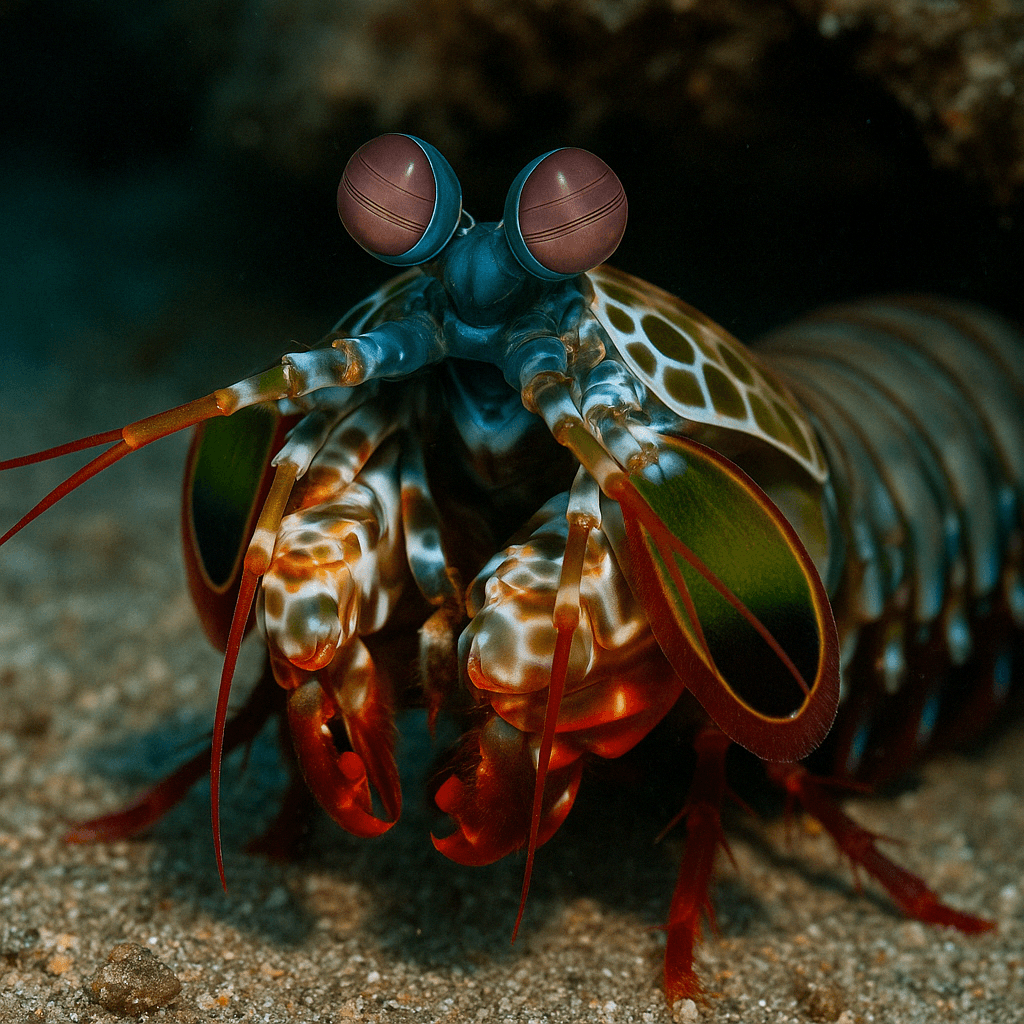
Mantis Shrimp
Realm | Animalia | ||||||||
|---|---|---|---|---|---|---|---|---|---|
Branch | Arthropoda | ||||||||
Subbranch | Crustacea | ||||||||
Class | Malacostraca | ||||||||
Subclass | Hoplocarida | ||||||||
Team | Stomatopoda | ||||||||
Mantis shrimps are marine crustaceans belonging to the order Stomatopoda, closely related to crabs and lobsters. They differ from true shrimps and have existed for approximately 400 million years. Over 400 species have been described today, with the majority concentrated in the Indo-Pacific region, particularly around Australia.
Mantis shrimps range in size from 1 to 46 centimeters. Although most are between 1 and 30 centimeters, the largest recorded specimen measured 46 centimeters. Some species are notable for their vibrant colors, which can include red, green, blue, purple, and yellow. The peacock mantis shrimp (Odontodactylus scyllarus) is one such species known for its vivid hues. Other species include Squilla mantis, S. empusa, and Oratosquilla oratoria. Some species exhibit zebra-like patterns of cream and brown stripes.
Mantis shrimps possess one of the most complex eye structures in nature. Each eye is stalked and divided into three sections, capable of independent movement. They can detect light across a broad spectrum, from deep ultraviolet to far red. Their eyes are so sensitive that they can perceive polarized light and, according to some studies, even detect biological changes caused by cancerous cells.
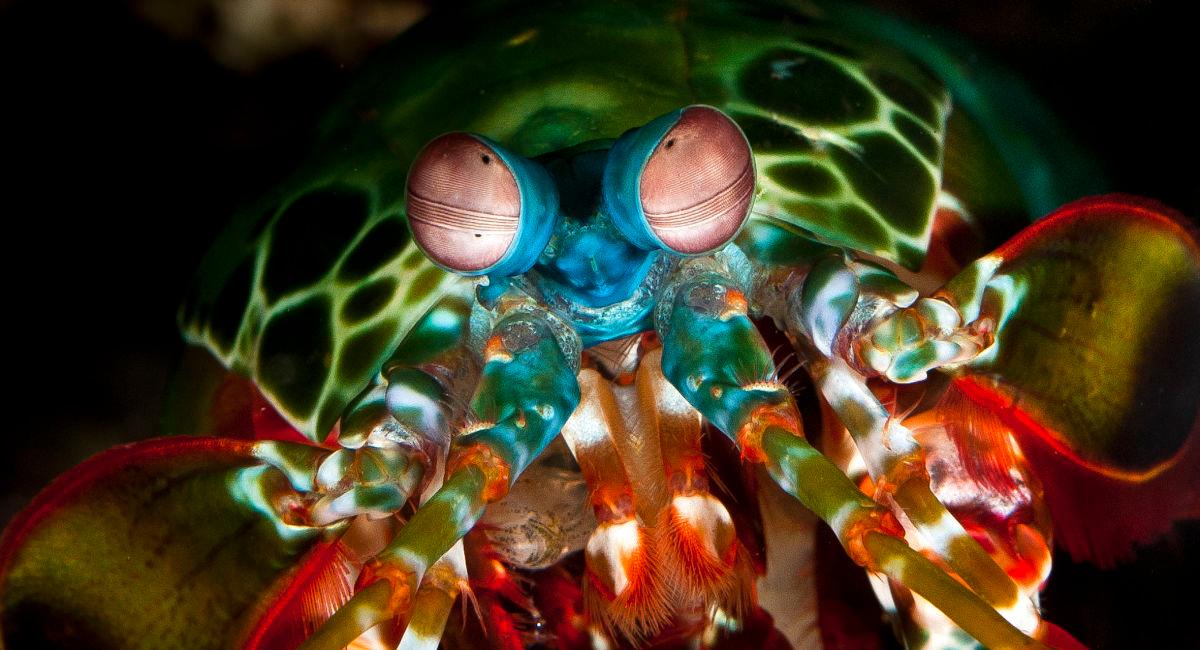
Mantis Shrimp Eyes (Great Barrier Reef Foundation)
They inhabit coastal areas and the seafloor, down to depths of 1,500 meters. Most species dwell in coral reefs, burrows, and crevices. Some prefer sandy or muddy substrates. Their burrowing behavior contributes to the oxygenation of seafloor sediments.
Mantis shrimps have evolved specialized raptorial appendages for capturing prey. These appendages occur in two main forms: spearers and smashers.
These strikes occur at speeds of up to 23 meters per second with an acceleration of approximately 10,400 g. The impact velocity of the appendage is comparable to that of a .22 caliber bullet. During the strike, cavitation bubbles form, producing both heat and sound waves. Complex layers of protein in the appendage structure prevent damage to the shrimp from these powerful impacts. This structure has inspired engineering designs for armor and sports equipment.
Most species are solitary, although some live in pairs for their entire lives. When threatened, they display a defense behavior known as “mantis spread,” in which they expand their bodies and open their raptorial appendages to appear more intimidating. Physical attacks are used only as a last resort. In physical defense, the most striking feature of mantis shrimps is their powerful fists.
Mantis Shrimp Punching (Nat Geo Animals)
During mating, the male transfers sperm to the female, who stores it until her eggs are ready to be laid. The eggs are glued together by a sticky substance secreted by the female and protected during incubation. Larvae begin hunting using club-like appendages about nine days after hatching. Some species are monogamous and remain together for life.

Mantis Shrimp with Eggs, Image: Ocean
Mantis shrimps regulate species balance in their ecosystems as predators and enhance biodiversity. Their burrowing activities also influence the physical and chemical structure of the seafloor. They are sensitive to environmental pollutants and can therefore serve as bioindicators in coral reef environments. Certain species are harvested for human consumption, especially along the coasts of Japan, the Mediterranean, and North America. They can also be kept in aquariums when appropriate conditions are provided.
Mantis shrimps may be active during the day or night depending on the species. Both larvae and adults are strong swimmers. Species diversity continues to expand, with new species still being discovered.
Ahyong, Shane. "Mantis Shrimp." *Australian Museum*, April 4, 2022.https://australian.museum/learn/animals/crustaceans/mantis-shrimp/.
Animals Around the Globe. "The Mantis Shrimp: An Underwater Hunter Without a Sound." Accessed April 5, 2025.https://www.animalsaroundtheglobe.com/the-mantis-shrimp-an-underwater-hunter-without-a-sound-2-281181/.
Great Barrier Reef Foundation. "Mantis Shrimp." Accessed April 5, 2025.https://www.barrierreef.org/the-reef/animals/mantis-shrimp.
National Geographic. "Mantis Shrimp." National Geographic, Accessed April 5, 2025.
Peacock Mantis Shrimp. "Genetics." Accessed April 5, 2025.https://peacockmantis-shrimp.weebly.com/genetics.html.
Smithsonian Ocean. "Mantis Shrimp Carries Eggs." May 2012.https://ocean.si.edu/ocean-life/invertebrates/mantis-shrimp-carries-eggs.

Mantis Shrimp
Realm | Animalia | ||||||||
|---|---|---|---|---|---|---|---|---|---|
Branch | Arthropoda | ||||||||
Subbranch | Crustacea | ||||||||
Class | Malacostraca | ||||||||
Subclass | Hoplocarida | ||||||||
Team | Stomatopoda | ||||||||
Morphology and Appearance
Vision
Habitat and Distribution
Hunting and Feeding
Behavior and Defense Mechanisms
Reproduction and Development
Ecological Role and Relationship with Humans
Daily Activity and Species Diversity