This article was automatically translated from the original Turkish version.
+1 More
Location | Kasaba Village Kastamonu Türkiye | ||||||||
|---|---|---|---|---|---|---|---|---|---|
Year of Construction | 1366 | ||||||||
Patron | Emir Mahmut Bey (Candaroğulları) | ||||||||
Uniqueness | It was constructed without the use of metal parts or nails | ||||||||
Conservation Status | UNESCO World Heritage List (2023) | ||||||||
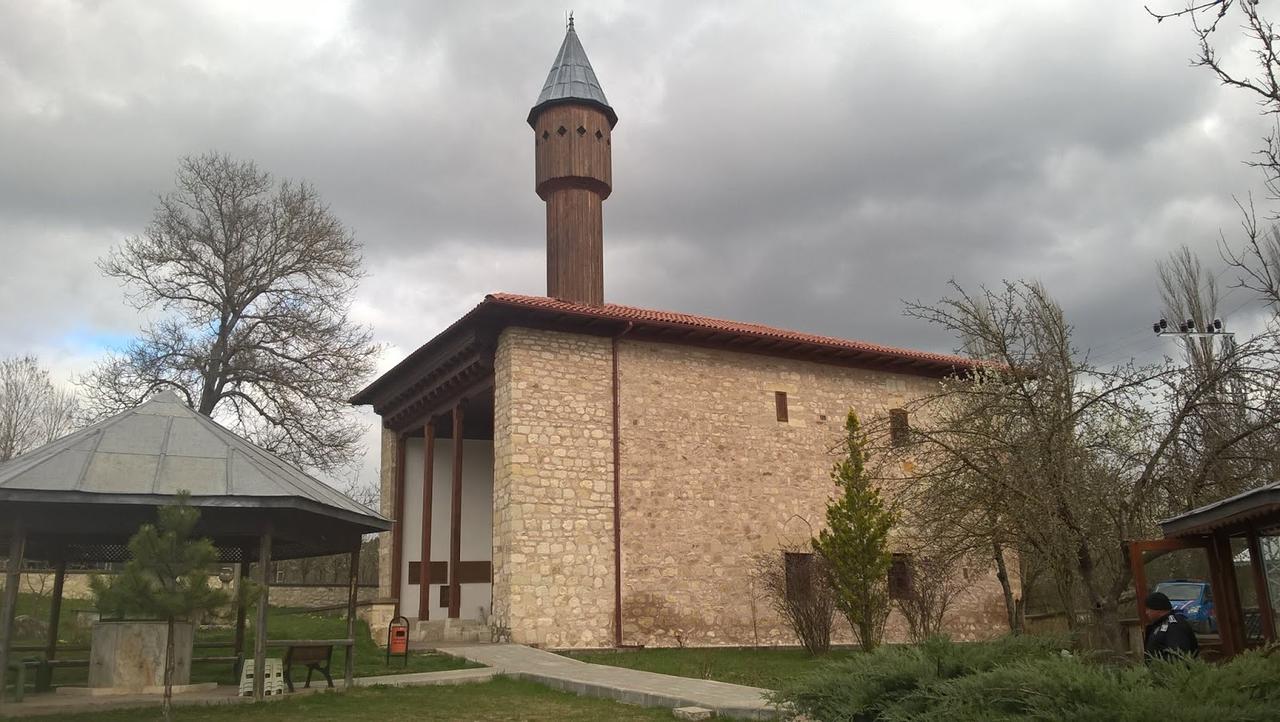
One of the most original examples of the wooden mosque tradition in Anatolian Turkish architecture, the Mahmut Bey Camii is located in the village of Kasaba, within the central district of Kastamonu. Built in 1366 during the period of the Candaroğulları Beyliği, the structure stands out for its construction using the lap-joint technique without nails and for its original calligraphic decorations within the interior space. The mosque’s architectural features, decorative repertoire, and preserved structural integrity have secured it a distinguished position among medieval Anatolian mosques. These qualities led to its inclusion on UNESCO’s Tentative List of World Heritage Sites in 2014 and, in 2023, to its inscription on the World Heritage List under the title “Medieval Wooden-Structural Mosques of Anatolia”.
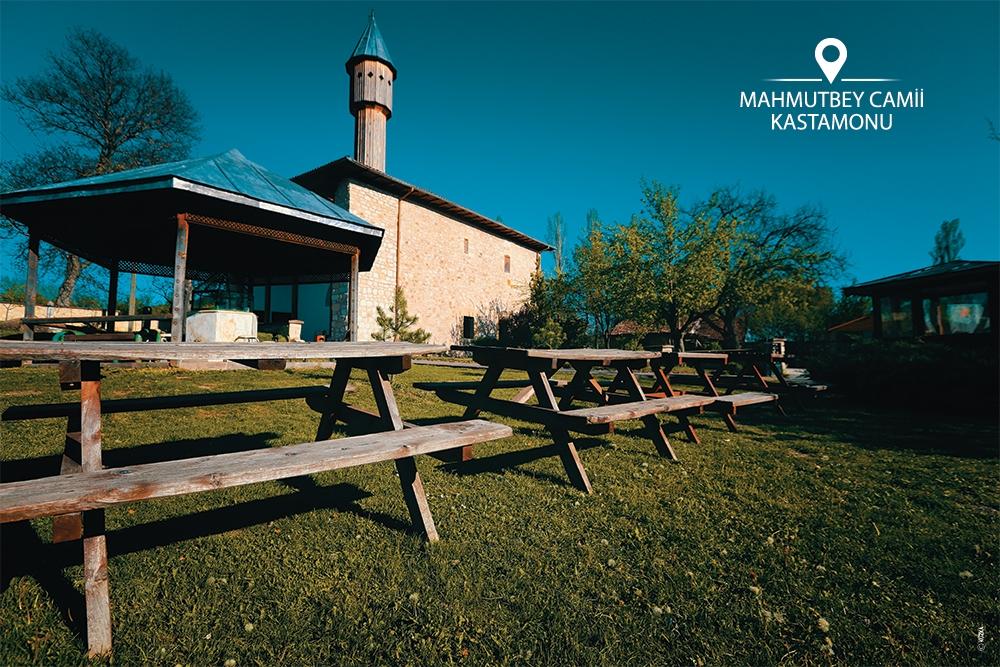
Mahmut Bey Camii (Kuzey Anadolu Kalkınma Ajansı)
The Mahmut Bey Camii belongs to the architectural tradition of the Anatolian Beyliks period. The Candaroğulları Beylik emerged in the late 13th century around Kastamonu and its surroundings following the decline of the Anadolu Selçuklu Devleti and dominated the region for approximately two centuries. During this period, numerous architectural works were constructed, especially religious buildings. The Mahmut Bey Camii stands out among these for its wooden architecture. According to its foundation inscription, the structure was built in 1366 and is one of the rare mosques in Anatolia constructed using the lap-joint technique without nails. This date has also been confirmed through dendrochronological analysis.
The history of Kasaba Village extends even further back. This area was one of the earliest settlements of the Çobanoğulları Beyliği and, according to archaeological evidence, has been inhabited since the Paleolithic period. The village bears traces from the Roman, Byzantine, Seljuk, and Ottoman periods and is regarded as an important cultural landscape due to its natural structure and historical fabric.
The Mahmut Bey Camii was constructed with a rectangular plan oriented north-south. The building measures approximately 17.9 × 11.55 meters. Its exterior walls are built of rubble stone, while the interior space is entirely constructed of wood. Plaster was used for the mihrab and window frames, and marble was preferred for the lintels of the entrance door.
The roof structure was built using the lap-joint technique without nails or metal components. The wooden load-bearing system consists of four main vertical posts, two of which have dodecagonal cross-sections and two circular ones. Mortise-and-tenon joinery was employed in the connections of the load-bearing wooden system, thereby eliminating the risk of corrosion and ensuring the structure’s longevity.
The wooden posts of the load-bearing system rest on stone bases and are adorned with carvings, inlays, and calligraphic decorations. The wooden ceiling system inside the mosque is detailed with beveled beams, lap-joint connections, and wooden pendants. The prayer hall is divided into three sections. The ceiling beams and floor junctions are made of wood and joined using mortise-and-tenon systems without any nails. This technique enhanced both durability and the structure’s long-term preservation.
The decorations in the mosque were executed using the calligraphic technique with natural dyes, designed to harmonize with the wooden surfaces. A rich color palette of red, blue, yellow, green, black, white, and cream tones was employed. The compositions feature plant and geometric motifs, as well as arrangements based on symmetry and repetition.
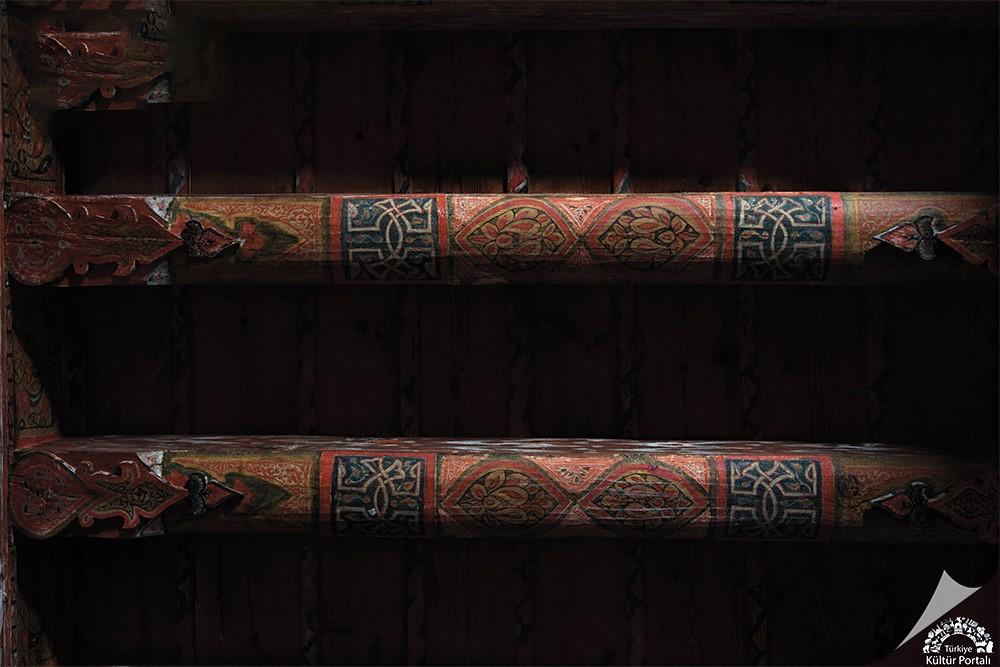
Original calligraphically decorated wooden ceiling details of Mahmut Bey Camii (Kültür Portalı)
The ceiling consists of three sections: a central section and two side sections. The undersides of the beams are covered with ornamental moldings, and wooden pendants are placed in the central areas. Geometric patterns appear on the wooden gallery railings, and access to the gallery is provided via wooden stepped staircases.
The minbar is made of pine wood, with only its platform retaining its original state. The minbar is decorated using ajur and chitakari techniques, with ten-pointed star motifs drawing particular attention. Its dome is pyramidal in form and adorned with four tiers of muqarnas. The mihrab is defined by stepped borders running from outside to inside, with muqarnas niches designed in elongated almond shapes.
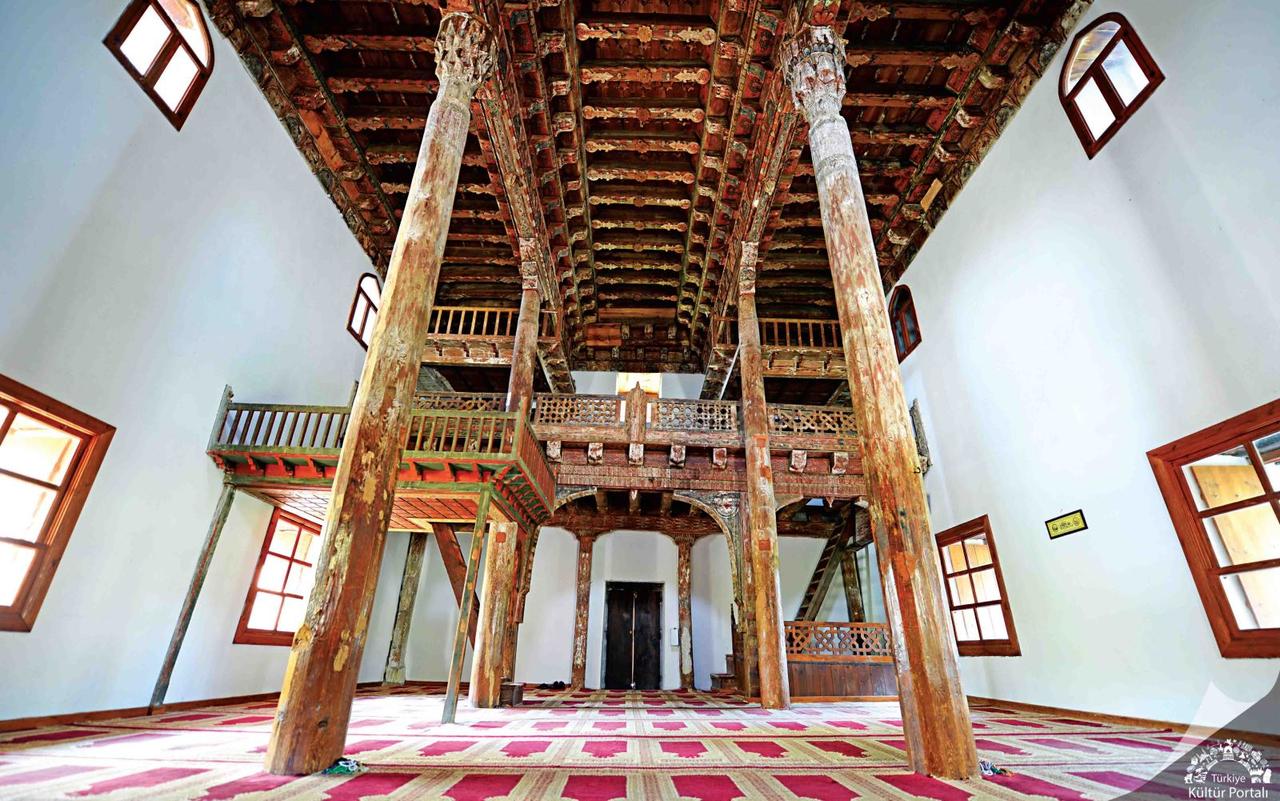
Interior view of Mahmut Bey Camii showing wooden ceiling decorations and load-bearing columns (Kültür Portalı)
One of the most striking elements of the Mahmut Bey Camii is its wooden entrance door, crafted by the Ankara-based calligrapher Mahmud oğlu Abdullah. This double-leaf door is decorated with geometric and vegetal details using the inlay technique. Circular and teardrop-shaped panels on the door feature star and floral motifs. The door, resting on a marble threshold, was illegally removed and stolen in 1972 but later recovered and placed under protection at the Kastamonu Ethnography Museum. Today, a replica made by the Kastamonu woodcraftsman Hikmet Değirmencioğlu stands in its place.
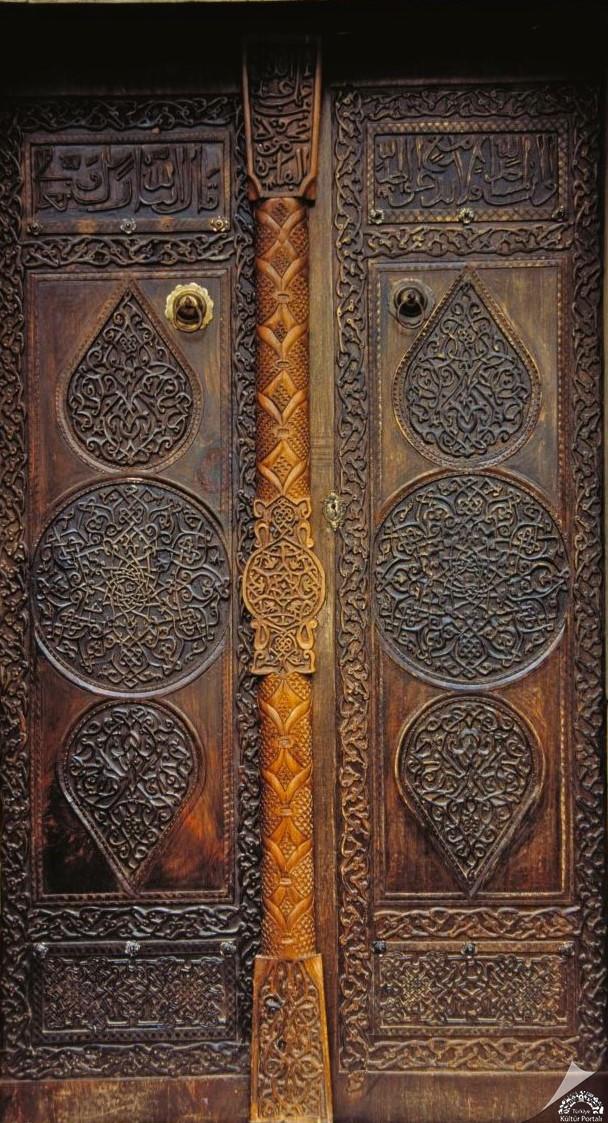
Wooden entrance door crafted with carving art by Ankara-based calligrapher Mahmutoğlu Abdullah (Kültür Portalı)
The gallery section of the mosque consists of four distinct galleries arranged at different levels. The floor beams resemble the ceiling beams in design. The upper sections of the wooden columns are decorated with white geometric motifs on a red background, while the lower sections feature black-framed white alternating arrow motifs on a red background.
On the side walls, vegetal motifs in green are applied on a red background. In the circular-sectioned columns on the north side, each motif is rendered in a different color.
The roof of the Mahmut Bey Camii is constructed using Scots pine. Although Scots pine is susceptible to woodworm infestation, no such damage has been observed in the mosque, a fact attributed to the technical choices made during its construction. According to tradition, the trees were cut during the coldest winter months, specifically during full moon periods. During this time, trees expel sap into the ground, naturally enhancing their durability. This traditional knowledge is based on a verse by the divan poet Feride Hanım:
“If you wish to make clogs, cut the root of the tree from the skin,
If you wish to leave a legacy, cut the tree and prepare it in the harshest winter.”
It is also reported that organic materials such as camel hide, straw bales, and ostrich eggs were used in the mosque’s construction. These materials are believed to have served purposes of moisture control and insect prevention.
Over its long history, the Mahmut Bey Camii has undergone various repairs. Initial restoration efforts began in the 19th century and were continued in the 1940s by the Ministry of National Education and the Turkish Historical Society. After an earthquake in 1943, the minaret collapsed and was rebuilt in 1945. In the 1960s, the General Directorate of Foundations renewed the minaret again, and in the 1980s, a comprehensive restoration was carried out with contributions from Middle East Technical University and Hacettepe University. In the 2000s, restoration projects focused particularly on preventing moisture and biological deterioration. Within this framework, interior lighting was restricted, and the roof and exterior walls were renewed.
To preserve the wooden decorations, the internal climate balance was carefully monitored, and vulnerable areas were isolated. The surrounding area of the mosque was also reorganized, with the addition of toilets, ablution facilities, and souvenir units for visitors. Informational signage inside and around the mosque has been expanded, though insufficient information remains a significant issue.
The Mahmut Bey Camii in Kasaba Village is regarded as one of the most advanced examples of the architectural and artistic achievements of the Candaroğulları Beylik. Land parcels donated to the mosque are recorded in the 1374 endowment deed of Mahmut Bey. In 2005, ownership of the mosque passed to the General Directorate of Foundations.
The structure has undergone multiple restorations over time. The most recent restorations were carried out in 2007 and 2008. The mosque has retained its function as a continuously used place of worship. Due to fire risk, it is currently used only for Friday prayers.
The Mahmut Bey Camii was first inscribed on UNESCO’s Tentative List of World Heritage Sites on 15 April 2014. This process was led by the Kastamonu Governorship, with coordination by the Northern Anatolia Development Agency (KUZKA), which established the “UNESCO Table”.
At the 25th World Heritage Committee meeting held in Riyadh, Saudi Arabia, in 2023, the Mahmut Bey Camii, together with the Ulu Mosque in Afyonkarahisar, the Ahi Şerefeddin Mosque in Ankara, the Ulu Mosque in Sivrihisar, Eskişehir, and the Eşrefoğlu Mosque in Beyşehir, Konya, was inscribed on the UNESCO World Heritage List as part of Türkiye’s first “serial nomination”.
The Mahmut Bey Camii and Kasaba Village hold significant potential as a cultural tourism destination in Kastamonu. Surveys and observations indicate that visitors are largely satisfied with the structure, but deficiencies exist in terms of accessibility and promotion. Limited access to Kasaba Village and insufficient promotional activities have prevented the mosque from attracting sufficient numbers of visitors. The limited number of souvenir stalls established around the mosque fail to extend the time visitors spend in the village.
It is recommended to increase guided tour services, update information panels, and expand environmental improvements to encourage visitors to spend more time at the site. Simultaneously, other historical structures in the village—the Camii Hamam, Pazariçi Hamam, and wooden mansions—should be restored and integrated into the tourist route. These developments will also contribute to the process of securing the Mahmut Bey Camii’s permanent inclusion on the UNESCO World Heritage List.
Kastamonu Candaroğlu Mahmutbey Camii (TRT Avaz)
The General Directorate of Mint and Stamp Printing has produced 3,000 commemorative coins made of 925-grade silver for the mosque. The obverse features an exterior view of the mosque, while the reverse displays a detail of its decorations. These coins have been available for sale since 17 January 2025.
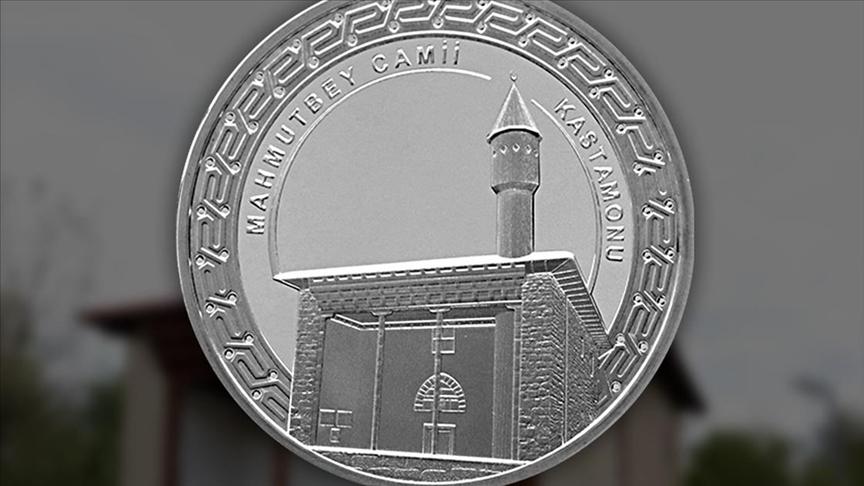
Issued Commemorative Coin (Anadolu Ajansı)
Akok, Mahmut. “Kastamonu’nun Kasaba Köyü’nde Candaroğlu Mahmut Bey Camii.” DergiPark, 1945. Accessed August 5, 2025.https://dergipark.org.tr/tr/download/article-file/3423804.
Aktaş, Rabia. “Kasaba Köyü ve UNESCO Sürecindeki Mahmutbey Camii’nin Kastamonu Turizmine Katkısı.” *Journal of Humanities and Tourism Research* 12, no. 4 (2022): 867–881.https://dergipark.org.tr/tr/download/article-file/2940013.
Aydın, Hasan, and Z. Sevgen Perker. “Geleneksel Mimaride Ahşap Kullanımının Kastamonu Kasaba Köyü Candaroğlu Mahmut Bey Camii Özelinde İncelenmesi.” Uluslararası Sosyal Araştırmalar Dergisi 10, no. 48 (February 2017): 285–291. Accessed August 5, 2025.https://www.sosyalarastirmalar.com/articles/the-review-on-the-wooden-material-usage-in-traditional-architecture-specificto-kastamonus-kasaba-villages-candaroglu-mah.pdf
Kastamonu Belediyesi. "Mahmut Bey Cami." Kastamonu Municipality Website. Accessed August 5, 2025.https://www.kastamonu.bel.tr/mahmut-bey-cami/
Kuzey Anadolu Kalkınma Ajansı. “Kasaba Köyü Mahmut Bey Camisi UNESCO Dünya Mirası Listesi’nde.” Accessed August 5, 2025.https://www.kuzka.gov.tr/basinda-detay.asp?H=1820&Haber=kasaba-koyu-mahmut-bey-camisi-unesco-dunya-miras-listesinde.
TRT Avaz. “Kastamonu / Candaroğlu Mahmutbey Camii.” YouTube video, 7 min 23 sec. August 5, 2025.https://youtu.be/ZkL3SfLf9S4
Türkiye Cumhuriyeti Kültür ve Turizm Bakanlığı. *Kastamonu Mahmut Bey Camii Yönetim Planı*. Kültür Varlıkları ve Müzeler Genel Müdürlüğü, 2021. Accessed August 5, 2025.https://kvmgm.ktb.gov.tr/Eklenti/93112,uyp-kastamonu-mahmut-bey-camii-yonetim-planipdf.pdf?0
Türkiye Cumhuriyeti Kültür ve Turizm Bakanlığı. “Kasaba Köyü Mahmut Bey Camii.” *Kastamonu İl Kültür ve Turizm Müdürlüğü*, 2014. Accessed August 5, 2025.https://kastamonu.ktb.gov.tr/Eklenti/49682,kasaba-camii-brosurpdf.pdf?0
Türkiye Kültür ve Turizm Bakanlığı. "Mahmut Bey Camisi." Kültür Portalı. Kastamonu İl Kültür ve Turizm Müdürlüğü. Accessed August 5, 2025.https://www.kulturportali.gov.tr/turkiye/kastamonu/gezilecekyer/mahmut-bey-cam
Yaylacıklıoğlu, Özlem. “Kastamonu Kasaba Köyü Mahmud Bey Camii.” Master's thesis,Hacettepe Üniversitesi Institute of Social Sciences, 2010. Accessed August 5, 2025.https://tez.yok.gov.tr/UlusalTezMerkezi/tezDetay.jsp?id=RfXE44bFfcLS-JV86vsrsQ
Yüksel, Semih. “Darphane UNESCO Listesi’ndeki Mahmutbey Camisi’nin Hatıra Parasını Bastı.” Anadolu Ajansı, January 16, 2025. Accessed August 5, 2025.https://www.aa.com.tr/tr/kultur/darphane-unesco-listesindeki-mahmutbey-camisinin-hatira-parasini-basti/3452348
Özkul, Kifayet. “Mahmut Bey Camii.” *Türkiye Turizm Ansiklopedisi*. 2019. Accessed August 5, 2025.https://turkiyeturizmansiklopedisi.com/mahmut-bey-camii
Location | Kasaba Village Kastamonu Türkiye | ||||||||
|---|---|---|---|---|---|---|---|---|---|
Year of Construction | 1366 | ||||||||
Patron | Emir Mahmut Bey (Candaroğulları) | ||||||||
Uniqueness | It was constructed without the use of metal parts or nails | ||||||||
Conservation Status | UNESCO World Heritage List (2023) | ||||||||
Historical Background
Architectural Structure and Material Characteristics
Decorations and Artistic Features
Wooden Entrance Door
Gallery and Other Wooden Elements
Construction Technology and Preservation
Conservation and Restoration Process
Historical and Cultural Context
UNESCO World Heritage Process and Inscription
Tourism and Promotion Potential
Commemorative Coin