


This article was automatically translated from the original Turkish version.
+2 More
The Lycian SarcophagusSarcophagus, discovered during excavations in 1887 at the Sidon Necropolis (located within the modern borders of Lebanon, in the ancient city of Sidon) by Osman Hamdi Bey and his team, is an ancient artifact exhibited at the Istanbul Archaeology Museums. The term “Lycian” in its name derives from its resemblance to the characteristic rock-cut tomb architecture of the Lycian civilization. Dating from the late 5th century BCE to the early 4th century BCE, this sarcophagus is of great value for shedding light on a transitional period where Eastern and Western artistic traditions converged.
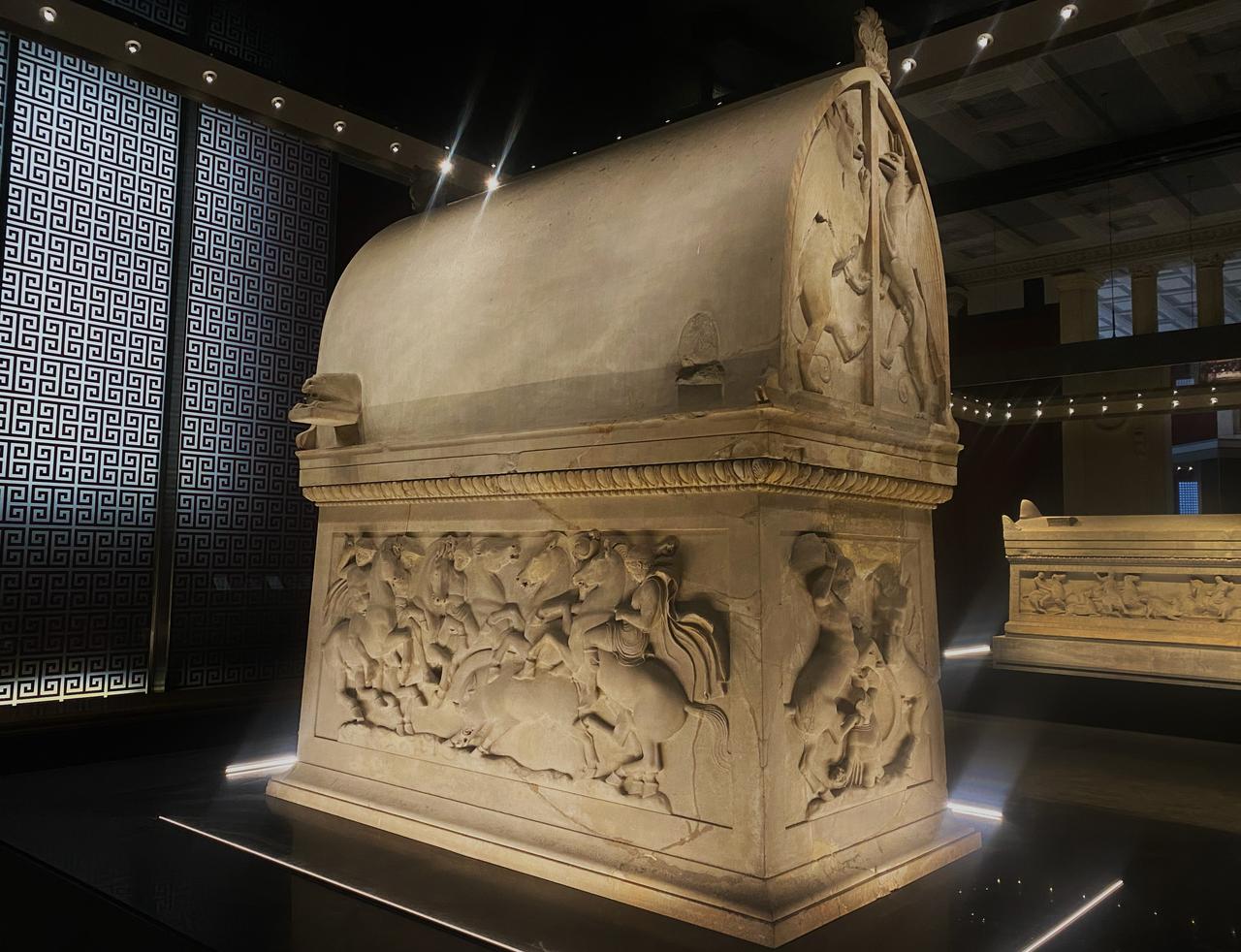
Lycian Sarcophagus, Istanbul Archaeology Museums (Photograph: Nazlı Kemerkaya)
The discovery of the sarcophagus occurred in 1887 during archaeological excavations led by Osman Hamdi Bey at the Sidon Royal Necropolis. A total of 22 royal sarcophagi were unearthed from the excavation site. Among the finds transported to Istanbul were the Tabnit Sarcophagus, the Satrap Sarcophagus, the Lycian Sarcophagus, the Weeping Women Sarcophagus, and the Alexander Sarcophagus, among other significant artifacts.
Period-wise, the sarcophagus was produced during a time dominated by the influence of the Achaemenid (Persian) Empire and marked by intense interaction with the Greek world, suggesting it serves as an artistic “bridge” between different cultures. After its arrival in Istanbul, the Lycian Sarcophagus was incorporated into the inventory of the Istanbul Archaeology Museums and is now one of the museum’s most prominent exhibits.
The Lycian Sarcophagus measures 2.96 meters in height, 2.53 meters in length, and 1.36 meters in width. The use of Parian marble in its construction indicates exceptional craftsmanship and suggests that its owner was a person of high status.
The lower section rests on a broad, flat base, while the trunk is a rectangular structure supported by pyramidal facades. The upper part consists of a tall lid with pointed arches along the short sides. The trunk, built higher than usual, achieves a balanced proportion between the lower and upper sections. Additionally, the sarcophagus tapers uniformly by 0.03 meters toward the top, acquiring a pyramidal silhouette. This structure enables the heavy lid to be securely supported.
The decoration of the sarcophagus is distinguished by its metopes and friezes reliefs. The reliefs are not deeply carved but rather executed in high surface projection. The figures are designed to extend beyond the relief frame. The background of the reliefs was painted a deep blue, with pigment traces particularly concentrated in areas depicting sphinxes, centaurs, and griffins. Some of the pearl-chain ornamentation along the edges was painted red, while the ground color of the egg-and-dart motif is a deep yellow. Red pigment traces are also visible on the architrave section.
The friezes of the sarcophagus show similarities to those of the Parthenon Temple on the Athenian Acropolis. This resemblance has led scholars to speculate that the artist may have traveled to Athens and possibly even worked on the Parthenon itself.
The coffin compartment is 0.18 meters high, with a flat lower section and an upper section sloping inward toward the sarcophagus. The rectangular coffin is designed to narrow by 0.03 meters on all sides toward the top. Each of its four sides is framed by a 0.13-meter-wide flat frame, within which the reliefs are contained.
The reliefs on the Lycian Sarcophagus provide a detailed reflection of the artistic style and narrative conventions of its time. One of the long sides depicts a lion hunt, while the other shows a boar hunt. The short sides feature figures and combat scenes drawn from Greek mythology.
On one of the long sides of the sarcophagus, a lion hunt is depicted using four-horse chariots known as quadrigas. The quadrigas are arranged in a sequential order, with horses rendered in dynamic, lifelike motion. One of the horses is shown with all four hooves lifted off the ground, enhancing the sense of movement. The positioning of the horses’ heads and bodies reflects the characteristic Greek artistic approach.
In the right corner of the composition, a lion figure is depicted. The lion, rendered in a smaller scale, is seated between the legs of the first chariot’s horses. Its head is turned to the right, and its body is curled inward with its forelegs bent beneath it, giving the impression of crouching and attempting to hide. Its mouth is open. The hunters are shown directing their spears directly at the animal.
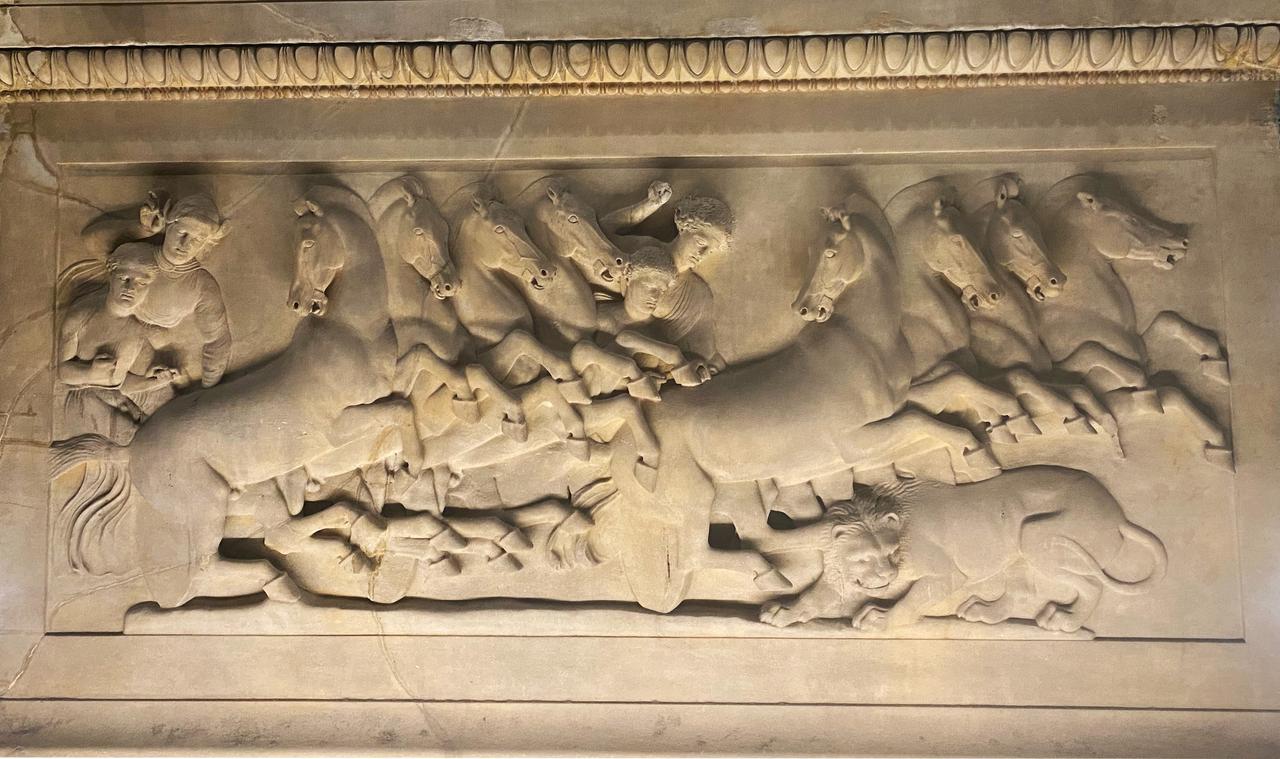
Lion Hunt Scene (Photograph: Nazlı Kemerkaya)
On the other long side, a boar hunt is depicted. The boar, shown in profile, is rendered with a long, pointed snout. It is fleeing from hunters approaching from the right while encountering another group of hunters from the left. Its snout is open, ears erect, and legs tense, emphasizing the scene’s dynamism. The horses are shown galloping at full speed, with three hunters attacking from one side and two from the other.
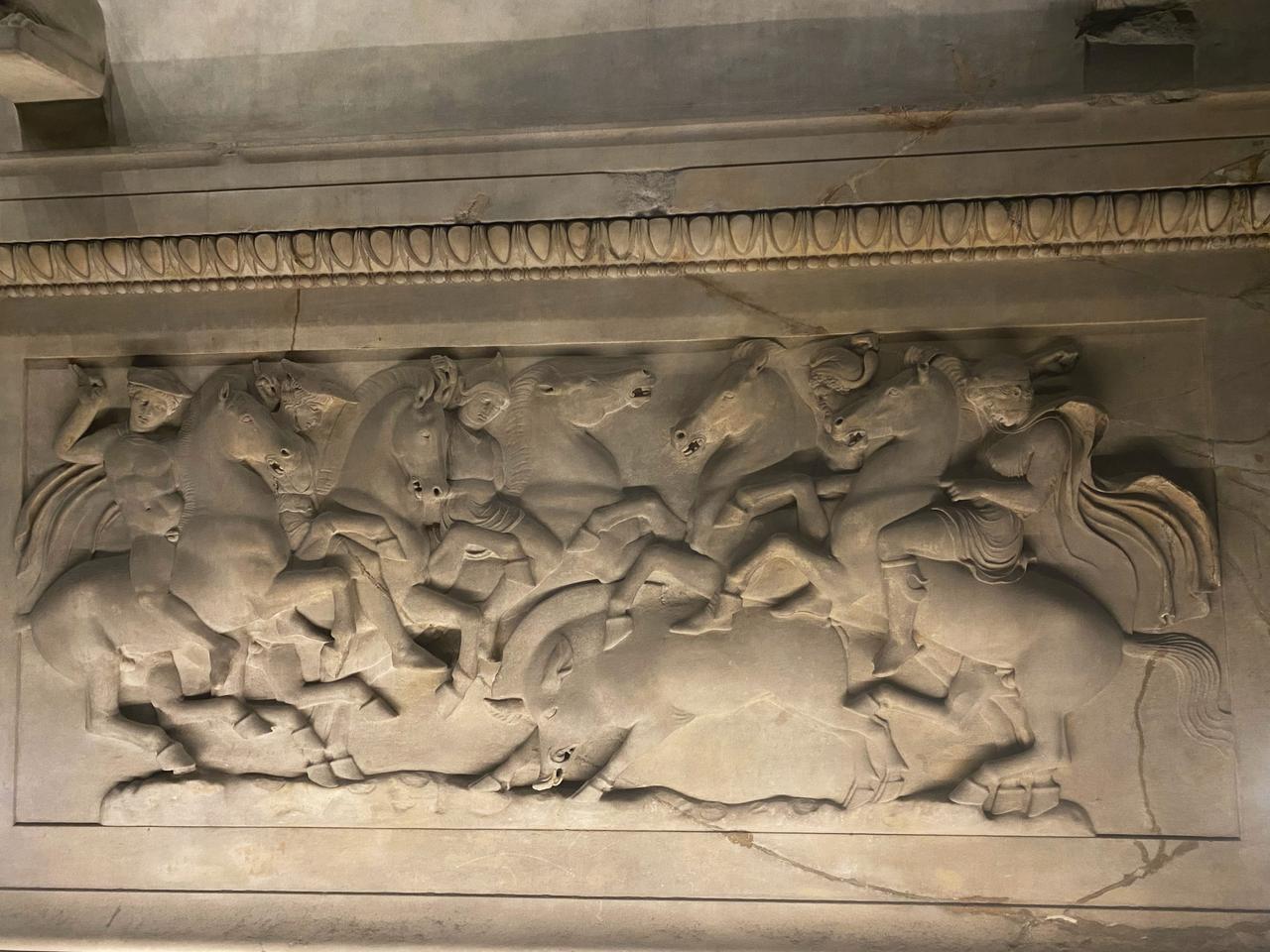
Boar Hunt Scene (Photograph: Nazlı Kemerkaya)
On one of the short sides, a battle scene from Greek mythology is depicted: two centaurs attack Kaineus, the son of Elatus, a Lapith. The central figure, the Lapith Kaineus, is shown naked, with a cloak tied around his neck and fluttering over his shoulders. His face is turned to the right, and he defends himself with an oval shield held in one hand, while wielding a spear in the other to launch a counterattack.
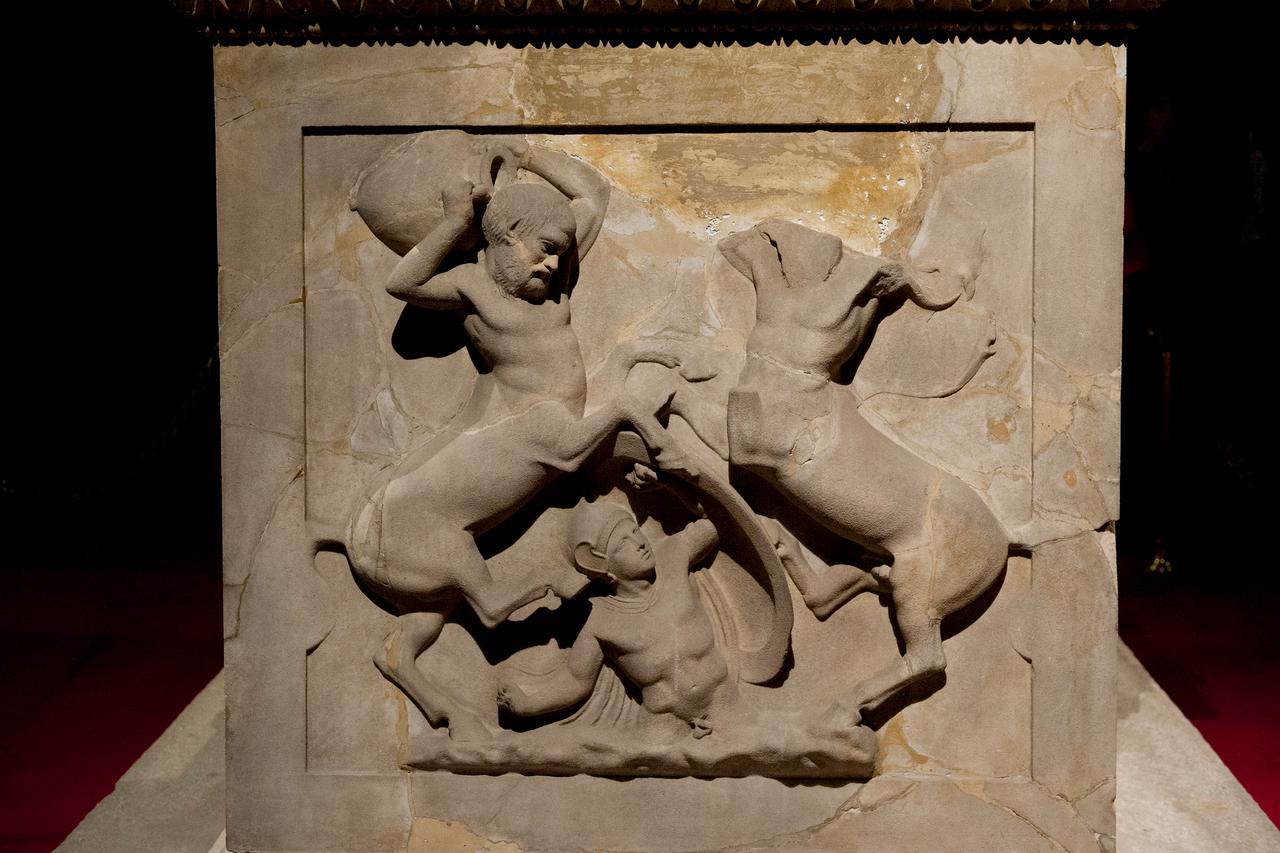
Centaur Attack on Kaineus, Son of Elatus (Photograph: Egisto Sani, flickr.com)
On this section of the lid, two figures are depicted with bodies combining features of both lions and eagles. These figures stand upright on their hind legs, raising their claws upward. They are portrayed with eagle heads, featuring long beaks and crests extending from the top of their heads down their necks. Their wings hang downward, while their lower bodies resemble the lion forms seen elsewhere on the sarcophagus.
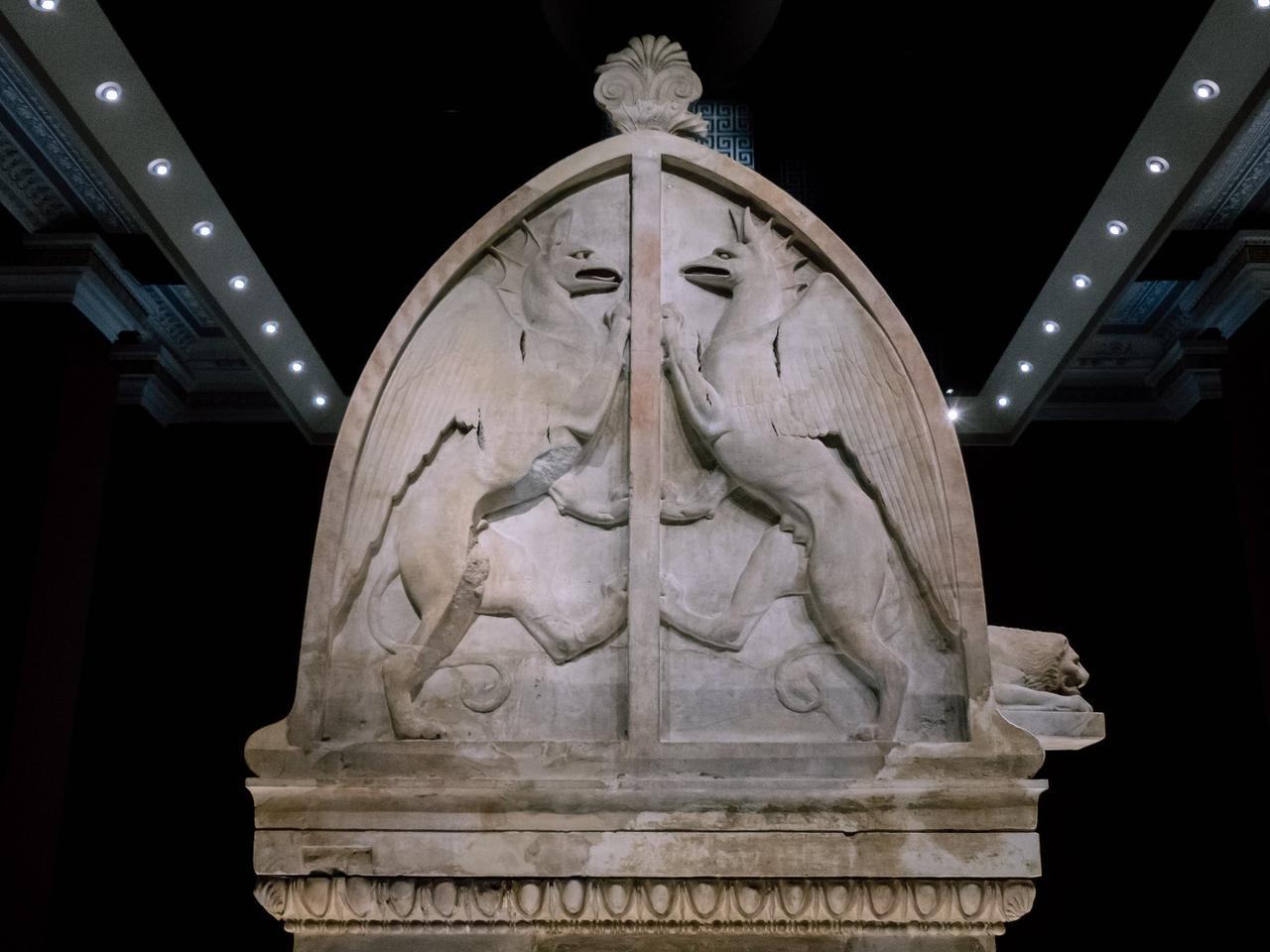
Lion-Eagle Figure on the Upper Section (Photograph: Alberto Trentanni, flickr.com)
The other short side depicts a scene of two centaurs fighting over a deer. The centaur figures are shown standing on their hind legs on a stony ground, their front legs entwined around each other. The deer they hold is the focal point of the composition.
On this arched lid section, two sphinxes are depicted seated, their wings extending up to the top of the arch. These figures have lion bodies, human female faces, and breasts, embodying human characteristics. Represented as guardians of the tomb, these sphinxes are among the key symbolic elements of the sarcophagus.
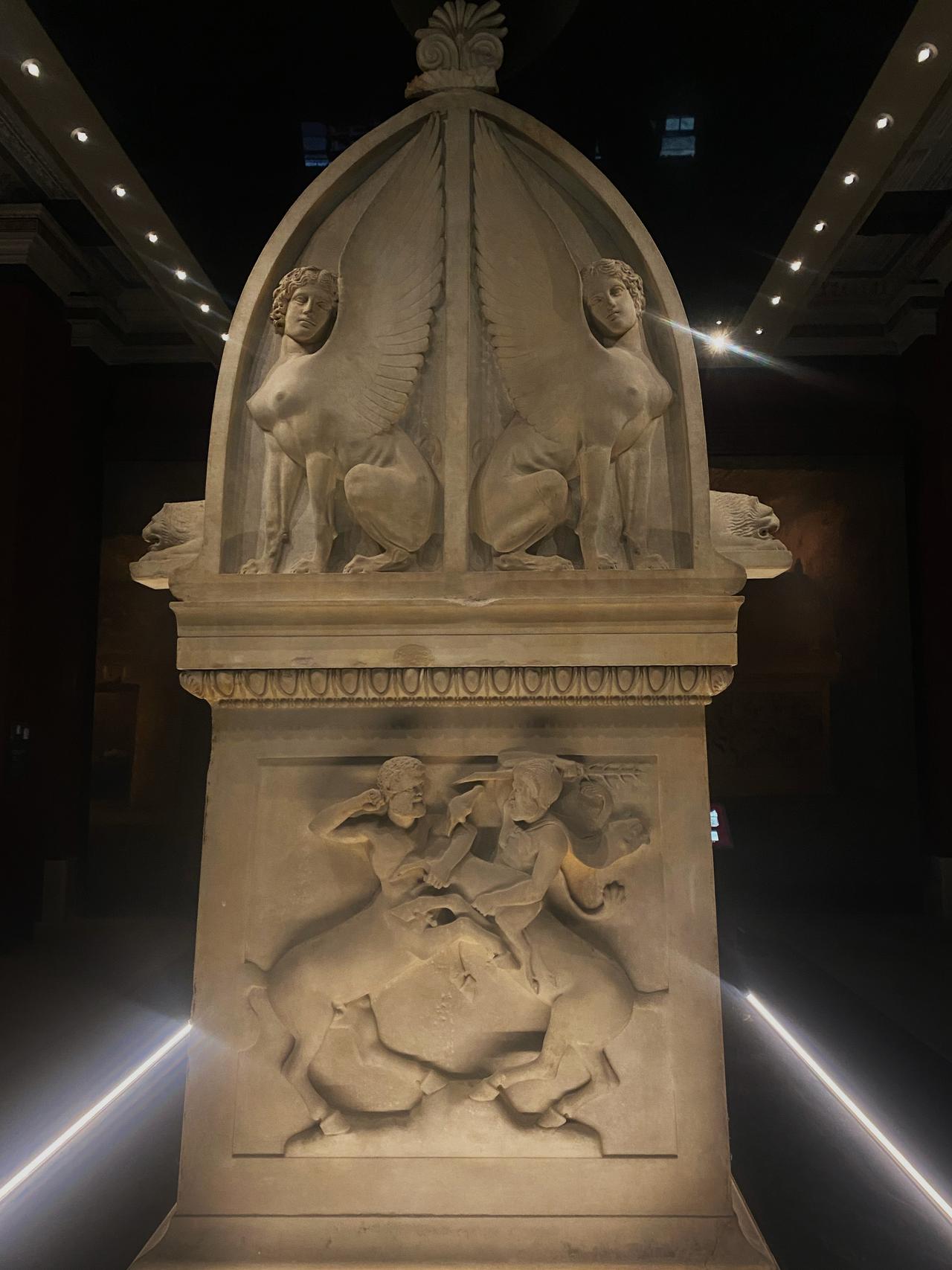
Centaur Deer Hunt and Sphinx Figures (Photograph: Nazlı Kemerkaya)
Alberto Trentanni. *Istanbul 033 - Archaeological museum, Lycian sarcophagus of Sidon [JPG].* Flickr. Accessedhttps://flic.kr/p/2nyAtKG.
Ayşegül Soslu. "Likya Lahdi." Türkiye Turizm Ansiklopedisi. Accessed February 8, 2025.https://turkiyeturizmansiklopedisi.com/likya-lahdi
Begüm, Bozoğlu. "Sidon’dan Getirilen Likya Lahdi.” Arkeofili. Accessed February 8, 2025.https://arkeofili.com/sidondan-getirilen-likya-lahdi/#google_vignette
Egisto Sani. *Lycian Sarcophagus - IX [JPG].* Flickr. Accessedhttps://flic.kr/p/ds1iyS.

History
Features
Depictions on the Sarcophagus
Lion Hunt Scene
Boar Hunt Scene
Mythological Scenes