


This article was automatically translated from the original Turkish version.
Long jump is one of the oldest disciplines in athletics, combining both track and field characteristics. In this sport, athletes sprint over a designated distance to build up speed and then leap as far as possible into a sandpit. The jump distance is measured from the point where the athlete’s body first makes contact with the sand. Long jump is not only a test of physical strength but also emphasizes technical precision, coordination, balance, and mental focus.
The origins of long jump date back to ancient Greece. It was included as part of the pentathlon at the Olympic Games held in 708 BCE. Unlike ancient athletes, modern long jumpers do not carry weights in their hands. By the mid-19th century, long jump had become recognized as a distinct discipline within organized modern athletics. It was first included as an Olympic event for men at the 1896 Athens Olympics; women’s long jump was added to the program at the 1948 London Olympics.
1. Approach Run: The athlete accelerates over a 30 to 45 meter runway to achieve maximum speed before reaching the takeoff board. This phase aims for rhythmic and controlled steps to generate high speed and optimal positioning.
2. Takeoff: The jump is executed from a takeoff board 20 centimeters wide. If the athlete’s foot extends beyond the front edge of the board or fails to make full contact with it, the jump is ruled a foul. Explosive force is applied to leap vertically and forward.
3. Flight: The athlete aims to maximize distance by maintaining balance and body position in the air. The main techniques used are:
4. Landing: The landing plays a critical role in long jump performance. The athlete pulls the knees toward the chest and extends the arms forward to prevent backward fall. The point where the body first touches the sand determines the measured distance.
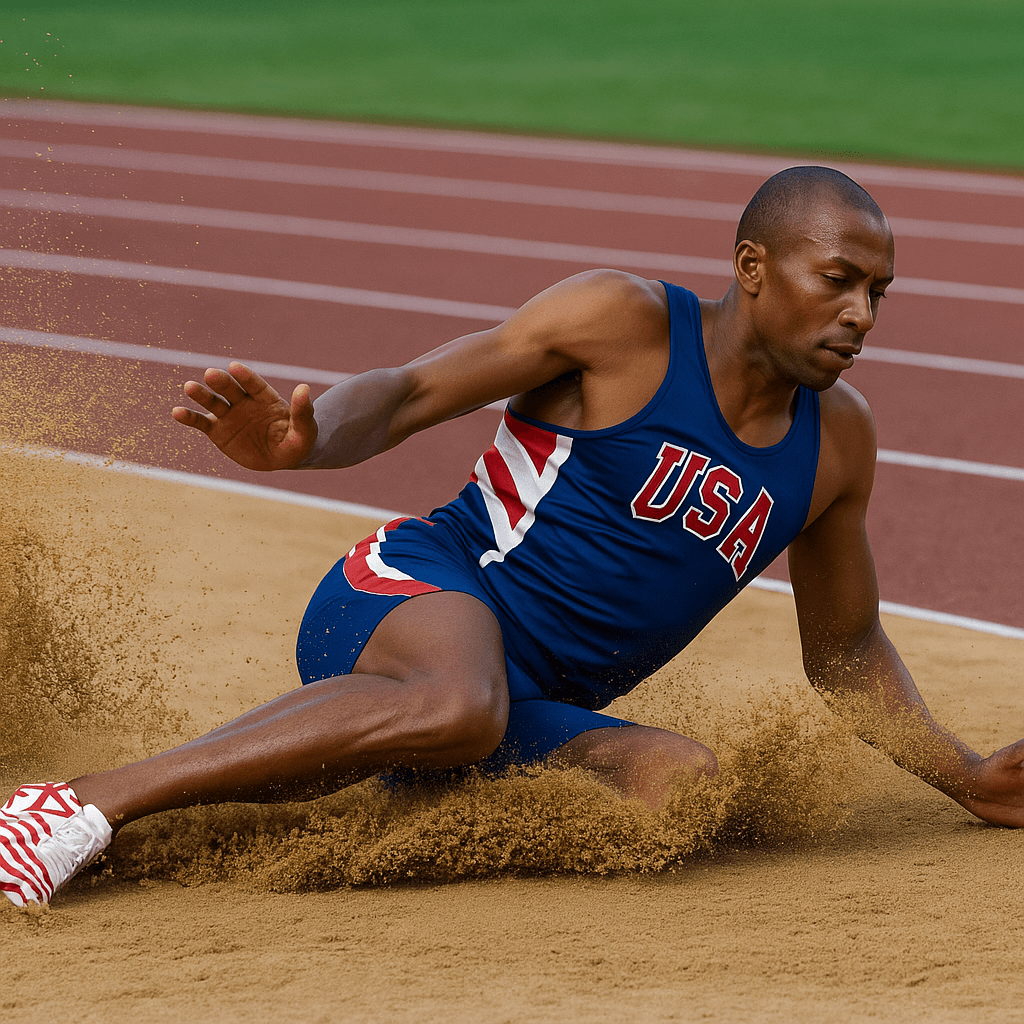
Bu görsel yapay zeka tarafından oluşturulmuştur.
Today, long jump continues to be featured in prestigious competitions such as the Olympics and World Championships. Thanks to technology-assisted training programs, video analysis systems, and biomechanical studies, athletes’ technical proficiency has improved and jump distances have increased.
USA Track & Field. "Long Jump Rules and Techniques." USATF Official Website. Accessed April 25, 2025.https://www.usatf.org/disciplines/long-jump.
World Athletics. "Long Jump – Men – Outdoor." World Athletics. Accessed May 7, 2025.https://worldathletics.org/records/by-discipline/jumps/long-jump/outdoor/men.
World Athletics. "Long Jump – Women – Outdoor." World Athletics. Accessed May 7, 2025.https://worldathletics.org/records/by-discipline/jumps/long-jump/outdoor/women.
World Athletics. "Long Jump." World Athletics Official Website. Accessed April 25, 2025.https://worldathletics.org/disciplines/jumps/long-jump.
[1]
Erkek Uzun Atlama Dünya Rekoru Sahibi https://worldathletics.org/records/by-discipline/jumps/long-jump/outdoor/men.
[2]
Kadınlar Uzun Atlama Dünya Rekoru Sahibi https://worldathletics.org/records/by-discipline/jumps/long-jump/outdoor/women

History
Technical Phases
Long Jump Field
Rules
Equipment Used
World Records
Long Jump Today