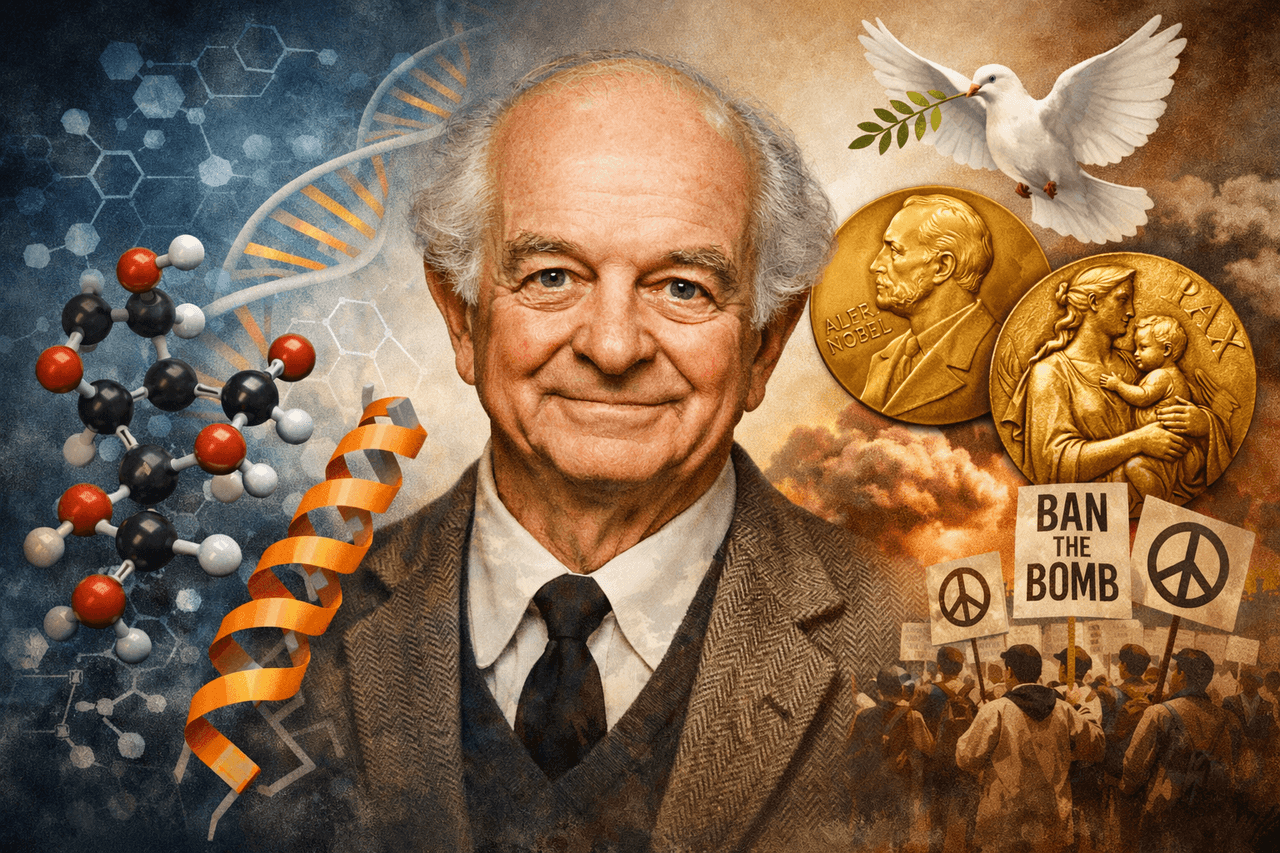

Linus Carl Pauling (February 28, 1901 – August 19, 1994) was an American chemist, biochemist, and peace activist renowned for his research on the nature of the chemical bond and molecular structures. His work laid the foundation for modern chemistry and molecular biology, bridging quantum mechanics and chemical theory. Pauling is one of the few individuals to have received multiple Nobel Prizes in different fields: the Nobel Prize in Chemistry in 1954 and the Nobel Peace Prize in 1962. He made significant contributions to understanding protein structures, molecular genetics, and the effects of chemical substances on human health.
Early Life and Education
Pauling was born in Portland, Oregon. He displayed a strong aptitude for science from an early age, which led him to pursue a degree in chemical engineering and later chemistry. His academic career included advanced studies in the United States and Europe, where he studied quantum mechanics and crystallography. These experiences shaped his approach to chemical research, combining theoretical frameworks with experimental validation.
Scientific Contributions
Pauling's work transformed the understanding of chemical bonds and molecular structures. He applied quantum mechanics to explain the nature of covalent bonds, ionic bonds, and resonance structures, producing models that remain influential in chemistry. His research on the structure of proteins, particularly the alpha-helix, revolutionized molecular biology and provided critical insight into the mechanisms of life at a molecular level. Pauling also contributed to understanding sickle-cell anemia as a molecular disease, demonstrating the connection between genetics and protein chemistry. His interdisciplinary approach connected chemistry with medicine and biology, fostering new research directions in both theoretical and applied sciences.
Nobel Prizes
Pauling was awarded the Nobel Prize in Chemistry in 1954 for his research into the nature of the chemical bond and its application to the elucidation of the structure of complex substances. His work provided a detailed understanding of molecular structures that influenced chemistry, biology, and medicine. Later, his activism in promoting nuclear disarmament and addressing the dangers of nuclear weapons earned him the Nobel Peace Prize in 1962. This recognition highlighted his role as a scientist-advocate, applying scientific knowledge to global humanitarian issues.
Activism and Peace Work
Beyond his scientific achievements, Pauling was a prominent activist. He campaigned against nuclear weapons testing, emphasizing their health risks and environmental impact. His advocacy involved publishing scientific research on radioactive fallout and participating in international discussions on nuclear disarmament. Pauling's efforts helped shape public understanding of nuclear risks and influenced policy discussions during the Cold War era.
Legacy and Influence
Pauling’s legacy is preserved through institutions such as the Linus Pauling Institute, which continues research in nutrition, chemistry, and health sciences. The Linus Pauling Distinguished Postdoctoral Fellowship supports emerging scientists, reflecting Pauling's commitment to mentoring the next generation of researchers. His work remains a cornerstone in the study of molecular biology, chemistry, and medical research, influencing both academic and practical applications in science.
Nobel Prize. “Linus Pauling – Biographical.” NobelPrize.org. Accessed March 9, 2026. https://www.nobelprize.org/prizes/chemistry/1954/pauling/biographical/
Linus Pauling Institute. “Linus Pauling Biography.” Oregon State University. Accessed March 9, 2026. https://lpi.oregonstate.edu/about/linus-pauling-biography
Stanford University Department of Chemistry. “Linus Carl Pauling.” Accessed March 9, 2026. https://chemistry.stanford.edu/people/linus-carl-pauling
Pacific Northwest National Laboratory. “Linus Pauling Distinguished Postdoctoral Fellowship.” Accessed March 9, 2026. https://www.pnnl.gov/projects/linus-pauling-distinguished-postdoctoral-fellowship

This article was created with the support of artificial intelligence.