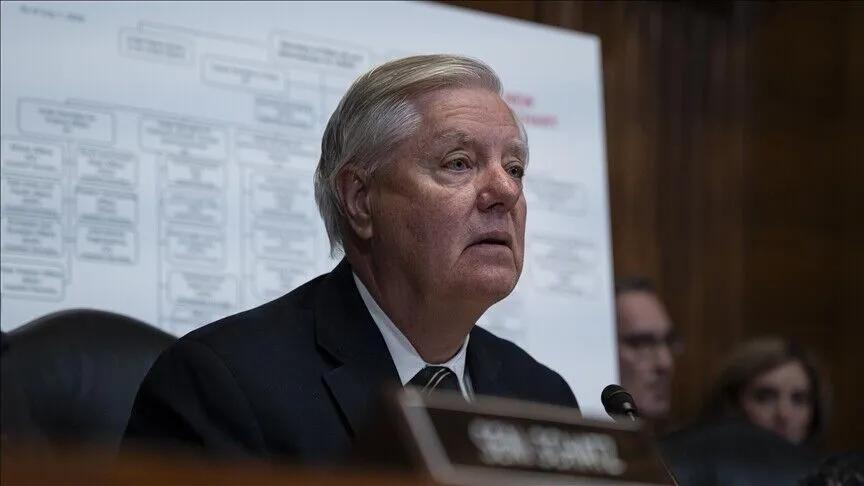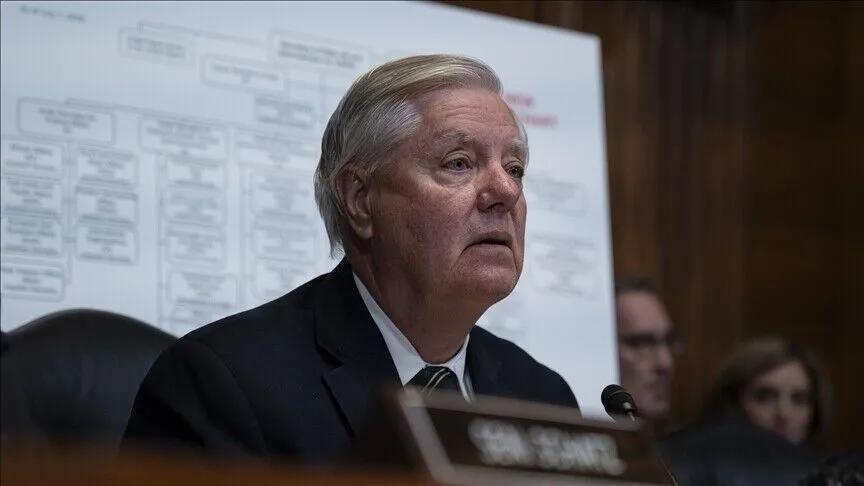

Full name: | Lindsey Olin Graham | ||||||||
|---|---|---|---|---|---|---|---|---|---|
Date of birth | 15 July 1955 | ||||||||
Place of birth: | Central, South Carolina, USA | ||||||||
Date of death: | 11 July 2026 | ||||||||
Place of death: | Washington, D.C., USA | ||||||||
Political party | Republican Party | ||||||||
Military service: | United States Air Force JAG (Judge Advocate General's Corps); Air Force Reserve | ||||||||
Political office: | United States Senator (South Carolina), 2003–2026 | ||||||||
Lindsey Olin Graham (9 July 1955, Central, South Carolina – 11 July 2026) was an American politician, lawyer and former military lawyer affiliated with the Republican Party. From 2003 until his death, Graham represented South Carolina in the United States Senate and was particularly known for his work in foreign policy, national security and defense. Over many years he served on numerous key committees including the Senate Armed Services Committee and the Senate Judiciary Committee and was regarded as one of the Republican Party’s most influential voices on foreign policy. He was among the politicians who drew significant attention in both the United States and international public opinion through his statements on Ukraine, the Middle East, Iran, Israel and NATO policies.
Born on 9 July 1955 in the city of Central, South Carolina, Graham was the son of Florence James Graham and Millie Graham. He grew up working in his family’s restaurant and bar business from an early age. After losing both his parents within a short period while still in university, he took responsibility for caring for his sister Darline, a period that became a pivotal turning point in his personal life and political career. In later statements, Graham said that losing his family at an early age shaped his sense of responsibility and his perspective on public service.
Graham completed his undergraduate studies in psychology at the University of South Carolina in 1977 and earned his Juris Doctor degree from the university’s Law School in 1981. After completing his legal education, he joined the Judge Advocate General’s Corps of the United States Air Force and served as a military prosecutor. Graham held legal advisory and prosecutorial roles at various U.S. military bases and in Europe. After active duty, he continued serving in the Air Force Reserve and retired with the rank of colonel. His experience in military law became a key reference point in his later work on defense and security policy in the Senate.
Lindsey Graham’s political career began in 1993 when he was elected to the South Carolina House of Representatives. After serving two years in the state legislature, he was elected to the United States House of Representatives in the 1994 elections and served four terms from 1995 to 2003. During this period he gained prominence within the Republican Party through his work on judicial, national security and military issues. His role as one of the Republican members involved in the impeachment proceedings against President Bill Clinton elevated his national profile.
In 2002, Graham won the election to succeed long-serving Senator Strom Thurmond and entered the United States Senate in January 2003. He was reelected in 2008, 2014 and 2020, maintaining his Senate seat for nearly a quarter century. Throughout his tenure he participated in drafting numerous pieces of legislation on defense budgets, foreign policy, counterterrorism, immigration policy and the federal judiciary. Within the Republican Party he was regarded as one of the most influential figures in shaping national security policy.
Graham served on some of Congress’s most powerful committees including Armed Services, Judiciary, Budget and Appropriations. Advocating for increased defense spending, the preservation of the U.S. military’s global deterrent capability and strengthened military cooperation with allied nations, Graham became one of the senators frequently consulted on international crises by both Republican and Democratic administrations. He was among the most visible Republican senators on issues relating to NATO, Ukraine, Israel and Middle East policy.
Lindsey Graham was recognized as one of the leading proponents of an interventionist and robust deterrence approach in American foreign policy. He supported the continuation of the United States’ global military presence, the strengthening of defense cooperation with allied nations and the imposition of strong sanctions against actors deemed to threaten national security. Graham backed U.S. military operations in Iraq and Afghanistan and later expressed favorable views toward American interventions in Libya and Syria. He advocated for enhanced counterterrorism efforts, intelligence sharing and increased defense spending, all of which became core policy pillars within the Republican Party.
During the Russia-Ukraine War, Graham was among the strongest defenders of military and financial aid to Ukraine and supported various initiatives calling for expanded economic sanctions against Russia. He met repeatedly with Ukrainian President Volodymyr Zelensky and visited Kyiv just one day before his death to reaffirm the United States’ continued support for Ukraine. Graham argued that Russia’s aggressive policies threatened not only Ukraine but also the broader European security architecture and frequently called for unified Western action.
One of the defining features of Lindsey Graham’s political career was his stance on Middle East policy. He emerged as a leading Republican voice advocating for the strengthening of the strategic partnership between Israel and the United States and asserted that Israel’s security was an inseparable component of U.S. national security policy. Graham supported continued U.S. military and financial aid to Israel, cultivated close ties with Israeli Prime Minister Benjamin Netanyahu and maintained regular contact with pro-Israel organizations such as the American Israel Public Affairs Committee (AIPAC).
Graham was among the Republican senators who supported the Trump administration’s 2018 decision to relocate the U.S. Embassy from Tel Aviv to Jerusalem. He argued that recognizing Jerusalem as Israel’s capital reflected the region’s existing political reality and would strengthen strategic ties between the two nations. His strong backing of Israel’s security policies made him one of the most prominent figures in both U.S. and international public opinion during this period.
Following the outbreak of the Gaza War in 2023, Graham continued to support Israel and advocated for the complete neutralization of Hamas. Some of his statements during the conflict in Gaza drew intense international criticism, particularly his unconditional support for Israel’s military operations and his calls for breaking Iran’s influence in the region. Throughout this period, Graham emphasized Israel’s right to self-defense and defended the uninterrupted continuation of U.S. military support.
On Iran, Graham stood out as one of the most hardline figures in the Republican Party. He argued for halting Iran’s nuclear program, limiting its ballistic missile capabilities and curbing the activities of the Islamic Revolutionary Guard Corps in the region. He supported expanding economic sanctions against Iran, occasionally called for regime change and openly backed potential U.S. and Israeli military operations against Iran. These positions made him one of the most controversial American senators on Middle East policy.
Lindsey Graham’s approach to Türkiye was shaped throughout his political career around issues of security, NATO, Syria and defense industry cooperation. He repeatedly emphasized Türkiye’s strategic importance as a key member of NATO’s southern flank and its geopolitical position between the Black Sea and the Middle East. At the same time, due to Ankara’s policies in Syria and its defense cooperation with Russia, Graham was occasionally among the most vocal Republican critics of Türkiye in the U.S. Congress. Despite these disagreements, he consistently argued for preserving the strategic partnership between the two countries and supported maintaining diplomatic dialogue.
During Türkiye’s 2019 Operation Peace Spring in northern Syria, Graham strongly criticized the operation and co-authored a bill with Democratic Senator Chris Van Hollen proposing sanctions against Türkiye. He argued that the United States must protect the Syrian Democratic Forces (SDF), with whom the U.S. had cooperated against ISIS, and warned that Türkiye’s military operation could undermine regional stability. At the same time, he stated that Türkiye’s security concerns should be addressed through diplomatic channels and suggested the possibility of establishing a demilitarized safe zone around Kobani.
Graham viewed Türkiye’s purchase of the Russian S-400 air defense system as a serious threat to NATO’s integrated defense architecture. He supported the application of U.S. CAATSA sanctions and was among the congressional members who advocated for Türkiye’s removal from the F-35 Joint Strike Fighter Program. He warned that integrating the S-400 system with F-35 technology posed a risk to NATO’s security.
However, in later years Graham’s approach toward Türkiye began to show a more conciliatory tone. Particularly during Donald Trump’s second term, he supported efforts to revitalize Ankara-Washington relations and emphasized that Türkiye remained an indispensable NATO ally. During his visit to Türkiye in May 2025, he indicated that a solution could be found in Congress regarding Türkiye’s reintegration into the F-35 program and held discussions with Turkish officials on CAATSA sanctions, Syria’s reconstruction and regional security.
Finally, attending the NATO Summit of Heads of State and Government in Ankara on 7–8 July 2026 alongside U.S. President Donald Trump, Graham stated that he was open to Türkiye’s reentry into the F-35 program. He also noted that the influence of Israel and Greece in Congress could complicate the decision-making process. These remarks were interpreted as a shift toward a more pragmatic and diplomatic approach compared to his earlier stance favoring sanctions.
The political relationship between Lindsey Graham and Donald Trump has been viewed as one of the most significant transformations in American politics. In 2015, during the Republican presidential primary race, Graham sharply criticized Trump, labeling him as “divisive,” “populist” and a candidate who could weaken the Republican Party’s chances of winning elections. Graham’s criticism of Trump’s immigration policies and campaign rhetoric led to a prolonged period of tension between the two.
After Trump won the 2016 presidential election, the relationship between the two politicians gradually changed. Graham increasingly aligned with the Trump administration on foreign policy, defense spending, the appointment of conservative judges to the federal judiciary and tough policies toward Iran. Over time, their political cooperation evolved into personal closeness, and Graham came to be regarded as one of Trump’s most important allies in Congress.
Following the January 6, 2021 Capitol riot, Graham, in a speech on the Senate floor, called on Trump to accept the election results and famously declared, “Enough is enough.” These remarks were interpreted as signaling a renewed distance between the two. However, in the following months they reconciled; Graham continued to support Trump’s policies and openly endorsed his candidacy in the 2024 presidential election.
During Trump’s second term, Graham emerged as one of the most influential Republican senators in shaping the administration’s foreign policy agenda. He worked closely with the Trump administration on issues relating to Ukraine, Iran, Israel, NATO and Türkiye and was regarded as one of the key figures bridging Congress and the White House. He remained among Trump’s closest political allies until his death.
Lindsey Graham was regarded as one of the most controversial Republican figures in American politics due to his hardline positions on foreign policy and national security. He advocated for preserving the United States’ global military presence, increasing defense spending and encouraging a more active U.S. role in international crises. Graham, who strongly supported harsh sanctions against Iran, Russia and international terrorist organizations, was seen as representing the Republican Party’s traditional interventionist foreign policy outlook.
Graham’s strong support for Israel and his statements on Gaza and Iran drew intense international criticism. His unwavering defense of Israel’s military operations and his harsh rhetoric toward the Iranian regime provoked backlash, particularly from countries in the Middle East. Nevertheless, Graham maintained that these policies were necessary to safeguard U.S. national security and protect its allies.
Within the Republican Party, Graham occasionally clashed with different factions. His evolving stance toward Donald Trump was viewed by some as political pragmatism but criticized by others. Nevertheless, throughout his nearly quarter-century Senate career, he stood out as one of the few politicians who worked effectively with both Democratic and Republican senators.
Lindsey Graham died on 11 July 2026 at the age of 71 following a sudden and brief illness. The official announcement the following day stated that the cause of death was an aortic dissection. Just one day before his death, he met with Ukrainian President Volodymyr Zelensky in Kyiv and had participated in the NATO Summit in Ankara a few days earlier. His unexpected death triggered widespread reactions in U.S. politics, and numerous politicians, including the Republican Party, issued condolences.
U.S. President Donald Trump described Graham as a “true American patriot.” Ukrainian President Volodymyr Zelensky, Israeli Prime Minister Benjamin Netanyahu and numerous world leaders highlighted in their messages Graham’s significant impact on foreign policy. Over his nearly 24-year Senate career, Graham was widely recognized as one of the most influential figures in the Republican Party on national security, defense and foreign policy. He left a lasting mark on American politics through his advocacy of interventionist foreign policy, his strong support for NATO and his unwavering backing of Ukraine and Israel.
Al Jazeera. "What made US Republican Senator Lindsey Graham a controversial figure?" Accessed July 13, 2026.
Associated Press (AP). "Sen. Lindsey Graham likely died after aorta tear, medical examiner says." Accessed July 13, 2026.
BBC News Türkçe. "Ani bir rahatsızlıkla" hayatını kaybeden ABD Senatörü Lindsey Graham kimdir, Türkiye'ye karşı tutumu nasıldı? Accessed July 13, 2026.
CNN Türk. "Lindsey Graham kimdir? ABD'li Senatör Lindsey Graham hayatını kaybetti, kaç yaşındaydı, neden öldü?" Accessed July 13, 2026.
CNN. "Sen. Lindsey Graham dies at 71 after brief illness." Accessed July 13, 2026.
Deutsche Welle (DW Türkçe). "Trump yanlısı Senatör Graham'ın ölüm nedeni belli oldu." Accessed July 13, 2026.https://amp.dw.com/tr/trump-yanl%C4%B1s%C4%B1-senat%C3%B6r-graham%C4%B1n-%C3%B6l%C3%BCm-nedeni-belli-oldu/a-77929256
Euronews Türkçe. U.S. Senator Lindsey Graham died after a brief and sudden illness. Accessed July 13, 2026.
NBC News. "Sen. Lindsey Graham dies at 71 after brief, sudden illness." Accessed July 13, 2026.
The Guardian. "Congress, Capitol and US politics live: Lindsey Graham's sudden death sends shockwaves through Congress as politicians mourn and mull his replacement." Accessed July 13, 2026.https://www.theguardian.com/us-news/live/2026/jul/13/congress-capitol-lindsey-graham-trump-republicans-democrats-us-politics-latest-news-updates

Full name: | Lindsey Olin Graham | ||||||||
|---|---|---|---|---|---|---|---|---|---|
Date of birth | 15 July 1955 | ||||||||
Place of birth: | Central, South Carolina, USA | ||||||||
Date of death: | 11 July 2026 | ||||||||
Place of death: | Washington, D.C., USA | ||||||||
Political party | Republican Party | ||||||||
Military service: | United States Air Force JAG (Judge Advocate General's Corps); Air Force Reserve | ||||||||
Political office: | United States Senator (South Carolina), 2003–2026 | ||||||||
Education
Political Career
U.S. Foreign Policy and Security Approach
Israel, Gaza and Iran Policy
Turkey Policy and Relations with Türkiye
Relationship with Donald Trump
Political Views and Controversies
Death and Political Legacy