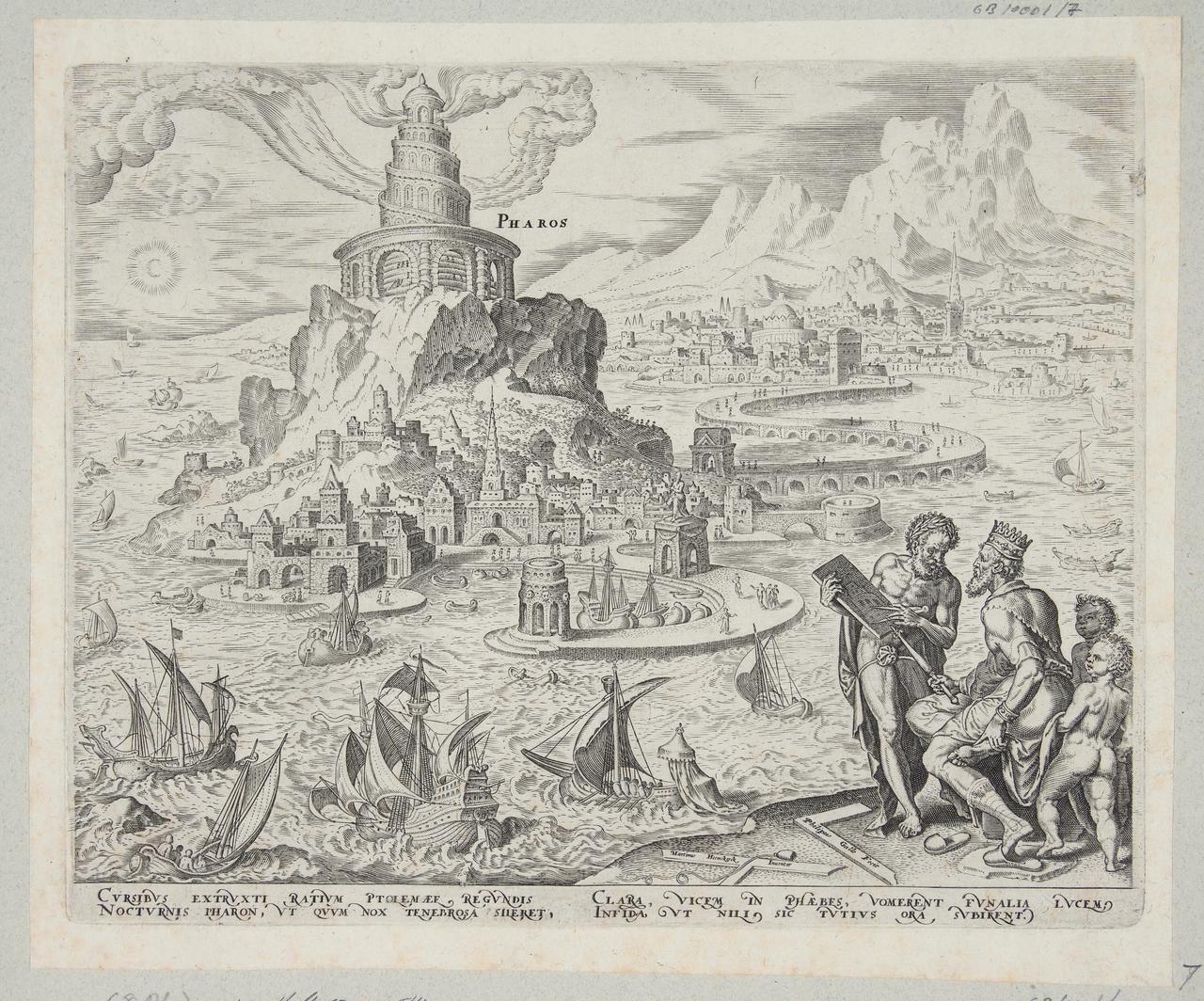
This article was automatically translated from the original Turkish version.
+1 More
Former Names | Pharos Lighthouse, Pharos, Pharos tesourōn | ||||||||
|---|---|---|---|---|---|---|---|---|---|
Location | Pharos Island, Alexandria, Egypt | ||||||||
Patrons | Ptolemy II Philadelphus (completed) Ptolemy I Soter (initiated) | ||||||||
Architect | Sostratus of Cnidus | ||||||||
Building Type | Lighthouse | ||||||||
Construction Date(s) | 285–247 BCE | ||||||||
Construction Materials | Lead Bronze Aswan granite Marble White calcareous stone | ||||||||
Condition | Completely destroyed by the 1375 earthquake; remains used in the construction of Qaitbay Castle | ||||||||
Position in the Ancient World | One of the Seven Wonders of the Ancient World | ||||||||
Height | Approximately 120–146 metres | ||||||||
Lighthouse of Alexandria is a monumental sea lighthouse constructed in the 3rd century BCE on the island of Pharos off the coast of Alexandria in Egypt and recognized as one of the Seven Wonders of the Ancient World. It is considered one of the earliest examples of lighthouse construction and remained standing for centuries on the site of the later Qaitbay Citadel until the 14th century. Also known as the Pharos Lighthouse, it was built on Pharos, a small rectangular island located on the western coast of the Nile Delta where the western branch of the Nile flows into the Mediterranean Sea.
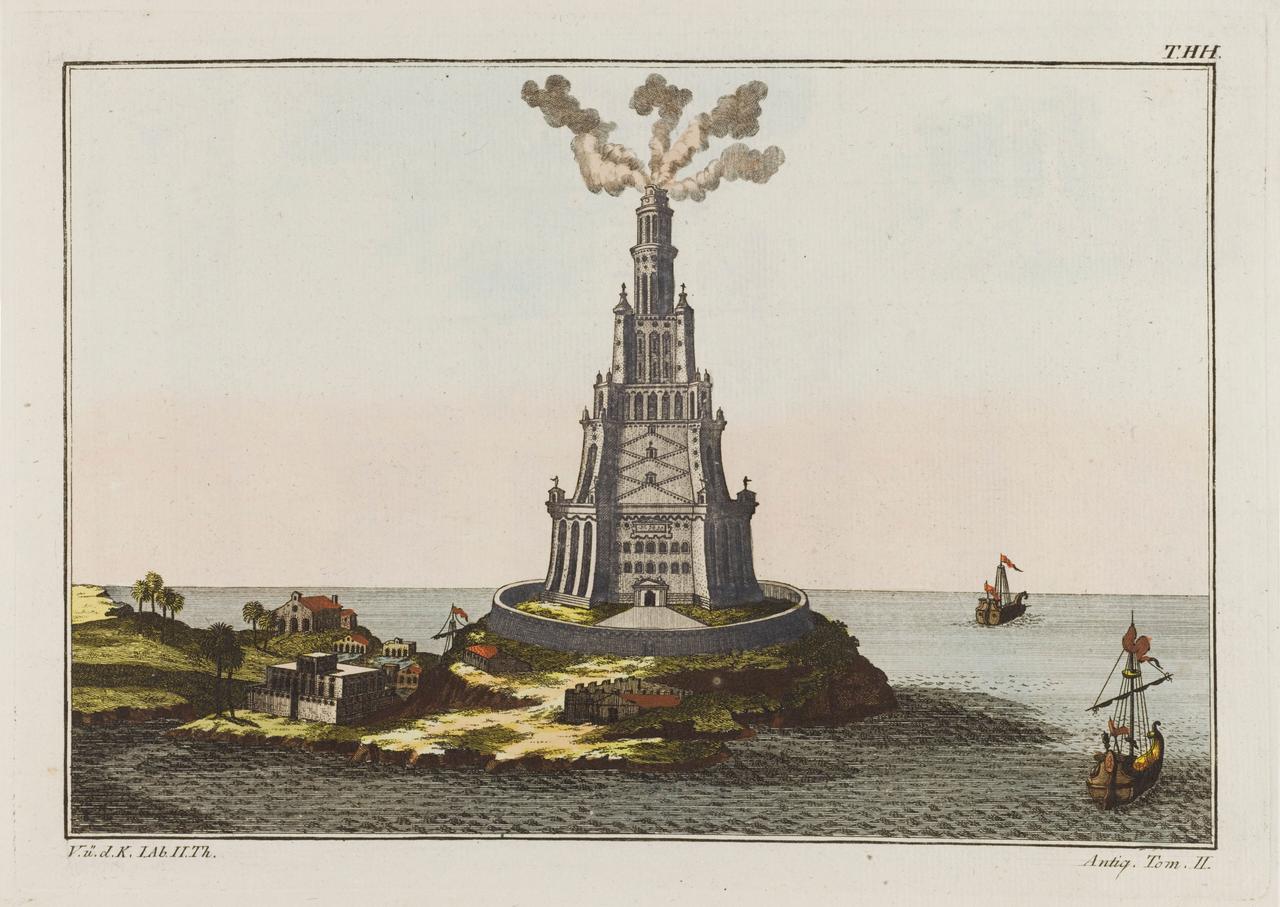
Colored Engraving of the Lighthouse of Alexandria (wellcome collection)
Alexandria, founded in 332 BCE by Alexander the Great (III Alexandros), quickly became the capital of his empire and of Egypt. After Alexander’s death, his empire was divided among his generals, and Egypt fell to Ptolemy I Soter (Ptolemaios).
The idea of building a lighthouse was first conceived by Ptolemy I Soter to warn ships of underwater reefs. However, Soter died before the massive construction could be completed, and the task passed to his son Ptolemy II Philadelphus. Construction began in 285 BCE and was completed in 247 BCE. According to tradition, the tower, built of white marble, cost 800 talents (an ancient unit of weight), equivalent to more than 20 tons of precious metal.【1】
The construction process faced challenging architectural and geographical conditions. Pharos Island was directly exposed to open-sea waves. Therefore, the foundation was excavated down to the seabed for reinforcement, and the lower sections were strengthened with sloping stone blocks above sea level. The stones used in the lighthouse were white marble, limestone, and Aswan granite quarried from sites west of Alexandria. To ensure no gaps remained between stone blocks and to enhance resistance to seawater, molten lead joining technique was employed.
In the initial phase of construction, a breakwater made of large stone masses was built to stabilize the seabed, followed by the placement of the square-plan ground floor walls atop this structure. The blocks used in the ground floor were carefully smoothed and fitted together interlockingly. As the widest and heaviest section of the lighthouse, it served as the load-bearing base. Subsequently, an octagonal middle section and a cylindrical upper section were constructed. During these stages, both stonemasonry and bronze casting techniques were combined, particularly in shaping the ramp system, which required considerable time.
The lighting mechanism was installed in the final stage of construction. A large bronze cauldron was placed on the upper platform, filled with a mixture of wood and oil to burn continuously. To make the light visible from greater distances, parabolic bronze mirrors were positioned behind the cauldron. This allowed sunlight to be reflected during the day and the fire’s glow to be directed toward the sea at night.
After construction, regular maintenance and repairs were carried out by successive Egyptian rulers. Especially during the Roman Empire, the lighting system atop the lighthouse was renewed and the bronze mirrors repaired. After the Islamic conquests, the lighthouse continued to function for some time, and during the reign of Ibn Tulun (9th century), a wooden dome and a small mosque were added to the upper section. During this period, the lighthouse also served as a minaret. However, increasing earthquakes from the 10th century onward weakened its structural integrity, and by the mid-14th century, most of the lighthouse had collapsed.
The lighthouse suffered damage from numerous earthquakes starting in 796 CE. Significant tremors in 796, 956, 1303, 1334, 1341, 1348, and 1375 caused severe damage. The 956 earthquake caused approximately 25 meters of the upper section to collapse, while the 1303 earthquake destroyed a large portion of the structure. Finally, a violent earthquake in 1375 completely demolished the lighthouse.
Ibn Battuta, during his visits to Alexandria in 1326 and 1349, observed the lighthouse in two different states. On his first visit he saw the structure still standing; on his second visit he found it in ruins and could not even approach its entrance.【2】
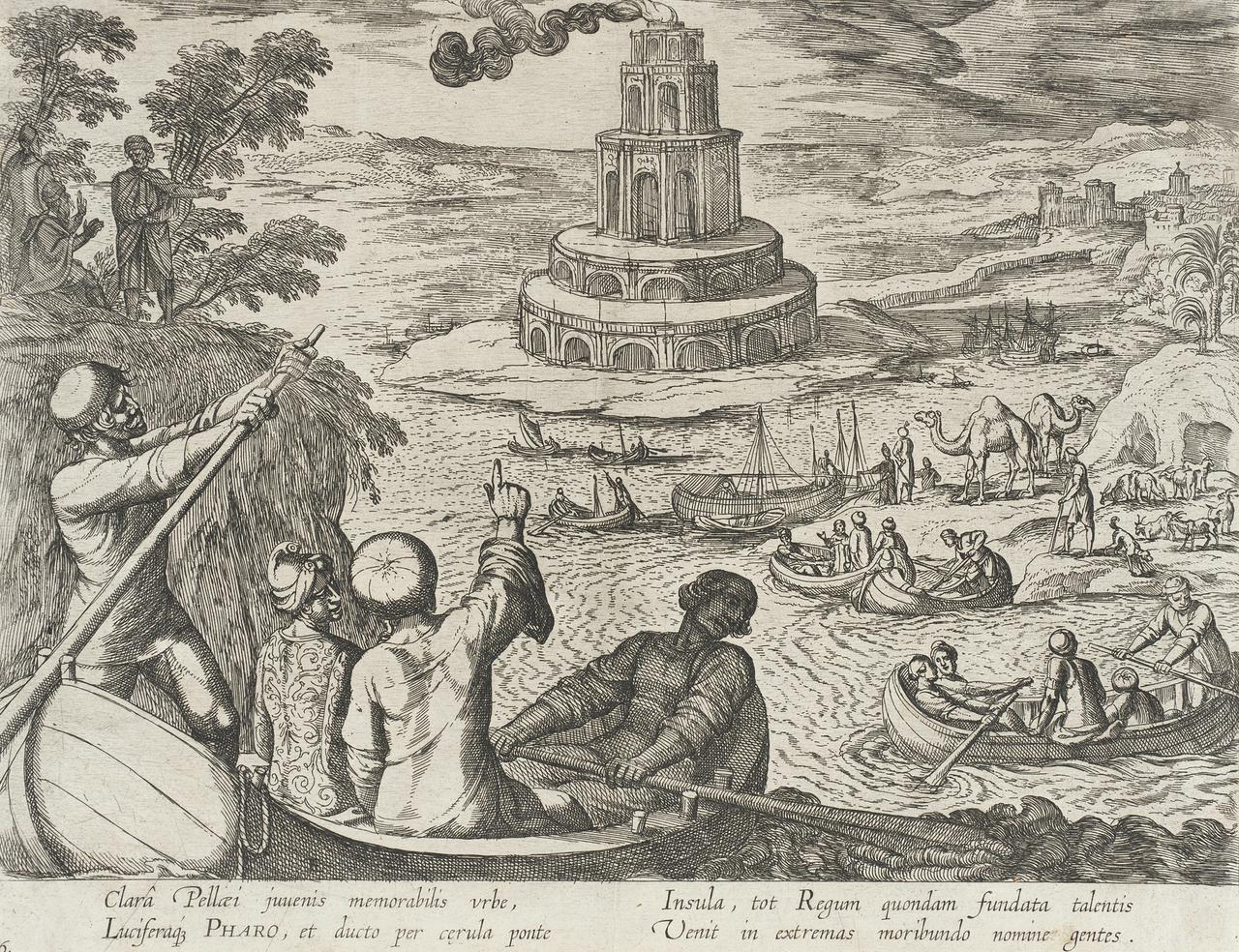
Engraving Depiction of the Lighthouse of Alexandria (Lacma)
The Lighthouse of Alexandria, standing approximately 120 to 146 meters tall, is considered one of the tallest structures of the ancient world. Its architect is known as Sostratus of Cnidus. Sostratus employed the engineering knowledge of his time to design a structure that was both aesthetically impressive and functionally effective. However, according to ancient tradition, such monumental buildings were typically dedicated in the name of the ruler. Nevertheless, it is known that Sostratus secretly inscribed his own name on the entrance of the structure:
“Sostratus, son of Dexiphanes of Cnidus, to the saviors of mariners, the two gods.” 【3】
The structure was located on the eastern tip of Pharos Island, commanding a strategic position over the harbor and built to guide maritime traffic. Its foundation features a square-plan, multi-tiered ascending tower system composed of three main sections (levels) that narrow as they rise.
Approximately 30 by 30 meters in base dimensions and 60 meters high, this level contained about 300 rooms. These rooms were used for housing workers, storing fuel (wood and oil), and operating mechanical systems. To reduce the risk of collapse, the rooms were equipped with ventilation openings and windows.
At the top of this level stood four large bronze statues representing Triton (son of Poseidon). These figures were also depicted on Roman coins. Inside the ground floor was a large cistern supplied by a water pipeline from the city.
Approximately 30 meters high, the octagonal plan allowed for even weight distribution to the upper levels. This section provided aerodynamic resistance against wind pressure. Its facades were adorned with pilasters, niches, and small columns.
Approximately 15 meters high, this section featured an 8-meter-high dome and atop it stood a bronze statue of Poseidon, forming the highest point of the lighthouse.【4】 This level housed the lighthouse’s light source. The fire emitted smoke during the day and a bright flame at night, visible for kilometers. It is also believed that a mechanical crane system was located here to facilitate the transport of wood and oil.
The Lighthouse of Alexandria was designed with a ramp system instead of internal staircases. This ramp enabled people and animals—particularly donkeys and mules carrying loads—to ascend to the top of the lighthouse. The spiral inner wall along the ramp formed the structural skeleton of the tower. Spiral staircases providing access to each level were also present.
The Lighthouse of Alexandria remained standing long after the eastern provinces of the Roman Empire adopted Christianity. Even during the Arab conquests in the 640s CE, it is recorded that the light from Pharos continued to guide Hellenistic ships. Over time, the lighthouse also served as a minaret; historical records note that Ahmad ibn Tulun climbed its wooden dome in 875 to perform the call to prayer.【6】
The foundation gradually weakened, and an earthquake on December 28, 955 or 956 caused the collapse of approximately 25 meters of the upper section. Although neglect began after the construction of Cairo from 969 onward, the remaining 60 to 70 meters of the lower section, which survived the 956 earthquake, were restored in 1182 and a domed mosque was built atop this structural section. Another major earthquake in 1375 led to the complete destruction of the lighthouse.
In the 12th century (1165–1173), Benjamin of Tudela recorded that the lighthouse served as a navigational landmark for sailors, visible from up to 100 miles away during the day, and that ships steered toward its flame at night. The discovery of the Cape of Good Hope in 1498 and the subsequent shift of shipping routes diminished Alexandria’s importance. Eventually, the remains of Pharos were either lost or reused as building material for other constructions.
The Lighthouse of Alexandria is one of the rare ancient structures visible through surviving Roman coins. Depictions of the lighthouse appear on coins minted from the reign of Emperor Domitian (81–96 CE) through that of Emperor Commodus (180–192 CE), approximately 300 years after its construction and about 100 years after Roman rule began.
These depictions on the reverse of the coins come in three main types: the first shows the lighthouse itself along with statues of Isis Pharia or Zeus Soter and Triton; the second features the figure of Isis Pharia, often depicted holding a sail, occupying half the coin’s surface; the third replaces Isis with a ship. After Commodus, the lighthouse ceased to appear on coins.【7】
Erdoğdu, Figen, Nafize Tatar, and Erşah Çakır. “NÜMİZMATİKTEN TARİHE KATKI SİKKELERDEKİ YAPILARA HARİKA BİR ÖRNEK: İSKENDERİYE FENERİ.” *Tarih Okulu*, no. 10 (2011): 87–99. Accessed November 2, 2025.https://dergipark.org.tr/tr/download/article-file/144810
Horoz, Gamze. “Tek Tanrılı Dinlerde İbadete Çağrının Mimariye Yansıması.” Master's thesis, Bursa Uludağ Üniversitesi Sosyal Bilimler Enstitüsü, 2025. Accessed November 2, 2025.https://acikerisim.uludag.edu.tr/server/api/core/bitstreams/111a7654-0a65-4352-a608-da194f28d860/content
LACMA. “The Lighthouse at Alexandria.” Los Angeles County Museum of Art. Accessed November 2, 2025.https://collections.lacma.org/node/234619
SMK Open. "The Lighthouse of Alexandria, 1572." Statens Museum for Kunst. Accessed November 2, 2025.https://open.smk.dk/en/artwork/image/kksgb10001/2
Wellcome Collection. "The Pharos of Alexandria. Coloured engraving, ca. 1804–1811." Wellcome Collection. Accessed November 2, 2025.https://wellcomecollection.org/works/e9m8bdgu/images?id=nbpjh968
Çetin, Altan, and Alyaguot Yousif Hassan Ahmed. “Memlûkler Döneminde Yıkılışına Kadar Orta Çağ’da İskenderiye Feneri.” *Şarkiyat Mecmuası*, 43 (2023): 23–54. Accessed November 2, 2025.https://dergipark.org.tr/en/pub/iusarkiyat/issue/81196/1274620
[1]
Figen Erdoğdu, Nafize Tatar, ve Erşah Çakır, “Numizmatikten Tarihe Katkısı: Kkelerdeki Yapılara Harika Bir Örnek: İskenderiye Feneri,” Tarih Okulu / The History School, no. 10 (Mayıs-Ağustos 2011): syf 89, https://dergipark.org.tr/tr/download/article-file/144810
[2]
Altan Çetin, ve Alyaguot Yousif Hassan Ahmed, ‘’Memlûkler Döneminde Yıkılışına Kadar Orta Çağ’da İskenderiye Feneri’’, Şarkiyat Mecmuası 43, (2023): syf 26, https://dergipark.org.tr/en/pub/iusarkiyat/issue/81196/1274620
[3]
Altan Çetin, ve Alyaguot Yousif Hassan Ahmed, ‘’Memlûkler Döneminde Yıkılışına Kadar Orta Çağ’da İskenderiye Feneri’’, Şarkiyat Mecmuası 43, (2023): syf 27,
[4]
Altan Çetin, ve Alyaguot Yousif Hassan Ahmed, ‘’Memlûkler Döneminde Yıkılışına Kadar Orta Çağ’da İskenderiye Feneri’’, Şarkiyat Mecmuası 43, (2023): syf 27,
[5]
Altan Çetin, ve Alyaguot Yousif Hassan Ahmed, ‘’Memlûkler Döneminde Yıkılışına Kadar Orta Çağ’da İskenderiye Feneri’’, Şarkiyat Mecmuası 43, (2023): syf 37,
[6]
Figen Erdoğdu, Nafize Tatar, ve Erşah Çakır, “Numizmatikten Tarihe Katkısı: Kkelerdeki Yapılara Harika Bir Örnek: İskenderiye Feneri,” Tarih Okulu / The History School, no. 10 (Mayıs-Ağustos 2011): syf 90, https://dergipark.org.tr/tr/download/article-file/144810
[7]
Figen Erdoğdu, Nafize Tatar, ve Erşah Çakır, “Numizmatikten Tarihe Katkısı: Kkelerdeki Yapılara Harika Bir Örnek: İskenderiye Feneri,” Tarih Okulu / The History School, no. 10 (Mayıs-Ağustos 2011): syf 91, https://dergipark.org.tr/tr/download/article-file/144810

Former Names | Pharos Lighthouse, Pharos, Pharos tesourōn | ||||||||
|---|---|---|---|---|---|---|---|---|---|
Location | Pharos Island, Alexandria, Egypt | ||||||||
Patrons | Ptolemy II Philadelphus (completed) Ptolemy I Soter (initiated) | ||||||||
Architect | Sostratus of Cnidus | ||||||||
Building Type | Lighthouse | ||||||||
Construction Date(s) | 285–247 BCE | ||||||||
Construction Materials | Lead Bronze Aswan granite Marble White calcareous stone | ||||||||
Condition | Completely destroyed by the 1375 earthquake; remains used in the construction of Qaitbay Castle | ||||||||
Position in the Ancient World | One of the Seven Wonders of the Ancient World | ||||||||
Height | Approximately 120–146 metres | ||||||||
No Discussion Added Yet
Start discussion for "Lighthouse of Alexandria" article
History and Construction
Architectural Features and Structure
Sections
First Level (Ground Floor – Square-Plan Mass)
Second Level (Octagonal Middle Section)
Third Level (Cylindrical Tower and Dome)
Access System and Internal Organization
Iconographic and Architectural Influences
Historical Significance and Fate
Its Place in Numismatics